Great horned owls are powerful nocturnal predators with one of the most varied diets among North American owls. They mainly eat mammals, birds, reptiles, amphibians, insects, and occasionally fish. What great horned owls eat depends largely on their habitat, season, and which prey animals are available nearby. From mice and rabbits to snakes and even other birds, these adaptable hunters can capture surprisingly large prey. Below, we explore 10 common foods great horned owls eat in the wild, along with their hunting habits and feeding behavior.
What Do Great Horned Owls Eat in the Wild?
Great horned owls are primarily carnivorous and hunt live animals rather than eating plants. They are highly opportunistic, meaning they take advantage of whatever suitable prey is abundant in their territory. Their powerful talons allow them to catch animals ranging from tiny insects to mammals almost as large as themselves.
A typical great horned owl diet may include:
- Rabbits and hares
- Mice and rats
- Squirrels
- Birds
- Skunks
- Snakes
- Insects
- Bats
- Fish
- Frogs and other amphibians
Their exact diet changes depending on whether they live in forests, deserts, wetlands, farmland, suburbs, or other habitats.
10 Foods Great Horned Owls Commonly Eat
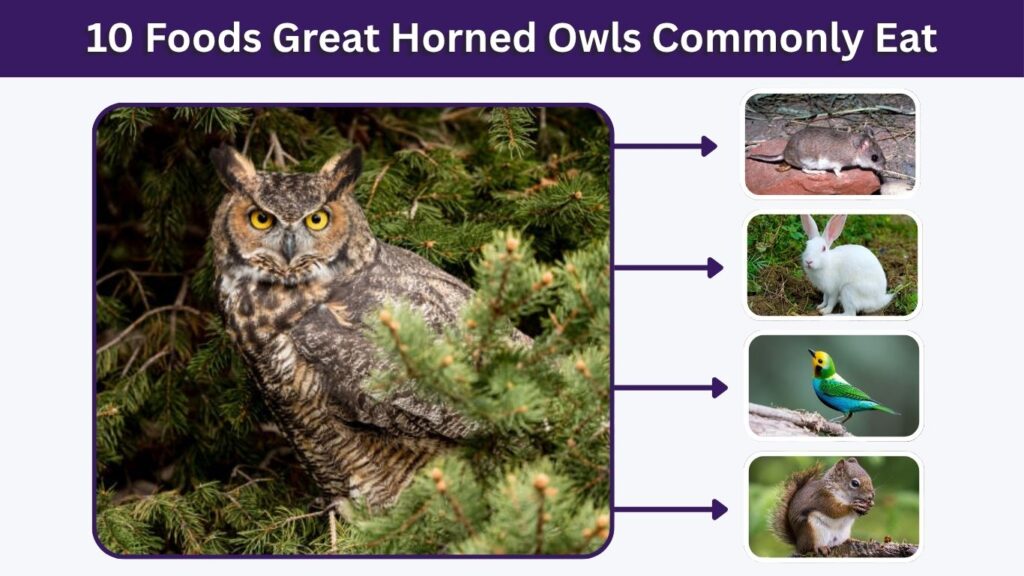
Great horned owls are generalist hunters rather than specialists. They may hunt hundreds of different animal species across their geographic range. However, mammals and birds generally make up a large portion of their diet.
1. Rabbits and Hares
Rabbits are among the most substantial meals available to great horned owls. Their strong feet and sharp talons allow them to attack rabbits despite the prey’s relatively large size.
Cottontail rabbits are particularly important prey in many parts of North America. Owls usually hunt them during the evening or nighttime when rabbits become active.
A rabbit can provide enough food for an owl to feed for an extended period, making these animals valuable targets whenever they are abundant.
2. Mice
Mice are one of the most common foods eaten by great horned owls. Deer mice, house mice, and other small rodents are especially vulnerable because they are frequently active after dark.
The owl can sit silently on a branch while listening for movement below. Once it detects a mouse, it swoops down rapidly and captures the animal with its talons.
Their excellent night vision and sensitive hearing make finding small rodents possible even in relatively low light.
3. Rats
Great horned owls also hunt different species of rats. Rats are larger than most mice and therefore provide a more substantial meal.
They are particularly available around farms, grasslands, woodland edges, and occasionally suburban areas.
Because both rats and great horned owls can be active at night, their activity periods frequently overlap. Owls may therefore help naturally control local rodent populations.
4. Squirrels
Squirrels are another important prey animal. Great horned owls may catch tree squirrels, ground squirrels, and other small members of the squirrel family.
Most tree squirrels are active during daylight, but owls may catch them around dawn, dusk, or while they are resting.
Ground-dwelling species can also become prey when moving through exposed areas. Young squirrels are usually easier for an owl to capture than large adults.
5. Birds
Great horned owls are capable bird hunters and will eat surprisingly diverse species.
Some birds they may prey on include:
- Ducks
- Pigeons
- Doves
- Crows
- Grouse
- Quail
- Woodpeckers
- Smaller owls
- Hawks
Great horned owls sometimes raid roosting locations at night when other birds are less alert. Their quiet flight enables them to approach sleeping birds with relatively little warning.
They may even capture other birds of prey, demonstrating why great horned owls are considered formidable predators.
6. Skunks
One of the most unusual animals great horned owls eat is the skunk. While many predators avoid skunks because of their powerful defensive spray, great horned owls are less deterred by it.
Owls have a relatively limited sense of smell compared with many mammals. Their large talons also allow them to attack quickly.
Striped skunks can therefore become prey in areas where both species occur. However, attacking such large animals requires considerable strength and is generally more challenging than capturing rodents.
7. Snakes
Snakes are another part of the great horned owl’s diverse diet. The species eaten depends largely on local habitat and availability.
Owls may capture snakes moving across open ground or vegetation. They attack using their strong feet, helping keep the snake away from their face and body.
Great horned owls living in warmer regions, including desert and southern habitats, may encounter reptiles more frequently than individuals living in colder regions.
8. Insects
Although mammals provide much larger meals, great horned owls sometimes eat insects.
Their insect prey can include:
- Beetles
- Grasshoppers
- Crickets
- Large moths
- Other large arthropods
Insects may be particularly useful to young owls learning to hunt because they are easier to capture than rabbits or large mammals.
Adult owls usually depend more heavily on vertebrate prey, but they remain opportunistic enough to consume insects when appropriate.
9. Fish
Fish are not one of the primary foods of great horned owls, but they may occasionally catch or consume them.
Unlike specialized fish-eating birds such as ospreys, great horned owls do not have adaptations specifically designed for catching fish. However, an accessible fish close to the water’s surface can become an opportunistic meal.
Owls living near rivers, ponds, wetlands, or lakes have greater opportunities to encounter aquatic prey.
10. Frogs and Other Amphibians
Great horned owls may also eat frogs, toads, and other amphibians, particularly around wetlands and moist habitats.
Frogs often become active at night, creating an overlap with the owl’s hunting schedule. Their calls can also make them easier for predators to locate.
Amphibians usually represent a smaller portion of the owl’s overall diet than mammals or birds, but they demonstrate how flexible this predator can be.
What Do Great Horned Owls Eat at Night?
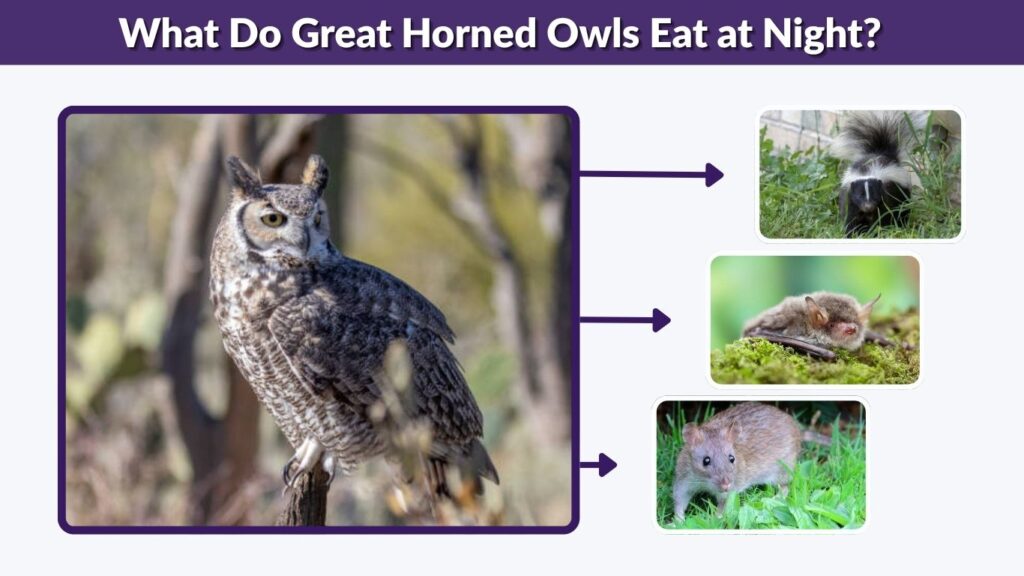
Great horned owls perform most of their hunting between dusk and dawn. At night, common targets include mice, rats, rabbits, skunks, bats, and other nocturnal animals.
The owl usually watches from a high perch while listening and looking for movement. Its feathers are adapted for exceptionally quiet flight, helping it approach prey without producing much warning.
After locating an animal, the owl dives toward it and grabs it with powerful talons. Small prey may be swallowed nearly whole, while larger animals are torn into manageable pieces.
What Do Baby Great Horned Owls Eat?
Baby great horned owls eat animal-based foods supplied by their parents. Very young owlets cannot hunt independently, so adult owls bring prey back to the nest.
Common foods may include rodents, rabbits, birds, and other locally available animals. Adults tear large prey into small pieces that the chicks can swallow.
As young owls grow stronger, they begin handling larger food pieces. After leaving the nest, juvenile owls continue receiving some food from their parents while gradually learning how to hunt successfully for themselves.
What Do Great Horned Owls Eat in the Desert?
Great horned owls are remarkably adaptable and can survive in desert environments as long as enough prey and suitable nesting or roosting sites are available.
Desert great horned owls may eat:
- Desert rodents
- Rabbits
- Ground squirrels
- Snakes
- Lizards
- Birds
- Bats
- Large insects
Their feeding habits change according to local prey availability. Desert rodents and rabbits can become particularly important because these animals provide more energy than insects or small reptiles.
What Do Great Horned Owls Eat in Indiana?
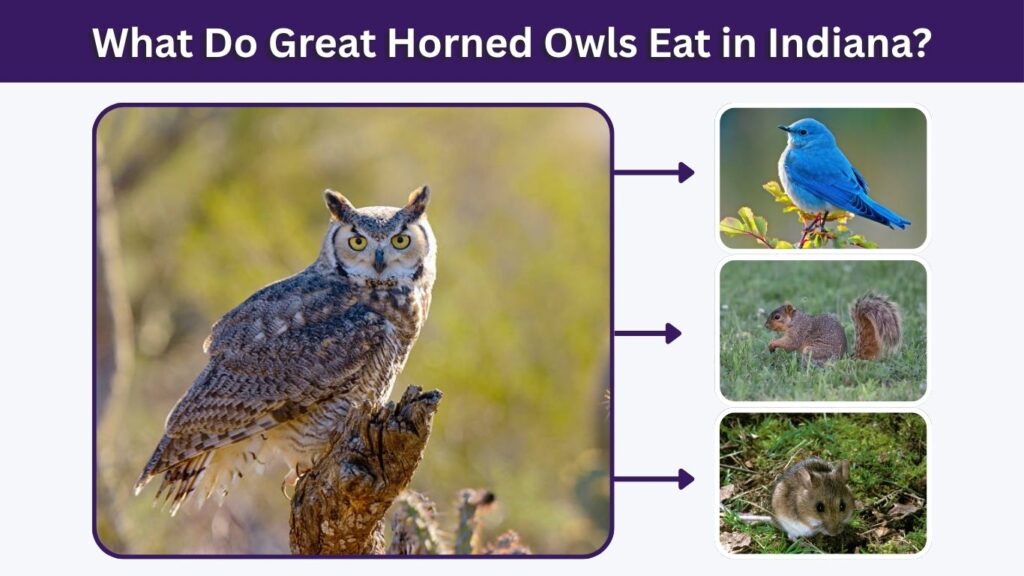
Great horned owls living in Indiana have access to woodland, farmland, wetlands, and suburban habitats. Their diet can include mice, voles, rats, rabbits, squirrels, birds, snakes, and other small animals commonly found throughout the state.
During colder months, they may depend more heavily on mammals and birds when reptiles, amphibians, and many insects become less active.
The owl’s ability to change its diet according to local conditions is one reason it thrives across such a large geographic range.
Do Great Horned Owls Eat Plants?
Great horned owls do not normally eat plants as part of their diet. They are carnivorous predators whose digestive systems and hunting adaptations are suited for eating animals.
Seeds, fruits, leaves, grass, and other vegetation do not provide their normal nutritional requirements.
Plant material might occasionally appear around prey or within stomach contents indirectly, but great horned owls obtain their food primarily from mammals, birds, reptiles, amphibians, insects, and other animals.
How Much Do Great Horned Owls Eat?
The amount a great horned owl eats varies according to its body size, prey availability, weather conditions, breeding season, and the size of individual meals.
A large rabbit may provide considerably more energy than several insects or mice. Owls may therefore eat different quantities depending on what they catch.
They can also store uneaten prey for later consumption. During nesting season, adults must hunt more frequently because they are feeding both themselves and growing owlets.
FAQs
What food do great horned owls eat most often?
Great horned owls commonly eat mammals such as mice, rats, rabbits, squirrels, and other rodents. Birds are also an important part of their diet.
What animals do great horned owls eat?
They eat rabbits, mice, rats, squirrels, skunks, bats, birds, snakes, frogs, insects, and occasionally fish and other animals.
What birds do great horned owls eat?
Great horned owls may hunt pigeons, doves, ducks, grouse, crows, woodpeckers, smaller owls, and occasionally other birds of prey.
What insects do great horned owls eat?
They can eat grasshoppers, beetles, crickets, moths, and other relatively large insects, although insects generally make up a smaller part of the adult owl’s diet.
What do young great horned owls eat?
Young great horned owls initially eat pieces of rodents, rabbits, birds, and other prey delivered by their parents. As they mature, they gradually learn to catch prey themselves.