
A great horned owl nest can look surprisingly simple for such a large and powerful bird. Great horned owls usually do not build traditional nests from scratch. Instead, they commonly take over old nests made by hawks, crows, ravens, or other large birds. They may also use tree cavities, cliff ledges, abandoned structures, and artificial nesting platforms. Understanding great horned owl nesting habits, nesting season, nest size, and suitable nest boxes or platforms can make these impressive birds much easier to recognize and observe safely.
What Does a Great Horned Owl Nest Look Like?
Great horned owl nests vary considerably because these owls frequently use structures created by other animals rather than constructing their own.
A typical nest may look like a large, somewhat messy collection of sticks positioned high in a tree. If the owl occupies an old hawk or crow nest, the original structure may already be several feet across.
Other nesting sites can look completely different.
Great horned owls may nest in:
- Abandoned hawk nests
- Old crow or raven nests
- Large tree cavities
- Broken tree trunks
- Cliff ledges
- Rock formations
- Cactus structures in desert habitats
- Buildings or human-made structures
- Artificial nesting platforms
Therefore, finding a great horned owl in a nest does not necessarily mean the owl built it.
Do Great Horned Owls Build Their Own Nests?
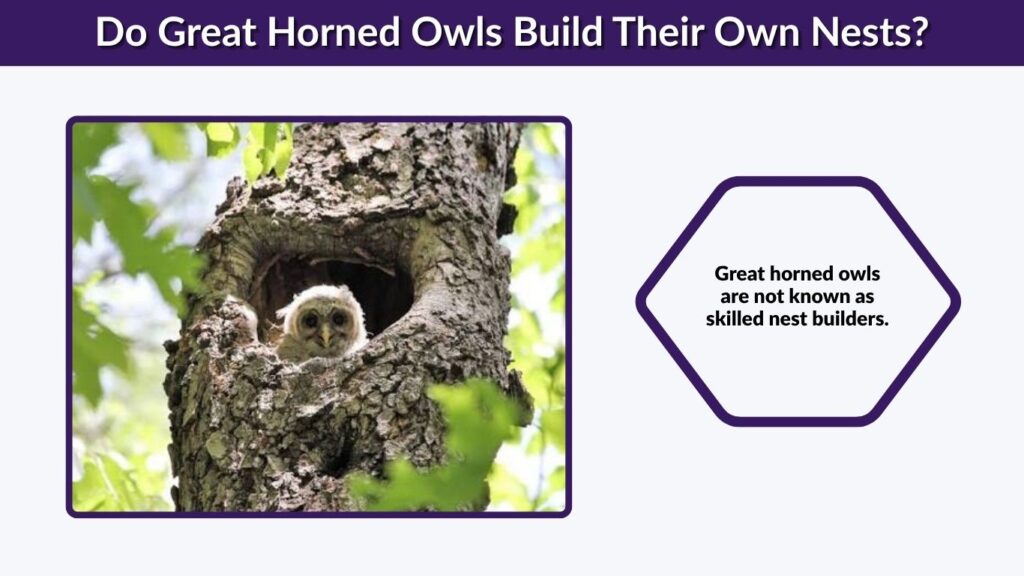
Great horned owls are not known as skilled nest builders. Instead of spending considerable time constructing a nest, they usually occupy an existing structure.
They may take over nests previously used by red-tailed hawks, crows, ravens, squirrels, or other large animals.
In some situations, they simply use a natural depression or protected surface.
The female may rearrange materials slightly before laying eggs, but extensive nest building is uncommon.
This behavior allows great horned owls to begin breeding relatively early in the year, sometimes while winter conditions are still present.
Great Horned Owl Nesting Season
The great horned owl nesting season often begins earlier than that of many other North American birds.
Courtship and territorial calling may begin during fall or early winter. Nesting activity commonly becomes more noticeable during winter, although timing varies according to latitude and local climate.
In warmer southern regions, breeding activity may start earlier, while northern populations may follow somewhat different schedules.
Great Horned Owl Nesting Time
Once a nesting site is selected, the female lays her eggs and performs most of the incubation.
Incubation lasts approximately one month. During this period, the female spends much of her time on the nest while the male hunts and delivers food.
After hatching, the young remain dependent on both parents for several weeks.
Great Horned Owl Nesting Habits
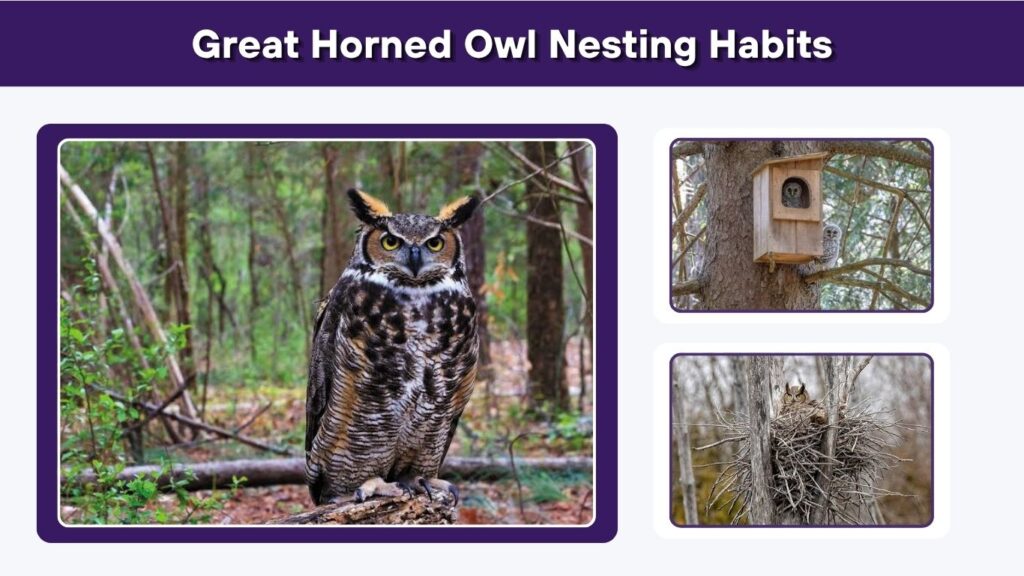
Great horned owls generally form breeding pairs and defend a territory around their nesting area.
Their nesting behavior differs from many smaller birds because they do not continually carry twigs and grass to construct a carefully shaped nest.
Instead, much of their effort goes into protecting the nesting territory, incubating eggs, hunting, and raising young.
Do Both Great Horned Owl Parents Sit on the Nest?
The female performs most egg incubation. The male’s primary role during this stage is providing food and protecting the territory.
After the eggs hatch, both parents contribute to raising the young. The male continues bringing prey while the female initially spends considerable time close to the chicks.
As the owlets become larger and better able to regulate their body temperature, the female can spend more time hunting.
Great Horned Owl Nest Size
There is no single standard great horned owl nest size because these birds use many different nesting structures.
A nest inherited from a large hawk may be several feet wide, whereas an owl using a tree cavity or cliff ledge may have considerably less open space.
The important factor is that the nesting site must be large and strong enough to support an adult female and growing owlets.
A nest also needs enough space for young owls to move around safely as they become larger.
Where Do Great Horned Owls Nest?
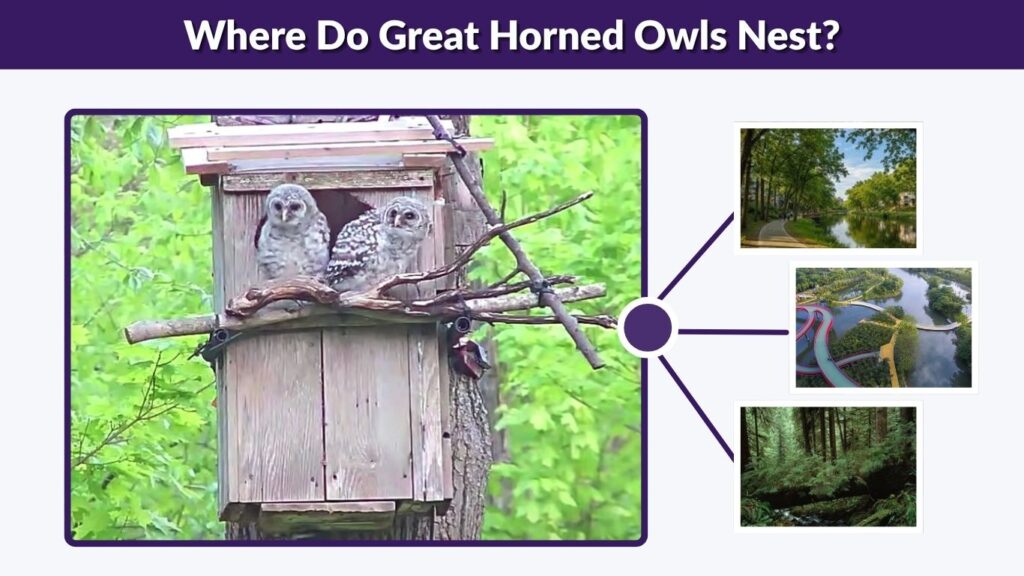
Great horned owls are highly adaptable and can find nesting sites in a surprising variety of environments.
Common locations include forests, wooded suburbs, farmland, deserts, wetlands, river corridors, and urban parks.
Great Horned Owl Nest Height
Many nests are located high above the ground in large trees, but there is no fixed height that every pair uses.
A suitable site generally provides:
- Protection from excessive disturbance
- A strong supporting structure
- Nearby hunting habitat
- Enough space for adults and young
- A relatively open approach for the adult owls
Some pairs may choose surprisingly exposed locations when suitable prey and nesting structures are available.
How to Find a Great Horned Owl Nest
Because the owls themselves can be difficult to see during daylight, listening can be one of the easiest ways to locate an active territory.
Repeated nighttime hooting during the breeding period may indicate that a pair is nearby.
During daylight, look carefully at large abandoned stick nests in mature trees. An adult owl sitting low in an old hawk nest can blend remarkably well with surrounding branches.
Other signs may include owl pellets, feathers, white droppings beneath favored trees, and repeated owl activity around one location.
Avoid approaching an active nest closely. Excessive disturbance can stress both adults and young.
Great Horned Owl Nest Box
People searching for a great horned owl nest box should understand that these owls usually prefer something quite different from a traditional enclosed birdhouse.
Great horned owls are large birds and generally need a substantial open nesting structure.
For this reason, an open nesting platform or large artificial nest structure may be more appropriate than a small enclosed box.
Great Horned Owl Nest Box Design
An artificial nesting structure should provide a broad, stable surface capable of supporting an adult owl, multiple growing owlets, and nesting material.
The structure should have drainage and should not trap rainwater.
Good designs typically emphasize:
- Large open nesting area
- Strong construction
- Secure mounting
- Drainage
- Raised edges
- Natural nesting material
- Easy access for the owls
- Protection from unnecessary human disturbance
Avoid creating a cramped enclosed structure that prevents a large owl from entering or leaving comfortably.
Great Horned Owl Nest Box Dimensions
There is no universal set of great horned owl nesting box dimensions because artificial structures can be platforms, baskets, cones, or modified open boxes.
Instead of concentrating on one exact measurement, the priority should be providing a wide and structurally strong nesting surface appropriate for such a large raptor.
The platform should be substantially larger than nesting boxes designed for smaller owl species.
Before building or installing one, consider the strength of the supporting tree or structure and whether the site provides enough unobstructed flying space.
How to Build a Great Horned Owl Nest
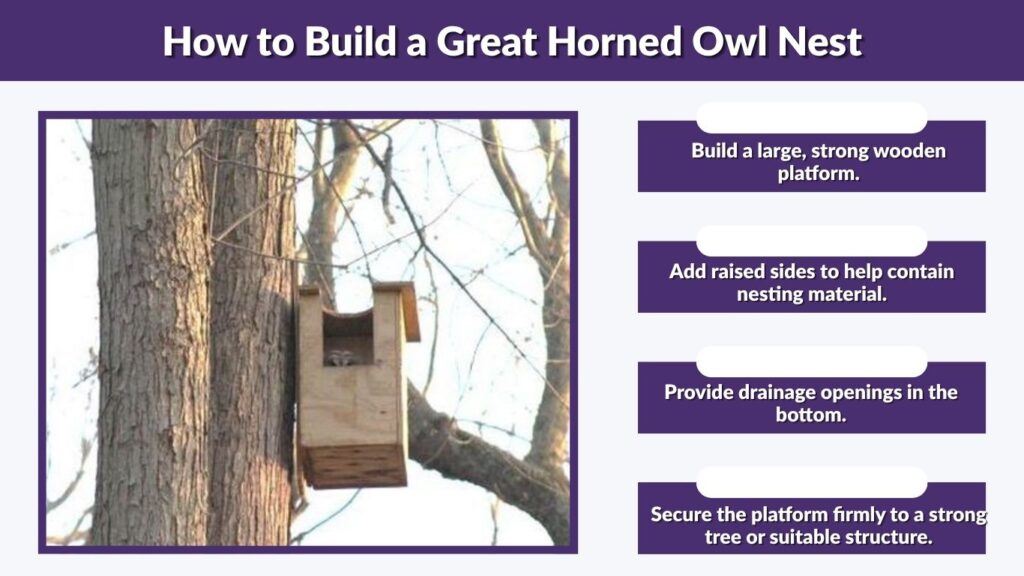
If you want to encourage great horned owls, creating an artificial nesting platform can be an option where natural nesting sites are limited.
Basic Great Horned Owl Nest Platform Plan
A basic approach involves:
- Build a large, strong wooden platform.
- Add raised sides to help contain nesting material.
- Provide drainage openings in the bottom.
- Secure the platform firmly to a strong tree or suitable structure.
- Add sticks and coarse natural material to create a shallow nest depression.
- Position it away from frequent human activity.
The structure must be strong enough to remain stable during wind and severe weather.
Never install a platform where falling branches, traffic, electrical lines, or frequent human disturbance could create additional hazards.
Great Horned Owl Nest Cone
A great horned owl nest cone is another artificial nesting option. Instead of using a completely flat platform, a cone or basket-shaped structure holds sticks and nesting material together.
The cone is usually secured in the fork of a sturdy tree and filled with branches to resemble an abandoned natural nest.
A large, heavy-duty basket has occasionally been adapted for a similar purpose, but any artificial structure must be safely secured and strong enough to support adult owls and growing chicks.
Great Horned Owl Eggs and Babies
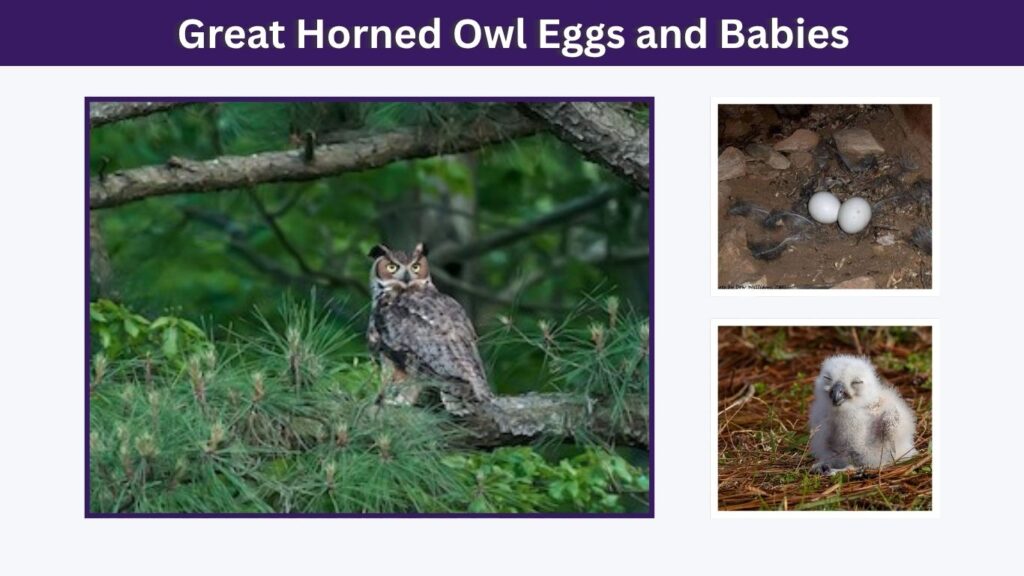
Great horned owls commonly produce a relatively small clutch of pale or white eggs.
After roughly a month of incubation, helpless young owlets hatch covered in soft down.
The parents provide food until the chicks become increasingly active.
When Do Baby Great Horned Owls Leave the Nest?
Young great horned owls may begin moving outside the main nest before they are capable of strong flight.
They often climb or hop onto nearby branches, a behavior commonly called branching.
For this reason, a baby great horned owl out of the nest is not automatically abandoned. Its parents may continue feeding and protecting it nearby.
If an owlet appears injured or is in immediate danger, contact an appropriate wildlife rehabilitation professional rather than attempting to raise or relocate it without guidance.
FAQs
Do Great Horned Owls Reuse the Same Nest?
They may return to the same nesting area or reuse a suitable nest, but they can also choose another nearby site in subsequent breeding seasons.
Do Great Horned Owls Use Nest Boxes?
They can use artificial nesting structures, although large open platforms or nest cones are generally more suitable than small enclosed bird boxes.
How Big Is a Great Horned Owl Nest?
Size varies substantially because great horned owls frequently occupy nests originally constructed by other large birds. Many are large stick structures capable of supporting an adult owl and several young.
Where Is the Best Place for a Great Horned Owl Nesting Platform?
A quiet location with a sturdy supporting tree or structure, nearby hunting habitat, and an unobstructed approach is generally preferable.
What Should I Do If a Baby Great Horned Owl Falls From the Nest?
Keep people and pets away and observe from a safe distance. Parents may still be caring for the young owl. If it appears injured or is in immediate danger, contact a licensed wildlife rehabilitator or local wildlife authority.