The great horned owl is one of the largest, strongest, and most recognizable owls in the Americas. Known for its prominent feather tufts, powerful talons, yellow eyes, and deep nighttime hoots, this adaptable predator can live in forests, deserts, farmland, suburbs, and even city parks. Scientifically known as Bubo virginianus, the species has an exceptionally varied diet and wide geographic range. Below, learn about great horned owl size, wingspan, sounds, habitat, diet, nesting behavior, lifespan, feathers, and other important facts.
Great Horned Owl Identification
A great horned owl has a heavy, barrel-shaped body and broad head. Its most obvious features are the two large feather tufts that rise from the top of its head. Although they resemble horns or ears, they are simply feathers and are not connected to hearing.
What Does a Great Horned Owl Look Like?
Key identification characteristics include:
- Body color: Mottled gray, brown, black, and cream
- Eyes: Large and bright yellow
- Facial disk: Brownish or gray with darker borders
- Throat: Noticeable white throat patch
- Head: Large with prominent feather tufts
- Feet: Thick, heavily feathered legs with powerful talons
- Bill: Short, sharply hooked, and dark
- Underparts: Usually marked with fine horizontal barring
Color varies considerably between regions. Some birds appear grayish while others can be strongly reddish-brown or relatively pale.
Great Horned Owl Size and Wingspan
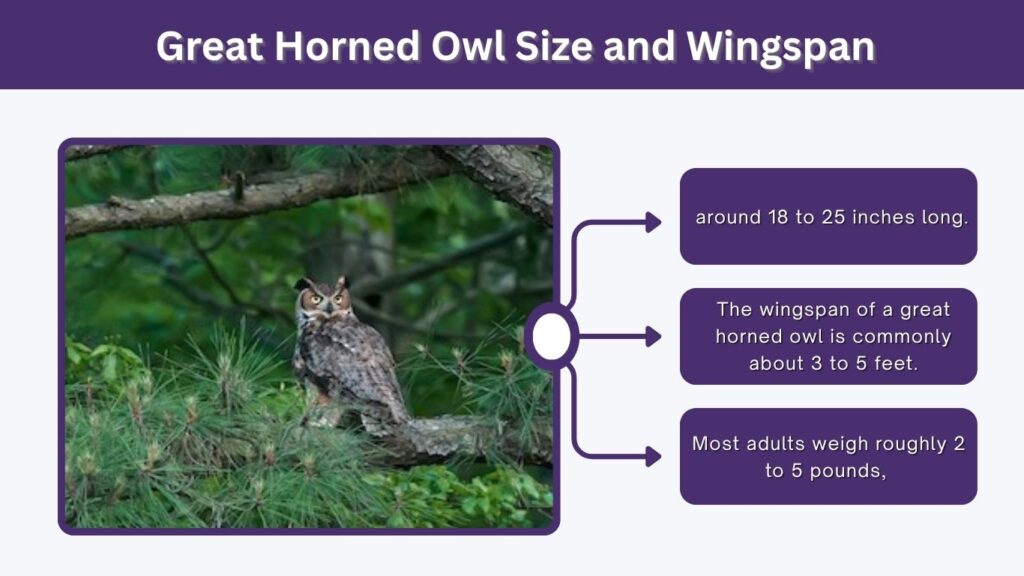
Great horned owls are large birds, although their exact measurements vary depending on sex, location, and individual.
Adults are generally around 18 to 25 inches long from head to tail. Their broad wings make them appear considerably larger when flying.
Great Horned Owl Wingspan
The wingspan of a great horned owl is commonly about 3 to 5 feet. Their wings are broad and rounded, allowing the owls to maneuver effectively through woodland while generating relatively little noise.
Great Horned Owl Weight
Most adults weigh roughly 2 to 5 pounds, although females commonly weigh more than males.
Despite their intimidating appearance, much of an owl’s apparent bulk comes from its thick layer of feathers.
Male vs. Female Great Horned Owl
Female great horned owls are generally larger and heavier than males. However, size alone can be difficult to use for identification when only one owl is present.
Their voices provide another clue. Males generally produce deeper, lower-pitched hoots, while females tend to have slightly higher-pitched voices.
What Does a Great Horned Owl Sound Like?
The classic great horned owl sound is a series of deep, resonating hoots. These calls are especially noticeable at night when other birds are quiet.
A typical call can consist of several deep hoots with short pauses between them. A pair may answer each other, creating a duet that carries over long distances.
Great Horned Owl Calls and Vocalizations
Great horned owl vocalizations are not limited to hooting. They may also produce:
- Screeches
- Growls
- Hisses
- Bark-like noises
- Bill snapping
- High-pitched calls from juveniles
Young great horned owls often make persistent begging sounds when requesting food from their parents.
Why Do Great Horned Owls Hoot at Night?
Hooting helps owls communicate with mates and defend territories. Calling can become particularly noticeable around courtship and breeding periods.
Hearing a great horned owl call at night does not necessarily mean the bird is directly beside you. Its low-frequency vocalizations can travel surprisingly far in quiet conditions.
Great Horned Owl Habitat and Range
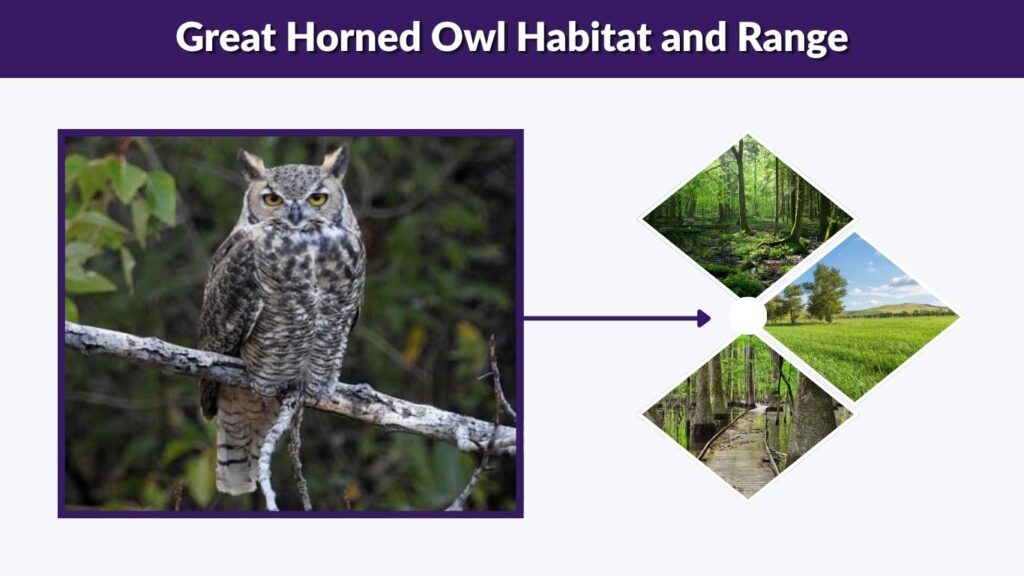
Great horned owls are extremely adaptable. Their habitat can include deciduous forests, coniferous forests, swamps, deserts, grasslands, farmland, mountains, suburbs, and urban parks.
They generally need suitable hunting areas combined with trees, cliffs, or structures that provide safe resting and nesting locations.
Where Do Great Horned Owls Live?
The great horned owl has an enormous range extending across much of North America and into Central and South America.
They can be encountered in areas ranging from Canada and Alaska to warm southern environments. Their adaptability explains why great horned owls can thrive in places as different as Florida, Texas, Arizona, California, Colorado, and Michigan.
Great Horned Owl Diet and Prey
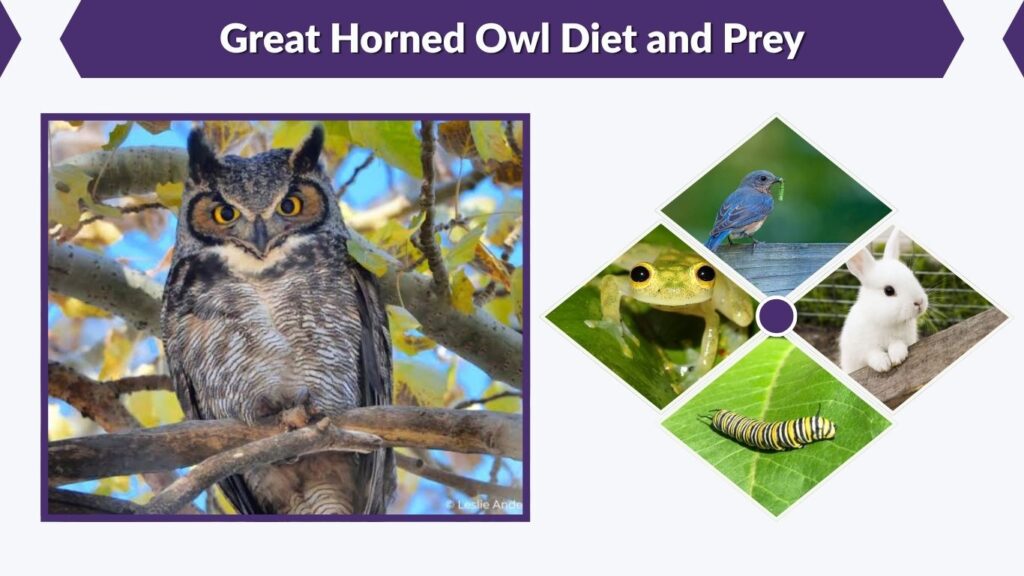
Great horned owls are powerful and opportunistic predators. Instead of depending on one food source, they hunt many different animals depending on what is available.
Common great horned owl prey includes:
- Mice
- Rats
- Rabbits
- Squirrels
- Voles
- Gophers
- Birds
- Snakes
- Lizards
- Frogs
- Insects
- Occasionally fish
They are even known for being capable of hunting skunks, something relatively few predators regularly attempt.
Do Great Horned Owls Eat Cats?
A great horned owl is physically capable of attacking a very small cat or other small pet, but domestic cats are not a normal primary food source.
Most of their diet consists of wild prey such as rodents, rabbits, and birds. However, keeping very small pets supervised outdoors at night is sensible in areas where large predators are active.
Great Horned Owl Nesting and Eggs
Great horned owls usually do not construct elaborate nests themselves. Instead, they frequently occupy existing nests built by hawks, crows, ravens, or other large birds.
They can also nest on cliff ledges, tree cavities, broken tree tops, and occasionally human-made structures.
Great Horned Owl Eggs
A female commonly lays around one to four white eggs, with two being frequent in many populations.
The female performs most incubation while the male supplies food. Incubation lasts approximately one month.
Juvenile Great Horned Owl and Fledgling Stage
Great horned owl chicks hatch covered in pale down and depend entirely on their parents.
As they grow, young owls may leave the actual nest and move onto nearby branches before they can fly confidently. This stage is sometimes called “branching.”
A great horned owl fledgling can therefore appear to be abandoned even while its parents remain nearby and continue feeding it.
Great Horned Owl Feathers and Silent Flight
Great horned owl feathers help provide camouflage, insulation, and remarkably quiet flight.
Specialized structures along the flight feathers help reduce turbulence and sound. This allows the owl to approach prey without producing the loud wing noise typical of many other large birds.
Their mottled brown and gray feathers also help them disappear against tree trunks during daytime roosting.
Great Horned Owl Talons and Hunting Ability
The great horned owl has powerful feet equipped with long, curved talons. These feet are its primary hunting weapons.
Once prey is located, the owl approaches using quiet flight and grabs the animal with its feet. The hooked bill is mainly used afterward for tearing food into manageable pieces.
Great horned owls also have exceptional low-light vision and extremely sensitive hearing, helping them locate prey during nighttime hunting.
Great Horned Owl Lifespan
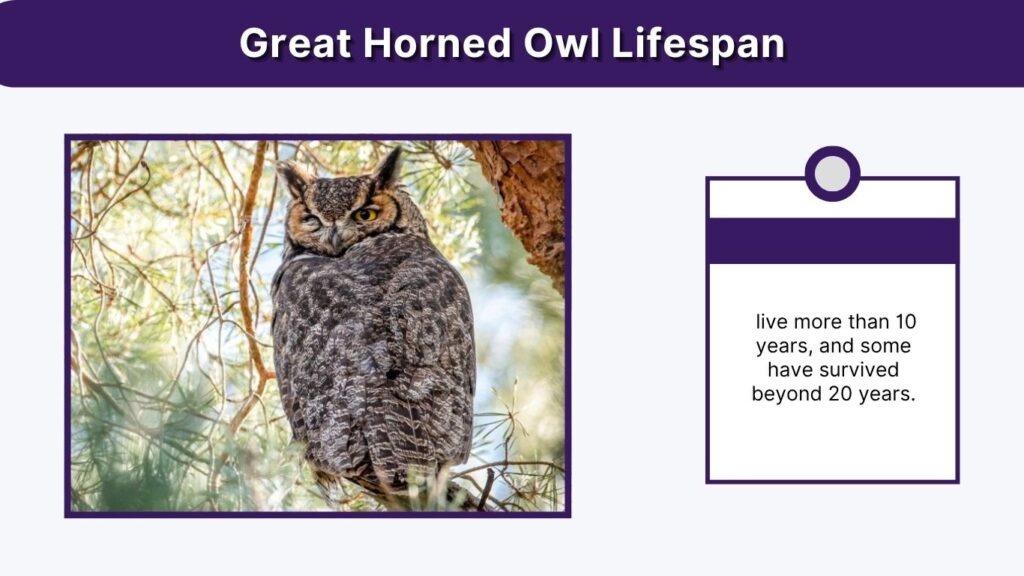
A great horned owl can live for many years when it survives the difficult juvenile period.
Wild individuals may live more than 10 years, and some have survived beyond 20 years. Birds under managed care can potentially live even longer because they are protected from starvation, collisions, predators, and many environmental hazards.
Great Horned Owl Predators
Healthy adult great horned owls have relatively few natural predators because they are among the dominant avian predators in their ecosystems.
Eggs, chicks, and inexperienced juveniles are more vulnerable. Nest predators and competing raptors can occasionally threaten young owls.
Humans indirectly present greater dangers through vehicle collisions, habitat changes, power lines, and other environmental hazards.
Great Horned Owl Facts
The great horned owl combines impressive size, strength, adaptability, and hunting ability. Its scientific name is Bubo virginianus, and its distinctive feather tufts make it one of the easiest North American owls to recognize.
These owls are primarily nocturnal but may occasionally be seen around dawn, dusk, or even during daylight. Their broad diet and ability to use many different habitats have helped them become one of the most widespread large owls in the Americas.
FAQs
Is a Great Horned Owl Dangerous to Humans?
Great horned owls generally avoid humans. However, they have strong talons and may defend a nest or young if they feel seriously threatened, so wild owls should always be given space.
How Big Is a Great Horned Owl Compared to a Human?
An adult is only around 18–25 inches tall, but its wings can span roughly 3–5 feet, making the bird look dramatically larger when flying.
What Time of Night Do Great Horned Owls Hoot?
They may call throughout the night, although vocal activity is often particularly noticeable around dusk, before dawn, and during the breeding season.
What Is the Scientific Name of the Great Horned Owl?
The scientific or Latin name of the great horned owl is Bubo virginianus.
Where Does a Great Horned Owl Sleep?
During the day, great horned owls commonly roost on sheltered tree branches where their mottled feathers provide excellent camouflage. They may also use dense vegetation or other protected locations.