The barred owl vs great horned owl comparison is interesting because both are large, powerful North American owls that can live in forests, wetlands, and even suburban areas. However, they differ noticeably in appearance, size, calls, hunting habits, and behavior. Barred owls are known for their dark eyes and distinctive rhythmic hooting, while great horned owls are recognized by their prominent ear tufts and powerful build. Understanding these differences makes it much easier to identify which owl you are seeing or hearing.
Barred Owl vs Great Horned Owl: Quick Comparison
Although the two species sometimes occupy similar habitats, their physical features and behavior are quite different. Great horned owls generally look heavier and more intimidating, while barred owls have rounder heads and a softer overall appearance.
| Feature | Barred Owl | Great Horned Owl |
| Scientific Name | Strix varia | Bubo virginianus |
| Head Shape | Rounded | Large with ear tufts |
| Eye Color | Dark brown to black | Yellow |
| Ear Tufts | Absent | Prominent |
| Body Build | Medium-large, rounded | Large, powerful |
| Plumage | Brown and white barred pattern | Mottled brown, gray, and buff |
| Typical Call | Rhythmic hooting phrase | Deep, low hoots |
| Main Habitat | Mature forests and wetlands | Forests, deserts, farmland, suburbs |
| Diet | Small mammals, birds, amphibians | Mammals, birds, reptiles, larger prey |
| Activity | Mostly nocturnal | Mostly nocturnal |
Barred Owl vs Great Horned Owl Size
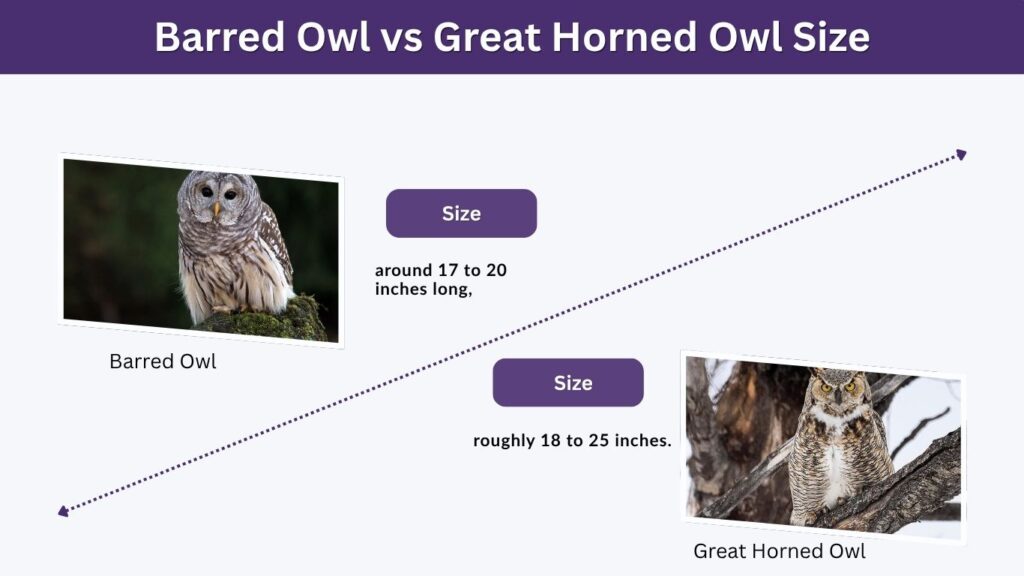
Size is one of the most common points of comparison between these two species. Both are large owls, but the great horned owl is usually heavier and more powerfully built.
Barred Owl Size
Barred owls are medium-to-large owls with broad wings and rounded bodies. Adults are generally around 17 to 20 inches long, although females are usually somewhat larger than males.
Their wingspan can reach approximately 3.5 feet. Despite their large-looking feathers, their actual body mass is relatively moderate compared with a great horned owl.
Great Horned Owl Size
Great horned owls are among the largest commonly encountered owls in North America. Adults can reach roughly 18 to 25 inches in length and may have wingspans approaching 4 to 5 feet.
Females are generally larger and heavier than males. Their broad chest, thick legs, and massive talons give them a noticeably more powerful appearance.
Which Is Larger?
The great horned owl is generally larger and heavier than the barred owl. Their body lengths can overlap, but great horned owls tend to have greater body mass, larger feet, and more powerful talons.
A barred owl may occasionally appear almost as tall because of its feathers and posture, but a great horned owl is normally the stronger bird.
Barred Owl vs Great Horned Owl Appearance
These owls can often be identified immediately by looking at the head and eyes. Their plumage also has distinctive patterns that become easier to recognize with experience.
Barred Owl Identification
The barred owl has a rounded head without visible ear tufts. Its dark eyes are one of its most distinctive characteristics because many other large owls have yellow or orange eyes.
Important identification features include:
- Large rounded head
- Dark brown or nearly black eyes
- No ear tufts
- Brown-and-white barred chest
- Vertical streaks on lower body
- Pale facial disks
- Yellow bill
- Broad rounded wings
The combination of dark eyes and a round head makes the barred owl relatively easy to identify.
Great Horned Owl Identification
Great horned owls have a much more dramatic appearance. Their prominent feather tufts resemble horns or ears, giving the species its common name.
Key characteristics include:
- Large ear-like feather tufts
- Bright yellow eyes
- White throat patch
- Broad, powerful body
- Mottled brown and gray feathers
- Strong dark barring
- Large feet and talons
- Rounded wings
The ear tufts are not actual ears. Their real ear openings are hidden beneath feathers on the sides of the head.
Great Horned Owl Call vs Barred Owl Call
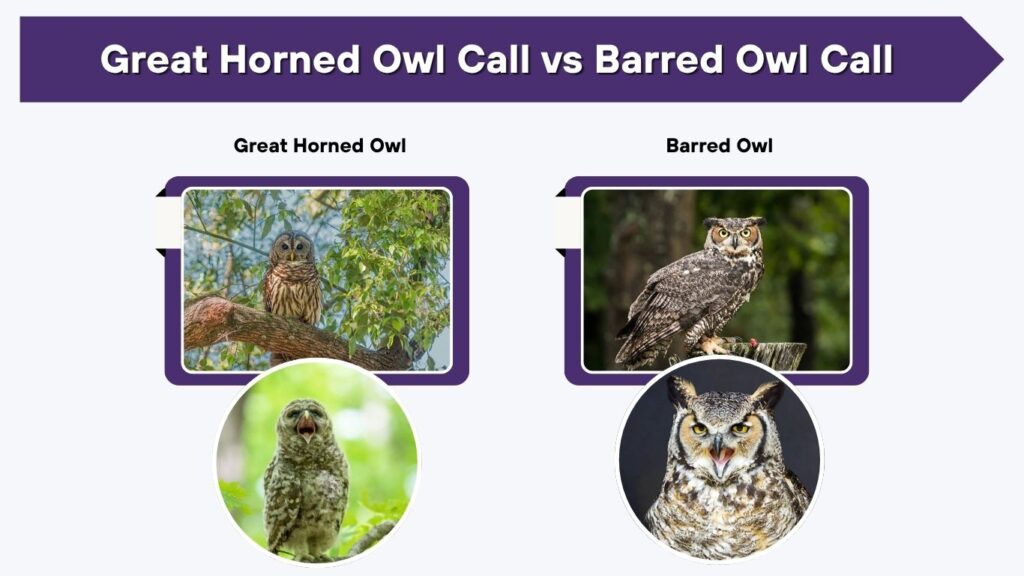
Listening to an owl is often easier than spotting one. Fortunately, barred owls and great horned owls have noticeably different vocalizations.
What Does a Barred Owl Sound Like?
Barred owls produce a recognizable series of hoots with a distinctive rhythm. Their classic call is often described using a phrase similar to “Who cooks for you? Who cooks for you all?”
The call usually contains several clear notes and may sound almost conversational.
Barred owls can also produce:
- Screeches
- Cackles
- Gurgling sounds
- Bark-like calls
- Excited hooting exchanges
Pairs may call back and forth, sometimes creating surprisingly loud nighttime vocalizations.
What Does a Great Horned Owl Sound Like?
Great horned owl calls are generally deeper, slower, and more resonant.
Their typical hoot consists of several low notes separated by short pauses. The call often sounds powerful and can travel a considerable distance through forests at night.
Males typically have deeper voices than females because they have larger voice boxes relative to body size.
Barred Owl Hoot vs Great Horned Owl Hoot
The easiest way to distinguish them is by rhythm and depth.
A barred owl usually gives a longer, more rhythmic sequence of notes. A great horned owl normally produces fewer, deeper hoots with more obvious pauses.
If you hear an energetic, patterned hooting sequence, it may be a barred owl. If you hear deep, booming hoots, a great horned owl is more likely.
Barred Owl Feather vs Great Horned Owl Feather
Their feathers may appear similar because both species have brown, gray, and cream patterns that provide excellent camouflage. However, the patterns can differ.
Barred Owl Feathers
Barred owl feathers often show strong horizontal brown-and-white bars, particularly around the upper chest.
The lower body commonly has vertical brown streaking against a lighter background. Flight feathers may display alternating dark and pale bands.
Great Horned Owl Feathers
Great horned owl feathers generally have a more irregular mottled pattern containing shades of brown, gray, black, buff, and white.
Their wing and tail feathers can also have dark bands, but the overall pattern tends to look less neatly barred than a barred owl.
Because individual feathers vary greatly depending on their location on the bird, identifying an owl species from a single loose feather can be difficult.
Habitat Differences
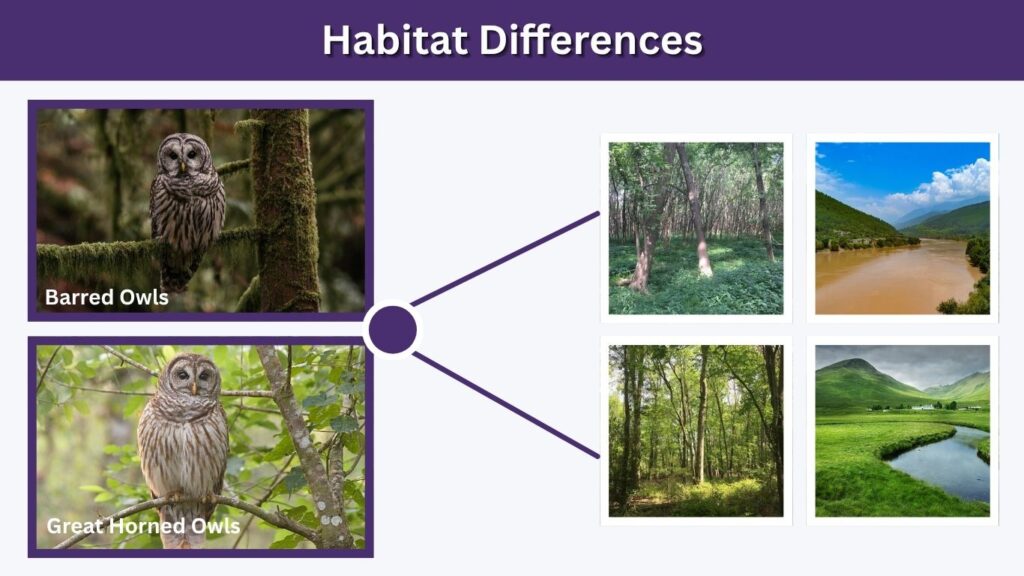
Both species use forests, but great horned owls occupy a wider variety of landscapes.
Where Barred Owls Live
Barred owls strongly favor mature forests, particularly areas containing large trees and nearby water.
Common habitats include wooded swamps, bottomland forests, river valleys, and mixed forests.
They prefer locations containing large cavities or suitable abandoned nests for breeding.
Where Great Horned Owls Live
Great horned owls are exceptionally adaptable.
They may live in:
- Forests
- Deserts
- Grasslands
- Farmland
- Wetlands
- Mountains
- City parks
- Suburban neighborhoods
They often use old nests built by hawks, crows, ravens, or other large birds rather than constructing their own.
Diet and Hunting Differences
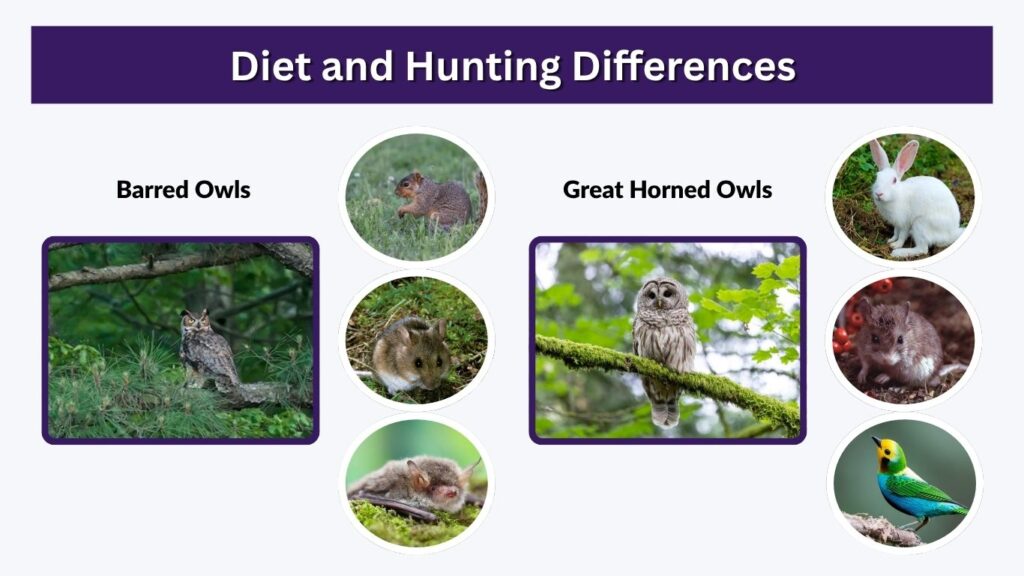
Both species are carnivorous predators, but great horned owls can regularly overpower larger animals.
What Barred Owls Eat
Barred owls primarily hunt small to medium-sized prey such as mice, voles, squirrels, frogs, crayfish, small birds, reptiles, and insects.
They often hunt from a perch, dropping silently onto prey below.
What Great Horned Owls Eat
Great horned owls have an extremely broad diet that includes rabbits, rats, mice, squirrels, skunks, snakes, birds, reptiles, and occasionally fish or amphibians.
Their large talons allow them to attack animals that many other owls cannot handle.
Great Horned Owl vs Barred Owl Behavior
Barred owls are often associated with heavily wooded areas and may remain within relatively stable territories.
Great horned owls can be highly territorial and are dominant predators in many ecosystems. They may hunt other birds of prey, including smaller owl species.
Both species defend nesting territories and can become especially protective during breeding season.
Can Great Horned Owls Attack Barred Owls?
Yes. Great horned owls can prey on barred owls.
Because great horned owls are larger, stronger, and equipped with exceptionally powerful talons, they may occasionally kill other owls occupying overlapping territories.
This predatory relationship can influence where barred owls choose to roost or nest. Barred owls may avoid areas where great horned owls are frequently active.
Immature Barred Owl vs Great Horned Owl
Young barred owls may initially be more difficult to identify because their feathers can look fluffy and less clearly patterned than those of adults.
However, their round heads and lack of ear tufts usually remain useful clues.
Young great horned owls develop recognizable ear tufts as they mature, although the tufts can sometimes lie flat. Their yellow eyes and heavy body structure also help distinguish them.
Which Owl Is Stronger?
The great horned owl is generally the stronger of the two species.
Its heavier body, large feet, and exceptionally powerful talons allow it to capture larger prey. Great horned owls can hunt mammals and birds that would normally be too large for barred owls.
Barred owls are still highly capable predators, but their typical prey tends to be smaller.
FAQs
Which is larger, a great horned owl or barred owl?
The great horned owl is generally larger and heavier. Although their lengths can overlap, great horned owls have more massive bodies, larger feet, and stronger talons.
How can you tell a barred owl from a great horned owl?
Look at the eyes and head. Barred owls have dark eyes and rounded heads without ear tufts, while great horned owls have yellow eyes and prominent feather tufts.
Do barred owls and great horned owls sound the same?
No. Barred owls have rhythmic, patterned hoots, while great horned owls produce deeper and slower hooting sequences.
Can a great horned owl kill a barred owl?
Yes. Great horned owls are powerful predators and may occasionally prey on barred owls or other smaller owl species.
Are barred owls and great horned owls found in the same habitat?
Yes. Their ranges and habitats can overlap, particularly in wooded environments. However, barred owls generally prefer mature forests near water, while great horned owls occupy a much broader variety of habitats.