
The Western Barn Owl (Tyto alba) is a medium-sized nocturnal owl recognized by its pale heart-shaped face, dark eyes, long legs, and golden-brown upperparts. Under modern bird taxonomy, the Western Barn Owl occurs mainly across Europe, Africa, and western Asia. Barn owls in the Americas are now generally classified as American Barn Owls, while those from South Asia through Australia are Eastern Barn Owls. Western Barn Owls are especially associated with open countryside where they silently hunt mice, voles, and other small mammals.
What Is a Western Barn Owl?
The Western Barn Owl belongs to the barn-owl family Tytonidae. Its scientific name is Tyto alba. Current major taxonomic treatments recognize it separately from the American Barn Owl (Tyto furcata) and Eastern Barn Owl (Tyto javanica).
The species has the classic barn-owl appearance: a white heart-shaped facial disc surrounded by a darker border, blackish eyes, pale underparts, and golden, gray, and brown markings across the back and wings.
| Feature | Western Barn Owl |
| Scientific name | Tyto alba |
| Family | Tytonidae |
| Length | About 29–44 cm |
| Weight | About 250–480 g |
| Activity | Mostly nocturnal |
| Main food | Small mammals |
| Call | Long rasping screech |
| Main range | Europe, Africa and western Asia |
Western Barn Owl Identification
Western Barn Owls look very different from many typical owls because they lack visible ear tufts and have a distinctive heart-shaped face.
How to Identify a Western Barn Owl
Look for:
- White or pale heart-shaped facial disc
- Dark brown to black eyes
- No ear tufts
- Golden-brown or orange-buff upperparts
- Gray and white spotting on the wings and back
- White to buff underparts
- Long, lightly feathered legs
- Rounded wings
- Short tail
Females often show more dark spotting on the underside than males, although coloration varies geographically.
Western Barn Owl Size
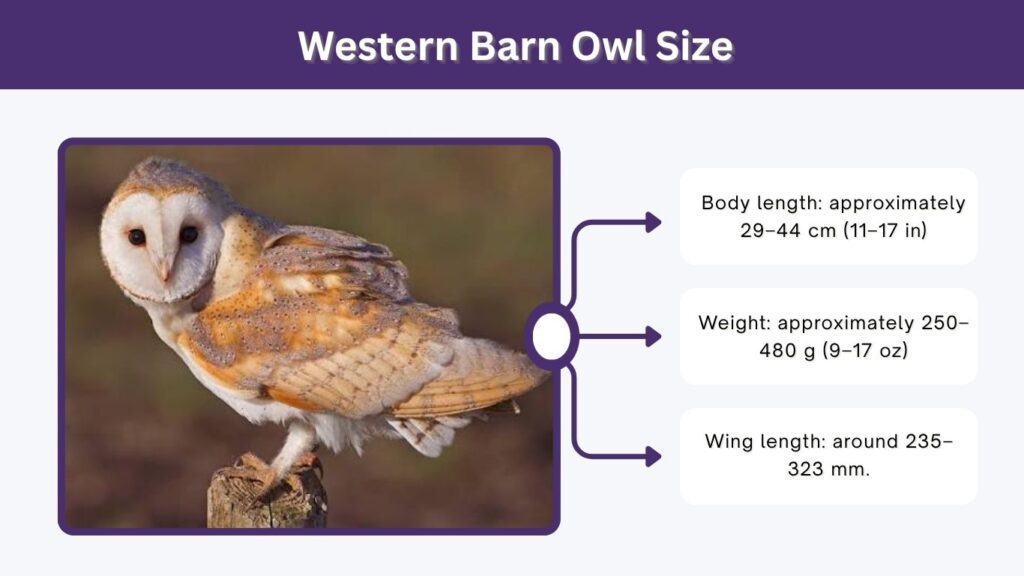
Western Barn Owls are medium-sized owls but can look considerably larger when flying because of their broad wings.
Typical measurements include:
- Body length: approximately 29–44 cm (11–17 in)
- Weight: approximately 250–480 g (9–17 oz)
- Wing length: around 235–323 mm
Females are often heavier than males.
Their relatively long wings allow them to fly slowly over grasslands while listening for prey below.
Western Barn Owl Habitat
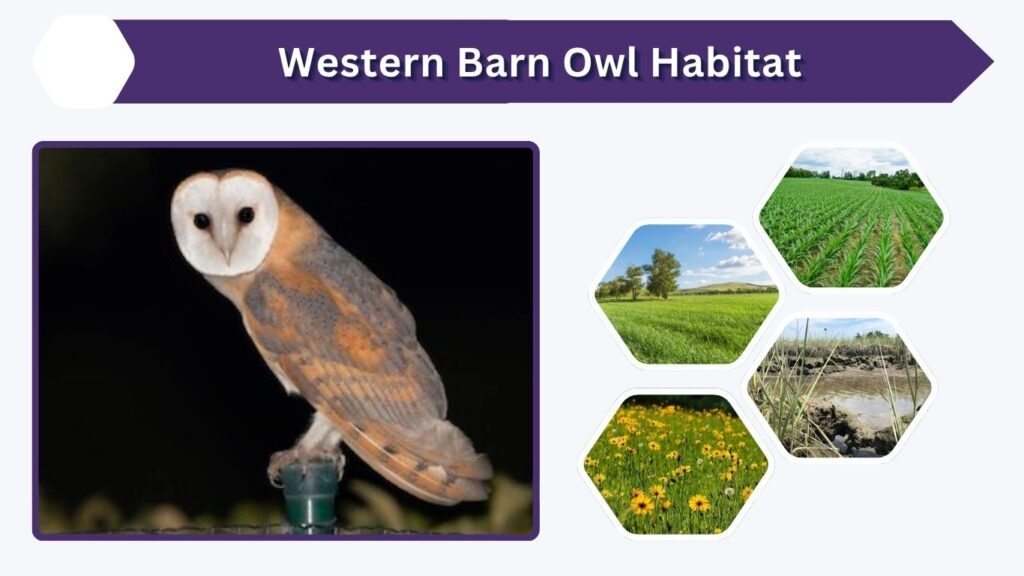
The Western Barn Owl habitat is strongly associated with open or semi-open landscapes rather than dense forests.
Suitable environments include:
- Grasslands
- Farmland
- Meadows
- Pastures
- Heathland
- Moorland
- Open woodland
- Marsh edges
- Agricultural landscapes
Barn owls need both productive hunting habitat and secure places for daytime roosting and nesting. Tree cavities, barns, old buildings, caves, nest boxes, and other sheltered cavities can provide nesting sites.
Why Do Barn Owls Like Farmland?
Farmland often provides open hunting areas containing mice, voles, rats, shrews, and other small mammals.
Barn Owls typically fly low over fields and grasslands while searching for prey. They can also hunt from low perches such as fence posts.
Where Do Western Barn Owls Live?
Under the current three-species treatment of the barn-owl complex, Western Barn Owls occur primarily in Europe, Africa, and western parts of Asia.
Their range includes much of:
- Britain and continental Europe
- North Africa
- Sub-Saharan Africa
- Mediterranean islands
- The Middle East
- Parts of southwestern Asia
Different subspecies occur across this enormous geographical range.
Are Western Barn Owls Found in the United States?
Under current taxonomy, native barn owls in the United States are American Barn Owls (Tyto furcata), not Western Barn Owls (Tyto alba). Cornell notes that the barn-owl complex was split so that American Barn Owls occupy the Americas, Western Barn Owls occur in Europe, Africa, and western Asia, and Eastern Barn Owls range from South Asia to Australia.
Therefore, searches for a “Western Barn Owl” in places such as western Pennsylvania, Pittsburgh, Massachusetts, or North Carolina usually refer geographically to barn owls in the western part of a state—not to the species officially named Western Barn Owl.
Those birds would generally be American Barn Owls.
Western Barn Owl Call and Sound
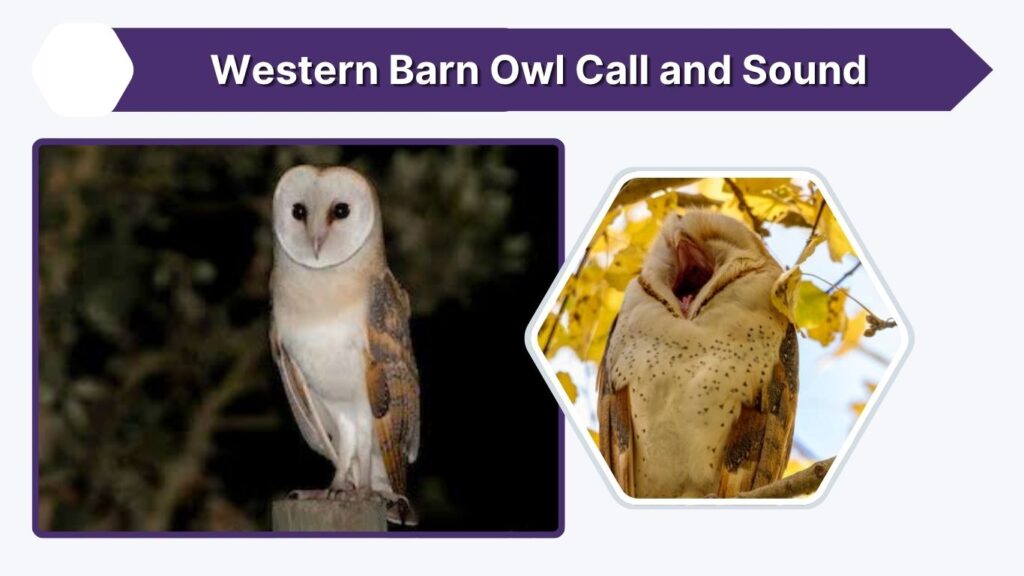
The Western Barn Owl call is quite different from the familiar “hoot” associated with many other owl species.
Its most characteristic sound is a long, harsh, rasping screech. Other vocalizations include repetitive twittering during courtship, low croaking sounds, hissing, rasping noises, and snapping sounds when threatened at a nest or roost.
Why Do Western Barn Owls Screech?
Calls can be associated with:
- Courtship
- Communication between mates
- Nest defense
- Territorial behavior
- Begging by young
- Alarm or distress
Barn owls tend to become more vocal during the breeding period.
Western Barn Owl Male vs Female
Male and female Western Barn Owls look broadly similar, so separating them visually is not always easy.
However, there are several general differences.
| Feature | Male | Female |
| Body size | Usually smaller | Usually larger/heavier |
| Underparts | Often paler | Often darker or more spotted |
| Dark spotting | Usually less | Often more extensive |
| Breeding role | Brings prey | Incubates eggs |
Females tend to be larger, and female barn owls frequently have more spotting on their pale underparts.
Color alone is not a perfect method for determining sex because plumage varies among subspecies and individuals.
What Do Western Barn Owls Eat?
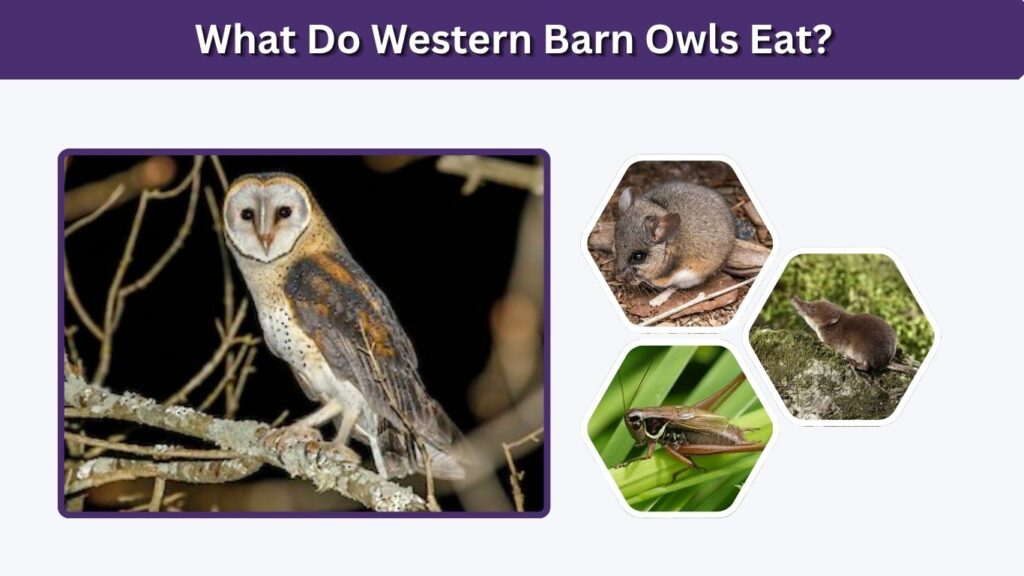
Western Barn Owls specialize in hunting small ground-dwelling mammals.
Their diet commonly includes:
- Voles
- Mice
- Rats
- Shrews
- Other small rodents
- Small birds
- Insects
- Occasionally frogs, lizards, bats, or young rabbits
Small rodents make up much of their diet in many regions.
Barn owls swallow many prey animals whole. Later, indigestible material such as fur and bones is compressed and regurgitated as an owl pellet.
How Do Western Barn Owls Hunt?
Western Barn Owls are remarkably well adapted for nighttime hunting.
They normally fly slowly and low over open ground while listening for small animals moving through vegetation. Their soft feathers help reduce flight noise, making their approach difficult for prey to detect.
Their hearing is exceptionally sensitive and allows them to locate prey even when visibility is poor.
They can also sit on fence posts, branches, or other low perches and listen before dropping onto prey.
Western Barn Owl Mating Season
Western Barn Owls do not have one universal mating season across their entire range.
Breeding timing depends heavily on food availability and local climate. Barn owls can potentially reproduce during different parts of the year when prey is plentiful.
Courtship can include males:
- Flying around the nesting area
- Screeching or calling
- Chasing females
- Performing display flights
- Bringing food to females
Pairs are generally monogamous, and males provide food while females incubate the eggs.
Western Barn Owl Eggs and Nesting
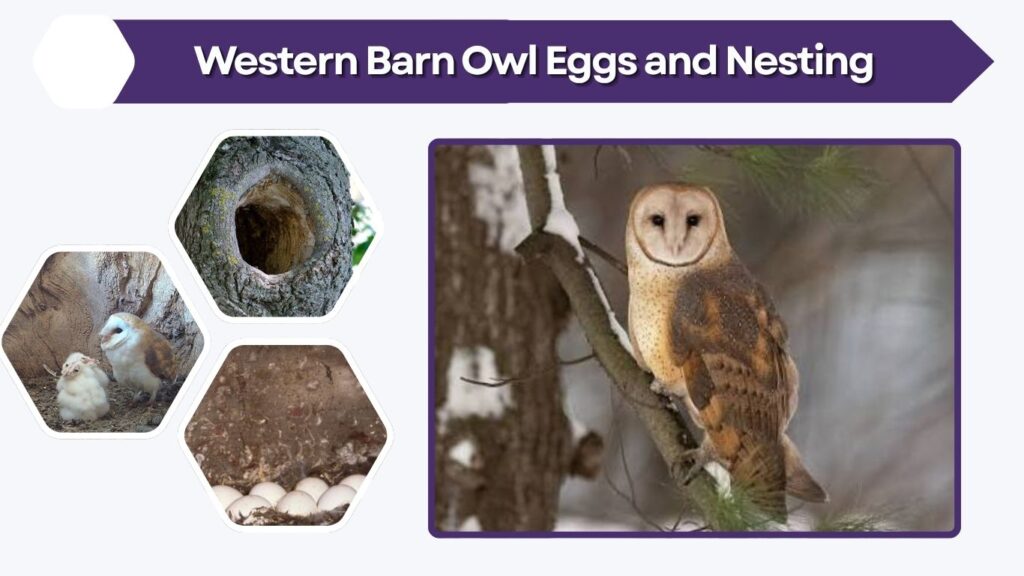
Barn Owls do not construct elaborate stick nests.
Instead, they commonly nest in protected cavities such as:
- Hollow trees
- Barns
- Old buildings
- Church structures
- Caves
- Wells
- Nest boxes
A typical clutch is often around 3–6 eggs, although larger clutches can occur when food is abundant. Incubation lasts approximately 30–34 days, with the female performing most or all incubation while the male brings food.
Young usually begin leaving the nest after roughly seven to eight weeks.
Western Barn Owl vs Eastern Barn Owl
Western and Eastern Barn Owls look extremely similar because they were historically treated as parts of a much broader barn-owl species.
Their most obvious distinction is geographical.
| Western Barn Owl | Eastern Barn Owl |
| Tyto alba | Tyto javanica |
| Europe | South and Southeast Asia |
| Africa | Australia |
| Western Asia | Parts of the Pacific |
| Similar heart-shaped face | Similar heart-shaped face |
The current taxonomy separates Tyto javanica from Tyto alba.
This means that a “barn owl in Western Australia” is geographically western within Australia but is taxonomically an Eastern Barn Owl, not a Western Barn Owl.
Western Barn Owl vs American Barn Owl
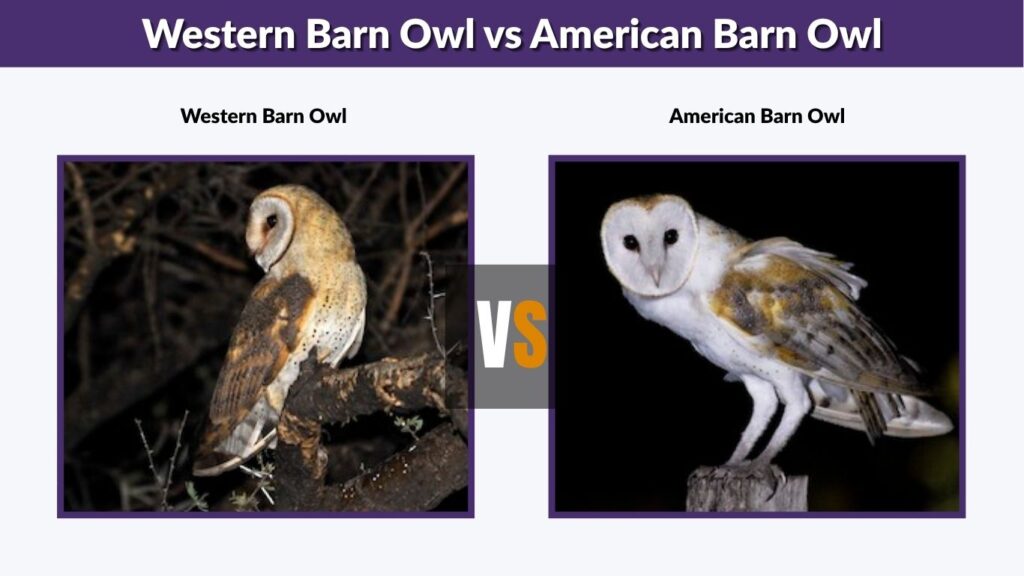
The American Barn Owl (Tyto furcata) occurs throughout the Americas, while the Western Barn Owl (Tyto alba) occurs primarily across Europe, Africa, and western Asia.
The two are closely related and look very similar, which is why older books and websites may simply call both Tyto alba or “Common Barn Owl.”
The modern split is important when identifying barn owls based on location.
Are Western Barn Owls Found in the Western Cape?
Yes. South Africa falls within the African distribution of the Western Barn Owl (Tyto alba) under current taxonomy.
Western Cape landscapes containing grassland, agricultural areas, open country, suitable prey, and nesting cavities can provide appropriate barn-owl habitat.
10 Western Barn Owl Facts
- Its scientific name is Tyto alba.
- It has a distinctive heart-shaped facial disc.
- It does not normally make the classic owl “hoot.”
- Its best-known call is a harsh screech.
- Females are generally heavier than males.
- Small mammals make up most of its diet.
- It hunts mainly at night.
- Its soft feathers allow exceptionally quiet flight.
- It frequently nests in barns, tree cavities, and nest boxes.
- Under current taxonomy, it is separate from American and Eastern Barn Owls.
FAQs
What is the difference between a Western and American Barn Owl?
The main distinction is taxonomy and geographic distribution. Western Barn Owls (Tyto alba) occur in Europe, Africa, and western Asia, while American Barn Owls (Tyto furcata) occupy North, Central, and South America.
What sound does a Western Barn Owl make?
Western Barn Owls are famous for their long, rasping screech rather than a traditional hoot. They can also produce twittering, croaking, hissing, and rasping sounds during courtship, nesting, or defensive situations.
Where does the Western Barn Owl live?
Western Barn Owls primarily live across Europe, Africa, the Middle East, and parts of southwestern Asia. They favor open habitats such as grasslands, farmland, heaths, moors, and open woodland where small mammals are abundant.
Is a barn owl in western Pennsylvania a Western Barn Owl?
No, not under current taxonomy. A native barn owl in Pennsylvania would be classified as an American Barn Owl (Tyto furcata). “Western” in “western Pennsylvania” describes the location within the state, not the owl species.
Is the Western Barn Owl nocturnal?
Yes. Western Barn Owls are primarily nocturnal, although they may emerge around dusk or remain active near dawn. They can occasionally be observed flying during daylight as well.