
The Powerful Owl (Ninox strenua) is Australia’s largest owl and one of the country’s most impressive nocturnal predators. Found mainly in eastern and southeastern Australia, this large forest owl hunts possums, gliders, flying foxes, birds, and other animals using strong feet and large talons. Powerful Owls also produce distinctive double hoots and depend on old trees with spacious hollows for nesting. This guide covers Powerful Owl size, wingspan, diet, pellets, habitat, hunting behavior, calls, chicks, breeding, conservation status, and interesting facts.
What Is a Powerful Owl?
The Powerful Owl is a large hawk-owl found only in Australia. Its long tail, broad wings, yellow eyes, heavily marked underparts, and powerful feet make it distinctive. Adults are mostly dark brown above with contrasting white and brown markings underneath. Females resemble males but are generally smaller, while young owls look much paler.
Powerful Owl Identification
Key identification features include:
- Scientific name: Ninox strenua
- Australia’s largest owl
- Body length around 45–60 cm
- Wingspan reaching about 140 cm
- Large yellow eyes
- Dark brown upperparts
- White underparts with bold brown chevrons
- Long, rounded tail
- Broad wings
- Large yellow feet and powerful talons
- Females generally smaller than males
- Juveniles noticeably whiter than adults
In flight, Powerful Owls have broad wings and a long rounded tail, using slow, deep wingbeats mixed with short glides.
How Big Is a Powerful Owl?
Adult Powerful Owls are roughly raven-sized but appear particularly imposing because of their thick bodies, large feet, and broad wings.
Their wingspan can reach approximately 1.4 meters, making them exceptionally large among Australian owls. Although both sexes share the same basic plumage, the female has a smaller body and narrower head.
Their physical strength allows them to capture prey that is surprisingly large compared with the owl itself.
Powerful Owl Habitat and Distribution
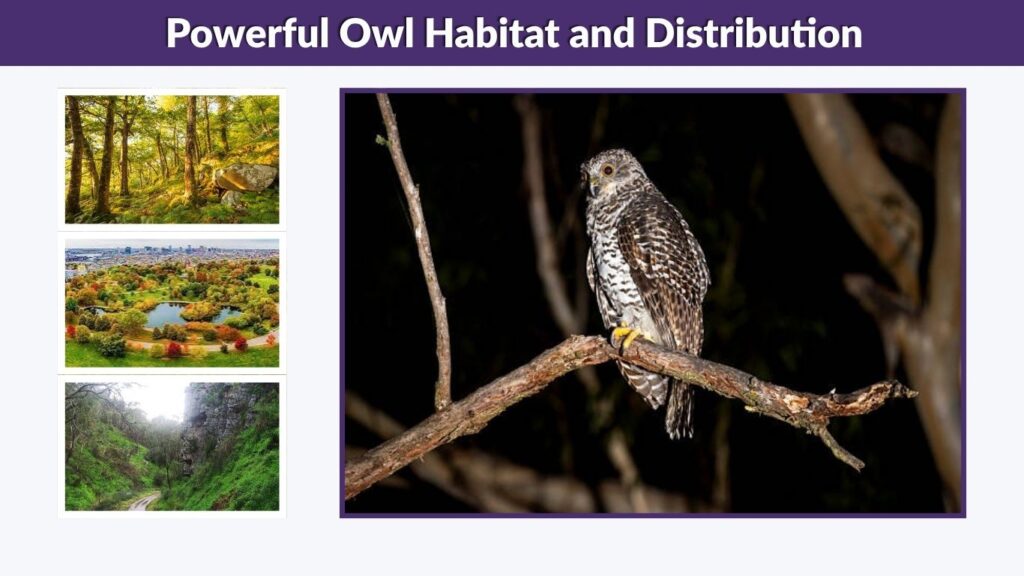
Powerful Owls inhabit eastern and southeastern Australia, particularly forests and woodlands containing mature trees. They need extensive hunting areas as well as old trees with large hollows for breeding. Although traditionally associated with forests, they are increasingly recorded in parks, suburban bushland, and other urban green spaces where prey remains abundant.
Where Do Powerful Owls Live?
Their distribution extends mainly from southeastern Queensland through New South Wales and into Victoria.
They occur in open forest, woodland, sheltered wet-forest gullies, and vegetation near watercourses. They may also use farmland edges, urban parks, suburban reserves, and remnant patches of native bushland.
Powerful Owls are largely sedentary rather than regularly migrating long distances. Old-growth trees are especially important because breeding pairs require large hollows for their nests.
Powerful Owls in Sydney and Melbourne
Powerful Owls can survive surprisingly close to major cities when enough trees and prey remain.
BirdLife Australia reports them in suburban Sydney, Melbourne, and Brisbane, particularly around remnant bushland. Greater Sydney records extend through the outer metropolitan region, with sightings occurring closer to the city in places including the Royal Botanic Garden and Centennial Park.
Urban environments can provide possums, but they also expose owls to vehicles, windows, habitat loss, and poisons.
What Does a Powerful Owl Eat?
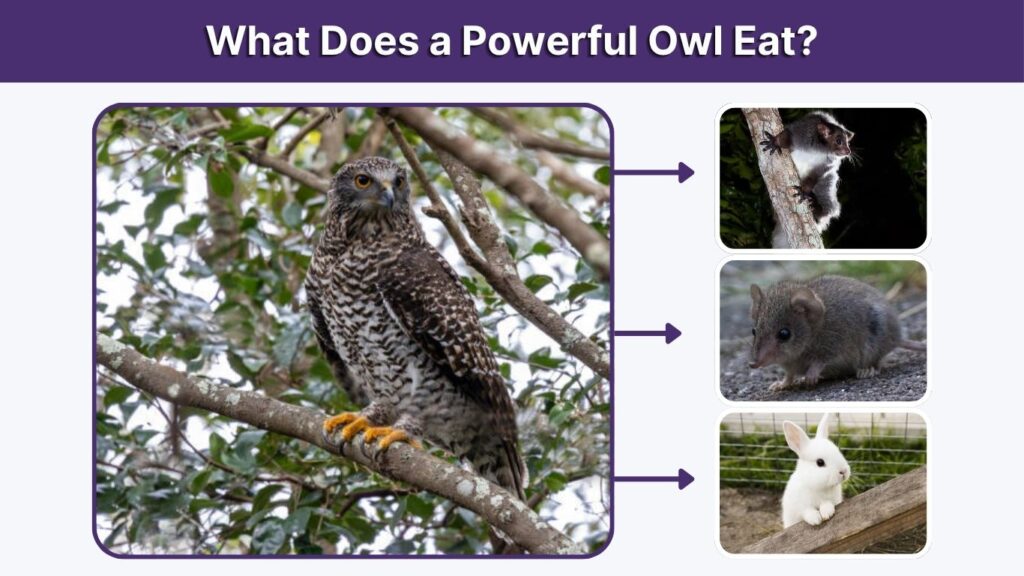
Powerful Owls are carnivorous hunters specialized in capturing medium-to-large tree-dwelling mammals. Possums and gliders form an especially important part of their diet. Rather than spending most of their time hunting on the ground, these owls usually search trees and forest canopies for prey before striking with their strong feet and talons.
Powerful Owl Diet and Prey
Recorded prey includes:
- Common Ringtail Possums
- Greater Gliders
- Sugar Gliders
- Flying foxes
- Small marsupials
- Roosting birds
- Rabbits
- Large insects and other arthropods
- Occasionally other available vertebrate prey
A study of Powerful Owls in the Australian Capital Territory found that arboreal marsupials dominated the prey recorded at the study sites, including Sugar Gliders, Greater Gliders, and possums.
How Does a Powerful Owl Hunt?
Powerful Owls are mainly nocturnal. They search for animals moving through branches and can swoop directly onto prey, grabbing it with their feet.
Their large eyes provide strong low-light vision, while quiet flight helps them approach prey without attracting much attention.
Adults are sometimes seen during daylight roosting with part of the previous night’s kill still held in their talons. Possums are particularly important prey, which helps explain why Powerful Owls can persist in some leafy suburbs with healthy possum populations.
What Are Powerful Owl Pellets?
Like many owls, Powerful Owls swallow parts of prey that cannot be fully digested. Fur, feathers, teeth, and bones are compacted inside the digestive system and later regurgitated as pellets. Scientists can carefully examine these pellets to identify prey remains, making them an important tool for studying Powerful Owl diets without needing to observe every hunting event.
What Does a Powerful Owl Pellet Look Like?
Powerful Owl pellets can contain:
- Fur
- Feathers
- Small bones
- Teeth
- Claws
- Other indigestible prey material
BirdLife Australia describes the pellets as generally gray and roughly thumb-sized.
The contents can reveal which mammals and birds an owl has recently eaten. Researchers also investigate food remains left beneath regular roosting sites, where feathers, fur, bones, or pellets may accumulate.
Pellets should not be confused with droppings. They are compact masses that are regurgitated through the mouth rather than passed through the digestive tract as waste.
Powerful Owl Call and Behavior
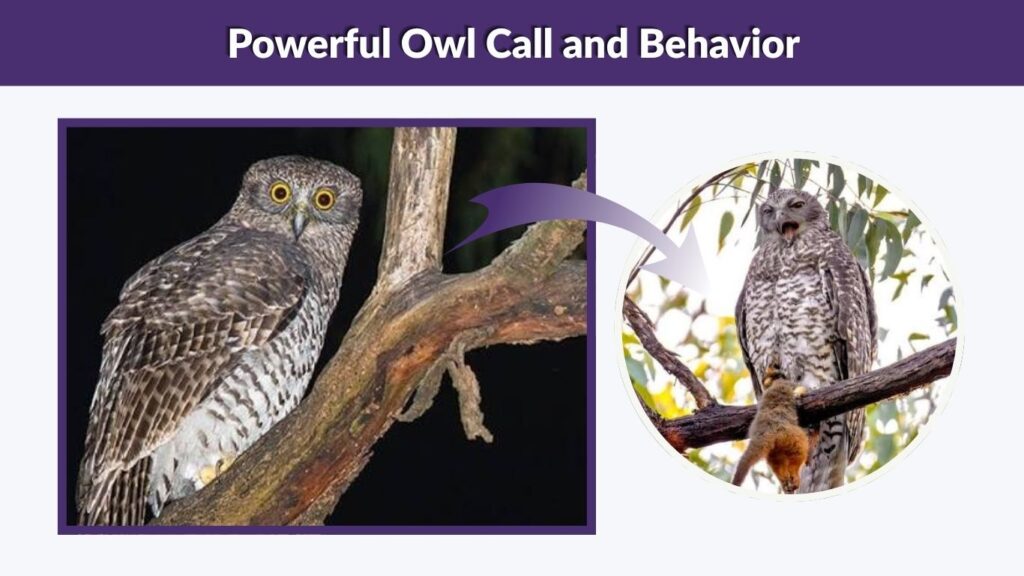
A Powerful Owl may be heard before it is seen. Pairs occupy territories throughout the year and communicate using several vocalizations. Their most characteristic call is a deep double note, particularly noticeable at night. Different calls are also produced between adults, during breeding, and by young birds communicating with their parents.
What Does a Powerful Owl Sound Like?
The classic adult call is a deep:
“woo-hoo”
The male generally has the deeper voice. Other recorded vocalizations include thin trills, piping sounds, low growling or bleating notes, and calls made by juveniles.
Pairs can use calls to communicate across their large territories.
Although Powerful Owls normally spend daylight hours quietly roosting among dense foliage, they become active after dark. They may also hunt around dusk or dawn depending on light conditions and prey activity.
Powerful Owl Nest, Chicks, and Life Cycle
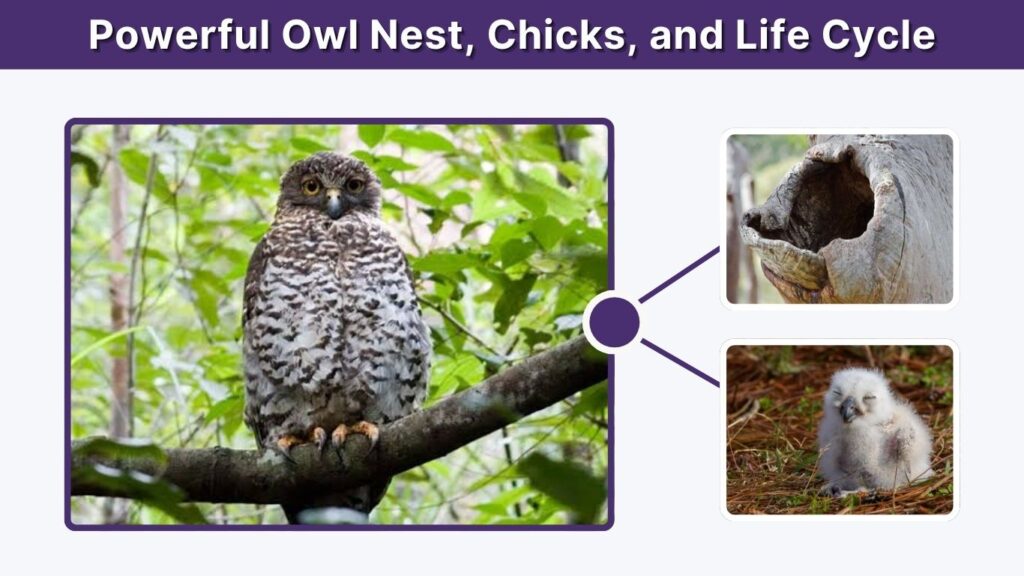
Powerful Owls form long-lasting breeding pairs and defend permanent territories. Their dependence on large nesting hollows is one of the most important aspects of their biology because suitable hollows develop only in very old trees. The male prepares the nesting site and initially supplies food, while the female incubates the eggs and broods the chicks.
Nesting and Powerful Owl Chicks
Powerful Owl breeding typically involves:
- A nest inside a large tree hollow
- Usually 1–2 eggs
- Long-term pair bonds
- The female incubating the eggs
- The male supplying much of the food early in nesting
- Young birds remaining dependent after fledging
- Juveniles staying within their parents’ territory for many months
Pairs have been known to remain together for more than 30 years. Juveniles are easily recognized by their mostly white head and underparts, which gradually change toward adult plumage.
Powerful Owl Conservation Status
The Powerful Owl has a complicated conservation picture. Globally, BirdLife lists the species as Least Concern, but several Australian states give it a threatened status. Habitat loss remains particularly important because the owls need both large hunting territories and ancient hollow-bearing trees. Urban birds also face collisions and secondary poisoning from rodenticides.
Conservation Status and Threats
Current statuses reported by BirdLife Australia include:
- Global/IUCN: Least Concern
- Queensland: Vulnerable
- New South Wales: Vulnerable
- Victoria: Vulnerable
- South Australia: Endangered
Major threats include habitat clearing, loss of hollow-bearing trees, urban development, vehicle and window collisions, and poisoning after consuming prey exposed to rodenticides.
Protecting mature trees is particularly important because nesting hollows large enough for Powerful Owls can take hundreds of years to develop.
FAQs
Powerful Owls combine impressive size with specialized hunting skills and an unusual ability to survive in some urban landscapes. Their dependence on possums, gliders, forests, and extremely old nesting trees also makes them sensitive to environmental change. The following questions cover their size, strength, prey, conservation, and the pellets commonly found beneath their roosting sites.
1. Is the Powerful Owl the biggest owl in Australia?
Yes. The Powerful Owl is regarded as Australia’s largest owl, reaching roughly 45–60 cm in length with a wingspan of up to about 140 cm.
2. What does a Powerful Owl eat?
Its diet is dominated by tree-dwelling mammals, particularly possums and gliders. Powerful Owls also take flying foxes, birds, rabbits, smaller mammals, and occasionally large insects.
3. What is inside a Powerful Owl pellet?
Pellets contain indigestible remains such as fur, feathers and bones. Scientists can identify prey species from these remains and use pellets to investigate an owl’s diet.
4. Are Powerful Owls endangered?
Their global IUCN category is Least Concern, but they are listed as Vulnerable in Queensland, New South Wales, and Victoria and Endangered in South Australia.
5. Where can Powerful Owls be found?
They occur mainly in eastern and southeastern Australia from southeastern Queensland through New South Wales to Victoria. They inhabit forests and woodlands but may also occur in suitable suburban parks and bushland around cities such as Sydney and Melbourne.