
The desert owl (Strix hadorami) is a pale, nocturnal owl adapted to rocky deserts and semi-desert landscapes of the Middle East. Formerly called Hume’s owl, it has a rounded head, yellow-orange eyes, no ear tufts, and plumage that blends naturally with cliffs and dry terrain. Desert owls spend daylight hours concealed among rocks and become active after sunset to hunt rodents, reptiles, and insects. This guide covers desert owl identification, size, habitat, range, diet, sounds, adaptations, breeding, and other owls that live in deserts.
What Is a Desert Owl?
The name “desert owl” refers specifically to Strix hadorami, a member of the typical owl family Strigidae. It is a small-to-medium-sized owl closely associated with dry, rocky landscapes. The species was formally described under its present scientific name in 2015 after taxonomic research separated it from the Omani Owl, Strix butleri.
Desert Owl Identification
Important characteristics include:
- Scientific name: Strix hadorami
- Family: Strigidae
- Length: approximately 29–33 cm
- Rounded head
- No prominent ear tufts
- Pale gray-buff overall coloration
- Yellow to orange-yellow eyes
- Light facial disc
- Darker bars and mottling across the plumage
- Strong feet equipped with curved talons
- Mostly nocturnal behavior
The pale plumage is particularly useful in rocky desert environments because it closely matches limestone, sandstone, and dry earth. This camouflage helps resting birds remain difficult to detect during daylight.
How Big Is a Desert Owl?
The Desert Owl is considerably smaller than many large eagle-owls. Sources generally place its body length around 29–35 cm. One regional species account reports a wingspan of approximately 95–98 cm and a weight range of about 140–284 grams.
Its rounded body can make it appear larger while perched, especially when the feathers are fluffed. As with many owls, exact measurements vary among individuals.
Desert Owl Habitat and Range
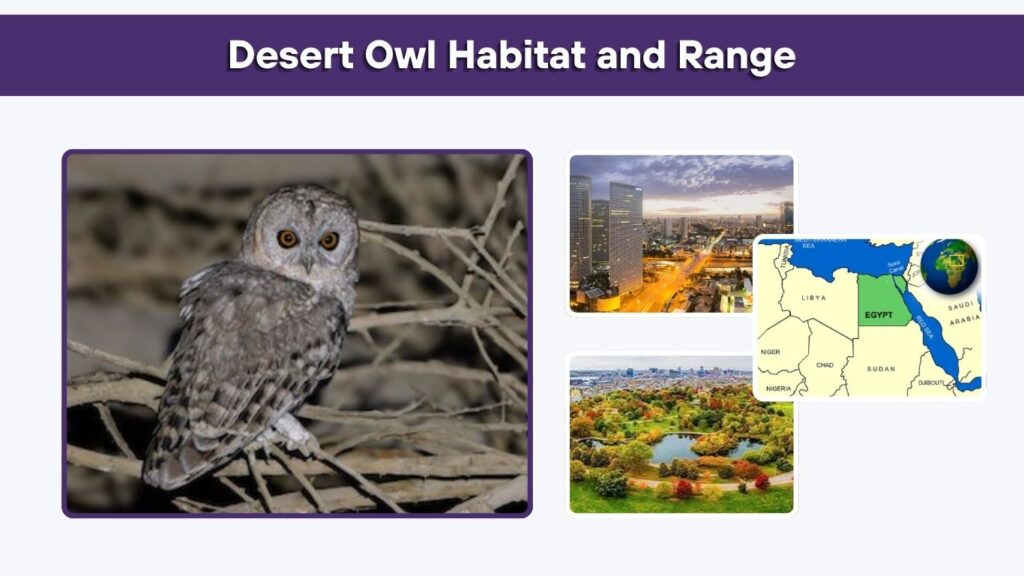
Desert Owls are adapted to arid environments, but they do not usually live in featureless open sand dunes. Instead, they favor landscapes containing rocky cliffs, ravines, wadis, crevices, and scattered vegetation. These features provide sheltered daytime roosts, nesting cavities, and hunting perches overlooking places where rodents and other prey are active.
Where Do Desert Owls Live?
Their range includes parts of:
- Israel
- Jordan
- Northeastern Egypt
- Syria
- Saudi Arabia
- Yemen
- Oman
- Other parts of the Arabian Peninsula
The species occurs patchily around both sides of the Red Sea and across suitable areas of the Arabian Peninsula.
Typical habitat includes desert, semi-desert, rocky gorges, cliffs, dry valleys, and sometimes palm groves or vegetation near springs and settlements.
Why Rocky Deserts Are Important
Rocky terrain provides something open sand cannot easily offer: secure cavities.
Desert Owls spend the day resting in crevices and can use holes or ledges in cliffs for nesting. Rock walls also provide elevated hunting positions from which an owl can watch the ground below.
Because many desert rodents, geckos, insects, and other small animals concentrate around rocky valleys and vegetation, these habitats can provide more dependable food than completely barren desert.
What Does a Desert Owl Eat?
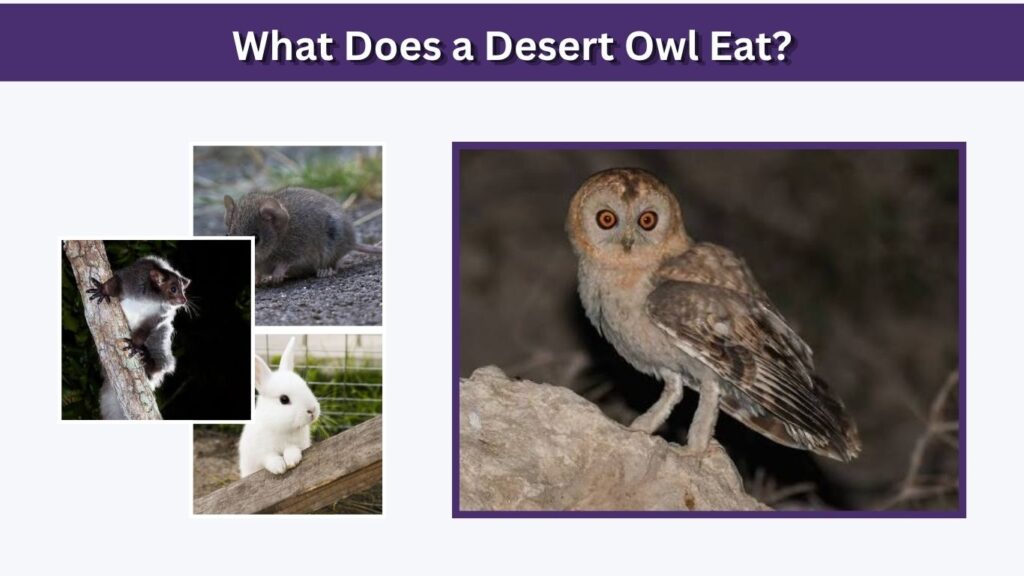
Desert Owls are nocturnal predators whose diet reflects the animals available in dry environments. Rodents are especially important, although these owls also take reptiles and large arthropods. Hunting after dark allows them to encounter prey that also avoids extreme daytime desert temperatures.
Desert Owl Diet
Known or reported prey includes:
- Mice
- Voles
- Gerbils
- Spiny mice
- Shrews
- Small lizards
- Geckos
- Small birds
- Grasshoppers
- Beetles
- Scorpions
- Other large arthropods
Rodents make up an important component of the diet, but the exact proportions vary according to local prey availability.
How Does a Desert Owl Hunt?
The Desert Owl commonly uses a perch-and-pounce strategy. It sits quietly on a rock, branch, or elevated ledge while listening and watching for movement.
Once prey is detected, the owl drops or flies toward it and captures it with its talons. Observations from Israel have even documented Desert Owls pursuing geckos on vertical cliff faces.
Large insects may also be caught in flight. These flexible hunting methods are useful in desert habitats where prey can be scattered and unpredictable.
Desert Owl Adaptations
Surviving in an arid landscape requires dealing with heat, limited water, sparse cover, and prey that is often active after sunset. Desert Owls possess a combination of physical and behavioral characteristics that allow them to function effectively in this demanding environment.
Important Desert Adaptations
Key adaptations include:
- Nocturnal activity: reduces exposure to extreme daytime temperatures.
- Pale plumage: provides camouflage against desert rocks.
- Large eyes: improve vision under low-light conditions.
- Sensitive hearing: helps locate hidden prey after dark.
- Quiet flight: allows close approach to prey.
- Strong talons: securely capture rodents and reptiles.
- Rock-crevice nesting: provides protection from heat and predators.
- Flexible diet: allows the owl to exploit several types of desert prey.
The species is described as nocturnal and strongly associated with rocky open habitats, characteristics that fit its specialized desert lifestyle.
How Do Desert Owls Handle Heat?
One of their most important behavioral adaptations is simply avoiding the hottest part of the day.
Desert Owls remain sheltered during daylight and become active after sunset, when air and ground temperatures fall. Rocky cavities can also provide shade and a more stable microclimate than fully exposed ground.
Their prey follows a similar schedule. Many desert rodents, insects, geckos, and other small animals emerge during evening and nighttime hours, giving the owl access to food while avoiding intense daytime heat.
Desert Owl Sounds and Calls
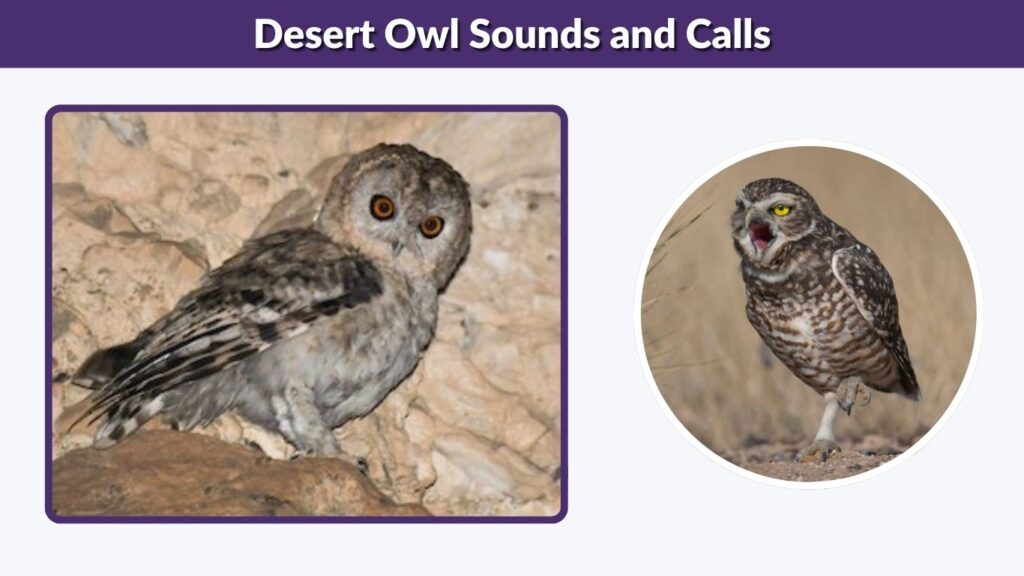
Desert Owls communicate most actively at night. Calls help paired birds remain in contact, advertise territories, and communicate around nests. Because they are difficult to spot against rocky cliffs after dark, listening for vocalizations is often one of the best ways birdwatchers detect their presence.
What Does a Desert Owl Sound Like?
Breeding observations in Israel describe several different vocalizations. A male approaching with food has been recorded giving a sequence of about five hooting notes, while females use other calls during food exchanges with their mates.
Like other Strix owls, their sounds carry effectively through quiet nighttime landscapes.
Calls can be particularly noticeable around rocky valleys, where cliff walls may help sound travel. However, hearing an owl in desert habitat is not enough by itself for identification because eagle-owls, barn owls, and other species may occur in the same general region.
Desert Owl Nesting and Life Cycle
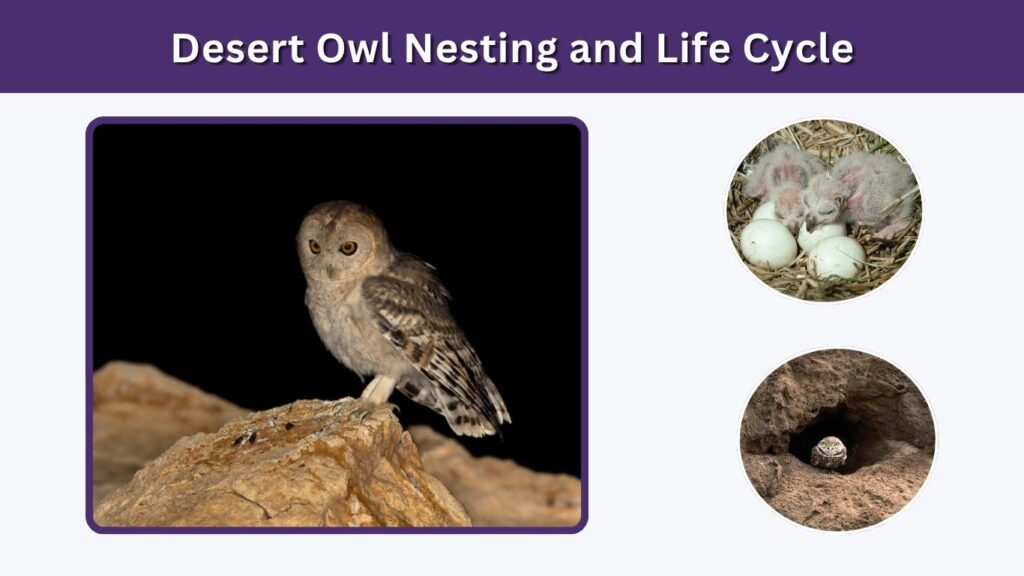
Desert Owls rely heavily on natural rock formations for breeding. Instead of constructing a traditional stick nest, they typically use existing holes and crevices in cliffs. These protected sites shelter eggs and chicks from direct sunlight, weather, and some predators. Breeding timing varies geographically and is influenced by local climate and food availability.
Nest and Young Owls
The breeding cycle generally involves courtship, egg laying, incubation, chick development, and fledging.
Studies in Israel have documented males supplying much of the food during early chick development. The male frequently brings prey to the female, which then transfers food to the young.
As chicks become older, they begin feeding more independently. Observations have documented fledglings about 35 days old taking food themselves.
Young birds remain dependent on their parents for some time after leaving the immediate nest area while they improve their flight and hunting skills.
What Other Owl Species Live in Deserts?
“Desert owl” can also be used informally when discussing any owl living in arid environments. Several unrelated species inhabit deserts around the world. They have developed different strategies for dealing with heat, scarce water, and limited nesting sites.
Other Desert-Dwelling Owls
Examples include:
- Elf Owl: A tiny owl found in parts of the southwestern United States and Mexico.
- Burrowing Owl: Lives in underground burrows in open, dry landscapes of the Americas.
- Great Horned Owl: Occurs in many habitats, including North American deserts.
- Barn Owl: Can hunt over desert farmland and open dry landscapes.
- Pharaoh Eagle-Owl: A large owl of deserts and rocky areas in North Africa and the Middle East.
- Omani Owl: A distinct Strix species associated with rocky mountains in northeastern Oman.
The Omani Owl is particularly important because it was historically confused with the Desert Owl. Modern taxonomy recognizes Strix hadorami and Strix butleri as separate species.
FAQs
Desert Owls are specially adapted to rocky arid environments, but the common name can cause confusion with several other owls that also inhabit deserts. Understanding the scientific name, geographic range, size, habitat, and behavior makes it easier to distinguish the true Desert Owl from unrelated desert-dwelling species.
1. What is the scientific name of the Desert Owl?
The scientific name is Strix hadorami. It is a member of the typical owl family Strigidae and was formerly confused taxonomically with the Omani Owl.
2. How big is a Desert Owl?
A Desert Owl is roughly 29–35 cm long. Regional data report a wingspan around 95–98 cm and weight of approximately 140–284 grams.
3. What do Desert Owls eat?
They primarily hunt small mammals such as mice, voles, gerbils, and spiny mice. They also eat geckos, other small reptiles, birds, grasshoppers, beetles, scorpions, and other large arthropods.
4. Where does the Desert Owl live?
The species occurs from parts of Syria, Israel, Jordan, and northeastern Egypt southward through suitable areas around the Red Sea and Arabian Peninsula. It prefers rocky desert, semi-desert, ravines, cliffs, and some palm groves.
5. Is the Desert Owl endangered?
The Desert Owl is currently listed as Least Concern in the conservation information cited by The Owl Pages from BirdLife/IUCN. Its specialized rocky habitat remains important for nesting and long-term survival.