
The Mottled Owl (Strix virgata) is a medium-sized nocturnal owl native to Central and South America. Recognizable by its dark eyes, rounded head, brown mottled plumage, and vertically streaked underparts, it inhabits everything from tropical rainforest to dry woodland and plantations. This adaptable predator feeds on insects, rodents, birds, reptiles, amphibians, and occasionally bats. Its haunting calls are often the easiest way to detect it after dark. This guide covers Mottled Owl size, habitat, diet, sound, breeding, juveniles, lifespan, and identification.
What Does a Mottled Owl Look Like?
Mottled Owls are compact members of the typical owl family, Strigidae. Their camouflage combines brown, gray, buff, and whitish markings that blend effectively with tree trunks and dense vegetation. They have rounded heads without ear tufts and large dark-brown eyes. Females tend to be larger and heavier than males, a pronounced example of reversed size dimorphism in owls.
Mottled Owl Identification
Typical identification features include:
- Scientific name: Strix virgata
- Former name often seen: Ciccaba virgata
- Length: Approximately 28–38 cm
- Weight: Roughly 175–320 g in commonly cited measurements
- Wingspan: Around 84–91 cm in some published references
- Eyes: Dark brown
- Head: Rounded with no ear tufts
- Upperparts: Dark brown with lighter mottling
- Underparts: Pale with prominent vertical brown streaks
- Bill: Grayish-yellow to bluish-gray
Measurements vary among subspecies, sexes, and sources.
Mottled Owl Feathers and Color Morphs
The normal plumage provides excellent camouflage during daytime roosting. The facial disc is usually brownish with noticeable pale markings around the eyes and bill, while the breast and belly show strong streaking.
A darker color morph also occurs. These birds may appear considerably deeper brown or rusty-buff underneath, which can make field identification challenging when light conditions are poor.
Where Does the Mottled Owl Live?
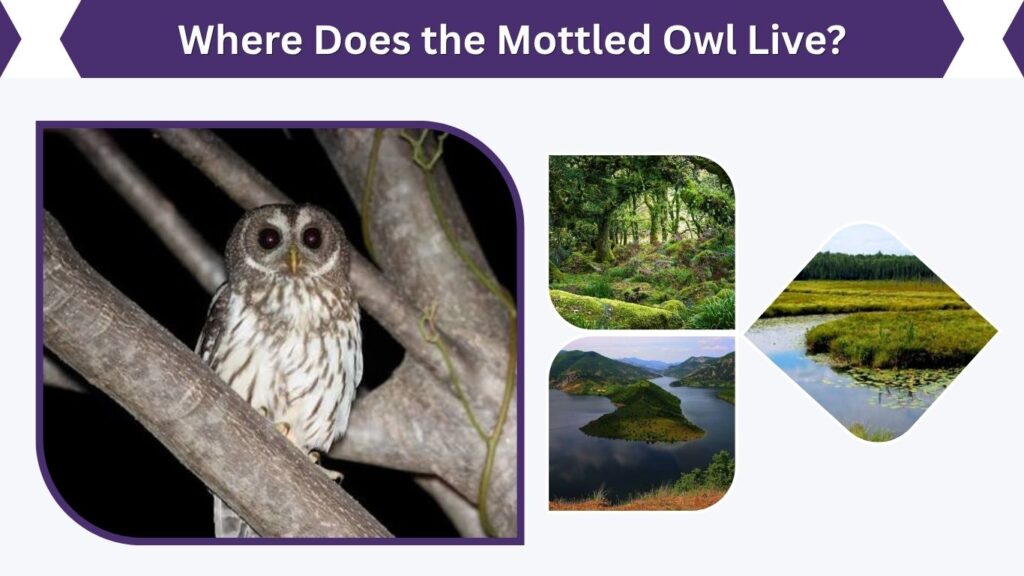
The Mottled Owl has an extensive Neotropical distribution stretching from Mexico through Central America and into much of South America, including Brazil and Argentina. It occupies habitats from sea level to roughly 2,500 meters. Its ability to tolerate both forest and modified landscapes helps explain why it can occur surprisingly close to towns and agricultural areas.
Mottled Owl Habitat and Distribution
Habitats used by Mottled Owls include:
- Tropical rainforest
- Humid evergreen forest
- Dry thorn forest
- Pine-oak woodland
- Forest edges
- Secondary woodland
- Plantations
- Open areas with scattered trees
- Landscapes near towns and villages
During the daytime, these nocturnal owls typically remain concealed within dense vegetation before emerging after sunset to hunt.
Mottled Owls in Costa Rica
The Mottled Owl is a resident species in Costa Rica and is part of the country’s native owl community. Suitable wooded habitats provide roosting sites and abundant prey, while its nocturnal behavior means visitors are much more likely to locate one by sound than by sight during daylight.
What Do Mottled Owls Eat?
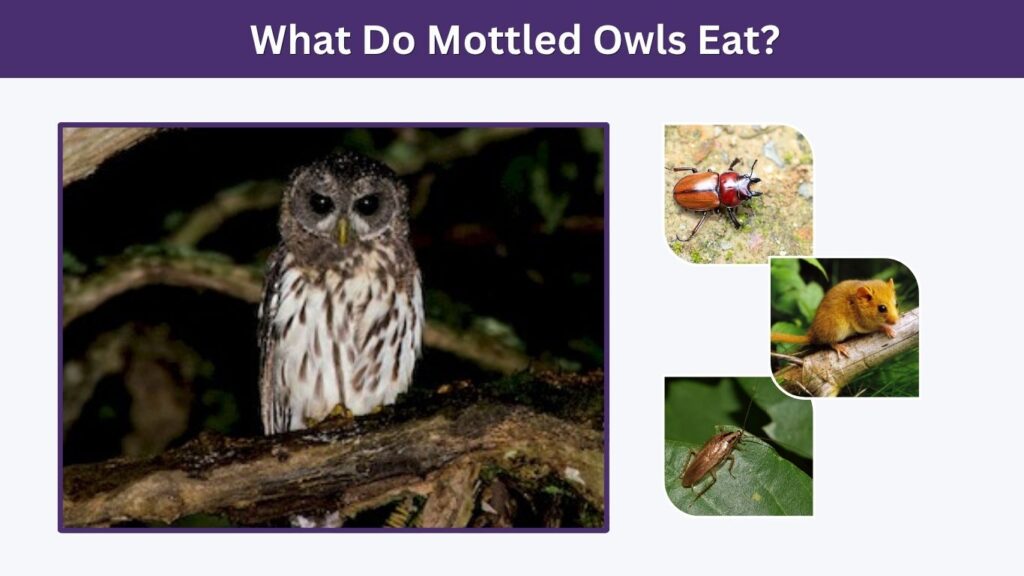
Mottled Owls are adaptable predators rather than specialists on a single prey type. They usually hunt at night from a perch, watching and listening for movement before dropping onto prey. Their varied diet allows them to occupy forests, agricultural landscapes, woodland edges, and other habitats where the availability of individual prey species changes.
Mottled Owl Diet
Recorded prey includes:
- Beetles and other large insects
- Grasshoppers
- Cockroaches
- Mice and other small mammals
- Small birds
- Frogs and other amphibians
- Lizards and snakes
- Other small reptiles
- Bats
Large insects can form an important part of the diet, while vertebrate prey becomes especially valuable when available.
How Does a Mottled Owl Hunt?
A Mottled Owl commonly waits quietly on a branch at the edge of a clearing or within woodland. Its sensitive hearing and low-light vision help it locate prey moving below.
Once prey is detected, the owl flies down and captures it with its talons. Its soft flight feathers help reduce noise during an attack, an important advantage when hunting small mammals, birds, or other alert animals at night.
What Does a Mottled Owl Sound Like?
The Mottled Owl is highly vocal, and its voice is often the most reliable clue to its presence. It uses vocalizations for territorial communication and interaction with other owls. The repertoire is broader than a single classic owl hoot and includes hooting sequences as well as whistles, screeches, and hiss-like sounds.
Mottled Owl Call and Song
Territorial calls typically consist of low, repeated hooting notes. Other vocalizations can sound sharper or more whistle-like, and agitated individuals may give screeches or hisses.
Calls are particularly useful for birders because the species is difficult to see while roosting. Xeno-canto maintains numerous field recordings of Strix virgata, demonstrating considerable variation among calls and locations.
When Are Mottled Owls Most Vocal?
Mottled Owls are strictly nocturnal, so vocal activity is mainly heard from evening through nighttime. They remain relatively inconspicuous during the day, usually roosting in dense vegetation.
Calling often becomes particularly important when individuals are establishing territories or communicating during the breeding period.
Mottled Owl Nest, Eggs, and Juveniles
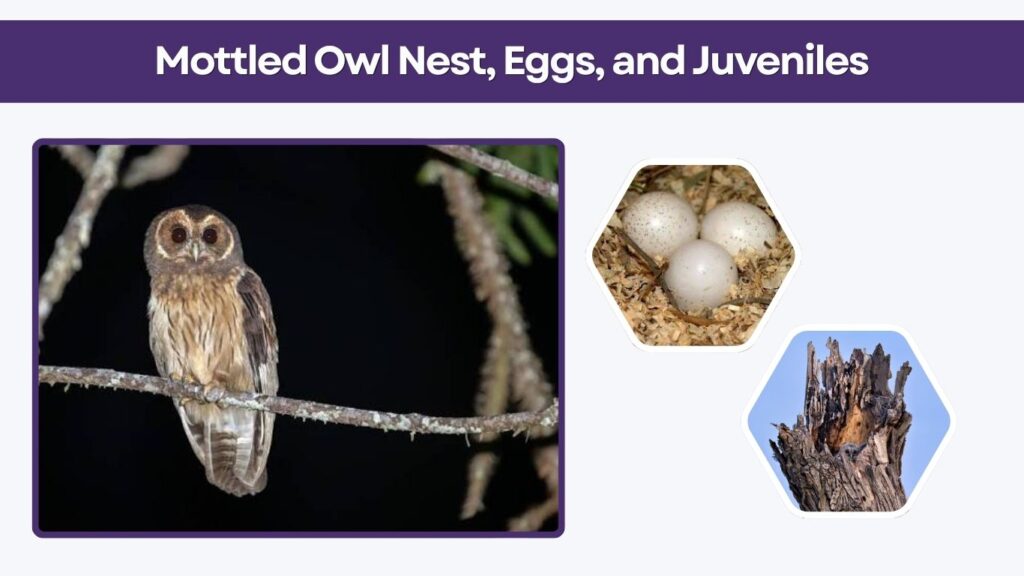
Mottled Owls reproduce in natural cavities and other protected nesting sites. Breeding timing changes geographically because this species occupies such a broad range. Records indicate breeding from roughly February to May in Colombia and from September into November in parts of Argentina, showing how local seasonal conditions influence reproduction.
Nesting and Young Owls
Important breeding characteristics include:
- Natural tree cavities are common nest sites.
- Abandoned bird nests may occasionally be used.
- The clutch usually contains one or two white eggs.
- The female performs most or all incubation.
- Both parents participate in caring for young.
- Juveniles have softer, less adult-like plumage.
- Young birds gradually develop the strongly streaked adult appearance.
A review of Brazilian owl biology gives an incubation period of around 28 days for the species.
What Does a Juvenile Mottled Owl Look Like?
Young Mottled Owls tend to look paler and fluffier than adults. Their coloration changes as juvenile feathers are replaced, and the characteristic dark eyes, rounded facial shape, and mottled brown adult plumage become increasingly apparent.
Juveniles remain dependent on their parents after leaving the nest while they develop hunting skills.
Mottled Owl vs. Mottled Wood Owl
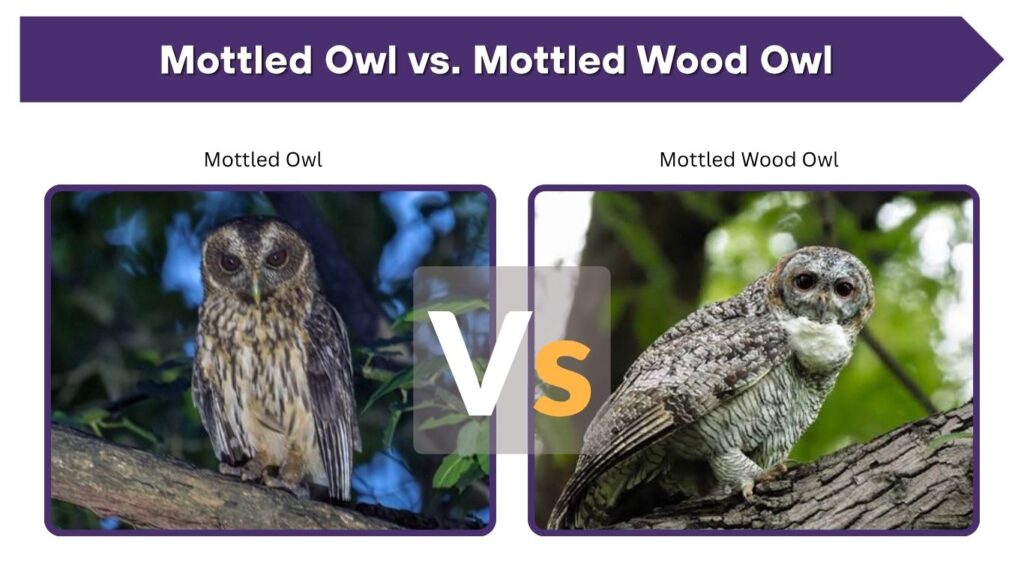
The similar names frequently cause confusion, but the Mottled Owl and Mottled Wood Owl are different species on different continents. The Mottled Owl is Strix virgata of the Americas, whereas the Mottled Wood Owl is Strix ocellata, a substantially larger South Asian owl associated particularly with India.
Key Differences
- Mottled Owl: Strix virgata
- Mottled Wood Owl: Strix ocellata
- Mottled Owl occurs from Mexico through Central and South America.
- Mottled Wood Owl occurs primarily on the Indian subcontinent.
- Mottled Owl measures roughly 28–38 cm.
- Mottled Wood Owl measures roughly 40–50 cm.
- Both species lack prominent ear tufts.
- Mottled Wood Owl has a strongly patterned facial disc with concentric markings.
- Mottled Wood Owl is famous for a loud, quavering duet call.
The Indian species also feeds on rodents, shrews, birds, reptiles, and large insects.
Mottled Owl Lifespan and Conservation
The Mottled Owl remains widespread and is currently treated as a species of Least Concern. Species-specific longevity information is less certain than basic measurements and distribution. An older Animal Diversity Web account specifically notes that reliable lifespan information was unavailable, while some newer secondary bird databases report lifespans extending into the teens. These figures should therefore be treated cautiously.
Conservation Status
The Mottled Owl’s large range and ability to occupy several types of wooded habitat help support its overall conservation status. Nevertheless, local populations may still be affected by forest clearing and degradation.
Its ecological role is important because it consumes rodents, insects, and other small animals, making it an active nocturnal predator within tropical food webs.
FAQs
These quick answers cover several commonly searched questions about Mottled Owl taxonomy, distribution, wingspan, lifespan, and related owl species.
1. What is the scientific name of the Mottled Owl?
The accepted name used by many modern bird authorities is Strix virgata. Older references frequently use Ciccaba virgata, which explains why both names appear in books and online databases.
2. What is the Mottled Owl’s wingspan?
Several secondary references place the wingspan around 84–91 cm, although exact measurements vary with sex, subspecies, and methodology. Females are generally larger than males.
3. How long does a Mottled Owl live?
Reliable wild lifespan data are limited. Some newer secondary sources report maximum ages into the teens, but older species accounts note that lifespan was not well documented, so precise numbers should not be treated as firmly established.
4. Is the Mottled Owl found in Texas?
The normal range lies farther south, but exceptional records have occurred in Texas, including historical and more recent observations. These are unusual occurrences rather than evidence of a widespread resident Texas population.
5. Is a Mottled Owl the same as a Mottled Wood Owl?
No. The Mottled Owl is Strix virgata from the Americas, while the Mottled Wood Owl is Strix ocellata from the Indian subcontinent. The latter is considerably larger and has a distinctive concentrically patterned facial disc.