
The Buffy Fish Owl (Ketupa ketupu) is a striking Southeast Asian owl known for its bright yellow eyes, long ear tufts, buff-brown plumage, and strong association with rivers and wetlands. Unlike many woodland owls, it specializes in catching fish, frogs, crabs, and other animals around water. Adults are roughly 40–48 cm long and often perch quietly over streams before hunting. This guide covers its identification, habitat, diet, sound, nesting behavior, juveniles, range, conservation, and differences from the Brown Fish Owl.
What Is a Buffy Fish Owl?
The Buffy Fish Owl is a medium-to-large member of the owl family Strigidae and one of Southeast Asia’s characteristic wetland predators. It is sometimes called the Malay Fish Owl. Its appearance is adapted to waterside hunting, with powerful feet, bare lower legs, and rough gripping surfaces that help it handle slippery aquatic prey.
Identification and Size
Important identification features include:
- Scientific name: Ketupa ketupu
- Length: About 40–48 cm
- Weight: Roughly 1.0–2.1 kg
- Eyes: Bright yellow
- Plumage: Buffy to tawny brown
- Underparts: Dark vertical streaking
- Ear tufts: Long and prominent
- Legs: Long and largely unfeathered
- Bill: Strong and hooked
- Sexes: Generally similar in appearance
It is considered the smallest of the commonly recognized fish owls.
Appearance and Special Adaptations
The owl’s warm brown feathers help it blend into tree trunks and dense riverside vegetation. Its ear tufts are feathers rather than true ears and help alter its outline while roosting.
Unlike many owls, Buffy Fish Owls lack some of the specialized feather fringes responsible for nearly silent flight. Their wingbeats can therefore be audible. This is less disadvantageous for a predator hunting over noisy streams and wetlands than for an owl stalking highly sound-sensitive mammals in quiet woodland.
Buffy Fish Owl Habitat and Range
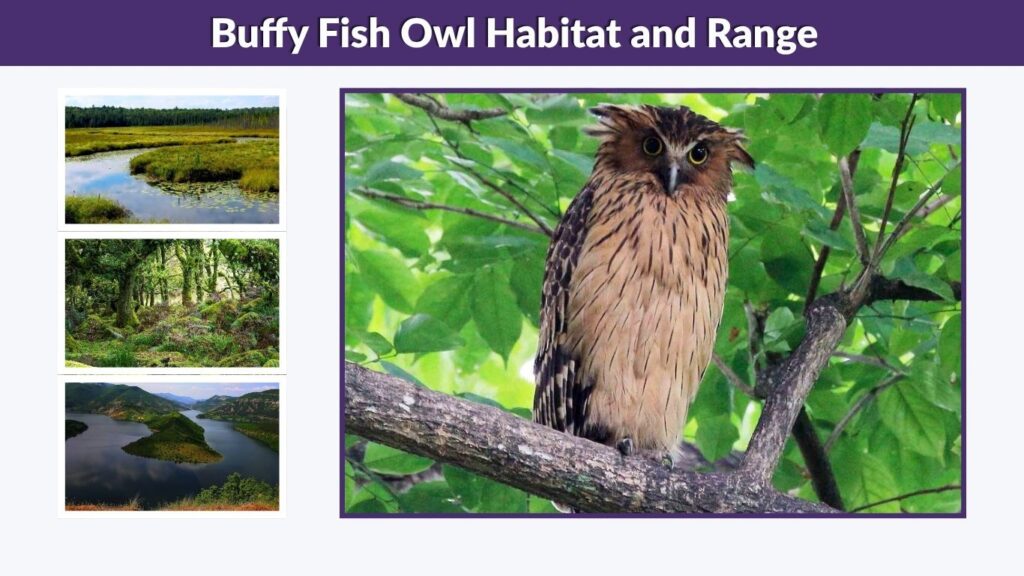
Buffy Fish Owls are strongly associated with water. They favor tropical forests containing rivers and streams but can also adapt to mangroves, reservoirs, ponds, plantations, wooded parks, and even gardens where suitable trees and aquatic prey are available. During daylight they usually remain concealed in dense foliage before becoming active around dusk and at night.
Where Does the Buffy Fish Owl Live?
Its range covers much of Southeast Asia, including parts of Bangladesh, Myanmar, Thailand, Malaysia, Singapore, Cambodia, Laos, Vietnam, Sumatra, Java, Borneo, Bali, and nearby islands. It has been recorded from lowlands up to approximately 1,600 meters in suitable habitats.
Typical habitats include tropical forests, freshwater wetlands, mangroves, riversides, lakes, reservoirs, aquaculture areas, plantations, and well-wooded urban environments.
Buffy Fish Owl in Singapore and Indonesia
In Singapore, Buffy Fish Owls are resident birds closely associated with forested streams, mangroves, and reservoir edges. NParks describes them as one of Singapore’s more familiar owl species and records them in green spaces and nature areas, including Sungei Buloh Wetland Reserve.
Indonesia is also an important part of their range, especially Sumatra, Java, Bali, and parts of Borneo. Nesting biology has been particularly well documented in western Java.
Buffy Fish Owl Diet and Hunting Behavior
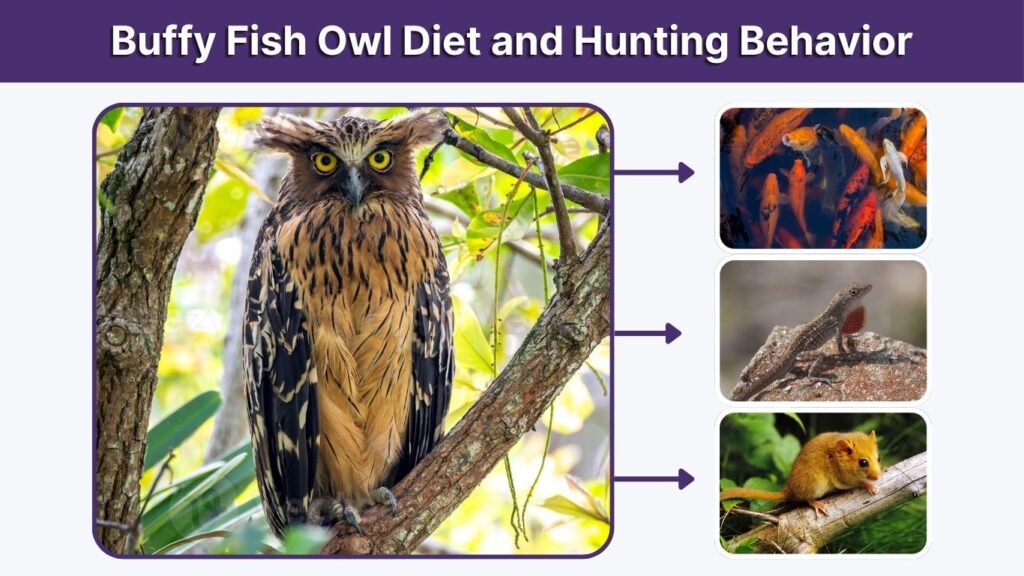
As its name suggests, aquatic prey forms an important part of the Buffy Fish Owl’s diet. The species typically hunts from low branches overlooking water, watching for movement before dropping toward the surface. It can also walk into shallow streams while searching for prey, making its feeding behavior noticeably different from that of many forest-dwelling owls.
What Does a Buffy Fish Owl Eat?
Its recorded diet includes:
- Fish
- Frogs
- Crabs
- Small reptiles
- Rodents
- Small birds
- Insects
- Winged ants and termites
- Bats
- Occasional carrion
Studies and observations show that the species is more opportunistic than its “fish owl” name might suggest.
How Does the Buffy Fish Owl Hunt?
A Buffy Fish Owl often waits quietly on a branch above a riverbank, pond, or muddy shore. When it detects prey, it swoops downward and grabs it using powerful talons.
Its feet have rough, spiky surfaces suited to gripping slippery fish. Rather than plunging deeply into water like some fishing birds, it generally grabs prey near the surface or wades into shallows.
Buffy Fish Owl Sound, Nest, and Breeding
Buffy Fish Owls are primarily nocturnal, so their calls may reveal their presence before the bird itself becomes visible. Vocal activity becomes particularly noticeable around the breeding period. Their reproduction is unusual among owls because females typically lay only a single egg, making every successful breeding attempt especially important to the population.
What Does a Buffy Fish Owl Sound Like?
Recorded vocalizations include hisses, rattling calls, loud repeated notes resembling “pof-pof-pof,” and higher-pitched sequences. Pairs may perform prolonged duets before breeding.
The call can therefore range from rough, low notes to surprisingly sharp sounds, rather than the classic deep “hoot” many people associate with owls.
Nest, Eggs, and Juvenile Buffy Fish Owls
Buffy Fish Owls frequently nest in large Bird’s Nest Ferns, but they also use tree cavities, moss-covered branch forks, orchid beds, rocky locations, and occasionally abandoned nests built by other birds.
The female normally lays one white egg. Incubation lasts approximately 28–29 days, and the youngster fledges at about six weeks. A young owl that has left the nest but still depends heavily on its parents may be described as a brancher or juvenile.
Brown Fish Owl vs. Buffy Fish Owl
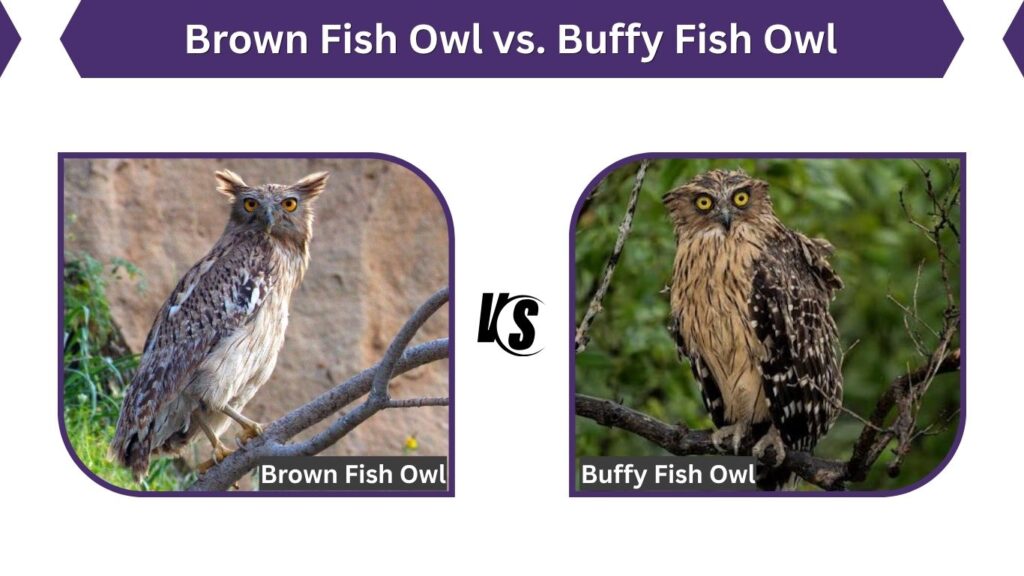
The Brown Fish Owl and Buffy Fish Owl are closely related and share several characteristics, including yellow eyes, ear tufts, powerful feet, and a preference for hunting around water. However, careful attention to size, plumage, range, and body proportions can usually separate them.
Key Differences
- Buffy Fish Owl: About 40–48 cm long
- Brown Fish Owl: About 48–61 cm long
- Buffy Fish Owl is generally smaller
- Buffy usually appears warmer and more buff-colored
- Brown Fish Owl often looks darker and heavier
- Brown Fish Owl has more extensive western and northern distribution
- Both hunt fish, frogs, and other waterside prey
The Brown Fish Owl may reach around 2.5 kg and has a wingspan of approximately 125–140 cm, making it noticeably larger in many encounters.
Conservation and Buffy Fish Owl Facts
Globally, the Buffy Fish Owl has a relatively broad range, but local populations can face different levels of pressure. Habitat alteration, disturbance, and illegal wildlife trade remain concerns in parts of Southeast Asia. Conservation status can therefore differ between the species’ global assessment and national or regional assessments.
Conservation Status
The species is globally assessed as Least Concern, reflecting its broad distribution. However, Singapore lists it as nationally threatened, and older national assessments classified it as Critically Endangered there. NParks also notes that Singapore’s population has increased in recent years.
Illegal trapping and wildlife trade have also been documented within its range.
Interesting Buffy Fish Owl Facts
- It is one of the smallest fish owls.
- Its flight is not completely silent.
- Its feet are adapted for gripping slippery prey.
- It may hunt from low branches overlooking water.
- It sometimes walks into shallow streams.
- Females typically lay only one egg.
- It can live surprisingly close to urban parks and reservoirs.
- Its ear tufts are feathers, not actual ears.
FAQs
These quick answers address common searches about Buffy Fish Owl size, lifespan, habitat, young birds, and distribution. Some biological details, especially maximum lifespan in the wild, are not well documented, so estimates should not be presented as exact where reliable species-specific data are lacking.
1. How big is a Buffy Fish Owl?
Adults are generally about 40–48 cm long and weigh approximately 1.0–2.1 kg.
2. What is the Buffy Fish Owl’s lifespan?
A precise, well-established maximum lifespan for wild Buffy Fish Owls is not widely documented. Like other medium-to-large owls, individuals may potentially survive for many years when food and habitat conditions are favorable, but exact species-specific figures should be treated cautiously.
3. Where can you see Buffy Fish Owls in Singapore?
They occur around wooded habitats close to water, including nature reserves, mangroves, reservoir edges, and several green spaces. Records include Sungei Buloh Wetland Reserve and other protected areas.
4. What does a baby Buffy Fish Owl look like?
Juveniles are generally softer and fluffier than adults, with less crisp plumage markings. As they grow, the characteristic ear tufts, streaked buff underparts, and yellow-eyed adult appearance become increasingly obvious.
5. Is the Buffy Fish Owl found in India?
Its main distribution lies farther east in Southeast Asia. Some taxonomic treatments place the northwestern range around northeastern India/Bangladesh into Myanmar, but the species is much more characteristic of Southeast Asia than most of the Indian subcontinent.