
The Mexican spotted owl (Strix occidentalis lucida) is a large, dark-eyed owl of the forests and rocky canyonlands of the southwestern United States and Mexico. Known for its brown-and-white spotted plumage, rounded head, and quiet nocturnal habits, it is one of three recognized subspecies of the spotted owl. Although its geographic range is broad, populations occur in scattered mountain ranges and canyon systems rather than continuously. The Mexican spotted owl is federally listed as threatened in the United States, with habitat loss and increasingly severe wildfires among its major conservation concerns.
What Is a Mexican Spotted Owl?
The Mexican spotted owl is a subspecies of the spotted owl, Strix occidentalis. Its scientific name is Strix occidentalis lucida.
The other two commonly recognized subspecies are the northern spotted owl and California spotted owl. The Mexican form is geographically and genetically separated from the northern and California populations.
Despite its name, this owl is not limited to Mexico. A significant portion of its range occurs in the American Southwest.
What Does a Mexican Spotted Owl Look Like?
Mexican spotted owls have a distinctive combination of mottled plumage and very dark eyes. Their feathers are primarily brown with irregular white spots across the head, back, wings, breast, and abdomen.
Identification Features
- Rounded head without ear tufts
- Large, dark brown to nearly black eyes
- Brown-and-white mottled plumage
- Large white spots across the body
- Rounded facial disk
- Brown tail crossed by lighter bands
- Strong feet with curved talons
- Broad, rounded wings
Among the three spotted owl subspecies, the Mexican spotted owl tends to be the palest, with particularly large white spots.
Mexican Spotted Owl Size
This is one of the larger owls found in North America.
Adults generally measure approximately 16–19 inches (41–48 cm) long, with a wingspan of around 42–45 inches (107–114 cm). Typical weight is about 19.5–23 ounces (547–647 g). Females average roughly 100 grams heavier than males.
Even though females tend to be larger, males and females have very similar plumage.
Mexican Spotted Owl Range
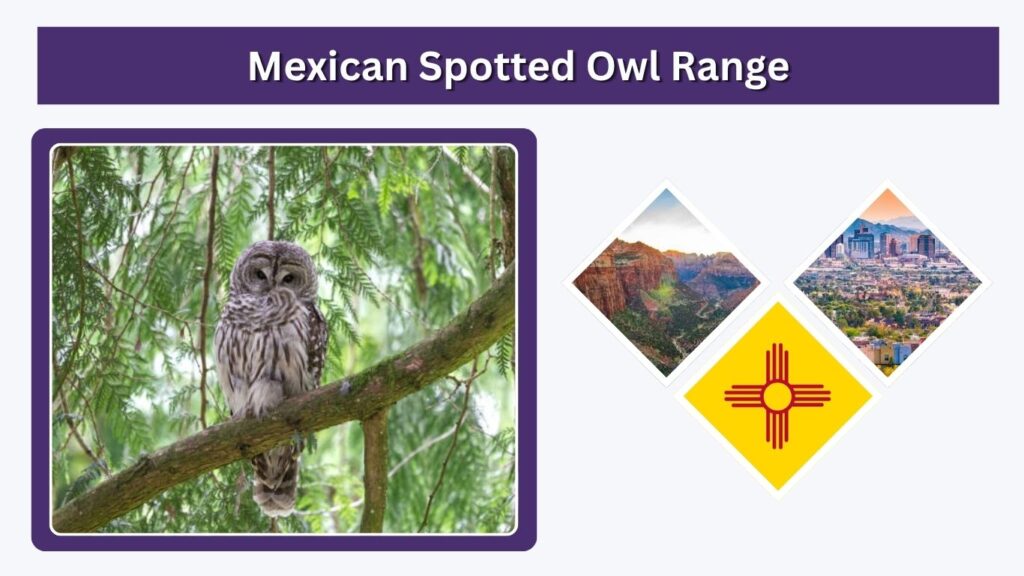
The Mexican spotted owl occupies a wide but fragmented geographic range.
In the United States, it occurs in:
- Arizona
- New Mexico
- Utah
- Colorado
- Western Texas
Its range continues south through mountain systems in Mexico.
Rather than occupying every suitable-looking area between these locations, populations tend to occur in isolated forests, mountains, and canyon systems. Some individuals also move to lower elevations during winter.
Mexican Spotted Owls in Utah and Colorado
In parts of southern Utah and Colorado, rocky canyon habitat can be particularly important. Owls may roost and nest on cliff ledges or in caves within steep-walled canyons instead of relying entirely on large forest trees.
Arizona and New Mexico also contain extensive areas of important Mexican spotted owl habitat.
Mexican Spotted Owl Habitat
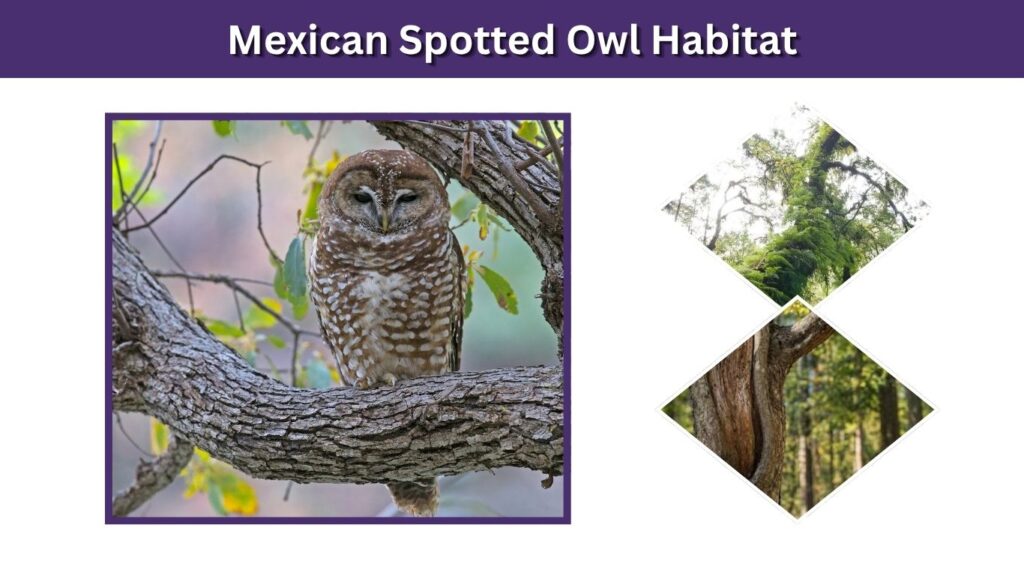
Mexican spotted owls depend heavily on structurally complex forests and rocky canyons for nesting and daytime roosting.
Mixed-conifer forests are especially important. Suitable forests often contain mature or old trees, multiple vegetation layers, high canopy cover, fallen logs, snags, and other features that create cool, protected roosting and nesting conditions.
They also use Madrean pine-oak forests.
Where Do Mexican Spotted Owls Nest?
Depending on location, nests may occur in:
- Douglas-fir trees
- Large tree cavities or natural structures
- Dense clusters of branches
- Cliff ledges
- Caves
- Protected canyon walls
Mexican spotted owls do not construct elaborate nests themselves. Instead, they commonly make use of existing structures, such as natural tree formations or sheltered rocky sites.
What Do Mexican Spotted Owls Eat?
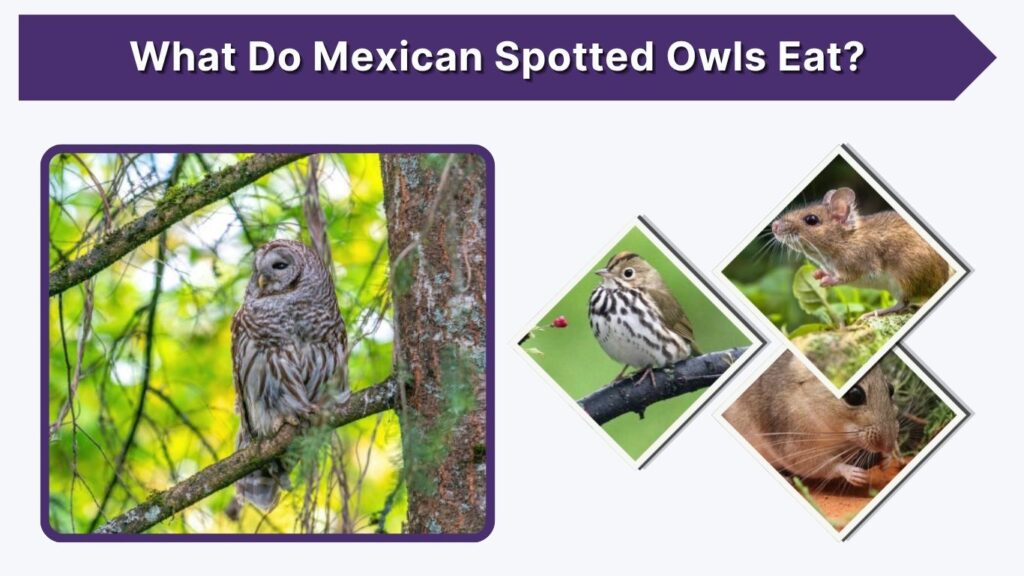
Mexican spotted owls are nocturnal predators. They begin hunting around sunset and may continue until shortly before sunrise.
Their diet is dominated by small mammals.
Mexican Spotted Owl Diet
Common prey includes:
- Woodrats
- Mice
- Voles
- Small birds
- Bats
- Reptiles
- Arthropods
Research in northern Arizona found that mammals represented about 94% of the diet by biomass at the study sites, with mice, Mexican woodrats, and Mexican voles among the major prey.
How Do They Hunt?
Mexican spotted owls frequently hunt from a perch.
They listen and watch for movement before dropping rapidly onto prey and grabbing it with their talons. They are also capable of taking flying prey, including small birds.
Their excellent low-light vision, sensitive hearing, quiet flight, and sharp talons are important hunting adaptations.
Mexican Spotted Owl Call and Sound
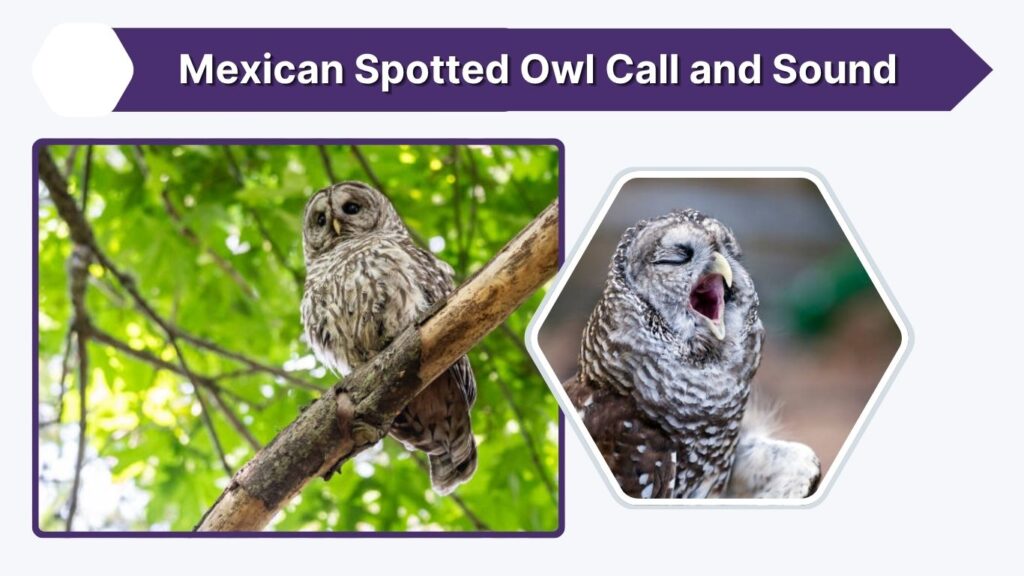
Mexican spotted owls have several calls used for communication between mates and neighboring birds.
Their calls tend to be relatively low-pitched and can travel through dense forest vegetation. Males generally have deeper voices and call more frequently than females.
Calling activity is most noticeable from March through November, increasing during spring. The owls are comparatively quiet during December through February. Calls are particularly frequent shortly after sunset and before sunrise.
Breeding and Life Cycle
Mexican spotted owls generally form long-term pair bonds.
Courtship commonly begins around late February or March. Females usually lay two to four eggs from late March into early April, although timing varies by location.
The female incubates the eggs for about 30 days while the male provides much of the food.
Baby Mexican Spotted Owls
Eggs generally hatch around early May.
Young owls usually leave the immediate nest approximately four to five weeks after hatching, although they remain dependent on their parents for food for much of the summer.
Juveniles eventually disperse from their parents’ territory during fall.
Life can be particularly difficult for young owls, and juvenile survival during the first year is relatively low. Mexican spotted owls that reach adulthood can be long-lived; average wild life expectancy is estimated at around 15 years.
Mexican Spotted Owl Predators
Adult Mexican spotted owls have relatively few predators because of their size, nocturnal activity, and ability to fly.
However, great horned owls are potential predators and competitors. Young owls and eggs are more vulnerable to predation from other raptors, mammals, and opportunistic nest predators.
Habitat alteration poses a much broader population-level concern than natural predation.
Is the Mexican Spotted Owl Endangered?
The Mexican spotted owl is often described online as endangered, but its federal classification in the United States is currently threatened, not endangered.
The U.S. Fish and Wildlife Service listed it as threatened under the Endangered Species Act in 1993. Historical changes to forest habitat were an important factor in the listing.
Today, the Fish and Wildlife Service identifies the increased risk of large, stand-replacing wildfires as the primary current threat in the United States.
Other concerns include habitat degradation and fragmentation, drought, climate-related changes to forests, development, and some forest-management activities.
Mexican Spotted Owl Critical Habitat
Critical habitat is designed to protect areas containing features essential to the owl’s conservation.
In 2004, approximately 8.6 million acres of federal land in Arizona, Colorado, New Mexico, and Utah were designated as Mexican spotted owl critical habitat.
Protecting mature forests, canyon habitat, nesting areas, roost sites, and appropriate forest structure is therefore a major component of recovery efforts.
How Many Mexican Spotted Owls Are Left?
There is no reliable single current number for all Mexican spotted owls remaining in the world.
Estimating the total population is difficult because the owl occupies widely scattered mountain and canyon habitats across both the United States and Mexico. Some areas are much better surveyed than others.
For this reason, claims giving an exact worldwide number should be treated cautiously unless they specify a particular survey, geographic area, and year.
The U.S. Fish and Wildlife Service completed a five-year status review in 2023 and continues to classify the Mexican spotted owl as threatened.
Mexican Spotted Owl vs Northern Spotted Owl
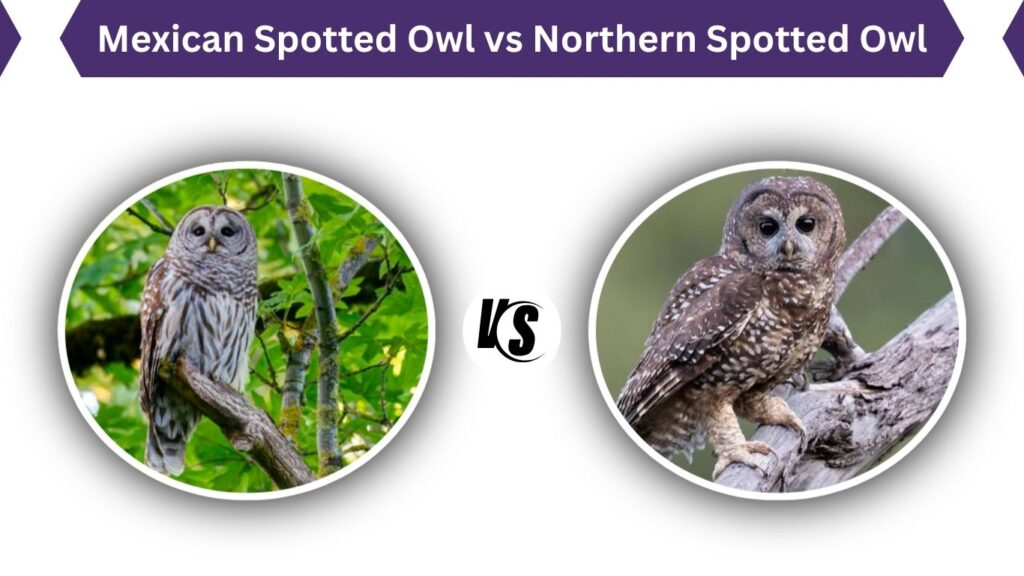
Both belong to the same spotted owl species but are different subspecies.
The northern spotted owl occurs mainly in forests of the Pacific Northwest, while the Mexican spotted owl occupies the southwestern United States and Mexico.
Mexican spotted owls generally appear lighter and more heavily spotted, whereas northern spotted owls tend to have darker plumage and smaller white spots.
Interesting Mexican Spotted Owl Facts
Mexican spotted owls have dark eyes, unlike many other large North American owl species. They can live for around 15 years in the wild, and some populations move between elevations seasonally.
They are also highly dependent on specific habitat structures. A forest may contain plenty of trees but still lack the dense canopy, mature trees, cool roosting areas, and nesting features that these owls require.
Their presence can therefore be an important indicator of complex forest and canyon ecosystems.
FAQs
Where does the Mexican spotted owl live?
It occurs in forested mountains and rocky canyonlands from Utah and Colorado through Arizona, New Mexico, western Texas, and south into Mexico.
What does a Mexican spotted owl eat?
Its diet consists mainly of small mammals such as woodrats, mice, and voles, although it can also eat birds, bats, reptiles, and arthropods.
Why is the Mexican spotted owl threatened?
Major concerns include habitat loss and degradation and, increasingly, large stand-replacing wildfires that can eliminate important nesting and roosting habitat.
How big is a Mexican spotted owl?
Adults are approximately 16–19 inches long with a wingspan of about 42–45 inches.
Are Mexican spotted owls nocturnal?
Yes. They generally rest during daylight hours and become active around dusk, hunting primarily throughout the night.