
Are spotted owls endangered? The answer depends on which spotted owl population you mean. The spotted owl (Strix occidentalis) has three recognized subspecies: the Northern, California, and Mexican spotted owl. As of September 2026, the Northern Spotted Owl and Mexican Spotted Owl are federally listed as threatened in the United States, not endangered. For the California Spotted Owl, federal listing has been proposed: the Coastal-Southern California population as endangered and the Sierra Nevada population as threatened. Despite these differences in legal status, all three face serious conservation pressures.
Are Spotted Owls Endangered or Threatened?
There is no single U.S. Endangered Species Act status covering every spotted owl population. Their legal classifications differ by subspecies and, for the California Spotted Owl, by distinct population segment.
| Spotted Owl | Current U.S. Federal Status |
| Northern Spotted Owl | Threatened |
| Mexican Spotted Owl | Threatened |
| California Spotted Owl – Coastal-Southern California DPS | Proposed Endangered |
| California Spotted Owl – Sierra Nevada DPS | Proposed Threatened |
Globally, BirdLife International currently categorizes the spotted owl species as Near Threatened, which is a different classification system from the U.S. Endangered Species Act.
Is the Northern Spotted Owl Endangered?
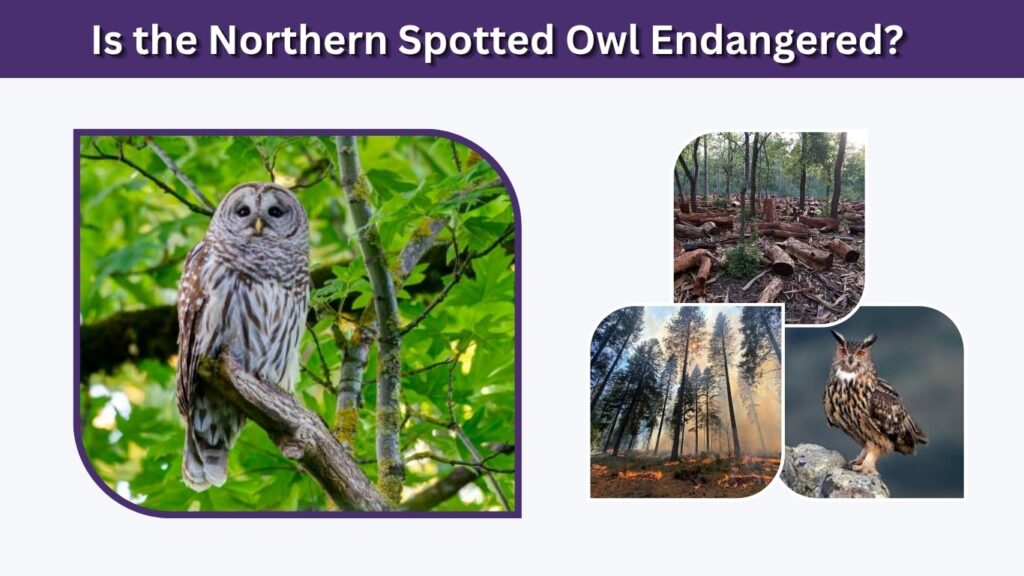
The Northern Spotted Owl (Strix occidentalis caurina) is federally classified as threatened under the U.S. Endangered Species Act.
It was officially listed as threatened on June 26, 1990, primarily because of widespread loss and modification of its forest habitat. Its range stretches from southwestern British Columbia through Washington and Oregon into northern California.
Why Is the Northern Spotted Owl Endangered?
Although its official U.S. classification remains threatened, its situation is serious enough that the U.S. Fish and Wildlife Service concluded that changing its status to endangered was warranted.
Important threats include:
- Competition from invasive Barred Owls
- Loss and fragmentation of mature forests
- Severe wildfires
- Changes in forest structure
- Climate-related habitat changes
- Continued decline in some populations
Barred Owls have become particularly important. They are larger, reproduce more rapidly, tolerate a wider range of habitats, and compete with Northern Spotted Owls for territory and food.
Why Isn’t the Northern Spotted Owl Listed as Endangered?
In 2020, the U.S. Fish and Wildlife Service determined that reclassifying the Northern Spotted Owl from threatened to endangered was warranted but precluded by other higher-priority listing actions.
That determination did not automatically change its legal status. Consequently, federal records still list the Northern Spotted Owl as threatened.
This distinction explains why some sources describe the owl as being at risk of extinction while government databases continue to identify it legally as threatened.
Why Are Spotted Owls Declining?
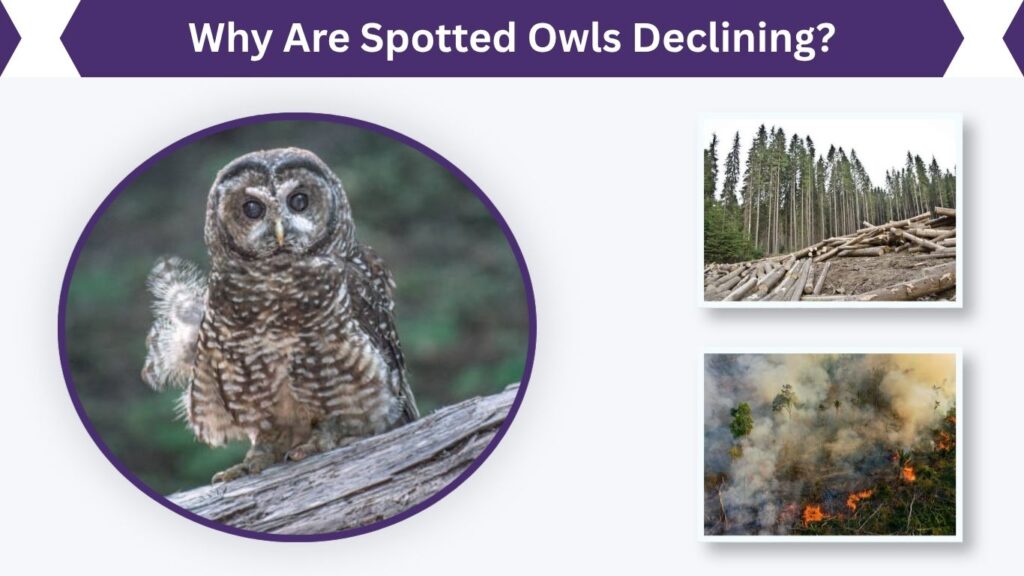
Several factors are responsible, and their importance differs across the three subspecies.
Loss of Forest Habitat
Spotted owls frequently depend on structurally complex forests containing large trees, dense canopy, snags, cavities, and suitable hunting habitat.
Historical timber harvest removed or altered significant amounts of this habitat, particularly in the Pacific Northwest. Although habitat protections have improved in many areas, forest loss and fragmentation remain concerns.
Competition With Barred Owls
The expansion of the Barred Owl (Strix varia) into western North America has become one of the most serious problems for Northern Spotted Owls.
Barred Owls compete for food and territories and can displace spotted owls. Their expansion has also reached parts of the California Spotted Owl’s range.
Severe Wildfires
Fire is naturally part of many western forests, but large, high-severity fires can destroy extensive areas of nesting and roosting habitat.
The U.S. Fish and Wildlife Service identifies large-scale, high-severity wildfire as a particularly important threat to Mexican and California Spotted Owls.
Is the Mexican Spotted Owl Endangered?
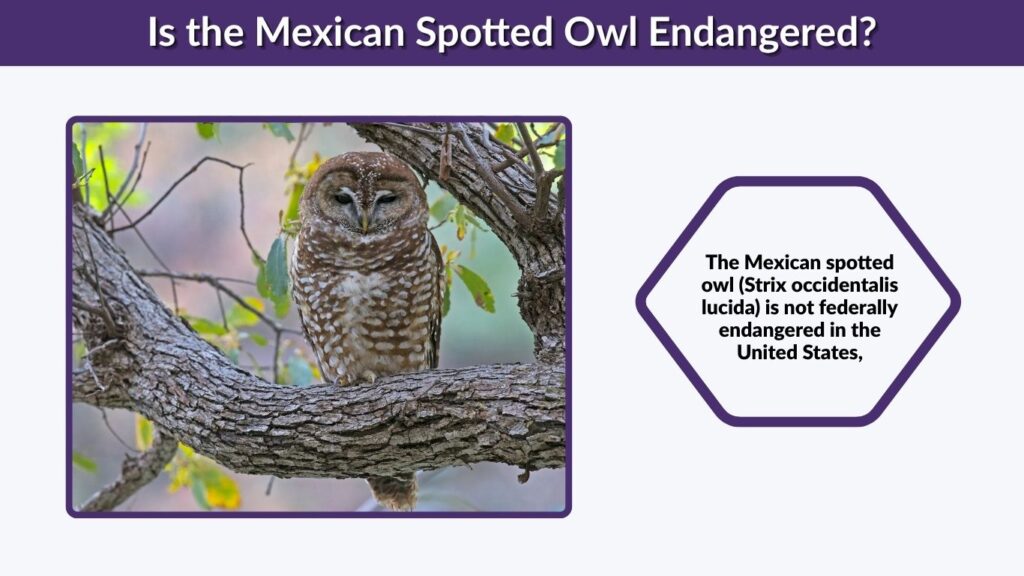
The Mexican Spotted Owl (Strix occidentalis lucida) is federally classified as threatened, rather than endangered, in the United States.
It was listed under the Endangered Species Act on March 16, 1993. Its range extends through parts of Utah, Colorado, Arizona, New Mexico, western Texas, and south into Mexico.
Why Is the Mexican Spotted Owl Threatened?
Historical alteration of forest habitat contributed substantially to its original listing.
Today, one of its biggest U.S. threats is the increasing risk of landscape-scale, stand-replacing wildfire. These intense fires can remove the forest canopy and other habitat structures the owls use for nesting, roosting, and hunting.
The subspecies also occupies rocky canyon systems, particularly in parts of the Southwest, so protecting both forest and canyon habitats is important.
Is the California Spotted Owl Endangered?
The situation is more complicated for the California Spotted Owl (Strix occidentalis occidentalis).
In 2023, the U.S. Fish and Wildlife Service proposed dividing it into two distinct population segments for federal listing purposes:
- Coastal-Southern California DPS – proposed endangered
- Sierra Nevada DPS – proposed threatened
Recent Fish and Wildlife Service materials continue to describe these as proposed listings rather than finalized federal classifications.
Why Is the California Spotted Owl at Risk?
Major concerns include severe wildfire, historical habitat degradation, loss of mature forest characteristics, and the southward spread of Barred Owls.
California Spotted Owls generally require forests containing suitable nesting trees, canopy cover, and adequate prey populations. Large changes to those environments can reduce breeding and foraging opportunities.
Northern vs Mexican vs California Spotted Owl
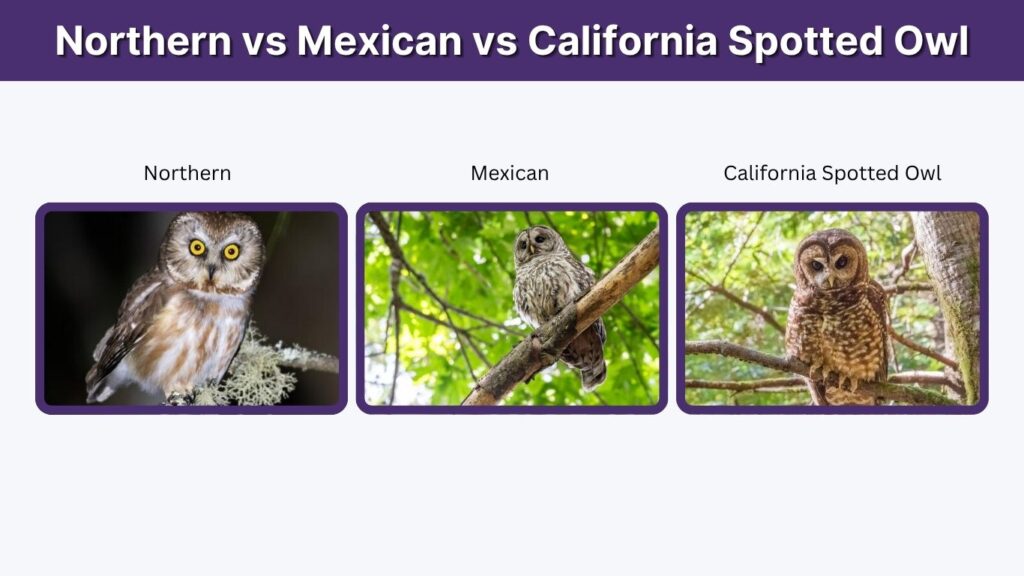
All three are subspecies of Strix occidentalis, but they occupy different geographic regions.
The Northern Spotted Owl is found mainly from British Columbia through Washington and Oregon into northern California. It tends to be the darkest and largest of the three.
The California Spotted Owl inhabits the Sierra Nevada and mountain ranges of coastal and southern California.
The Mexican Spotted Owl occurs across parts of the southwestern United States and Mexico and generally has paler plumage and larger white spots.
How Are Spotted Owls Protected?
Conservation programs focus primarily on maintaining suitable habitat and addressing threats that cannot be solved by habitat protection alone.
Major Conservation Efforts
Conservation measures include:
- Protecting nesting and roosting forests
- Maintaining large mature trees
- Protecting designated critical habitat
- Restoring appropriate forest structure
- Reducing risks from catastrophic wildfire
- Monitoring owl populations
- Managing competition from invasive Barred Owls
- Protecting important breeding territories
For the Northern Spotted Owl, approximately 9.58 million acres were included within revised federal critical-habitat boundaries designated in 2012.
Are Spotted Owls Still Endangered Today?
Spotted owls remain conservation concerns, but describing all of them simply as “endangered” is technically inaccurate.
As of September 2026, the Northern and Mexican subspecies remain threatened under the U.S. Endangered Species Act. The Northern Spotted Owl has nevertheless been judged serious enough for an endangered reclassification to be warranted. The California Spotted Owl has proposed endangered and threatened classifications for its two principal populations.
Their long-term survival depends heavily on retaining suitable forest and canyon habitat while addressing wildfire, habitat change, and competition from Barred Owls.
FAQs
Is the Northern Spotted Owl endangered or threatened?
The Northern Spotted Owl is federally listed as threatened in the United States. It has held that classification since June 26, 1990.
When did the Northern Spotted Owl become endangered?
It has not officially been reclassified as endangered under the U.S. Endangered Species Act. It was listed as threatened in 1990, although the Fish and Wildlife Service later concluded that an endangered classification was warranted.
Why are Northern Spotted Owls disappearing?
Major causes include competition with invasive Barred Owls, habitat loss and fragmentation, and severe wildfire.
Is the Mexican Spotted Owl endangered?
Under U.S. federal law, it is threatened, not endangered. It has been federally protected since 1993.
Is the California Spotted Owl endangered?
The Coastal-Southern California population has been proposed for endangered status, while the Sierra Nevada population has been proposed as threatened. The latest Fish and Wildlife Service information still describes these federal listings as proposed.