
The northern spotted owl is a secretive forest-dwelling owl native to the Pacific Northwest of North America. Scientifically known as Strix occidentalis caurina, it is recognized by its dark brown plumage, white spots, rounded head, and large dark eyes. This owl depends heavily on mature forests for nesting, roosting, and hunting. Habitat loss and competition with barred owls have contributed to major population declines. Protecting suitable forests and reducing other threats remain important parts of northern spotted owl conservation.
What Is a Northern Spotted Owl?
The northern spotted owl is one of three recognized subspecies of the spotted owl. It belongs to the family Strigidae, which includes most true owls. It is primarily nocturnal and spends daylight hours resting quietly within shaded forest vegetation.
Unlike many owls with yellow eyes, northern spotted owls have distinctive dark brown eyes.
Northern Spotted Owl Scientific Name
The scientific name is Strix occidentalis caurina.
Its classification includes:
- Common name: Northern spotted owl
- Scientific name: Strix occidentalis caurina
- Species: Strix occidentalis
- Family: Strigidae
- Order: Strigiformes
- Type: Bird of prey
The other spotted owl subspecies are the California spotted owl and Mexican spotted owl.
Northern Spotted Owl Description
Northern spotted owls are predominantly dark brown with numerous pale spots across their head, back, wings, and underparts.
Important identification features include:
- Dark brown eyes
- Rounded head
- No visible ear tufts
- Brown and white spotted plumage
- Pale facial markings
- Broad, rounded wings
- Relatively short tail
- White horizontal markings across the chest
Their mottled coloration provides excellent camouflage against tree trunks and shaded forest backgrounds.
Northern Spotted Owl Habitat
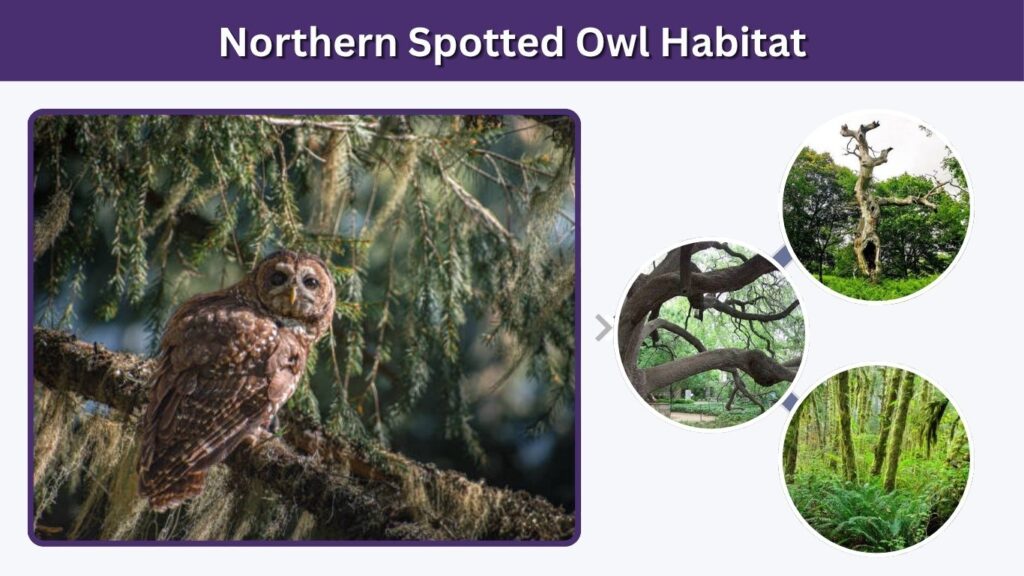
Northern spotted owls are strongly associated with mature forests containing large trees and complex vegetation. These environments provide places to nest and roost while also supporting populations of small mammals that serve as prey.
A suitable habitat is more complex than simply having trees. Forest age, canopy structure, dead wood, and nesting opportunities are all important.
Preferred Habitat Features
Northern spotted owl habitat often contains:
- Large mature trees
- Multiple canopy layers
- Standing dead trees
- Fallen logs
- Tree cavities
- Broken tree tops
- Dense shaded areas
- Open spaces beneath the canopy for hunting
Older forests frequently provide these features in greater abundance than recently disturbed forests.
Where Does the Northern Spotted Owl Live?
The northern spotted owl occurs along the Pacific coast of North America.
Its range extends from southwestern British Columbia through Washington and Oregon into northern California.
Populations are especially associated with the Cascade Range, Coast Range, and forested regions west and east of these mountain systems.
Northern Spotted Owl in Oregon and California
Oregon contains substantial portions of the owl’s historical range. Northern spotted owls occur in suitable forests across western Oregon and parts of the Cascades.
In California, the northern subspecies occupies the northern portion of the state. Farther south, its distribution transitions toward that of the California spotted owl.
What Does a Northern Spotted Owl Eat?
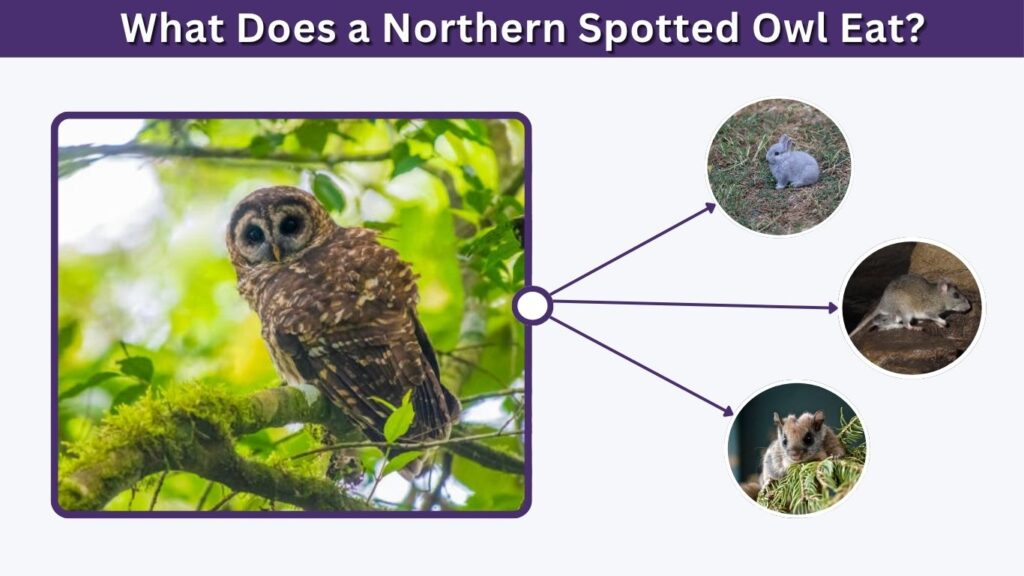
Northern spotted owls are carnivorous predators that feed mainly on small mammals. Their diet varies geographically because different prey species dominate different forests.
They hunt primarily at night, using exceptional hearing, vision, and nearly silent flight to locate prey.
Northern Spotted Owl Diet
Common prey can include:
- Northern flying squirrels
- Woodrats
- Mice
- Voles
- Small rabbits
- Bats
- Small birds
- Large insects
- Other small vertebrates
Flying squirrels are particularly important in many northern forests, while woodrats can become more significant farther south.
How Does a Northern Spotted Owl Hunt?
The owl often uses a sit-and-wait hunting strategy.
It remains quietly perched while listening and watching for movement. Once it detects prey, it flies from the perch and attacks with its powerful feet and talons.
Soft-edged flight feathers reduce the noise produced during flight, helping the owl approach prey without being easily detected.
Northern Spotted Owl Size
The northern spotted owl is a medium-sized owl. Females are generally larger and heavier than males, a pattern common among birds of prey.
Although substantial in size, northern spotted owls are smaller than barred owls, one of their major competitors.
Physical Characteristics
Typical characteristics include:
- Body length of roughly 16–19 inches
- Broad, rounded wings
- Large head relative to the body
- Powerful feet and curved talons
- Dense, soft plumage
- Female size generally larger than male size
Their wings are well suited for maneuvering among trees rather than high-speed flight across open landscapes.
Northern Spotted Owl Nesting and Life Cycle
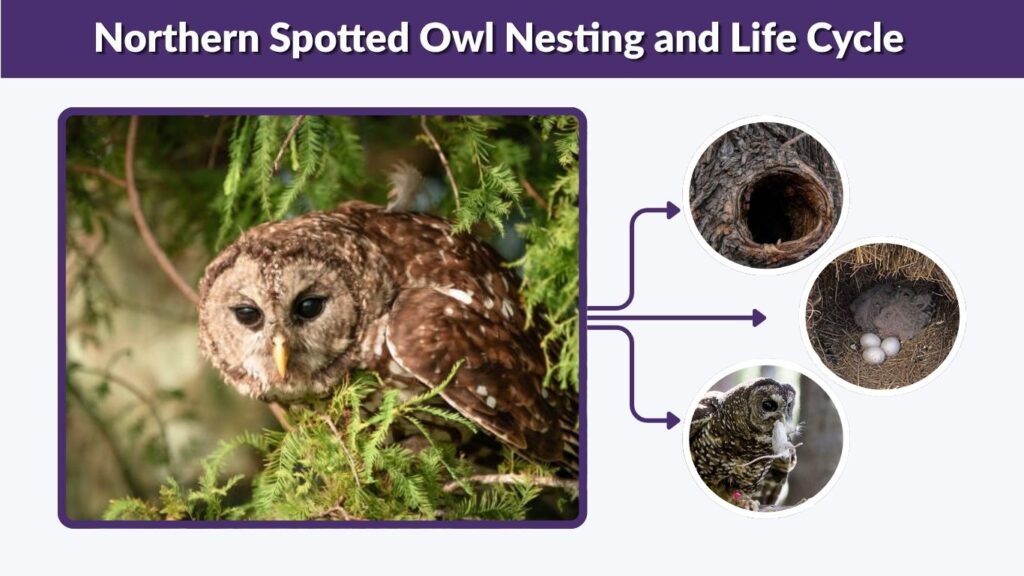
Northern spotted owls typically form breeding pairs and establish territories that contain nesting, roosting, and hunting habitat.
They do not construct elaborate nests themselves. Instead, they rely on existing structures within mature trees.
Northern Spotted Owl Nest
Possible nest sites include:
- Large natural tree cavities
- Broken tree tops
- Platforms formed by debris
- Large branch structures
- Abandoned nests built by other birds
Large old trees are particularly valuable because they are more likely to develop cavities and structural features suitable for nesting.
Eggs and Young
Females generally produce relatively small clutches.
The female performs most of the incubation while the male supplies food. After hatching, the young remain in or near the nest while their parents provide prey.
Juveniles eventually leave the nest but may continue depending on their parents for food while learning to fly and hunt.
Northern Spotted Owl Lifespan
Northern spotted owls can survive for many years under favorable conditions.
Their relatively long lifespan is balanced by slow reproduction. Because pairs do not produce large numbers of offspring annually, populations may recover slowly after substantial declines.
Northern Spotted Owl Calls and Sounds
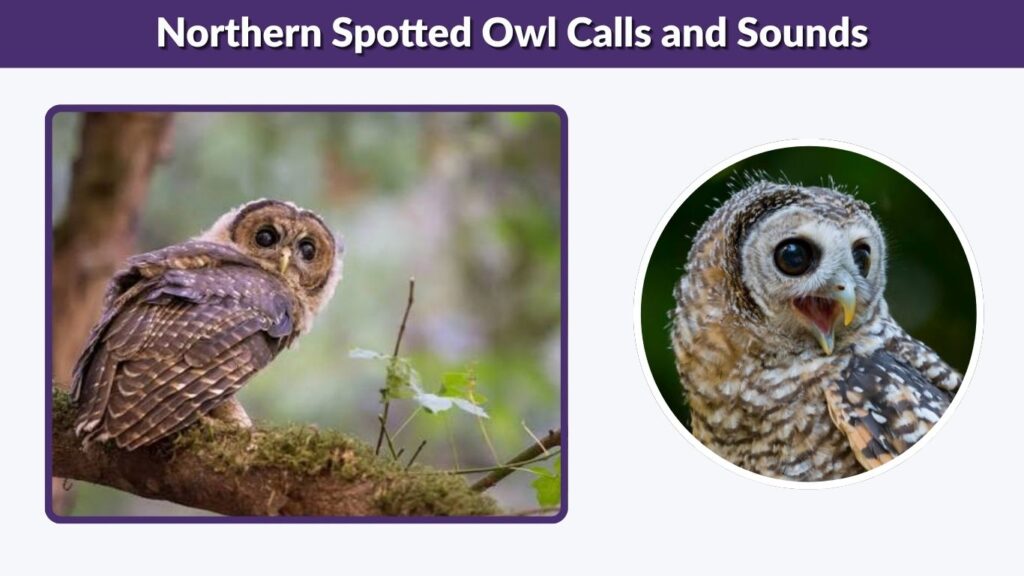
Northern spotted owls communicate through several vocalizations. Their calls are especially important because these nocturnal birds are often easier to hear than to see.
Researchers also use vocal responses to help locate owls during field surveys.
What Does a Northern Spotted Owl Call Sound Like?
One recognizable call consists of a sequence of several deep hoots delivered in a distinctive rhythm.
Northern spotted owls can also make:
- Hooting calls
- Whistles
- Bark-like sounds
- Contact calls
- Calls between paired birds
Different vocalizations may be associated with territorial behavior, courtship, communication between mates, or interactions with young owls.
Northern Spotted Owl vs Barred Owl
Barred owls and northern spotted owls belong to the same genus and share several physical features. Both have rounded heads, dark eyes, and brownish plumage.
However, barred owls are generally larger and have expanded into much of the northern spotted owl’s range.
Key Differences
- Northern spotted owl: Pale spots dominate the plumage.
- Barred owl: Strong bars and vertical streaks are more obvious.
- Northern spotted owl: Generally smaller.
- Barred owl: Larger and more robust.
- Northern spotted owl: Closely tied to certain mature forest conditions.
- Barred owl: Uses a broader variety of habitats.
- Northern spotted owl: More specialized prey and habitat requirements.
- Barred owl: Has a broader diet.
Their calls also differ considerably and can help with identification.
Why Are Barred Owls a Threat?
Barred owls have expanded westward into areas historically occupied by northern spotted owls.
They can compete for food, nesting areas, and territories. Because barred owls are larger and can exploit a wider range of prey and habitats, they may displace spotted owls from otherwise suitable areas.
The two species can also occasionally hybridize.
Why Is the Northern Spotted Owl Endangered or Threatened?
Northern spotted owl populations have declined significantly across much of their range. Several pressures act simultaneously, making recovery particularly difficult.
The loss and alteration of suitable forest habitat historically played a major role, while competition with barred owls has become an increasingly important challenge.
Major Threats
Important threats include:
- Loss of mature forest habitat
- Forest fragmentation
- Competition with barred owls
- Severe wildfire
- Changes in prey populations
- Drought
- Disease
- Reduced reproductive success
- Disturbance around nesting territories
Because northern spotted owls reproduce slowly, even relatively modest reductions in adult survival can have significant population effects.
How Deforestation Affects Northern Spotted Owls
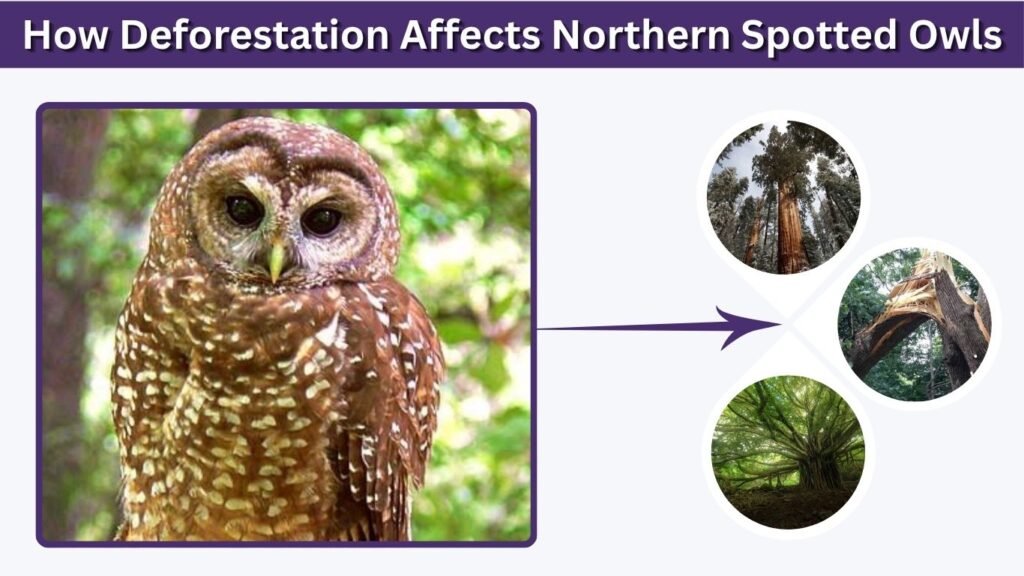
Removing large areas of mature forest can eliminate nesting cavities, protected roosting locations, and productive hunting habitat.
Forest fragmentation can also separate suitable territories and make it more difficult for young owls to find new areas in which to settle.
Importance of Old Forests
Older forests provide characteristics that are difficult to replace quickly.
Large trees may require decades or centuries to develop cavities, broken tops, broad branches, and complex canopy structures. Fallen logs and standing dead trees also support prey populations and contribute to overall forest complexity.
Protecting existing high-quality habitat therefore plays an important role in owl conservation.
Northern Spotted Owl Conservation
Conservation of northern spotted owls involves protecting suitable habitat while addressing competition and other sources of mortality.
Monitoring populations is particularly important because changes can occur gradually over large forest landscapes.
Conservation Strategies
Efforts can include:
- Protecting important nesting habitat
- Restoring degraded forests
- Preserving large mature trees
- Monitoring owl populations
- Protecting nesting territories
- Studying barred owl interactions
- Managing severe wildfire risks
- Maintaining connections between suitable habitats
- Monitoring prey populations
Conservation strategies must consider entire forest ecosystems rather than individual nest trees alone.
Why Is the Northern Spotted Owl Important?
The northern spotted owl has become closely associated with the conservation of mature Pacific Northwest forests.
Because it relies on particular forest conditions, changes in its population can provide information about broader environmental changes within forest ecosystems.
Protecting owl habitat can also benefit numerous mammals, birds, amphibians, insects, fungi, and plants that depend on similar forest environments.
Interesting Northern Spotted Owl Facts
Northern spotted owls possess numerous adaptations for living and hunting within dense forests.
10 Northern Spotted Owl Facts
- Its scientific name is Strix occidentalis caurina.
- It has dark brown eyes.
- Females are generally larger than males.
- It hunts mainly at night.
- Flying squirrels are important prey.
- It does not build a traditional nest from scratch.
- Soft flight feathers help reduce noise.
- It occurs from southwestern Canada to northern California.
- Barred owls are important competitors.
- Mature forests provide crucial nesting and roosting habitat.
FAQs
Is the northern spotted owl endangered?
The northern spotted owl is a conservation-dependent bird with substantially reduced populations in many areas. In the United States, it has long received federal protection because of threats to its survival.
What does a northern spotted owl eat?
It primarily eats small mammals, particularly flying squirrels, woodrats, mice, and voles. Birds, bats, and insects may also be eaten.
Where does the northern spotted owl live?
Its range extends from southwestern British Columbia through Washington and Oregon into northern California.
What is the northern spotted owl’s scientific name?
Its scientific name is Strix occidentalis caurina. It is a subspecies of the spotted owl, Strix occidentalis.
Why is the northern spotted owl important?
It is an important forest predator and is closely associated with complex mature forests. Protecting its habitat can also conserve many other species that depend on similar ecosystems.