
The Long-eared Owl (Asio otus) is a secretive, medium-sized owl recognized by its tall ear tufts, striking yellow-orange eyes, and heavily patterned feathers. Although widespread across North America, Europe, and Asia, it can be surprisingly difficult to find because it spends daylight hours hidden among dense branches and becomes active mainly after dark. Long-eared Owls are highly specialized hunters of mice and voles, using exceptional hearing and silent flight to locate prey. This guide covers their size, sounds, habitat, range, diet, nesting, behavior, lifespan, and identification.
What Does a Long-Eared Owl Look Like?
Long-eared Owls have slender bodies, relatively long wings, prominent facial disks, and tall feather tufts that give them a horned appearance. Their plumage combines brown, black, buff, and orange tones, creating excellent camouflage against bark and dense vegetation.
The so-called ears on top of the head are actually feather tufts. Their real ear openings are hidden beneath feathers on the sides of the skull.
Long-Eared Owl Identification
- Scientific name: Asio otus
- Family: Strigidae
- Length: 13.8–15.8 inches (35–40 cm)
- Weight: 7.8–15.3 ounces (220–435 g)
- Wingspan: 35.4–39.4 inches (90–100 cm)
- Eyes: Yellow to orange
- Ear tufts: Long, narrow, and usually upright
- Plumage: Brown, black, buff, and cream
- Body shape: Slender and crow-sized
- Face: Narrow facial disk with dark markings around the eyes
Females are generally slightly larger than males, although both sexes have very similar plumage.
Long-Eared Owl Feathers and Camouflage
The intricate streaking across the body provides excellent concealment. During daylight, the owl often sits upright close to a tree trunk, where its feather pattern resembles bark and shadows.
When alarmed, a Long-eared Owl may stretch its body vertically and compress its feathers, making itself look narrow like a broken branch. This camouflage helps explain why even several owls can remain unnoticed in the same roost.
Long-Eared Owl Habitat and Range
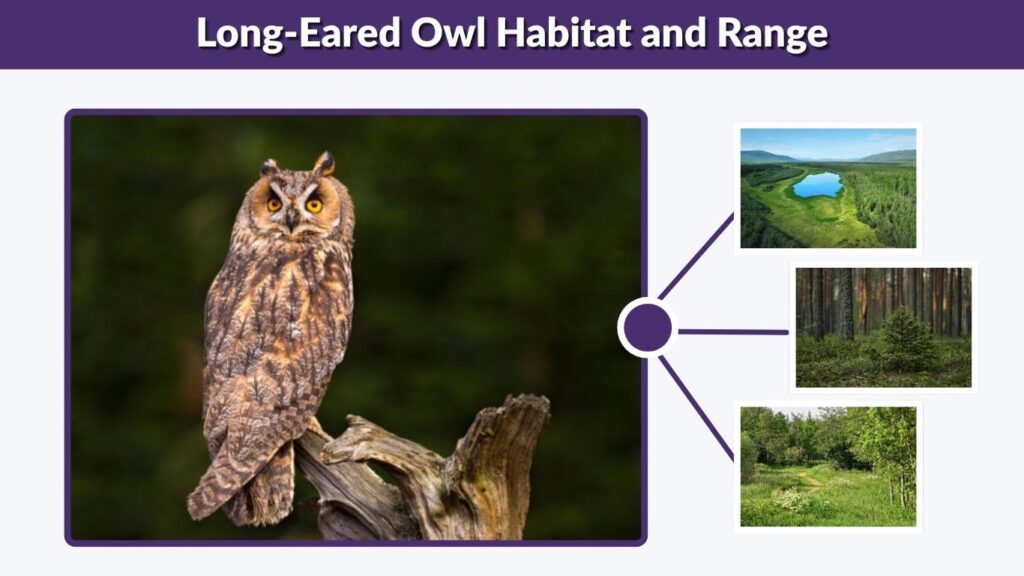
Long-eared Owls require two different habitat types close together: dense trees or shrubs for roosting and nesting, plus open land for hunting.
They commonly occupy conifer stands, shelterbelts, woodland edges, riparian groves, and tall shrublands next to grasslands, fields, or open countryside. They occur from near sea level to elevations above 6,500 feet in some regions.
Where Do Long-Eared Owls Live?
Suitable environments include woodland edges, pine stands, windbreaks, willow and cottonwood groves, shrubsteppe, agricultural landscapes, open forests, grasslands bordered by trees, and dense shelterbelts.
This combination allows the owl to stay concealed during the day and fly out over open ground after dark to hunt rodents.
Long-Eared Owl Range
The Long-eared Owl has an enormous geographic distribution. Populations occur across much of North America, Europe, and Asia, with additional populations in parts of North Africa and some Atlantic islands.
In North America, some populations remain in the same general region year-round, while others migrate. Birds banded in northern parts of the United States and southern Canada have later been recovered as far south as Mexico. Migration usually occurs at night.
Long-Eared Owl Call and Sounds
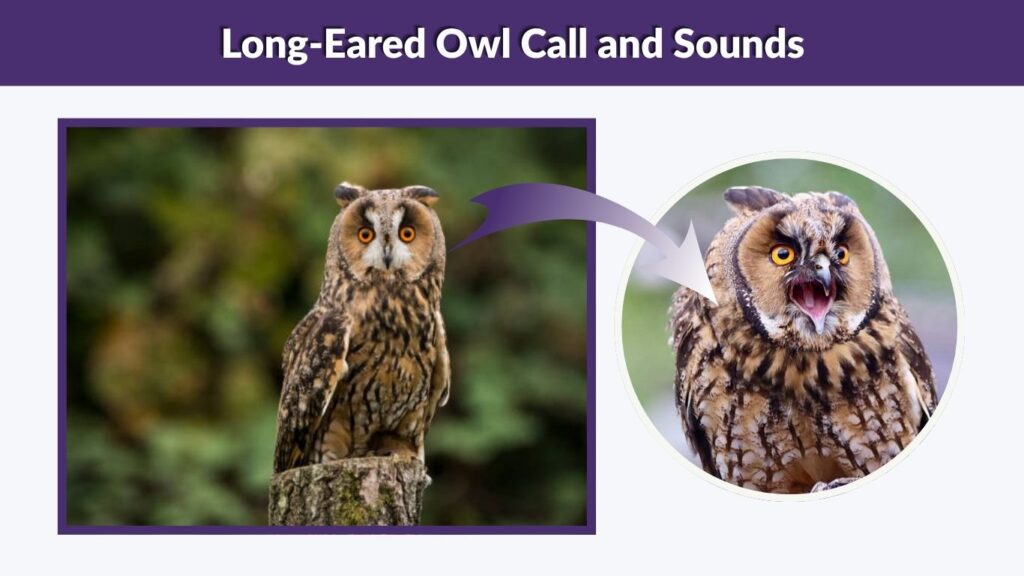
The Long-eared Owl has a surprisingly varied voice. It may be silent for much of the year, but vocal activity increases considerably during courtship and breeding.
What Does a Long-Eared Owl Sound Like?
A male’s characteristic breeding call consists of low, deep “whoo” notes delivered repeatedly. A sequence may contain 10 to more than 200 notes, generally separated by a few seconds.
The call is quiet in tone yet carries surprisingly far. Under suitable conditions, a male may be heard from more than half a mile away.
Females produce higher-pitched nest calls, while both sexes may make barks, squeals, whines, and catlike mewing sounds.
Young Long-eared Owls make distinctive begging calls. In Britain, their call is sometimes compared to the squeak of an old gate.
Other Sounds
Long-eared Owls can also snap their bills when disturbed. During courtship, adults sometimes clap their wings together beneath their bodies while flying, creating a sharp, whip-like noise.
What Does a Long-Eared Owl Eat?
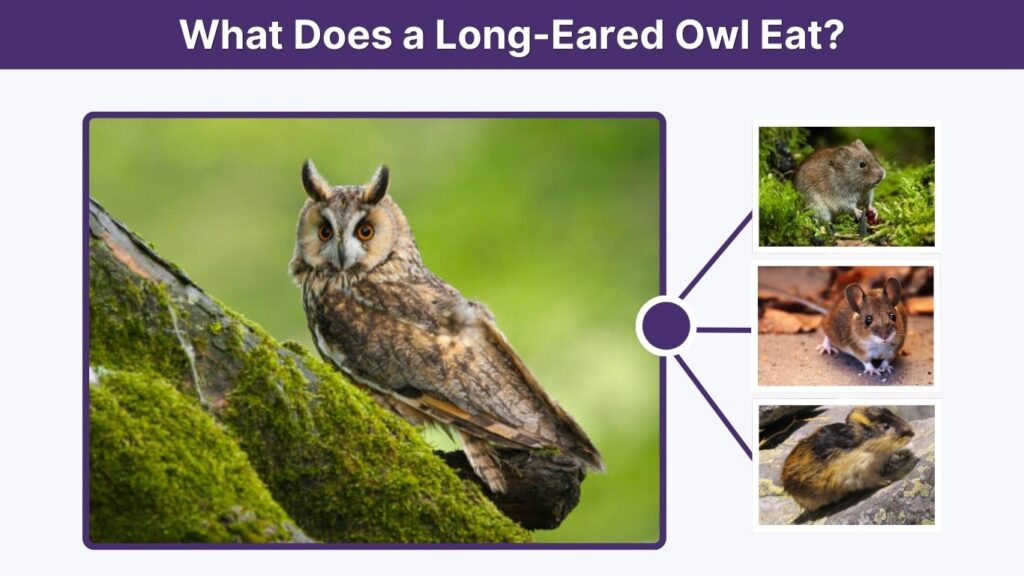
The Long-eared Owl is primarily a small-mammal specialist. Its diet depends heavily on whatever rodents are abundant locally.
Voles and mice often dominate the diet, but the owl can take a wider variety of small animals when opportunities arise.
Long-Eared Owl Diet
Common prey includes:
- Voles
- Deer mice and other mice
- Kangaroo rats
- Shrews
- Pocket gophers
- Young rats
- Small rabbits
- Occasional small birds
- Rarely bats, snakes, lizards, squirrels, or weasels
After swallowing prey, the owl later regurgitates indigestible fur, feathers, teeth, and bones as compact pellets. Finding several pellets beneath a dense stand of trees can indicate a Long-eared Owl roost.
Long-Eared Owl Hunting and Flight
Long-eared Owls usually begin hunting after darkness falls. They fly low over fields and grasslands, repeatedly coursing back and forth while listening for prey below.
Their large facial disk funnels sound toward asymmetrically positioned ear openings. This allows the owl to determine the location of small mammals with remarkable precision, even under very dark conditions.
Long-Eared Owl in Flight
In flight, the owl appears long-winged and relatively lightweight. The broad wings allow slow, controlled movement just above vegetation.
Special feather structures reduce turbulence and sound, producing the nearly silent flight characteristic of owls. Once prey is detected, the owl drops rapidly and captures it with its talons.
Long-Eared Owl Roosting Behavior
One of the most interesting characteristics of this species is its tendency to roost communally during winter.
Groups may gather inside dense conifers, willows, mesquite, or other sheltered vegetation. Cornell reports winter roosts containing as many as about 100 individuals, although smaller groups are more typical.
During daylight, these birds remain quiet and well concealed. Roosts should be observed from a respectful distance because repeated disturbance can force owls to leave important resting sites.
Long-Eared Owl Nest and Life Cycle
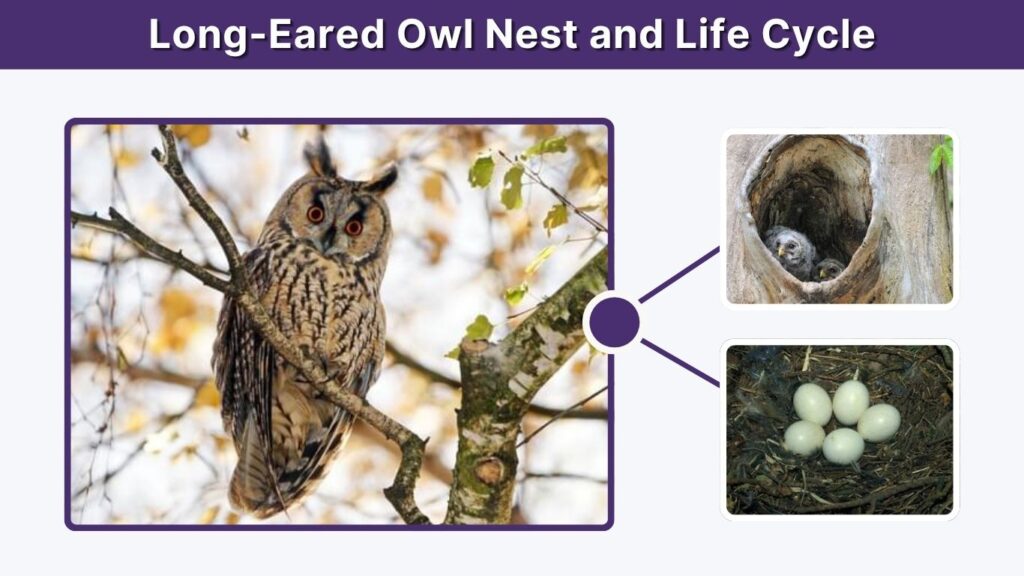
Long-eared Owls generally do not construct their own nests. Instead, they take over existing stick nests made by other birds.
Common nest builders whose abandoned nests are used include crows, ravens, magpies, and hawks. They occasionally use tree cavities, cliff sites, squirrel nests, or even the ground.
Nesting and Reproduction
Clutches usually contain several white eggs, though Cornell records a range of 2–10 eggs. Incubation lasts approximately 25–30 days. Newly hatched chicks are helpless, with closed eyes and white down.
Older young often leave the nest before they can fly properly. These fledglings, sometimes called branchers, climb and hop around surrounding branches while their parents continue feeding them.
Males also perform striking courtship flights involving zigzag movements, gliding, deep wingbeats, and occasional wing clapping.
Long-Eared Owl Lifespan
Long-eared owls can survive for many years, although young birds face significant mortality.
The oldest recorded wild Long-eared Owl in Cornell’s North American records was at least 12 years and 1 month old.
Actual lifespan depends on prey availability, severe weather, habitat quality, collisions, predation, and other environmental pressures.
Great Horned Owl vs Long-Eared Owl
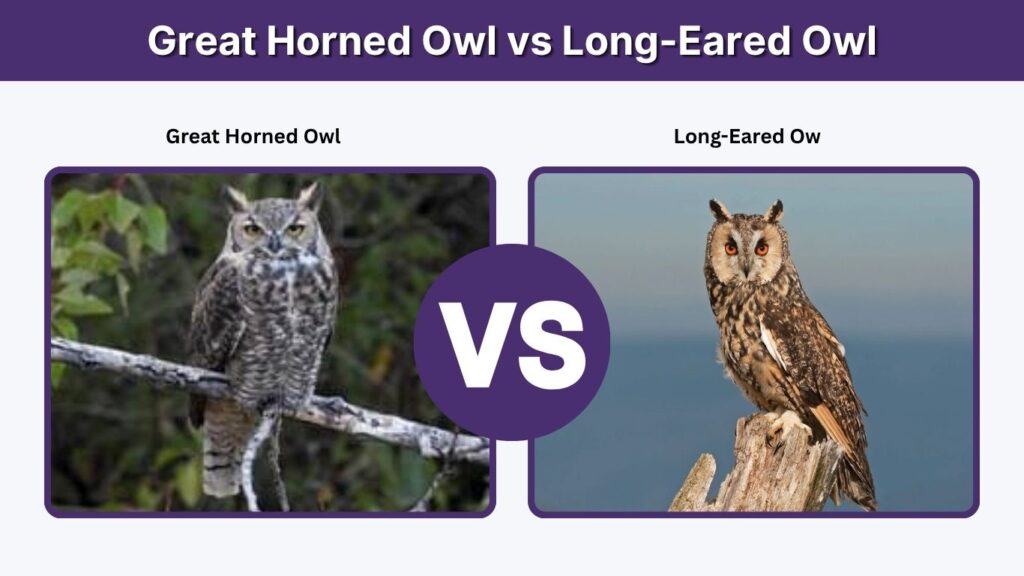
These species can initially look similar because both have prominent feather tufts and yellowish eyes. Size provides one of the easiest distinctions.
A Great Horned Owl is much larger, heavier, and more powerful. The Long-eared Owl is slimmer, typically only 13.8–15.8 inches long, whereas the Great Horned Owl has a much heavier build.
Long-eared Owls also have narrower facial disks, closely spaced tall ear tufts, prominent dark markings around the eyes, and strongly streaked underparts.
The Great Horned Owl is a powerful generalist capable of killing comparatively large animals. Long-eared Owls specialize much more strongly in small rodents.
Is the Long-Eared Owl Endangered?
The Long-eared Owl is not globally considered endangered. Cornell places it in a relatively low conservation-concern category, with Partners in Flight estimating a worldwide breeding population of about 520,000 birds.
However, exact population trends are difficult to measure because the species is nocturnal, secretive, nomadic, and difficult to survey. Some evidence indicates declines in parts of North America.
Loss of grasslands, riparian woodland, shelterbelts, and isolated tree groves can remove both hunting habitat and important nesting or roosting sites.
Interesting Long-Eared Owl Facts
Long-eared Owls are among the most secretive owls despite having an enormous geographic range. Their ear tufts are decorative feathers rather than actual ears, and their true ear openings are asymmetrical to improve directional hearing. Winter groups may share communal roosts, while breeding birds become more territorial.
Their combination of silent flight, excellent night vision, highly sensitive hearing, and camouflage makes them extraordinarily effective nocturnal hunters.
FAQs
How Big Is a Long-Eared Owl?
Adults measure roughly 13.8–15.8 inches long, weigh around 7.8–15.3 ounces, and have wingspans of approximately 35.4–39.4 inches.
What Does a Long-Eared Owl Call Sound Like?
Males produce repeated low, breathy hoots during breeding season. Females and young produce higher-pitched calls, while adults can also bark, squeal, whine, and make catlike sounds.
What Does a Long-Eared Owl Eat?
Its diet consists mainly of voles, mice, shrews, and other small mammals. Small birds and other vertebrates are occasionally taken.
Where Do Long-Eared Owls Roost?
They usually roost inside dense trees, particularly conifers, shelterbelts, willows, and other thick vegetation. In winter, several owls may share the same communal roost.
Are Long-Eared Owls Rare?
They are widespread globally but can appear rare because they are highly secretive and mostly nocturnal. Local populations fluctuate, and habitat loss has contributed to concern about declines in some regions.