
The Great Gray Owl (Strix nebulosa) is one of the tallest and most impressive owls in the world. Its enormous round face, piercing yellow eyes, silvery-gray feathers, and nearly silent flight give it an unmistakable appearance. Despite looking massive, much of its size comes from thick plumage, and it weighs less than some other large owls. Found across northern forests of North America and Eurasia, this remarkable predator specializes in detecting small mammals hidden beneath grass or deep snow.
Great Gray Owl Identification and Size
Great Gray Owls are large, long-tailed owls with broad rounded wings and an exceptionally large facial disk. Their plumage consists of gray, brown, and white streaks that provide excellent camouflage against tree bark. Yellow eyes stand out from the concentric circles of facial feathers, while a distinctive white “bow tie” with a dark center appears beneath the face.
Identification
- Scientific name: Strix nebulosa
- Family: Strigidae
- Length: 24–33.1 inches (61–84 cm)
- Weight: 24.7–60 oz (700–1,700 g)
- Wingspan: 53.9–60.2 inches (137–153 cm)
- Eyes: Bright yellow
- Plumage: Silvery gray with brown and white markings
- Head: Large and rounded without ear tufts
- Distinctive feature: White bow-tie marking below the facial disk
Females are generally larger than males.
Great Gray Owl Size Comparison
A Great Gray Owl can appear bigger than a Great Horned Owl because of its height, long tail, and extremely fluffy plumage. However, the Great Horned Owl is more heavily built and can weigh more.
The Great Gray is therefore impressive primarily for its length and apparent bulk, rather than extreme body mass. Cornell describes it as one of North America’s tallest owls.
Great Gray Owl Wingspan
With a wingspan reaching roughly 5 feet, the Great Gray Owl can glide smoothly across meadows while using surprisingly slow, quiet wingbeats.
Its broad wings allow controlled low-level flight when searching for voles and other small mammals. The owl’s flight often appears effortless despite its large silhouette.
Great Gray Owl Habitat and Range
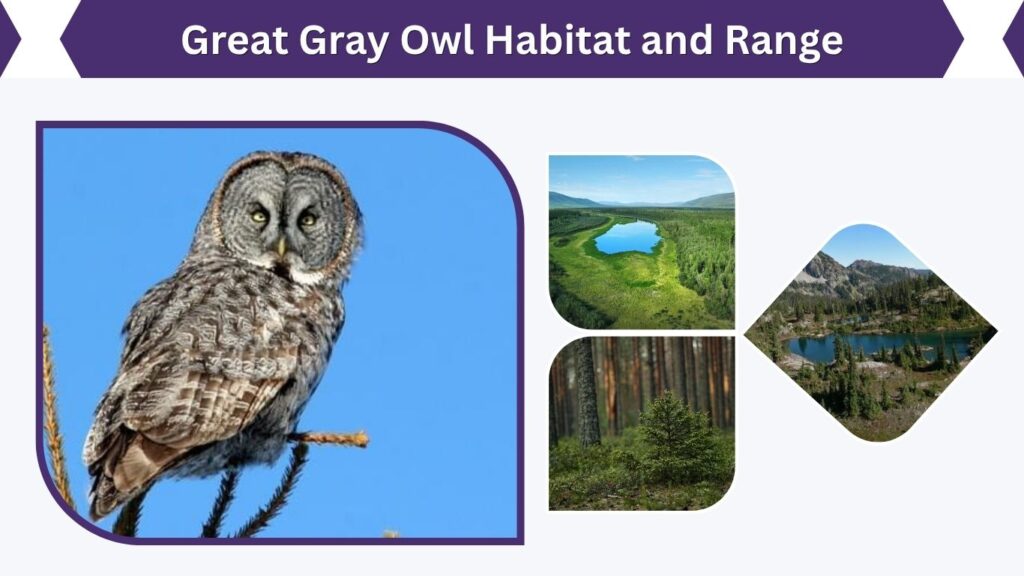
Great Gray Owls are strongly associated with northern coniferous forests, but they need openings where small mammals are abundant. An ideal landscape combines dense trees for resting and nesting with nearby meadows, bogs, fields, or clearings for hunting. In western North America, they also inhabit mountain forests adjoining open montane meadows.
Where Does the Great Gray Owl Live?
Important habitats include:
- Boreal forests
- Taiga
- Pine and fir forests
- Forested mountain regions
- Bogs and wetlands
- Meadows
- Forest clearings
- Aspen and mixed woodland
- Oak woodland during some winter movements
In the United States, suitable western mountain habitat may occur from roughly 2,500 to 7,500 feet in elevation.
Great Gray Owl Range
The species has a broad northern distribution covering parts of North America, Europe, and Asia. In North America, its primary range includes Alaska, Canada, and portions of the western United States.
Smaller populations occur in areas of the Rocky Mountains, Cascades, and Sierra Nevada. Most populations are considered resident rather than regular long-distance migrants.
What Is a Great Gray Owl Irruption?
During some winters, Great Gray Owls travel outside their usual range. These irregular movements are known as irruptions.
They are often linked to changes in populations of voles and other rodents. When prey becomes scarce in northern areas, owls may move farther south or to lower elevations searching for food.
Great Gray Owl Diet and Hunting
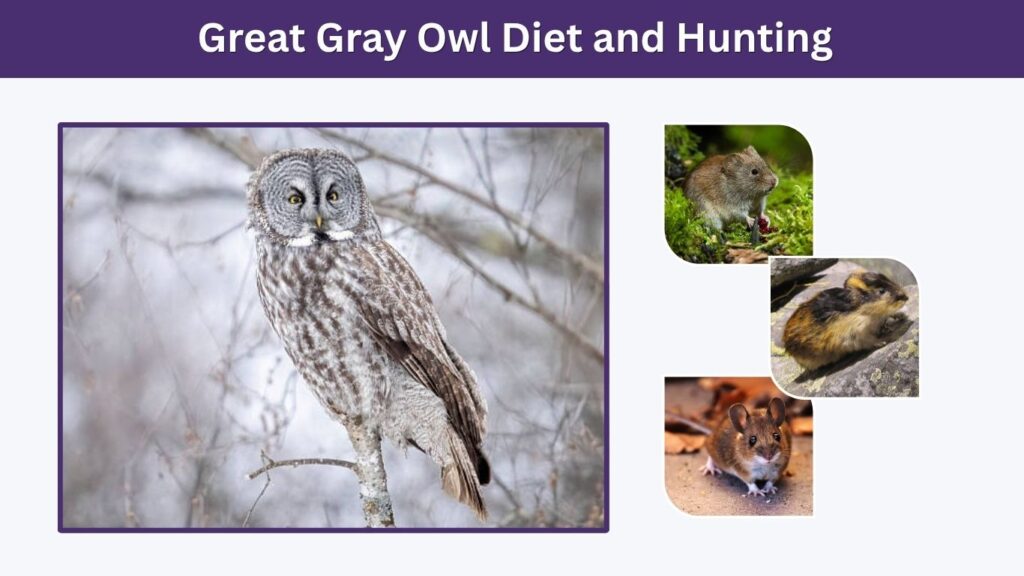
Small mammals dominate the Great Gray Owl’s diet. Its oversized face is not merely ornamental—the facial disk helps funnel sound toward asymmetrically positioned ear openings, giving the owl extremely precise hearing. This adaptation allows it to locate prey it cannot even see, including rodents moving underneath snow.
What Does a Great Gray Owl Eat?
Common prey includes:
- Voles
- Pocket gophers
- Mice
- Lemmings
- Moles
- Chipmunks
- Other small mammals
Voles and similarly sized rodents are particularly important prey. During winter, an adult may consume several vole-sized mammals per day.
Great Gray Owl Hunting Adaptations
The owl frequently waits quietly from a perch, listening for movement below. Once prey is detected, it launches, glides toward the sound, and plunges feet-first.
Its asymmetrical ears help determine the direction and distance of sound with exceptional accuracy. Great Grays can even capture rodents hidden beneath substantial snow cover.
Great Gray Owl in Flight
Great Gray Owls fly with slow, smooth wingbeats and often travel low across open meadows while hunting.
Soft feather structures help make owl flight remarkably quiet, allowing the bird to listen for prey while approaching without creating much flight noise. They may hunt at night, around dawn and dusk, and sometimes during daylight, particularly in winter or while feeding young.
Great Gray Owl Call and Sounds
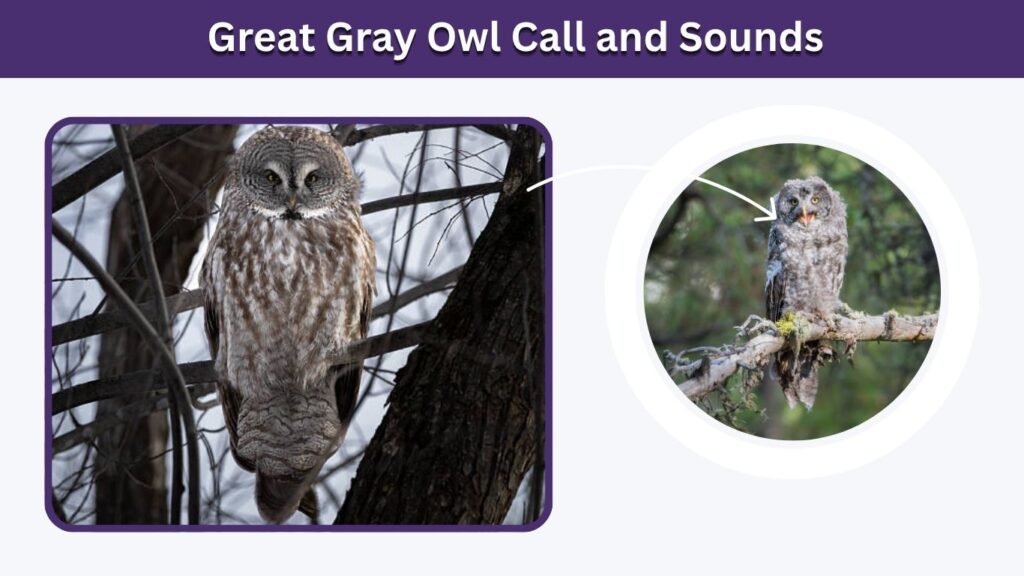
Despite its impressive appearance, the Great Gray Owl can be surprisingly difficult to detect. Vocal activity becomes especially important around the breeding season when males advertise territories and communicate with potential mates.
What Does a Great Gray Owl Sound Like?
The classic Great Gray Owl call is a series of deep, resonant hoots. Audubon describes the sound as booming hoots repeated many times, gradually descending in pitch.
Great Gray Owls can also produce other sounds depending on circumstances, including calls associated with courtship, alarm, begging young, and nest defense.
Because these owls can be sensitive to disturbance, birders should avoid repeatedly playing recordings to make wild birds respond. Cornell specifically advises against call playback when searching for them.
Great Gray Owl Nest and Life Cycle
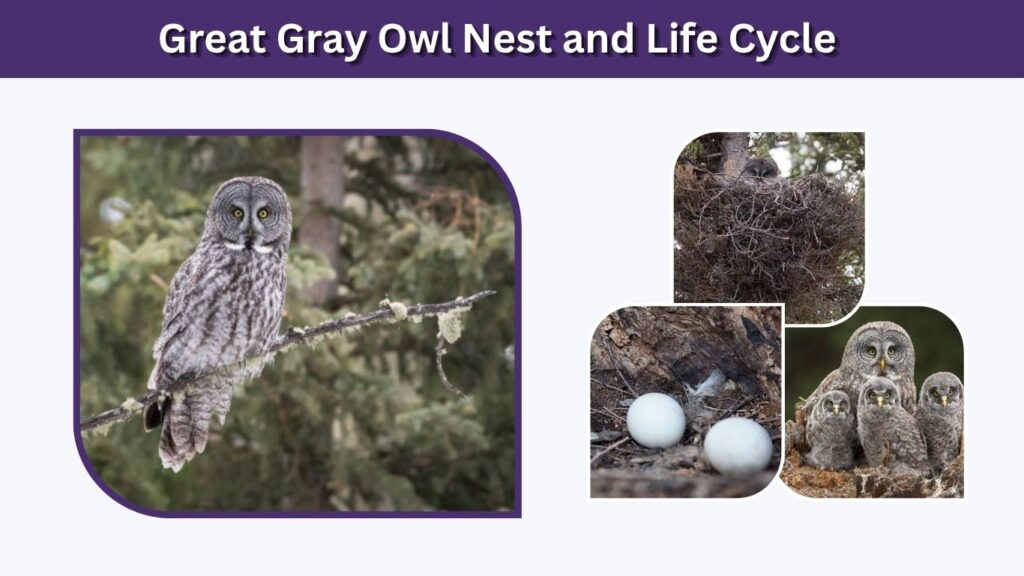
Great Gray Owls generally do not construct traditional nests from scratch. Instead, they take advantage of existing structures close to open hunting habitat. The availability of appropriate nesting sites can therefore be an important component of suitable breeding habitat.
Nesting and Reproduction
- Often use abandoned raven or raptor nests
- May nest in broken-topped dead trees
- Can use artificial nesting platforms
- Usually lay 2–5 eggs
- Incubation lasts about 28–36 days
- Nestlings remain at the nest approximately 26–29 days
- Females perform incubation
- Males supply much of the food during early nesting
Pairs defend the immediate nesting area from other owls and potential threats.
Great Gray Owl Lifespan
Wild individuals can live for many years. Cornell reports that the oldest documented Great Gray Owl in its North American longevity records was at least 18 years and 9 months old.
Actual lifespan varies widely because young and adult owls face threats from starvation, collisions, habitat change, severe weather, and other causes.
Is the Great Gray Owl Endangered?
Globally, the Great Gray Owl is not considered endangered. Cornell reports a Partners in Flight estimate of approximately 120,000 breeding individuals worldwide and places the species in a relatively low conservation-concern category.
However, conservation status can be dramatically different at the regional level.
Great Gray Owls in California and Yosemite
California’s Great Gray Owl population is particularly vulnerable. The species is listed as endangered in California, and Yosemite National Park reports an estimated state population of only about 200–300 individuals, with roughly 65% occurring in Yosemite.
These owls use forest-meadow environments at middle elevations for breeding and may move downslope during winter to find areas with less snow and easier access to rodents.
Great Gray Owl vs Barred Owl vs Great Horned Owl
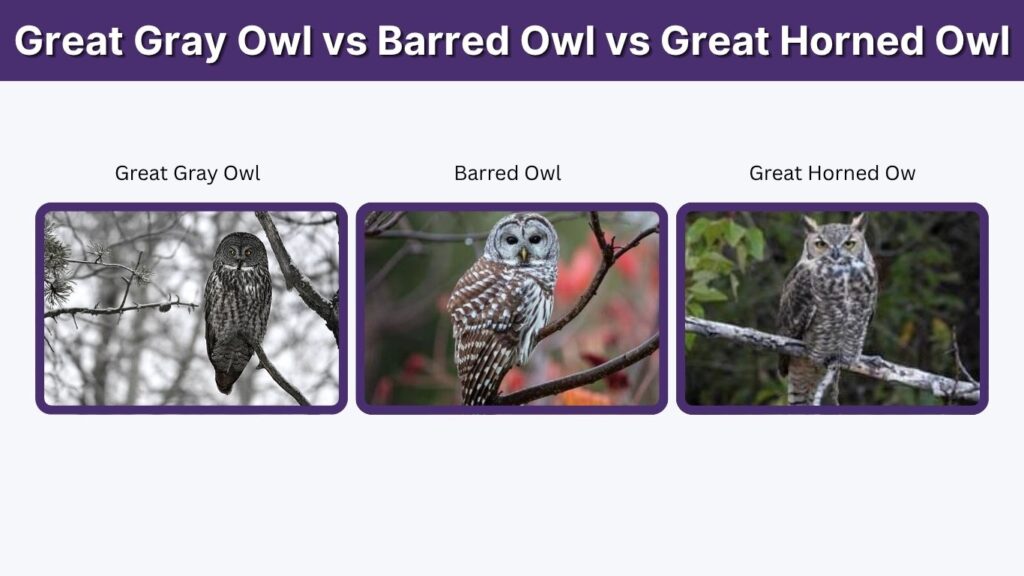
These three large North American owls can sometimes cause identification confusion, but several characteristics separate them.
Key Differences
Great Gray Owl: Very large round facial disk, yellow eyes, no ear tufts, long tail, gray plumage, and a white bow-tie marking.
Barred Owl: Smaller and more compact, with dark brown eyes and distinctive barred and streaked plumage.
Great Horned Owl: More powerful and heavier-bodied, with yellow eyes and conspicuous feather tufts resembling horns.
Although a Great Gray may appear larger than a Great Horned Owl, much of that apparent size comes from feathers rather than a heavier body.
Interesting Great Gray Owl Facts
- Strix nebulosa is the scientific name.
- It is one of the world’s tallest owls.
- Its wingspan can reach about five feet.
- Thick feathers make it appear heavier than it actually is.
- Its asymmetrical ears provide extremely accurate directional hearing.
- It can locate rodents beneath snow using sound.
- Great Grays lack the ear tufts seen on Great Horned Owls.
- Adults may hunt during both daylight and darkness.
- They often reuse nests constructed by other large birds.
- Populations sometimes irrupt southward when prey becomes scarce.
- The oldest recorded North American individual lived at least 18 years and 9 months.
FAQs
How Big Is a Great Gray Owl?
Adults are approximately 24–33.1 inches long, weigh about 24.7–60 ounces, and have a wingspan of roughly 53.9–60.2 inches. Females tend to be larger than males.
What Does a Great Gray Owl Sound Like?
Its best-known call consists of low, booming hoots that may be repeated numerous times and gradually descend in pitch.
Where Does the Great Gray Owl Live?
Great Gray Owls inhabit boreal forests across northern North America and Eurasia, with smaller populations extending south through western mountain forests. They prefer forest landscapes containing nearby meadows, bogs, or clearings for hunting.
What Does a Great Gray Owl Eat?
Its diet consists mainly of small mammals, particularly voles, pocket gophers, mice, lemmings, and related prey. Their powerful hearing enables them to locate rodents even when vegetation or snow hides them.
Is the Great Gray Owl Endangered?
Globally, the species is considered of relatively low conservation concern, but some regional populations are threatened. California, for example, lists the Great Gray Owl as endangered and supports only a few hundred individuals.