
The short-eared owl (Asio flammeus) is a medium-sized owl best known for hunting low over grasslands, marshes, tundra, and other open country. Unlike many owls, it is frequently active during daylight, especially around dawn and dusk. Its broad wings, yellow eyes, pale facial disk, dark eye patches, and tiny ear tufts make it distinctive. Short-eared owls occur across an exceptionally broad global range and primarily hunt voles, mice, and other small mammals. Their floating, moth-like flight makes them especially memorable when seen hunting over open fields.
What Is a Short-Eared Owl?
The short-eared owl belongs to the typical owl family Strigidae. Its scientific name is Asio flammeus. The “short ears” in its name are actually small feather tufts rather than external ears, and they can be so short that they are often invisible. The species is adapted to open landscapes rather than dense forests and is among the owls most likely to be seen hunting during daylight.
Short-Eared Owl Identification
Important identification features include:
- Medium-sized, crow-sized body
- Rounded head with very small ear tufts
- Bright yellow eyes surrounded by dark patches
- Pale facial disk
- Brown, buff, and white mottled plumage
- Heavily streaked breast
- Broad, rounded wings
- Short tail
- Pale underwings with dark wrist patches
- Low, buoyant hunting flight
The combination of bright yellow eyes, black eye patches, and broad wings is particularly helpful when identifying a bird in flight.
Short-Eared Owl Size and Wingspan
Adult short-eared owls measure approximately 34–43 cm (13.4–16.9 inches) long and weigh around 206–475 g (7.3–16.8 ounces). Their wingspan is considerably larger than their body length, reaching approximately 85–103 cm (33.5–40.5 inches).
Those broad wings are an important adaptation for slowly searching large areas of grassland while listening and watching for prey.
Short-Eared Owl Habitat and Range

Short-eared owls favor expansive landscapes with relatively low vegetation. They are strongly associated with environments where small mammals are abundant and where their low-flying hunting technique works effectively. Their habitat use can change seasonally, but open ground remains an important feature throughout the year.
Where Does the Short-Eared Owl Live?
Typical habitats include grasslands, prairie, coastal meadows, marshes, heathlands, shrubsteppe, savanna, tundra, dunes, agricultural fields, and other open areas. During winter, they may also use stubble fields, weedy areas, gravel pits, dumps, shrub thickets, and open spaces surrounded by woodland.
The short-eared owl is one of the world’s most widely distributed owl species. In North America, many populations migrate, although breeding and wintering ranges overlap across parts of the continent.
Short-Eared Owl Migration
Short-eared owls can be residents or medium-distance migrants depending on location. Their movements are strongly influenced by prey abundance, especially populations of voles and other small mammals.
When rodent populations increase in a particular region, short-eared owls may appear there in unusually large numbers and sometimes breed outside their usual concentration areas.
Short-Eared Owl Flying and Hunting
Watching a short-eared owl in flight is one of the easiest ways to recognize the species. It typically flies only a short distance above grass or marsh vegetation, weaving back and forth while searching for prey. Its flight often appears buoyant and somewhat moth-like rather than fast and direct.
How Does a Short-Eared Owl Hunt?
Short-eared owls rely heavily on acute hearing as well as vision. They fly slowly over open ground and may briefly hover before suddenly dropping onto prey.
They can hunt during daylight, particularly in the breeding season and at high northern latitudes, although dawn and dusk are especially productive times for observing them.
Their broad wings allow controlled low-speed flight, helping them search large areas without constantly perching.
What Does a Short-Eared Owl Eat?
Small mammals dominate the diet. Voles and mice are particularly important, but short-eared owls also take shrews, lemmings, rabbits, pocket gophers, rats, moles, bats, and occasionally larger small mammals.
Birds are also captured, especially in coastal habitats. Documented prey includes shorebirds, songbirds, rails, terns, gulls, and storm-petrels.
Short-Eared Owl Call and Sounds
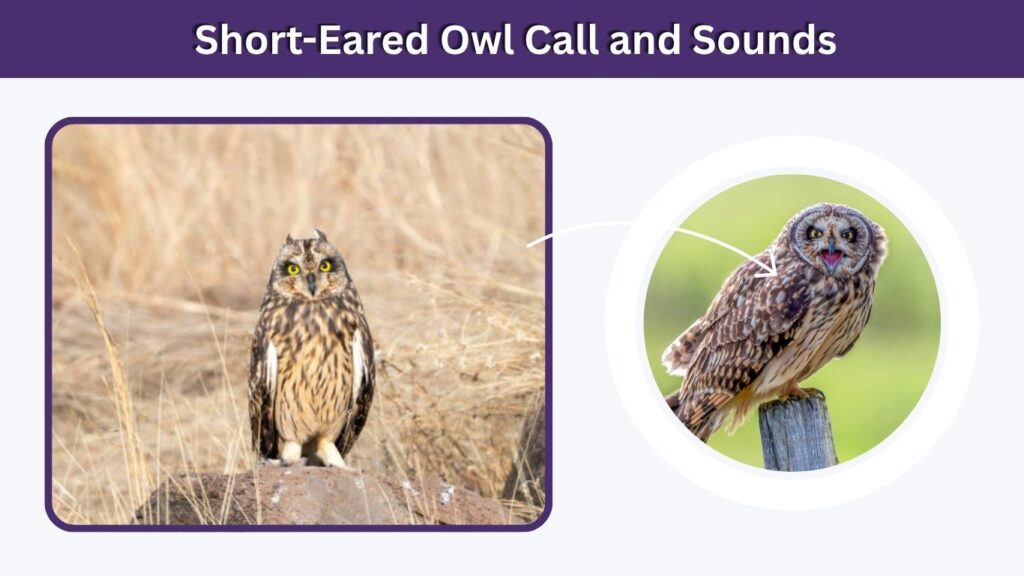
Short-eared owls are not among the most continuously vocal owl species. Their calls are most noticeable during courtship and territorial or nest-defense behavior. Vocalizations include hoots, barks, screams, whines, and other sounds depending on the situation.
What Does a Short-Eared Owl Sound Like?
Male courtship vocalizations can consist of a series of repeated hoots. Both sexes may produce barking, screaming, or whining calls while defending nests or young.
Females can also make a clucking sound. Another remarkable sound comes not from the voice but from wing-clapping during aerial displays, producing a rapid slapping noise.
So, although people sometimes search for a “short-eared owl hoot,” barking or yelping sounds may be more noticeable in many situations.
Short-Eared Owl Nesting and Eggs
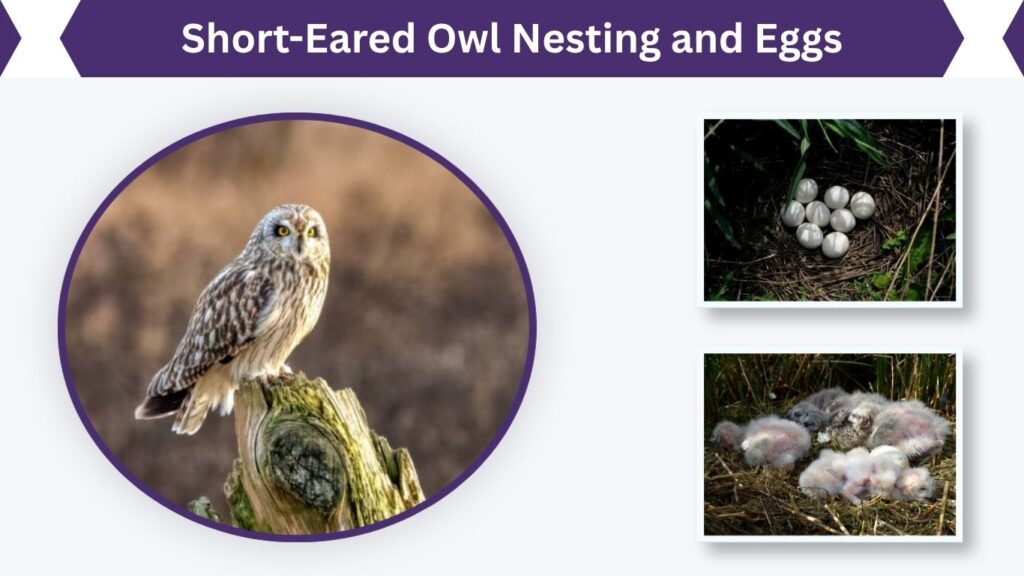
Short-eared owls are unusual among owls because they routinely nest on the ground and the female actually constructs a simple nest. Open vegetation provides camouflage, while slightly raised and dry locations help protect eggs from wet conditions.
Short-Eared Owl Nest
The female typically scrapes a shallow depression into the ground among grasses or low vegetation and lines it with grass and down feathers.
Nests are often positioned on hummocks, ridges, or other relatively dry places in open habitat.
Clutches can range from 1 to 11 eggs, and incubation generally lasts about 21–37 days. Young may begin leaving the nest on foot before they can fly well.
Short-Eared Owl Breeding Behavior
Courtship can be dramatic. Males perform aerial “sky dances,” climbing and diving while vocalizing and sometimes clapping their wings.
Males also bring food to incubating females and help defend the nesting territory. Short-eared owls may breed relatively close to one another when prey is abundant.
Hawaiian Short-Eared Owl: The Pueo
The Hawaiian short-eared owl, known as the pueo, is the subspecies Asio flammeus sandwichensis. It is endemic at the subspecies level to Hawaiʻi and occurs across the main Hawaiian Islands. Pueo are particularly well known for being active during daylight and for hunting over open habitats.
Pueo Habitat and Diet
Pueo occur from sea level to approximately 2,450 meters (8,000 feet) and use grasslands, shrublands, montane parklands, some forests, and even certain urban environments.
Like continental short-eared owls, they feed mainly on small mammals. Rats introduced to the Hawaiian Islands may have provided an important food source during or after the subspecies became established there.
The pueo is state-listed as endangered on Oʻahu.
Galápagos Short-Eared Owl
Short-eared owls also occur in the Galápagos Islands, illustrating the species’ remarkable ability to colonize remote islands.
Galápagos individuals belong to a distinctive regional population and occupy open landscapes where prey is available. Their presence is another example of the extremely broad geographic distribution of Asio flammeus.
Long-Eared Owl vs Short-Eared Owl
The long-eared owl is one of the species most often confused with the short-eared owl.
Long-eared owls have much more obvious ear tufts and usually roost in dense trees or woodland vegetation. Short-eared owls have tiny, often invisible ear tufts and spend much more time in open grassland and marsh habitat.
Nesting behavior also differs significantly. Short-eared owls normally nest on the ground, whereas long-eared owls usually occupy abandoned stick nests built by crows, magpies, hawks, or other birds.
Northern Harrier vs Short-Eared Owl
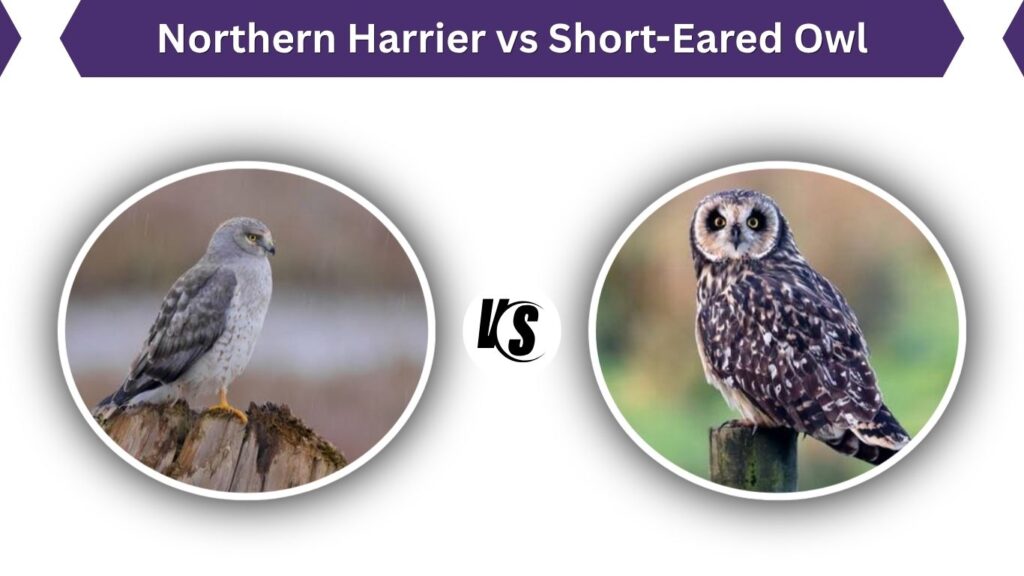
A hunting short-eared owl can sometimes be mistaken for a northern harrier because both fly low over open fields while searching for rodents.
The owl has a larger round head, shorter tail, broad rounded wings, and prominent facial disk. A northern harrier has a more hawk-like silhouette, proportionally longer tail, and different wing shape.
Both species can occur in the same grasslands, making careful observation important. Cornell specifically lists the northern harrier among the short-eared owl’s common look-alikes.
Is the Short-Eared Owl Endangered?
Globally, the species is still widespread, but conservation concerns exist because many populations have declined. Loss and fragmentation of large open habitats are particularly important threats.
Grassland conversion, development, intensive agriculture, recreation, and changing land management can reduce suitable nesting and hunting areas.
Because short-eared owls nest on the ground, breeding sites can also be vulnerable to disturbance.
Short-Eared Owl Lifespan
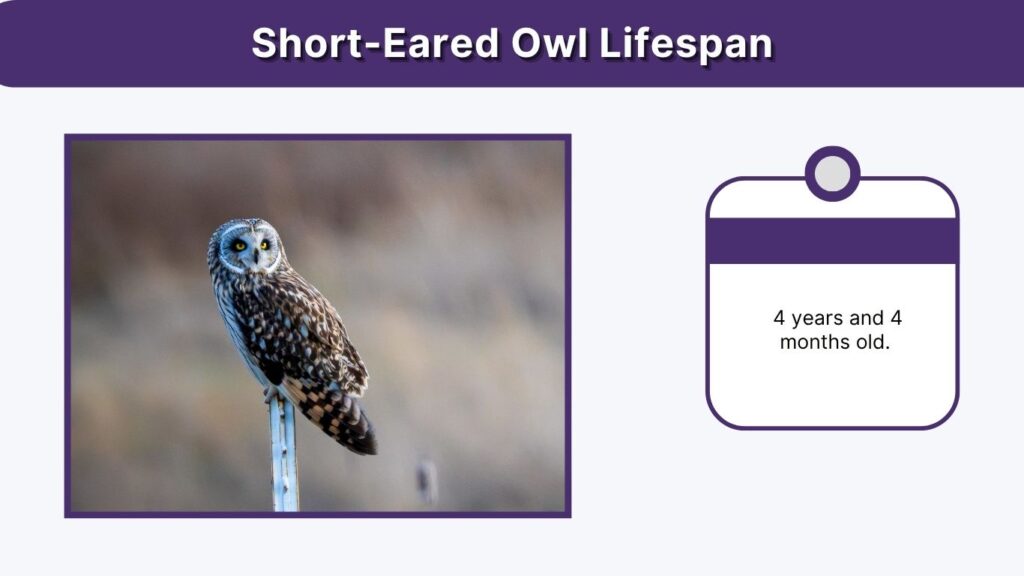
Wild lifespan varies considerably because birds face predation, disease, weather, collisions, and other hazards.
Cornell reports that the oldest recorded short-eared owl in its North American longevity records was at least 4 years and 4 months old. That figure represents a confirmed record from banding data rather than a maximum biological lifespan for every individual.
FAQs
How big is a short-eared owl?
Adults are approximately 34–43 cm long, with a wingspan of about 85–103 cm.
What does a short-eared owl eat?
It mainly eats voles, mice, and other small mammals, although birds and other prey are also taken.
Where do short-eared owls nest?
They normally nest directly on the ground in grasslands, marshes, tundra, and other open habitats.
What does a short-eared owl call sound like?
Males give repeated hoots during courtship, while both sexes may bark, scream, or whine when defending nests. They also produce audible wing-claps during display flights.
Are short-eared owls active during the day?
Yes. They are among the owls most frequently observed in daylight and commonly hunt around dawn and dusk.