
The Eurasian eagle-owl is a massive nocturnal predator recognized by its vivid orange eyes, prominent ear tufts, and heavily patterned plumage. Scientifically named Bubo bubo, it occurs across large parts of Europe and Asia and occupies habitats ranging from rocky mountains to forests and open grasslands. Its powerful talons, silent flight, excellent hearing, and varied diet place it near the top of the food chain.
Eurasian Eagle-Owl Overview
The Eurasian eagle-owl belongs to the true owl family, Strigidae. It is among the world’s largest and heaviest owls, with females noticeably bigger than males.
| Feature | Details |
| Scientific name | Bubo bubo |
| Family | Strigidae |
| Length | Approximately 56–75 cm |
| Wingspan | Approximately 131–188 cm |
| Weight | About 1.5–4.2 kg |
| Diet | Carnivorous |
| Activity | Primarily nocturnal |
| Lifespan | Around 20 years in the wild |
| Eggs | Usually 2–4 |
| Conservation status | Least Concern |
Measurements vary among sexes, geographic populations, and subspecies. Large females may approach 4 kg or more, while males are generally smaller and lighter.
Eurasian Eagle-Owl Identification and Physical Traits
A full-grown Eurasian eagle-owl has a broad head, thick body, long wings, and powerful feathered legs. Its mottled coloring provides camouflage against tree bark, rocks, and dry vegetation.
Identification
- Bright orange or reddish-orange eyes
- Long blackish ear tufts
- Mottled brown, buff, cream, and black feathers
- Dark streaks across the chest
- Fine bars across the lower body
- Large black bill
- Strong feathered feet and curved talons
- Broad, rounded wings
- White throat patch
The ear tufts are feathers rather than external ears. They may help with communication, camouflage, and displaying the owl’s mood, but they do not directly improve hearing.
Eurasian Eagle-Owl Size and Wingspan
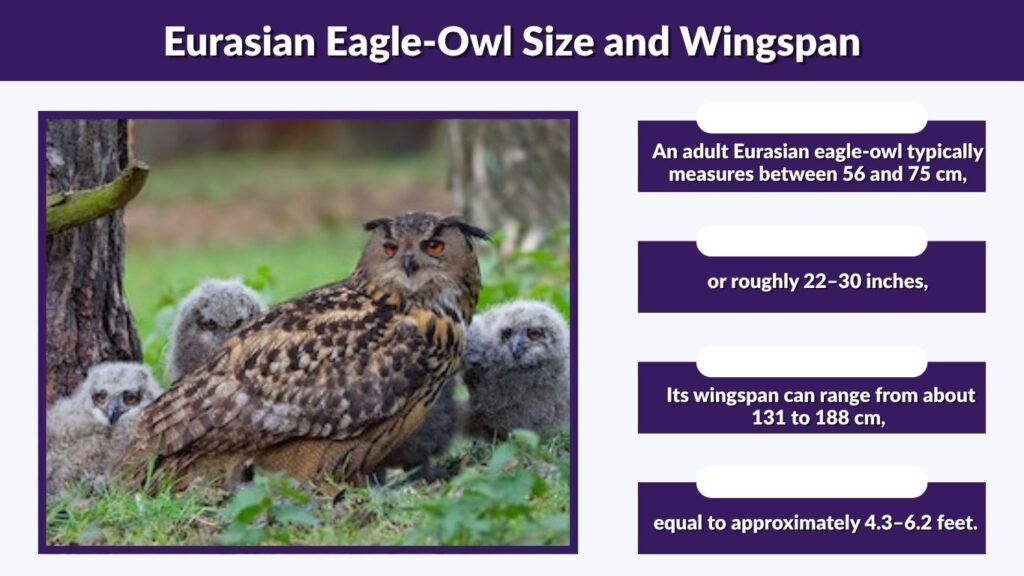
An adult Eurasian eagle-owl typically measures between 56 and 75 cm, or roughly 22–30 inches, from head to tail. Its wingspan can range from about 131 to 188 cm, equal to approximately 4.3–6.2 feet.
Females are larger and heavier than males. This size difference is common among birds of prey and may help the sexes use somewhat different prey sizes while sharing a territory.
Size Comparison
A large Eurasian eagle-owl can stand nearly as tall as a small child’s upper leg. When its wings are fully extended, the bird may span wider than an average adult person is tall.
Despite its heavy appearance, the owl flies quietly. Specialized soft edges on its flight feathers reduce turbulence and sound, allowing it to approach prey with little warning.
Eurasian Eagle-Owl Habitat and Geographic Range
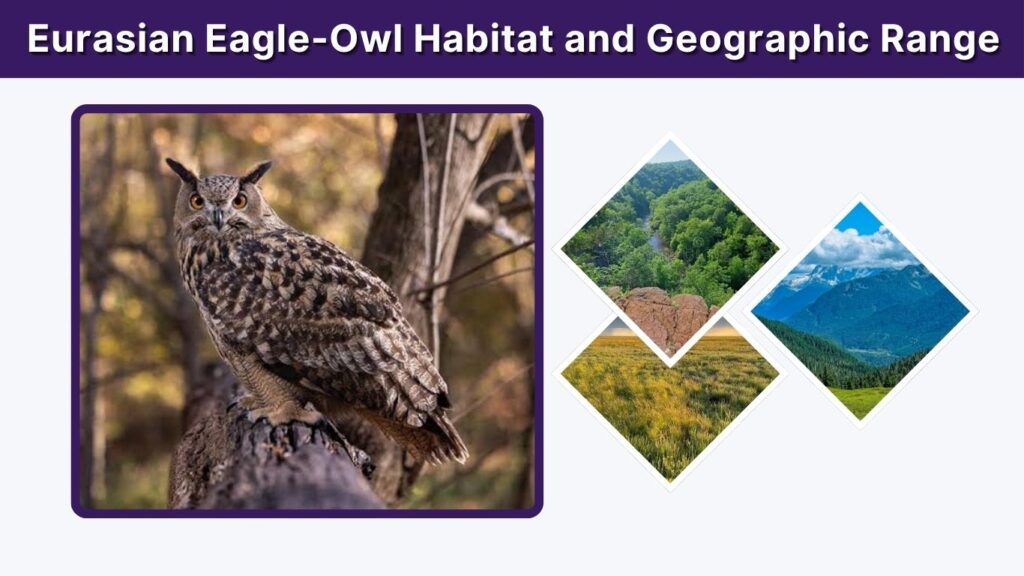
Eurasian eagle-owls have an extensive distribution across Europe, the Middle East, and much of northern and central Asia. Different populations occupy cold northern regions, Mediterranean environments, mountains, dry steppes, and areas near deserts.
Preferred Habitats
They may live in:
- Rocky cliffs and ravines
- Mountain forests
- Coniferous and mixed woodland
- Grasslands and steppes
- Agricultural landscapes
- River valleys
- Marshes and wetlands
- Coastal cliffs
- Quarries and other modified environments
Rocky areas are especially valuable because they provide sheltered nesting ledges and daytime roosts. The surrounding landscape usually needs open hunting areas and a reliable supply of mammals or birds.
What Do Eurasian Eagle-Owls Eat?
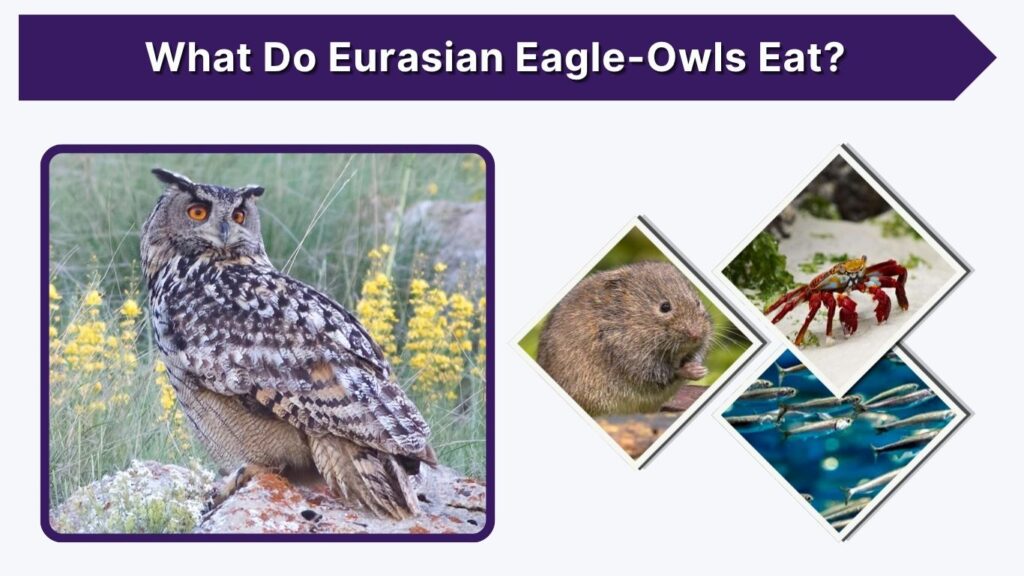
The Eurasian eagle-owl is a carnivore and opportunistic predator. Small and medium-sized mammals usually form an important part of its diet, but the exact prey changes according to location and availability.
Common foods include:
- Rats and mice
- Voles
- Rabbits and hares
- Squirrels
- Hedgehogs
- Ducks and other waterbirds
- Pigeons and crows
- Smaller owls and raptors
- Reptiles
- Frogs
- Fish
- Large insects
Most prey is much smaller than the owl. However, powerful individuals may occasionally attack young foxes, small deer, or other comparatively large animals. Such prey should not be considered their normal daily food.
Hunting Behavior and Adaptations
Eurasian eagle-owls are mainly active after sunset and before sunrise. They commonly watch from an elevated perch before flying toward prey detected through sight or sound.
Hunting Adaptations
Their most important adaptations include:
- Large eyes adapted to dim light
- Sensitive hearing for detecting hidden prey
- Facial feathers that direct sound toward the ears
- Silent flight feathers
- Strong legs and sharp talons
- Camouflaged plumage
- A hooked bill for tearing meat
- Flexible neck movement
Like other owls, they swallow some prey whole. Indigestible bones, fur, teeth, and feathers are later compressed and regurgitated as pellets. Scientists can examine these pellets to determine what the owls have eaten.
Eurasian Eagle-Owl Sound
The best-known Eurasian eagle-owl call is a deep, resonant hoot. The sound can travel over long distances and is commonly used to advertise territory or communicate between mates.
The owl can also produce barks, growls, whistles, and bill-snapping sounds. Vocal activity is often more noticeable during courtship and the breeding season. Although the bird is large, its nocturnal habits and camouflage mean it is frequently heard before it is seen.
Nesting, Eggs, and Chicks
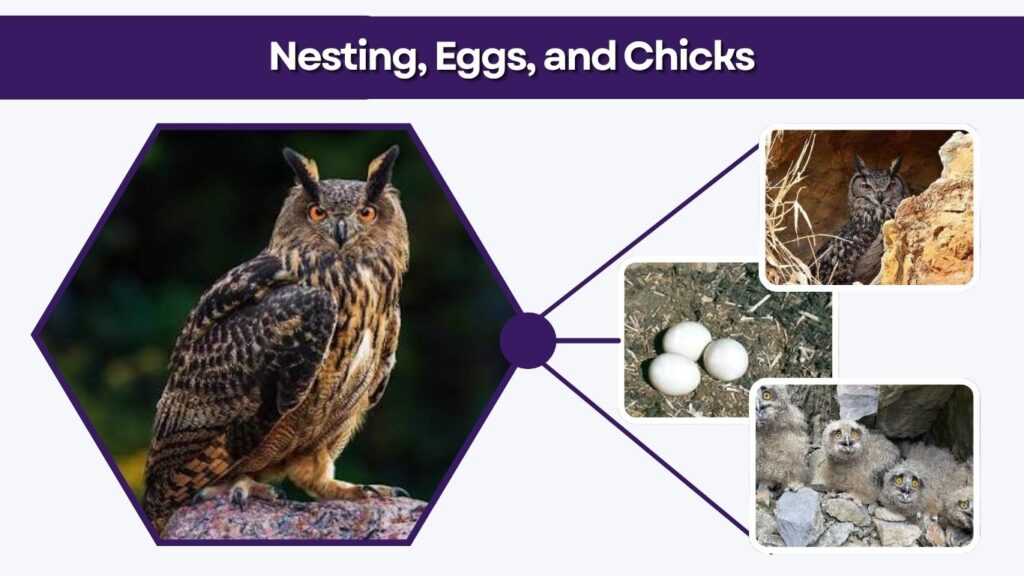
Eurasian eagle-owls are generally monogamous and may maintain long-term pair bonds. Courtship includes calling, displaying, and sometimes presenting food.
They do not normally construct elaborate stick nests. Instead, nesting locations may include:
- Sheltered cliff ledges
- Rock crevices
- Cave entrances
- Ground depressions
- Abandoned nests of large birds
- Quarries
- Occasionally protected human-made structures
A female commonly lays two to four eggs, although clutch size can vary. She performs most of the incubation while the male supplies food. Incubation lasts approximately one month. After hatching, the chicks remain dependent on their parents for food and protection while developing their flight skills.
Lifespan and Predators
Eurasian eagle-owls can live for approximately 20 years in the wild. Individuals in managed human care may survive much longer, with some reported lifespans exceeding 50 years.
Healthy adults have few natural predators because of their strength and position near the top of the food chain. Eggs and young chicks are more vulnerable to foxes, martens, other birds of prey, and disturbance.
Major human-related risks include collisions with vehicles or power lines, electrocution, habitat disturbance, poisoning, and illegal persecution. Globally, however, the species is currently classified as Least Concern.
Eurasian Eagle-Owl vs Great Horned Owl
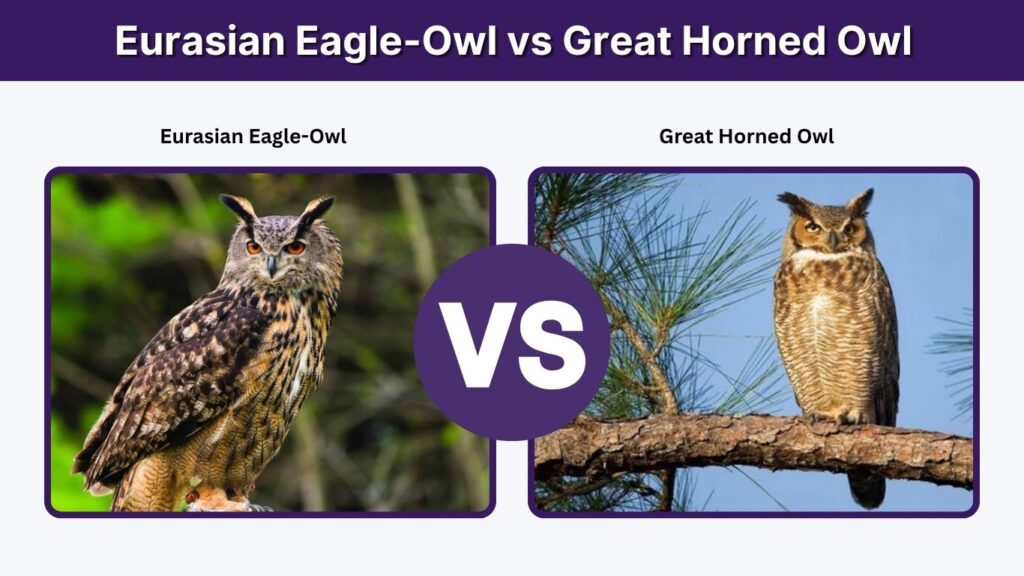
The Eurasian eagle-owl and great horned owl belong to the same genus and share prominent ear tufts, strong talons, and mottled plumage. However, they live naturally on different continents.
| Feature | Eurasian Eagle-Owl | Great Horned Owl |
| Scientific name | Bubo bubo | Bubo virginianus |
| Natural range | Europe and Asia | North and South America |
| Length | Up to about 75 cm | Up to about 63 cm |
| Maximum wingspan | Around 188 cm | Around 145 cm |
| Eye color | Usually orange | Usually yellow |
| Overall build | Generally larger and heavier | Large but usually smaller |
The Eurasian eagle-owl is generally larger, especially in wingspan and maximum weight. The great horned owl has a more defined facial pattern and yellow eyes, whereas the Eurasian species typically has bright orange eyes.
Can Eurasian Eagle-Owls Be Pets?
Eurasian eagle-owls are not suitable conventional pets. They are powerful wild predators requiring extensive space, specialized food, professional handling, veterinary expertise, and secure facilities.
Their talons can cause severe injuries, and their natural behaviors cannot be met in an ordinary home. Ownership and transport are also regulated in many countries, so anyone involved in legal falconry, rehabilitation, or captive management must follow local wildlife laws.
FAQs
Are Eurasian eagle-owls aggressive?
They generally avoid people but can defend their nest, chicks, or territory. A cornered or habituated bird may strike with its powerful feet. Wild individuals should always be observed from a respectful distance.
Can a Eurasian eagle-owl kill a human?
A healthy adult is physically capable of causing serious injury, but attacks on people are exceptionally uncommon. Humans are not normal prey. Most conflicts occur when someone approaches a nest, handles a captive bird improperly, or corners an owl.
How strong are Eurasian eagle-owl talons?
Their talons are strong enough to capture and restrain rabbits, birds, and other substantial prey. Reliable standardized measurements of grip strength are limited, so dramatic numerical claims found online should be treated cautiously.
Are white Eurasian eagle-owls albino?
Not necessarily. Some northern subspecies naturally have much paler plumage. True albinism would involve unusually reduced pigmentation, often affecting the eyes as well as the feathers, and is considerably rarer.
Are Eurasian eagle-owls endangered?
The species is globally classified as Least Concern. However, individual regional populations may face habitat damage, poisoning, electrocution, collisions, and persecution, making local conservation and nest protection important.