The Eurasian eagle-owl and great horned owl are two powerful, tufted owls belonging to the genus Bubo. Their heavy bodies, prominent feather tufts, strong feet, and nocturnal hunting habits make them look closely related. However, they live on different continents and differ noticeably in size, eye color, markings, habitat, and prey. The Eurasian eagle-owl is generally larger and heavier, while the great horned owl is exceptionally adaptable and occupies an enormous variety of habitats across the Americas.
Quick Comparison
Both species are formidable predators, but the Eurasian eagle-owl usually has the advantage in overall body mass and wingspan.
| Feature | Eurasian Eagle-Owl | Great Horned Owl |
| Scientific name | Bubo bubo | Bubo virginianus |
| Native range | Europe and Asia | North, Central, and South America |
| Length | Up to about 30 inches | About 18–25 inches |
| Wingspan | Approximately 4.5–6 feet | Approximately 3.3–4.8 feet |
| Weight | About 3–10 pounds | About 2–5.5 pounds |
| Eye color | Usually orange | Usually yellow |
| Main prey | Mammals and birds | Mammals, birds, reptiles, and other prey |
| Ear tufts | Long and prominent | Broad and prominent |
| Conservation concern | Generally low globally | Generally low globally |
The measurements overlap because sex, subspecies, age, and geography influence an individual owl’s size. Females are larger than males in both species.
Appearance and Identification
At first glance, the two owls have similar broad heads, upright ear tufts, rounded wings, hooked bills, and heavily mottled feathers. Their colors help them blend into trees, rocky cliffs, and dry vegetation during daylight.
Eurasian Eagle-Owl Identification
The Eurasian eagle-owl usually has vivid orange or reddish-orange eyes. Its plumage combines brown, black, cream, and buff markings, while its chest commonly has strong dark streaks. It has a broad body, long wings, feathered legs, and a pale throat patch.
Its ear tufts can appear tall and pointed when the bird is alert. These structures are feathers rather than true ears and do not directly improve hearing. The owl’s actual ears are hidden beneath the feathers on the sides of its head.
Great Horned Owl Identification
The great horned owl usually has bright yellow eyes, a reddish-brown facial disk, and a clean white throat patch. Its underparts are marked with narrow horizontal bars, while its back is covered with gray, brown, and black mottling.
Color varies across its wide range. Great horned owls in humid northwestern forests can be dark, while individuals living in deserts and dry areas are often much paler.
Eurasian Eagle-Owl vs Great Horned Owl Size
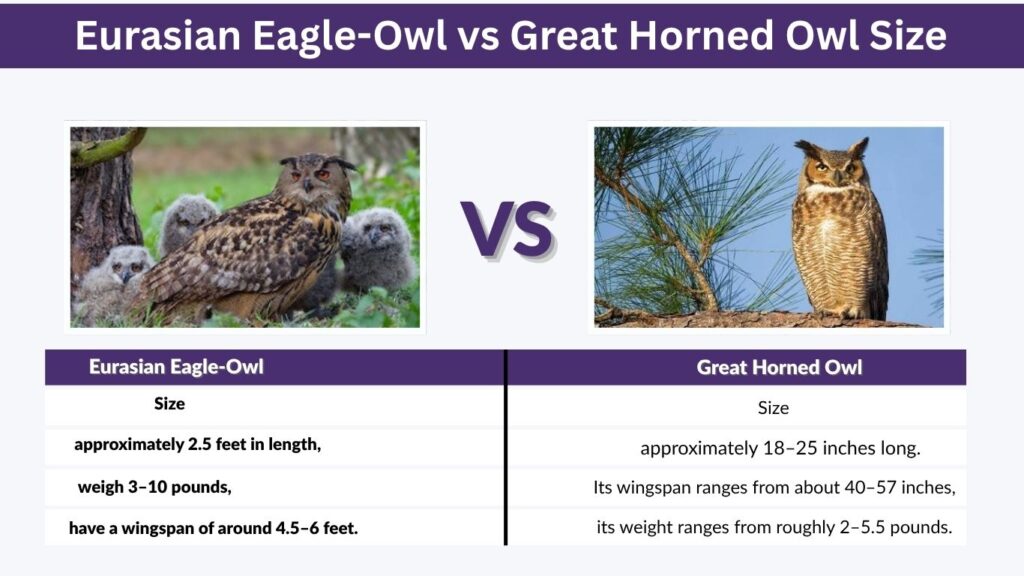
Size is the clearest difference between these species. The Eurasian eagle-owl can reach approximately 2.5 feet in length, weigh 3–10 pounds, and have a wingspan of around 4.5–6 feet. It is among the heaviest living owls.
The great horned owl measures approximately 18–25 inches long. Its wingspan ranges from about 40–57 inches, and its weight ranges from roughly 2–5.5 pounds. Large female great horned owls can look imposing, but they generally remain smaller than large female Eurasian eagle-owls.
Which Owl Is Bigger?
The Eurasian eagle-owl is usually bigger in all three major measurements:
- Greater average body mass
- Longer maximum wingspan
- Greater maximum body length
A particularly large female Eurasian eagle-owl may weigh nearly twice as much as a medium-sized great horned owl. However, a small male Eurasian eagle-owl and a large female great horned owl could be closer in size.
Habitat and Geographic Range

The two species do not naturally share most of their geographic ranges. Their similar appearance results from their close relationship and comparable predatory lifestyles rather than regularly living together.
Eurasian Eagle-Owl Habitat
The Eurasian eagle-owl occurs across much of Europe and Asia. It lives in rocky cliffs, wooded hills, mountains, river valleys, steppes, semideserts, and landscapes containing both cover and open hunting ground.
Rocky cliffs and ledges are particularly important because they provide secure nesting and daytime roosting locations. The species may also occupy quarries and other modified habitats when disturbance is limited and prey remains available.
Great Horned Owl Habitat
The great horned owl occupies an exceptionally broad range across the Americas. It lives in deciduous and evergreen forests, swamps, deserts, agricultural areas, tropical forests, tundra edges, suburban parks, orchards, and cities.
It generally benefits from a mixture of wooded cover and open hunting areas. Its ability to use different habitats and nesting locations is one reason it is so widespread.
Diet and Hunting Behavior
Both owls are carnivorous ambush predators. They normally hunt from a perch, detect prey through sight and hearing, and then approach with quiet wingbeats before striking with their feet.
What Eurasian Eagle-Owls Eat
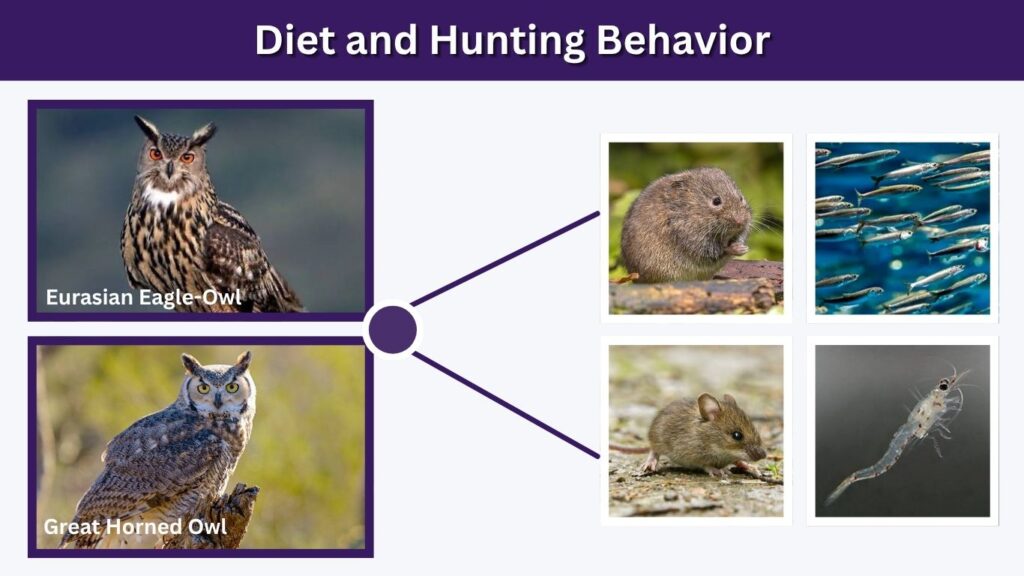
Eurasian eagle-owls commonly eat rats, mice, voles, rabbits, hares, pigeons, ducks, crows, and other medium-sized animals. They may also capture reptiles, amphibians, fish, and other birds of prey.
Large prey such as small foxes or very young deer may occasionally be taken, but rodents, rabbits, and birds represent more typical food. Their broad diet helps them survive in habitats that change seasonally.
What Great Horned Owls Eat
Great horned owls have one of the most varied diets among North American raptors. They eat mice, rats, rabbits, hares, squirrels, skunks, bats, ducks, geese, crows, hawks, smaller owls, reptiles, insects, fish, and occasionally carrion.
They usually hunt at night but may also hunt during daylight, especially when feeding demands are high or food is difficult to find.
Strengths and Hunting Adaptations
Both owls possess adaptations that make them effective nocturnal hunters.
Shared Adaptations
- Powerful feathered legs
- Sharp, curved talons
- Hooked bills for tearing food
- Broad wings suited to controlled flight
- Soft-edged feathers that reduce flight noise
- Facial disks that help direct sound
- Excellent low-light vision
- Camouflaged plumage
- Flexible neck movement
The Eurasian eagle-owl’s main physical advantage is its greater size and mass. The great horned owl’s major advantage is its extreme adaptability. It can hunt in forests, deserts, wetlands, farms, and urban environments while exploiting a wide range of prey.
Calls and Sounds
The Eurasian eagle-owl produces a deep, resonant hoot that carries across cliffs and valleys. It can also make barks, whistles, growls, and bill-snapping sounds. Calling is especially important during territorial displays and courtship.
The great horned owl gives a recognizable sequence of low, far-carrying hoots. Males generally have deeper voices than females, although females are physically larger. The species also produces screams, hisses, bill-clapping, and other defensive sounds.
Nesting and Reproduction
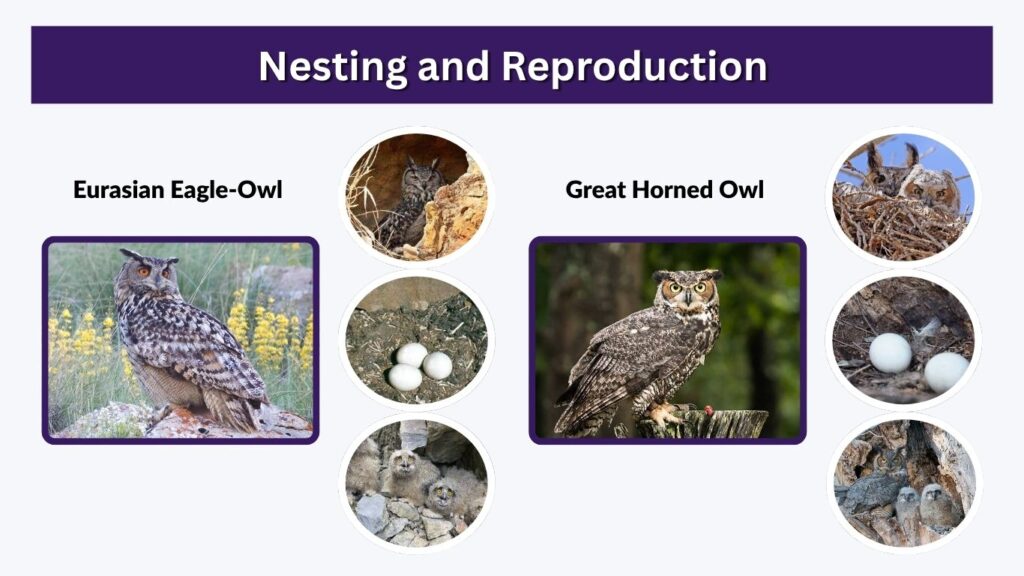
Eurasian eagle-owls commonly nest on rocky ledges, in crevices, in sheltered ground depressions, or at abandoned nesting sites. They do not usually construct an elaborate nest.
Great horned owls frequently occupy nests previously built by hawks, crows, ravens, herons, or squirrels. They may also use tree cavities, cliffs, buildings, platforms, or occasionally the ground. A typical great horned owl clutch contains one to four eggs.
Both species are strongly territorial during the breeding season. Adults may defend nests aggressively when people or animals approach too closely.
Eurasian Eagle-Owl vs Great Horned Owl: Who Would Win?
A direct fight would be unnatural because these owls originate from different regions and normally have no reason to encounter each other. The outcome would also depend on sex, age, health, surprise, location, and which bird initiated the encounter.
In a theoretical comparison between two healthy adults, the Eurasian eagle-owl would usually have the physical advantage because it is generally heavier and has a longer wingspan. Greater body mass could provide more force during a close struggle.
However, size does not guarantee a predictable outcome. Great horned owls are aggressive territorial predators with powerful feet and experience attacking other raptors. Either owl could be seriously injured, so claims of a guaranteed winner are not scientifically supportable.
Which Owl Is More Powerful?
The Eurasian eagle-owl is generally the more physically powerful species because of its larger maximum size. The great horned owl remains one of the strongest and most formidable owls in the Americas and is capable of killing prey larger than many people expect.
Reliable scientific comparisons of their talon grip strength are limited. Exact grip-force figures repeated online should therefore be treated carefully unless they come from controlled measurements.
FAQs
Are Eurasian eagle-owls related to great horned owls?
Yes. Both belong to the genus Bubo and the family Strigidae. Their shared features include prominent ear tufts, powerful feet, broad wings, nocturnal behavior, and strongly carnivorous diets.
Can the two owl species live in the same area?
Their natural ranges are largely separate. Eurasian eagle-owls inhabit Europe and Asia, while great horned owls occur throughout the Americas. An escaped or captive bird could create an unusual overlap, but this is not their normal situation.
Which owl has the larger wingspan?
The Eurasian eagle-owl has the largest maximum wingspan. It may reach about six feet across, while the great horned owl typically reaches a maximum of approximately 4.8 feet.
Which owl has larger eyes?
Both have proportionally large eyes adapted to low-light hunting. The Eurasian eagle-owl’s orange eyes may appear more dramatic, but visible eye size alone is not a useful measure of hunting ability.
Which species is more adaptable?
The great horned owl is especially adaptable. It occupies forests, deserts, wetlands, farmland, suburbs, parks, and cities across a vast geographic range. Eurasian eagle-owls also use diverse habitats but are often closely associated with rocky nesting areas.