
The African Wood Owl (Strix woodfordii) is a medium-sized nocturnal owl found throughout much of sub-Saharan Africa. It has a rounded head, large dark eyes, barred brown plumage, and no ear tufts. Although it is widespread in suitable habitat, its camouflage and nighttime habits make it difficult to see. Its rhythmic hooting call is often the first sign that a pair is living in a nearby forest, woodland, plantation, or tree-filled garden.
African Wood Owl Overview
The African Wood Owl belongs to the true owl family, Strigidae. It was formerly placed in the genus Ciccaba but is now classified within Strix.
| Feature | Details |
| Scientific name | Strix woodfordii |
| Family | Strigidae |
| Adult height | About 33 cm |
| Typical weight | Around 240–350 g |
| Color | Brown, rufous, buff, and white |
| Eyes | Dark brown to black |
| Activity | Nocturnal |
| Diet | Mainly insects and small vertebrates |
| Nest | Natural tree cavity |
| Typical clutch | 1–2 eggs |
| Incubation | About 31 days |
| Conservation status | Least Concern |
The species is a mostly sedentary resident of forests and well-wooded habitats, although young birds disperse after becoming independent.
What Does an African Wood Owl Look Like?
The African Wood Owl is a compact, heavily barred owl with broad wings and a large rounded head. It lacks the upright feather tufts seen on many eagle-owls.
Identification
Important identification features include:
- Large, dark eyes
- Rounded head without ear tufts
- Pale facial disc bordered by darker feathers
- White eyebrow-shaped facial markings
- Brown or rufous upperparts
- Strong horizontal barring across the chest
- Barred wings and tail
- Yellow bill and feet
- Legs feathered down to the toes
Color varies geographically and between individuals. Some birds are dark chocolate-brown, while others appear pale buff or reddish-brown. The combination of dark eyes, white facial crescents, and heavily barred underparts is especially useful for identification.
Male vs. Female
Males and females have similar plumage, so they are difficult to distinguish visually. Females are generally heavier and may weigh about 30% more than males.
Despite being smaller, the male usually gives the deeper call. Listening to a pair vocalizing together may therefore provide a better clue to sex than appearance alone.
African Wood Owl Distribution
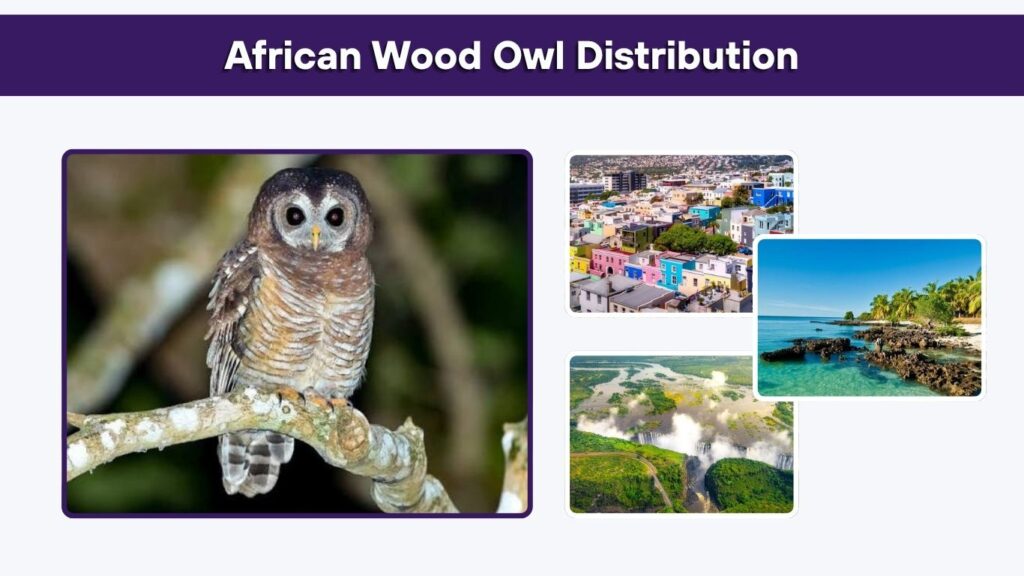
African Wood Owls occur widely across sub-Saharan Africa. Their range extends through parts of West, Central, East, and southern Africa.
They have been recorded in countries including:
- South Africa
- Mozambique
- Zimbabwe
- Botswana
- Namibia
- Eswatini
- Kenya
- Uganda
- Tanzania
- Zambia
- Malawi
- Angola
- Cameroon
- Ghana
- Nigeria
The species occurs in more than 30 African countries south of the Sahel. Most populations remain in the same general region throughout the year rather than undertaking long-distance migrations.
African Wood Owl Habitat
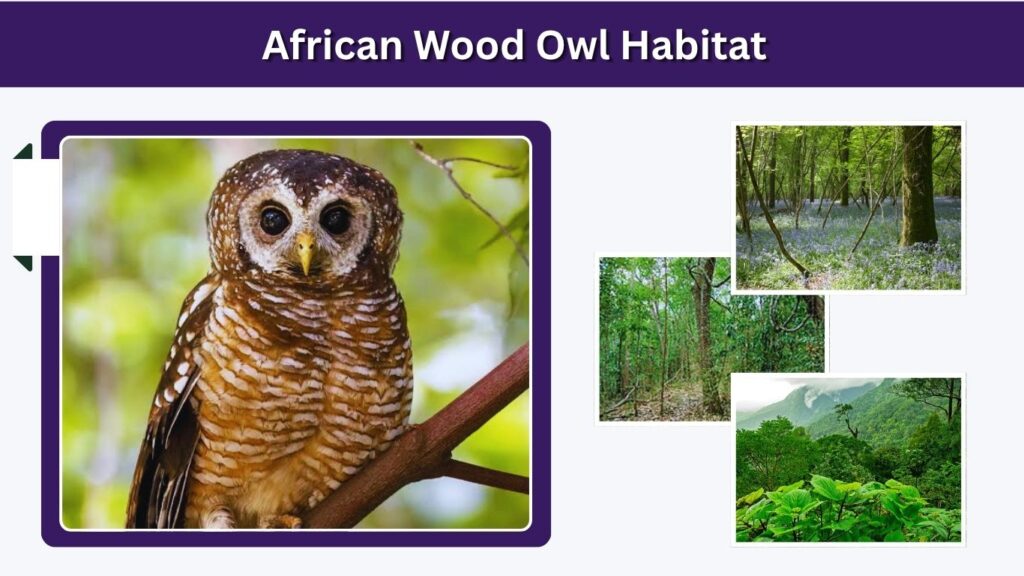
This owl depends on trees and dense vegetation. Common habitats include:
- Moist evergreen forest
- Tall deciduous woodland
- Riverine forest
- Coastal bush
- Forest edges
- Plantations
- Pine and eucalyptus stands
- Large, tree-filled gardens
It has been recorded at elevations of up to approximately 2,100 meters. In some regions, African Wood Owls have expanded into wooded suburban areas near natural forest. Mature trees remain important because they provide daytime roosts and nesting cavities.
African Wood Owl Call and Sound
The African Wood Owl is highly vocal after dark. A bird may begin calling soon after leaving its daytime roost and continue at intervals through much of the night.
What Does the Call Sound Like?
The best-known call is a rhythmic series of deep hoots that is sometimes interpreted as:
“Who-who, who-who-who”
or
“Who-are-you?”
The male can also give a long, rising hoot, while pairs produce a gruff, rising-and-falling series of notes. Males and females frequently alternate or duet, especially while defending their territory or strengthening their pair bond. Young owls produce shorter wheezing begging calls.
Individual calls can be distinctive enough for researchers to identify particular owls and monitor how long adults remain within a territory.
What Do African Wood Owls Eat?
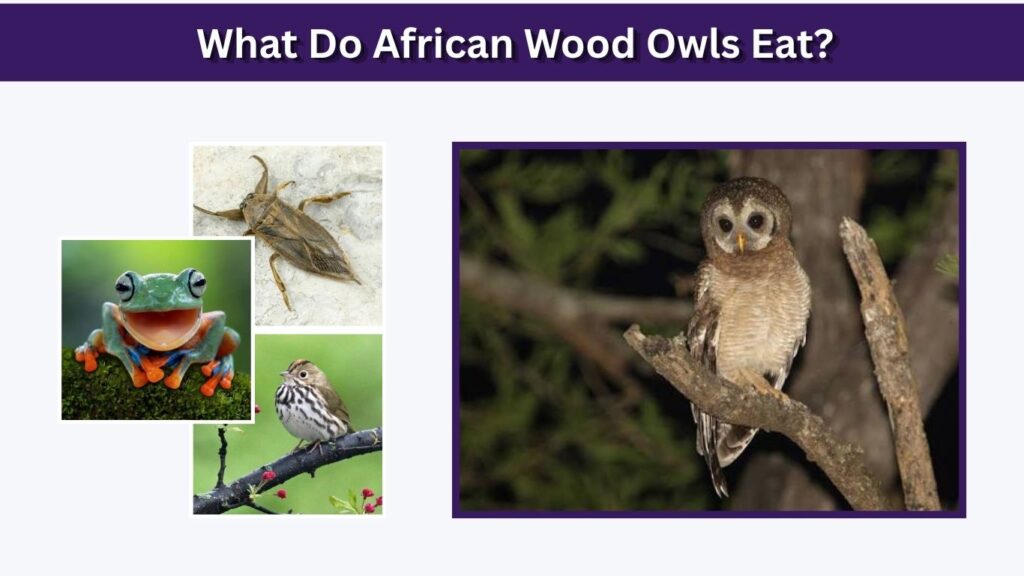
African Wood Owls are opportunistic carnivores, but invertebrates form an especially important part of their diet.
Common Foods
Their prey includes:
- Beetles and other large insects
- Moths and caterpillars
- Grasshoppers and katydids
- Centipedes
- Rodents
- Shrews and other small mammals
- Small birds
- Frogs
- Small snakes
- Bats
The owl commonly waits on a low perch and listens for movement below. Once prey is detected, it drops silently onto the ground and captures it with its talons. It may also catch insects or bats in flight and pick insects directly from vegetation.
Its relatively small talons reflect its reliance on insects and other modest-sized prey rather than the larger animals taken by some eagle-owls.
Behavior and Daily Activity
The African Wood Owl is primarily nocturnal. During the day, it rests quietly among dense foliage, where its barred brown plumage blends into branches, leaves, and tree bark.
After sunset, it leaves its roost to call and hunt. It may use forest clearings, paths, riverbanks, garden lawns, and woodland edges where prey is easier to detect.
Pairs are territorial and may occupy the same area for many years. Their calls advertise ownership of the territory and help maintain the pair bond.
Nesting and Breeding
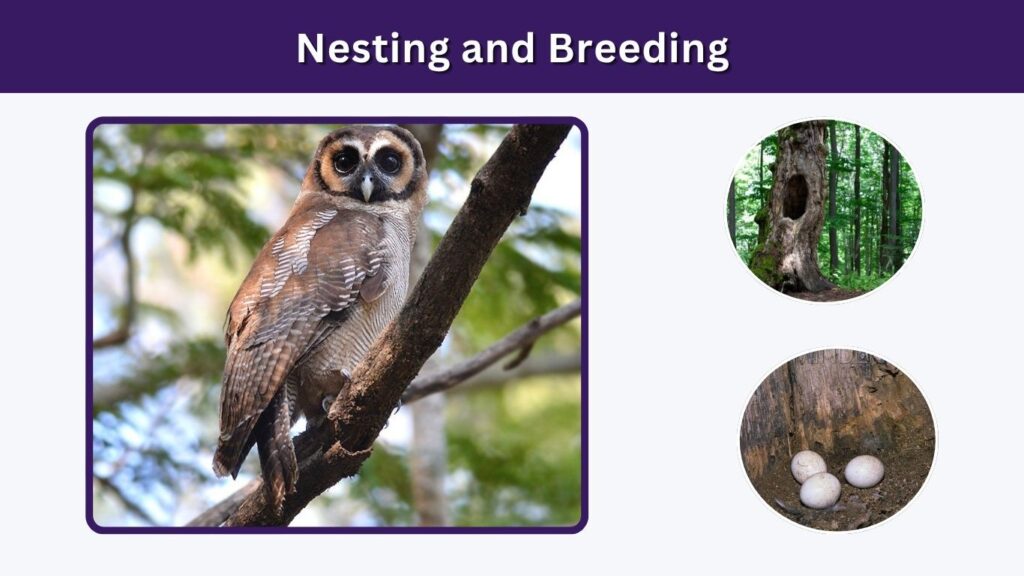
African Wood Owls are monogamous and are believed to maintain strong pair bonds. They normally nest inside an existing natural cavity rather than building a stick nest.
Nesting Sites
A pair may use:
- A hollow tree trunk
- A cavity in a broken branch
- A hole with a side entrance
- A cavity open at the top
- Occasionally a suitable artificial nest box
A nest box must be large, secure, correctly positioned, and placed within suitable wooded habitat. Installing one does not guarantee occupancy, particularly when the surrounding area lacks adequate prey or tree cover.
Eggs and Incubation
Breeding time varies across the species’ range. In South Africa, egg laying is commonly recorded between July and October.
The female normally lays one or two white eggs and incubates them for approximately 31 days. Nestlings remain in the cavity for around 30–37 days before fledging.
Juvenile African Wood Owls
Young African Wood Owls leave the nest with pale rufous down that may remain visible for several months. A recently fledged bird can appear fluffier and lighter than an adult.
After leaving the cavity, juveniles often hide in vegetation near their parents. They gradually improve their flight and hunting ability but may continue receiving food from the adults for three to four months. This is a comparatively long period of dependence for an owl of this size.
A young owl found outside the nest is not necessarily abandoned. The parents may remain nearby and continue feeding it after dark. People should keep pets and children away and contact a qualified wildlife rehabilitator when the bird is visibly injured or facing immediate danger.
Predators and Threats
Eggs, nestlings, and recently fledged juveniles are the most vulnerable life stages. Potential threats include larger birds of prey, mammalian predators, domestic cats and dogs, and disturbance around nesting cavities.
The species is currently classified as Least Concern because it has an extensive distribution and is not believed to be declining rapidly. However, it depends strongly on forests and woodlands, making local populations vulnerable to deforestation and the removal of mature hollow trees.
FAQs
Is the African Wood Owl rare?
It is widespread and can be locally common in suitable forests and woodlands. However, its nocturnal habits, silent flight, and excellent camouflage make it difficult to observe during the day.
How big is an African Wood Owl?
An adult is approximately 33 cm tall and generally weighs around 240–350 g. Females are typically larger and heavier than males, although both sexes have similar plumage.
What does an African Wood Owl sound like?
Its call is a rhythmic sequence of deep hoots often described as “who-who, who-who-who.” Pairs frequently perform duets, with the smaller male usually producing the deeper notes.
What do African Wood Owls eat?
They eat large insects, centipedes, rodents, small mammals, frogs, birds, bats, and small snakes. Invertebrates form a particularly important part of their diet.
Can an African Wood Owl be kept as a pet?
It is a wild bird of prey with specialized dietary, space, behavioral, and veterinary needs. Private possession and trade may also be restricted by wildlife laws, so it is unsuitable as a conventional pet.