
The Brown Wood Owl (Strix leptogrammica) is a large nocturnal owl found across southern and southeastern Asia. It is recognized by its rounded head, deep black eyes, dark-bordered facial disc, rich brown upperparts, and finely barred chest. Unlike horned or eagle-owls, it has no visible ear tufts. This shy forest species spends the day hidden among dense foliage and becomes active after sunset, when its deep, echoing calls can travel through the woodland.
Brown Wood Owl Overview
The Brown Wood Owl belongs to the typical owl family Strigidae and the earless owl genus Strix. Its coloration, measurements, and markings vary among the numerous regional populations found across its extensive range.
| Feature | Details |
| Scientific name | Strix leptogrammica |
| Family | Strigidae |
| Adult length | Approximately 40–55 cm |
| Wingspan | Roughly 125–167 cm |
| Weight | Around 720–970 g |
| Diet | Small mammals, birds, reptiles, frogs, and insects |
| Activity | Primarily nocturnal |
| Nest | Tree cavity, cave, or sheltered crevice |
| Typical clutch | Usually 1–2 eggs |
| Conservation status | Least Concern |
Measurements differ by sex and subspecies, with females generally being larger and heavier than males.
What Does a Brown Wood Owl Look Like?
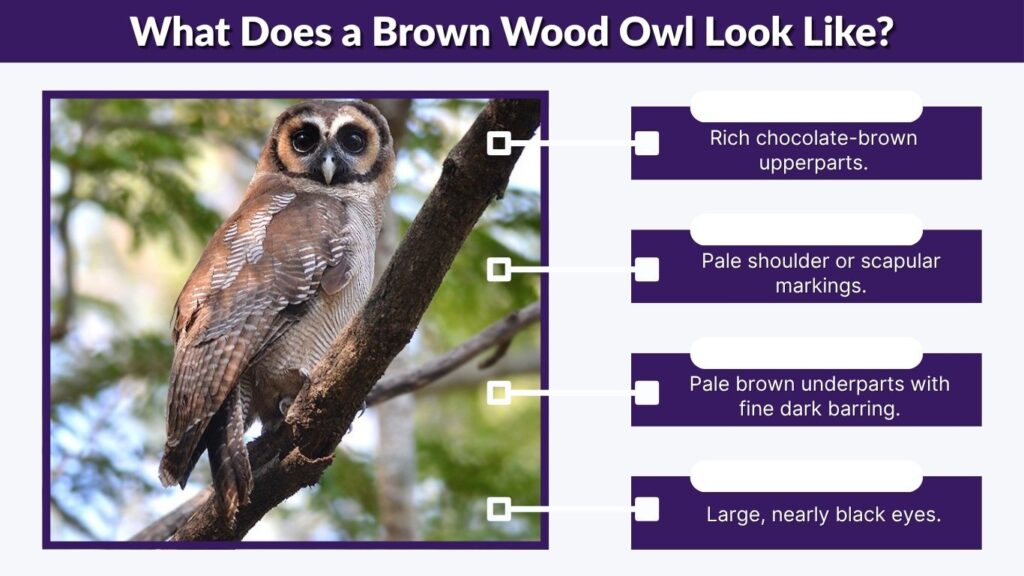
This owl has a heavy body, broad wings, a rounded head, and a relatively long barred tail. Its cryptic plumage helps it disappear against tree trunks and shaded forest vegetation.
Identification Features
- Rich chocolate-brown upperparts
- Pale shoulder or scapular markings
- Pale brown underparts with fine dark barring
- Large, nearly black eyes
- Pale facial disc bordered with dark brown
- Whitish eyebrow-like markings
- Pale bluish or horn-colored bill
- Rounded head without ear tufts
- Heavily feathered legs
The species varies considerably across its range, but the combination of dark eyes, a pale dark-bordered face, brown plumage, and fine barring remains characteristic.
Male vs. Female
Male and female Brown Wood Owls have similar plumage, making them difficult to distinguish by color. Females are usually larger and more heavily built, while males may sound slightly different during vocal exchanges.
Reliable sex identification normally requires measurements, close examination, genetic testing, or observation during breeding.
Brown Wood Owl Size and Wingspan
A full-grown Brown Wood Owl generally measures about 40–55 cm from the bill to the end of the tail. Large individuals may weigh close to 1 kg.
Reported wingspans range from approximately 125 to 167 cm. These broad, rounded wings allow the owl to fly quietly between trees and maneuver through dense woodland while pursuing prey.
| Measurement | Approximate range |
| Body length | 40–55 cm |
| Wingspan | 125–167 cm |
| Weight | 720–970 g |
Where Do Brown Wood Owls Live?
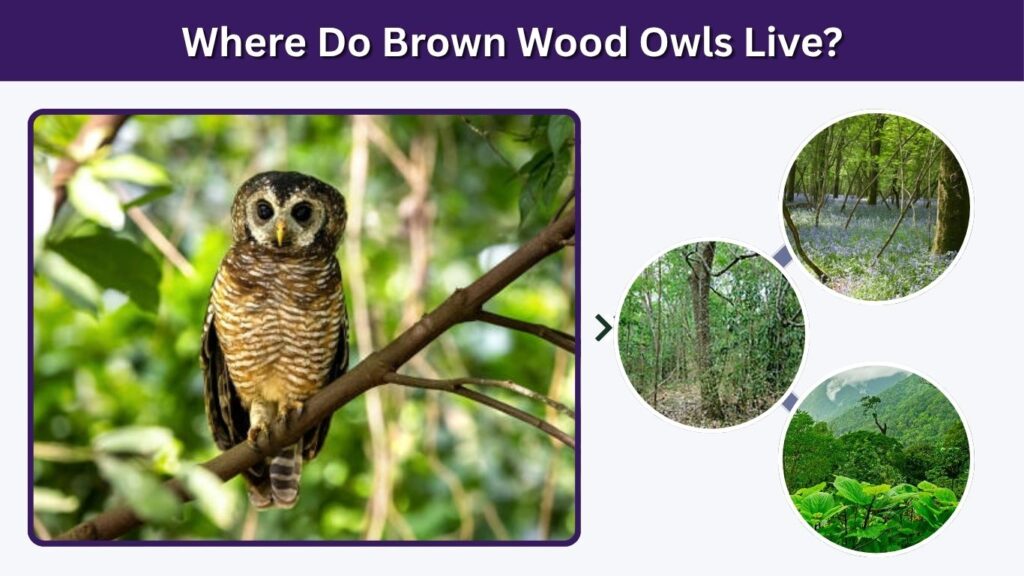
Brown Wood Owls occur across parts of the Indian subcontinent, southern China, Taiwan, mainland Southeast Asia, Malaysia, Indonesia, and nearby islands. Their range includes India, Nepal, Bangladesh, Sri Lanka, Myanmar, Thailand, Laos, Vietnam, southern China, Taiwan, the Malay Peninsula, Sumatra, and Borneo. The exact range varies among recognized subspecies and taxonomic treatments.
Habitat
Brown Wood Owls primarily inhabit:
- Tropical and subtropical broadleaf forests
- Mature secondary woodland
- Evergreen forest
- Mixed deciduous forest
- Forested foothills
- Mountain woodland
- Wooded river valleys
- Forest edges near undisturbed habitat
They are strongly associated with mature woodland that provides large trees, shaded daytime roosts, nesting cavities, and abundant prey. They may sometimes occur near plantations, gardens, and forested villages when sufficient tree cover remains.
Brown Wood Owls in India and Bangladesh
In India, the species occurs in suitable forests across northern, central, southern, northeastern, and Himalayan foothill regions. It is also recorded in Bangladesh, including forested areas and the Sundarbans region.
The name “Himalayan Brown Wood Owl” is sometimes used informally for northern populations. Owl taxonomy can differ among authorities, however, so scientific names and geographic details should be checked when identifying birds from the Himalayan region.
What Do Brown Wood Owls Eat?
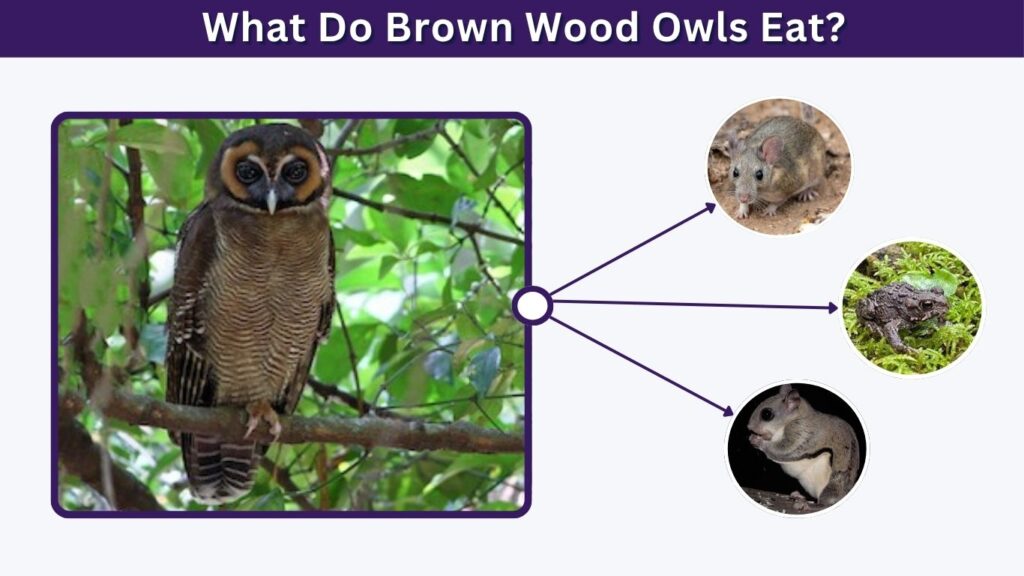
Brown Wood Owls are carnivorous hunters that capture a wide range of forest animals. Their diet commonly includes:
- Rats and mice
- Shrews
- Small birds
- Frogs
- Lizards and other reptiles
- Large insects
- Occasionally other small vertebrates
They normally hunt alone at night. The owl watches or listens from a concealed perch before flying down to seize prey with its talons. Its facial disc helps direct sound toward the ears, allowing it to locate animals moving through leaves or undergrowth in low light.
Brown Wood Owl Call and Sound
The Brown Wood Owl is often heard more easily than it is seen. Its primary call consists of several deep, resonant hoots delivered in a short sequence. The sound may carry a considerable distance through dense forest.
Its vocalizations include:
- Deep three- or four-note hoots
- Loud reverberating sequences
- Barking “wow-wow” alarm calls
- Long screeches or whinnying sounds
- Softer contact calls between paired birds
Call patterns vary by region, individual, situation, and subspecies. Birds may call during the night, around dawn or dusk, and occasionally during daylight.
Nesting and Reproduction
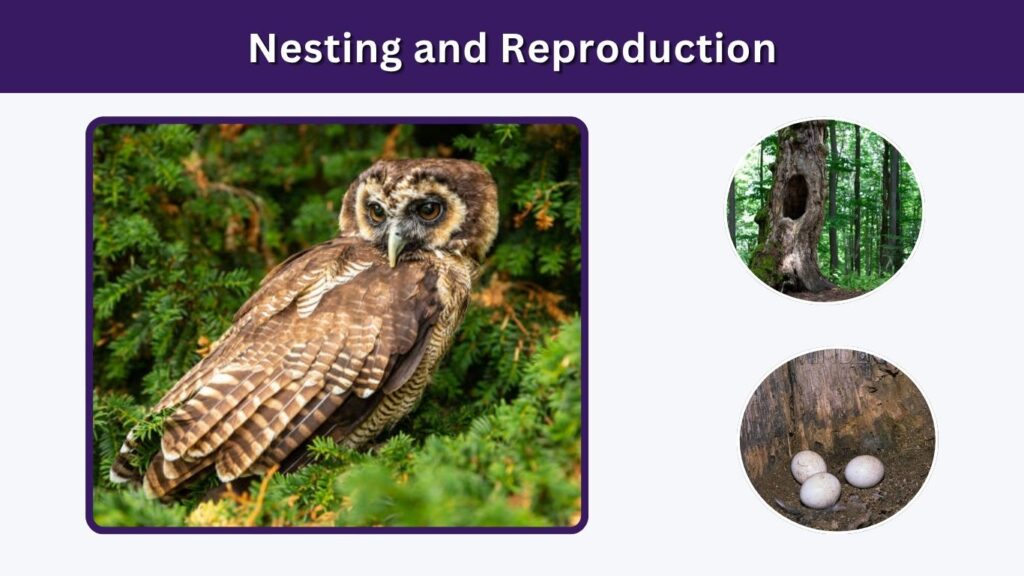
Breeding times vary according to location and climate. In some parts of the range, nesting activity occurs from late winter through spring.
Brown Wood Owls may nest in:
- Natural tree hollows
- Cavities in large mature trees
- Sheltered cliff crevices
- Caves
- Protected ledges
They do not normally construct elaborate stick nests. A suitable existing cavity provides shelter for the eggs and young. Tree-hole nesting has been documented in Hong Kong and Taiwan.
Eggs and Incubation
A female normally lays one or two white eggs. Incubation is generally estimated at approximately 28–30 days, although detailed information is limited and timing may differ among populations.
The female performs most or all incubation, while the male supplies food. Both adults continue protecting and feeding the chicks after hatching.
Brown Wood Owl Juvenile
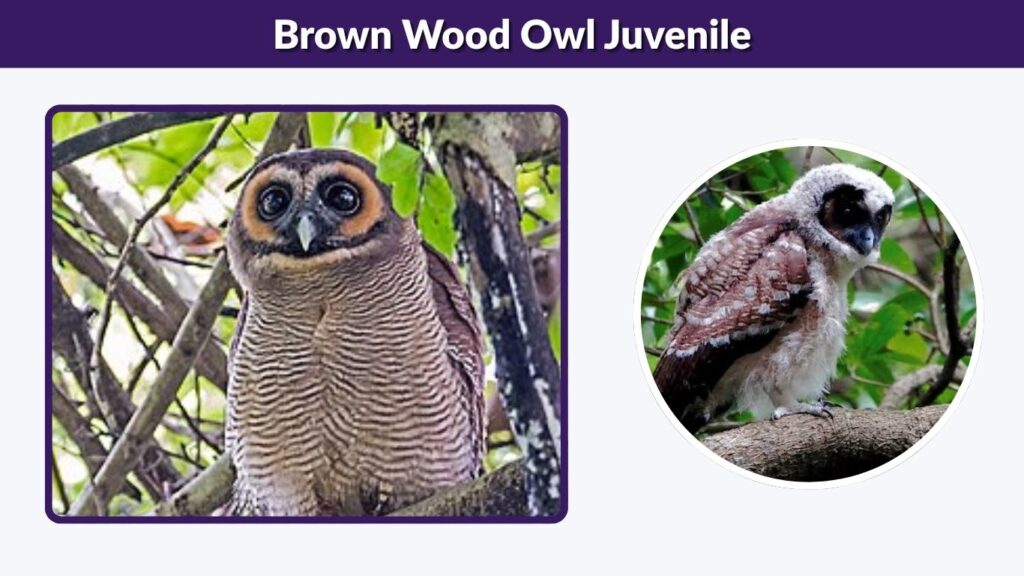
A newly hatched Brown Wood Owl is covered with pale down. Recently fledged juveniles may retain white or cream-colored down across the head, chest, and belly while developing adult-style wing and tail feathers.
Juveniles have a recognizable dark-bordered facial disc but generally appear paler, fluffier, and less evenly barred than adults. They may remain near the nesting area for several weeks while their parents continue bringing food.
A young owl found on the ground should not automatically be assumed abandoned. Fledglings may leave a cavity before becoming strong flyers, and their parents may be nearby. Keep people and pets away and contact a licensed wildlife rehabilitator when the bird is injured or in immediate danger.
Behavior and Daily Activity
Brown Wood Owls are primarily nocturnal. During daylight, they rest quietly on concealed branches within dense tree cover. Their brown plumage makes them extremely difficult to notice unless they move or are detected by smaller birds.
After dark, they patrol forest edges, clearings, paths, and the spaces beneath the canopy. They are generally shy and retreat deeper into the forest when disturbed. Pairs may remain within the same general territory, particularly during the breeding period.
Conservation Status
The Brown Wood Owl is currently classified as Least Concern, reflecting its broad geographic distribution. Nevertheless, it depends strongly on forest habitat, and local populations can be affected by deforestation, removal of mature nesting trees, disturbance, road collisions, and illegal capture.
Maintaining connected mature forests is important because these areas provide nesting cavities, sheltered roosts, and sufficient prey.
FAQs
Is the Brown Wood Owl rare?
It has a broad Asian distribution and is classified as Least Concern, but it can be locally uncommon. Its nocturnal behavior, dense forest habitat, and excellent camouflage also make it seem rarer than it is.
How big is a Brown Wood Owl?
An adult usually measures approximately 40–55 cm long and may have a wingspan of around 125–167 cm. Females are generally larger than males, and measurements differ among regional populations.
What does a Brown Wood Owl sound like?
Its best-known call is a short sequence of deep, echoing hoots. It can also produce barking alarm notes, screeches, whinnies, and quieter contact sounds.
What do juvenile Brown Wood Owls look like?
Recently fledged juveniles have pale, fluffy down on much of the head and body, a dark-bordered facial disc, and developing brown wing and tail feathers. Their plumage gradually becomes darker and more strongly barred.
Can you keep a Brown Wood Owl as a pet?
Brown Wood Owls are wild birds of prey with specialized space, diet, behavioral, and veterinary needs. Private ownership or trade may also be restricted by wildlife laws, making them unsuitable as ordinary pets.