The great horned owl (Bubo virginianus) is famous for its deep, powerful hooting, especially after sunset and during the night. Its classic call consists of several low, resonant hoots that may carry a long distance through forests and open country. However, great horned owls do much more than hoot. They can screech, hiss, bark, growl, and make unusual cat-like sounds. Learning these calls—along with the owl’s distinctive appearance—can help you recognize a great horned owl even when it is hidden in darkness.
What Does a Great Horned Owl Sound Like?
A great horned owl’s most recognizable sound is a series of deep, rhythmic hoots. People often represent the call as something similar to:
“Hoo-hoo-hoo, hoo, hoo.”
The exact rhythm varies between individual owls. The notes are deep, soft, and surprisingly powerful, allowing the sound to travel over considerable distances at night.
Great Horned Owl Hoot
The territorial hoot usually consists of several low notes delivered with brief pauses between them. Great horned owls use these calls to advertise their territory and communicate with mates.
Males generally have a deeper, lower-pitched hoot than females because of differences in body and voice-box structure. A female may sound slightly sharper or higher even though she is usually larger than the male.
During courtship, a male and female may call back and forth, producing a nighttime duet.
What Does a Great Horned Owl Sound Like at Night?
At night, great horned owls can sound mysterious because their calls carry through otherwise quiet surroundings.
You may hear:
Deep hooting from distant trees, short barking notes, harsh screams, growling sounds, hisses, or raspy calls from young owls.
Calling becomes especially noticeable during the breeding season when pairs establish territories and communicate more frequently.
Do Great Horned Owls Sound Like Cats?
Some great horned owl vocalizations can sound surprisingly cat-like.
Besides their familiar hooting, these owls sometimes produce mewing, screaming, or whining sounds that may remind listeners of a cat. When heard in darkness, such calls can be difficult to identify.
However, repeated deep hooting remains the easiest way to recognize an adult great horned owl.
Can a Great Horned Owl Sound Like a Dog?
Occasionally, yes. Great horned owls can make short, rough sounds that resemble barks.
A person hearing one from a distance might briefly mistake it for a small dog or another animal. These barking sounds are not the owl’s primary call but may occur during alarm, territorial encounters, or communication.
What Does a Great Horned Owl Screech Sound Like?
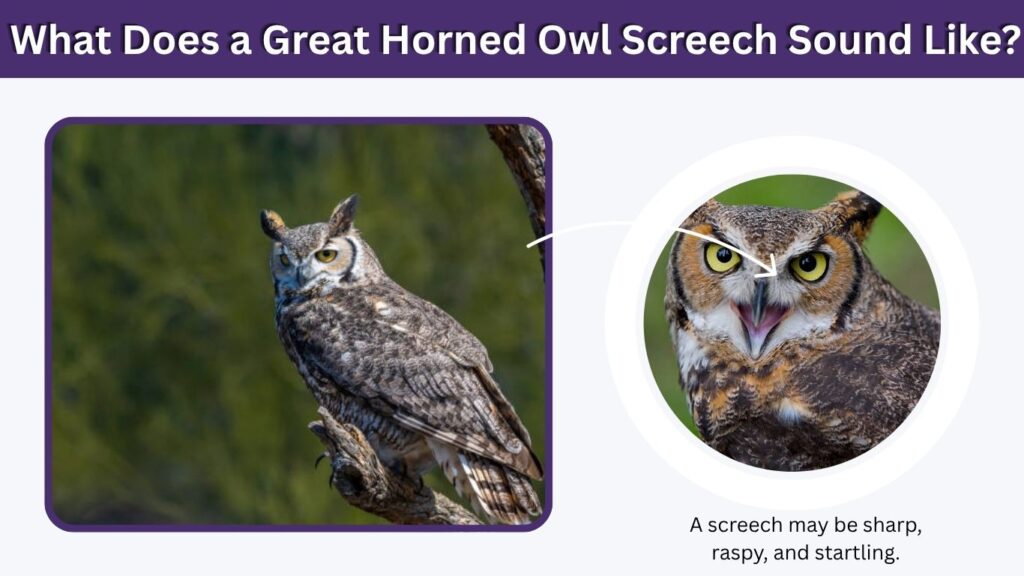
Great horned owls do not rely exclusively on hooting. They can produce loud, harsh screeches or screams that sound dramatically different from their familiar territorial call.
A screech may be sharp, raspy, and startling. It can occur when an owl feels threatened, interacts aggressively with another owl, or communicates with nearby family members.
Because several nocturnal animals make screaming noises, hearing a scream by itself does not always confirm that a great horned owl is nearby.
What Does a Baby Great Horned Owl Sound Like?
Baby and juvenile great horned owls sound quite different from adults.
Juvenile Great Horned Owl Call
Young owls commonly make high, raspy begging calls when requesting food from their parents. The sound may resemble a harsh screech, hiss, or repeated shriek rather than the deep hooting associated with adults.
Juvenile owls may continue begging even after they leave the nest because their parents continue feeding them while they learn to hunt.
As young owls mature, their vocalizations gradually become more similar to those of adult birds.
What Does a Great Horned Owl Look Like?
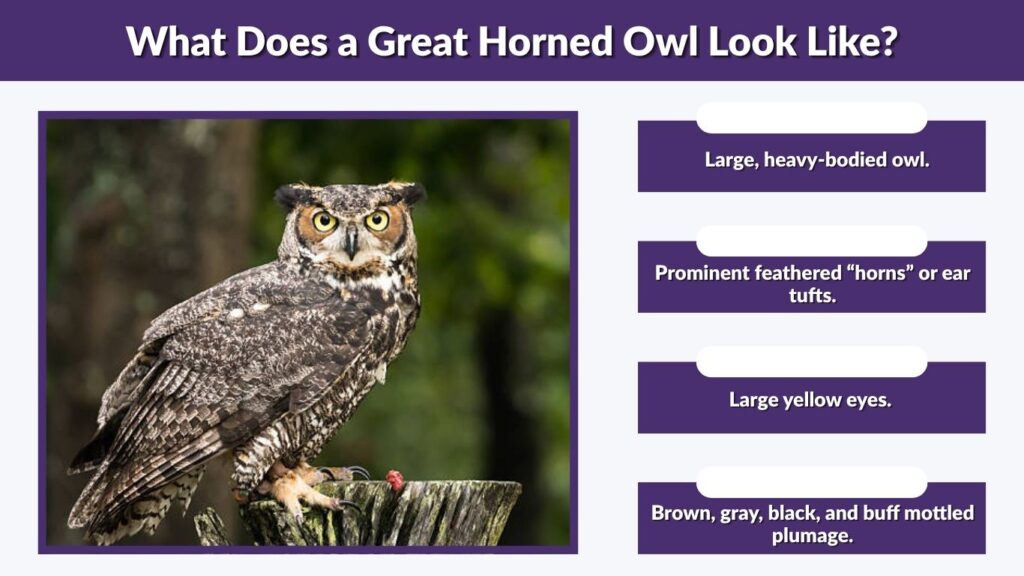
Great horned owls are among the most recognizable North American owls. Their large size and prominent feather tufts create an impressive silhouette.
Great Horned Owl Identification
- Large, heavy-bodied owl
- Prominent feathered “horns” or ear tufts
- Large yellow eyes
- Brown, gray, black, and buff mottled plumage
- White throat patch
- Broad wings
- Strong feathered legs
- Powerful feet and curved talons
- Rounded head and facial disc
- Typically about 18–25 inches long
The “horns” are actually feather tufts and are not the owl’s ears. Its real ear openings are located on the sides of the head beneath the feathers.
What Do Baby Great Horned Owls Look Like?
Newly hatched great horned owls look very different from their parents.
They initially have pale, fluffy down instead of fully developed adult feathers. Their eyes are closed shortly after hatching and gradually open as they develop.
As young owls grow, grayish juvenile plumage replaces much of the soft white down. Their recognizable ear tufts become more noticeable with age.
Juveniles leaving the nest may appear awkward and fluffy compared with sleek adult birds.
What Does a Great Horned Owl Nest Look Like?
Great horned owls rarely construct their own traditional nests. Instead, they commonly take over structures previously created by other large birds.
Great Horned Owl Nesting Sites
They may use abandoned hawk or crow nests, large tree cavities, cliff ledges, broken tree tops, rocky crevices, and occasionally human-made structures.
A nest may consist of a relatively simple platform of sticks rather than a carefully constructed structure.
Great horned owls often begin nesting surprisingly early in the year, sometimes while winter conditions are still present.
What Do Great Horned Owl Eggs Look Like?
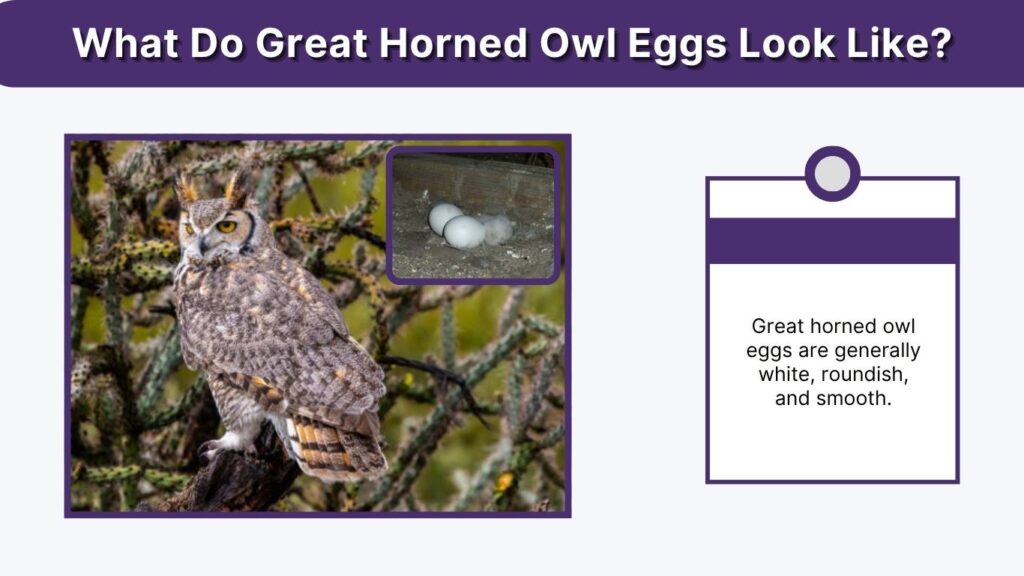
Great horned owl eggs are generally white, roundish, and smooth.
A female commonly lays around two eggs, although clutch size can vary depending on food availability and environmental conditions.
The female performs most of the incubation while the male provides food and guards the territory.
What Do Great Horned Owl Feathers Look Like?
Great horned owl feathers are usually mottled with combinations of brown, gray, tan, buff, and black.
This complicated pattern provides excellent camouflage against tree bark.
Great Horned Owl Tail Feathers
Tail feathers are broad and generally show alternating darker and lighter horizontal bands.
Like other owl feathers, great horned owl flight feathers have specialized edges that help reduce noise during flight. This adaptation allows the owl to approach prey quietly.
In the United States, native owl feathers are legally protected, so found feathers generally should not be collected or kept without appropriate authorization.
What Does Great Horned Owl Poop Look Like?
Great horned owl droppings generally contain both dark digestive waste and white uric acid, which is the bird equivalent of urine.
Droppings may accumulate beneath frequently used roosting locations. However, droppings alone are usually not enough to positively identify an owl because many birds produce similar waste.
What Does a Great Horned Owl Pellet Look Like?
Great horned owls swallow many prey animals largely whole. Bones, fur, feathers, and other indigestible materials are compressed inside the digestive system and later regurgitated as pellets.
Great horned owl pellets are usually dark gray or brown, elongated, and packed with fur and small bones.
Examining pellets can reveal what an owl has recently eaten.
What Do Great Horned Owls Like to Eat?
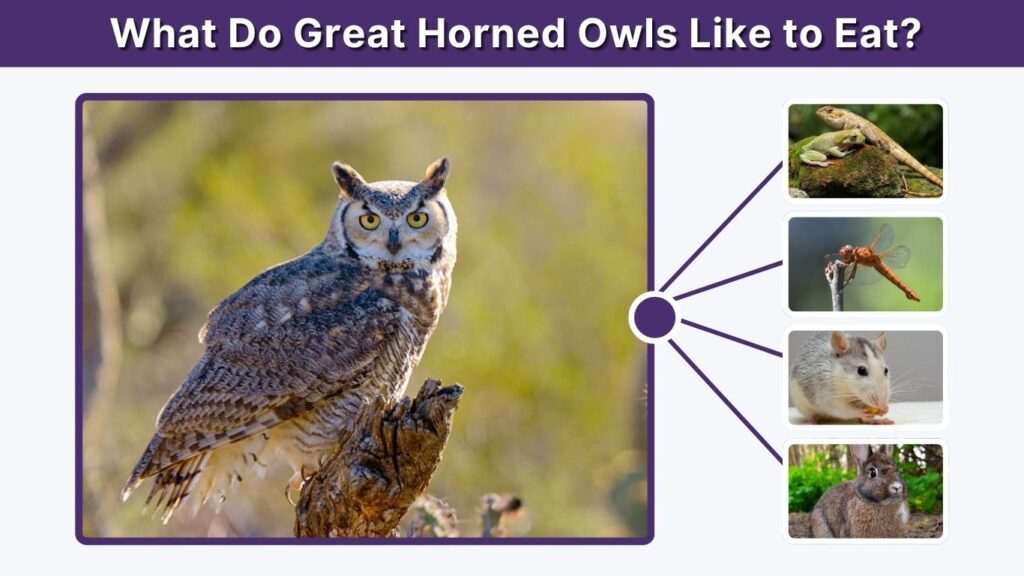
Great horned owls are powerful carnivorous predators with an exceptionally varied diet.
They commonly hunt rabbits, mice, rats, squirrels, voles, birds, snakes, reptiles, and other small animals.
They are also one of the few predators capable of regularly attacking skunks. Because owls have a relatively weak sense of smell, a skunk’s defensive odor does not discourage them as effectively as it does many mammalian predators.
What Trees Do Great Horned Owls Like?
Great horned owls can live around many types of trees rather than depending on one particular species.
Large mature trees are especially useful because they provide sturdy daytime roosts and suitable nesting locations.
They may occupy pine, oak, cottonwood, eucalyptus, and other large trees depending on the region. They also thrive around forest edges where trees provide resting sites and nearby open areas provide good hunting opportunities.
What Birds Sound Like a Great Horned Owl?
Other owls can sometimes cause confusion, particularly when heard from far away.
Barred owls produce distinctive hooting calls but usually have a recognizable rhythm often described as “Who cooks for you?”
Some dove calls can also be mistaken for distant owls, although they are generally softer.
The combination of a deep series of hoots, nighttime activity, and a large horned silhouette provides much stronger evidence that you are hearing a great horned owl.
FAQs
What is the most common great horned owl sound?
The most recognizable sound is a series of deep, resonant hoots used for territorial communication and communication between mates.
Why do great horned owls hoot at night?
They hoot to defend territory, attract or communicate with mates, and maintain contact with other owls.
Do female great horned owls hoot?
Yes. Females hoot, but their voices are generally higher-pitched than those of males.
Why does a great horned owl sound like a cat?
Some of its secondary vocalizations include screams, mews, and whining sounds that can resemble a cat, especially when heard from a distance at night.
What does a juvenile great horned owl sound like?
Juveniles usually make loud, raspy begging calls or screeches when requesting food from their parents rather than producing the classic deep adult hoot.