
The rufous-legged owl is a fascinating nocturnal bird native to the forests of Chile and Argentina. Known for its reddish-brown legs, rounded head, and mysterious calls, this owl is remarkably adapted to life in dense woodland. Its beautifully patterned feathers help it remain hidden among trees during daylight. Understanding the rufous-legged owl’s appearance, habitat, hunting behavior, and breeding habits reveals what makes this South American species so distinctive.
What Is a Rufous-Legged Owl?
The rufous-legged owl (Strix rufipes) is a medium-sized owl belonging to the family Strigidae. It is native to southern South America, where it inhabits temperate forests and wooded landscapes. Sometimes called the concón in Chile, this species is recognized for its rounded facial disc, dark eyes, and distinctive vocalizations that echo through forests after sunset.
Scientific Classification
- Common Name: Rufous-Legged Owl
- Scientific Name: Strix rufipes
- Family: Strigidae
- Order: Strigiformes
- Genus: Strix
- Native Range: Chile and Argentina
- Conservation Status: Least Concern globally
The species belongs to the same genus as several other woodland owls. Unlike owls with prominent feather tufts, it has a smooth, rounded head that gives it a distinctive appearance.
Rufous-Legged Owl Size and Physical Appearance
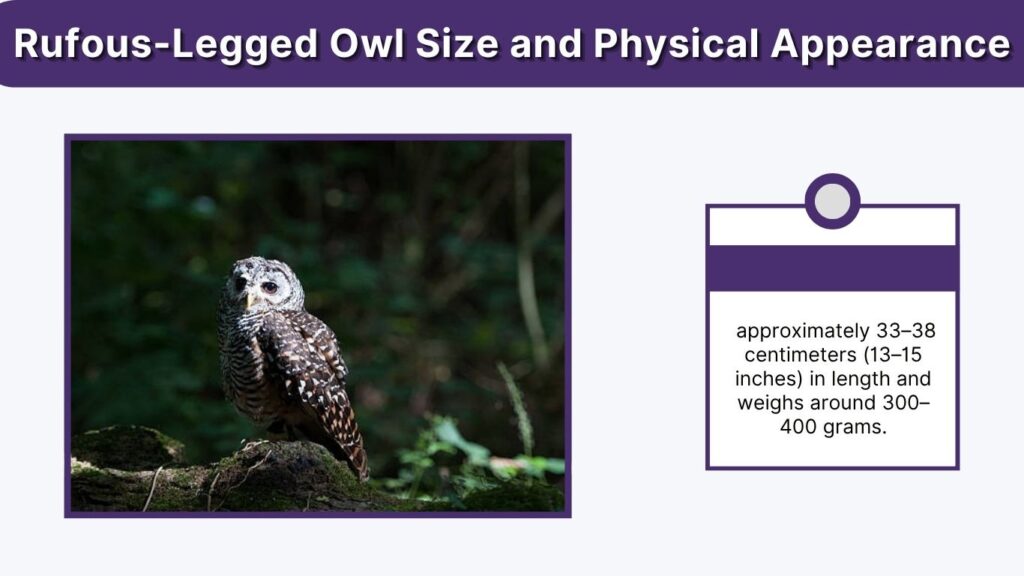
The rufous-legged owl has a compact body, broad wings, and thick plumage that helps it blend into its surroundings. Its markings combine reddish-brown, cream, gray, and dark brown shades. Although it resembles some other woodland owls, its facial pattern, reddish leg feathers, and strongly barred underparts provide useful identification clues.
Size and Weight
An adult rufous-legged owl generally measures approximately 33–38 centimeters (13–15 inches) in length and weighs around 300–400 grams.
Females are typically larger than males, a common characteristic among many owl species. Its broad wings and relatively short tail create a sturdy appearance, while its soft flight feathers allow it to move quietly through wooded environments.
Distinctive Identification Features
Several characteristics help birdwatchers recognize this owl:
- Head: Large and rounded, without prominent ear tufts.
- Eyes: Dark brown eyes surrounded by a rounded facial disc.
- Facial Markings: Pale eyebrow-like markings and warm brown facial feathers.
- Body: Brown upperparts and pale underparts with dark barring.
- Legs: Cinnamon-colored or reddish-brown feathering.
- Wings: Broad and rounded, with barred flight feathers.
Its intricate feather patterns provide effective camouflage against tree bark and branches, making the bird difficult to detect while resting.
Rufous-Legged Owl Habitat and Distribution
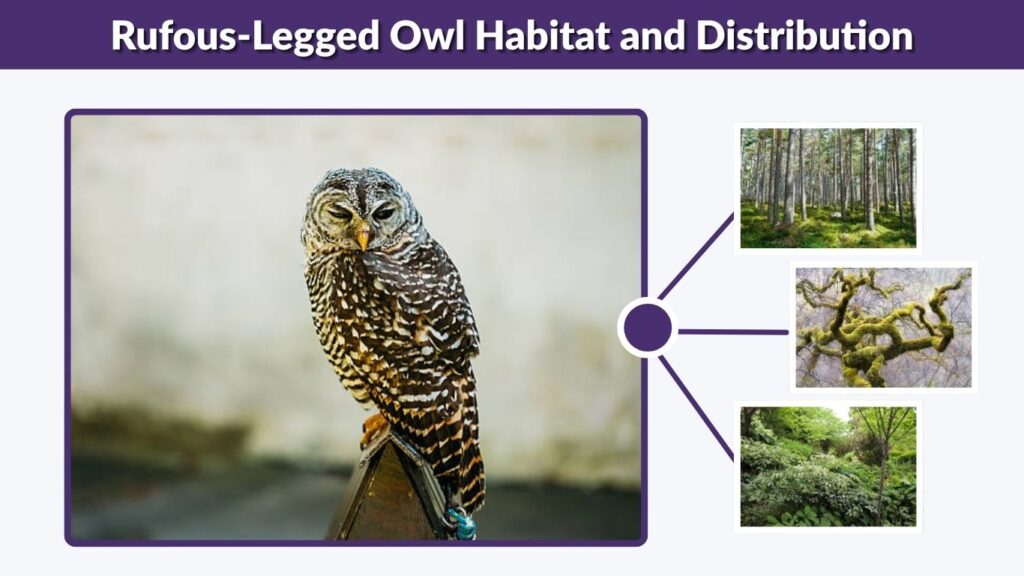
The rufous-legged owl primarily inhabits temperate forests throughout southern South America. It prefers wooded environments with suitable roosting locations, abundant prey, and opportunities for nesting. Mature forests are especially important because they provide natural tree cavities, sheltered branches, and the complex vegetation structure this species uses for daily activities.
Chilean Temperate Rainforest Habitat
The rufous-legged owl is particularly associated with Chilean temperate rainforests, including forests dominated by southern beech trees of the genus Nothofagus.
These habitats often contain tall trees, moss-covered branches, and dense understory vegetation. Such environments offer concealed resting locations and support rodents, insects, and other small animals.
The owl also occupies some drier native forests and forest-edge environments. However, areas containing mature trees and relatively undisturbed woodland remain important for its survival.
Geographic Distribution
The species occurs across central and southern Chile and neighboring western Argentina, extending southward into Patagonia and Tierra del Fuego.
Its distribution includes forested mountains, valleys, and protected natural areas. The owl is generally a year-round resident rather than a long-distance migrant.
Although widespread across its overall range, it can be difficult to observe because of its secretive and primarily nocturnal behavior.
Rufous-Legged Owl Calls and Sounds
One of the most recognizable characteristics of the rufous-legged owl is its unusual vocalization. Its calls are commonly heard at night, especially in forested areas where sound travels between trees. These vocalizations help individuals communicate, maintain contact with their mates, and advertise territories without revealing their exact positions through visual movements.
What Does a Rufous-Legged Owl Sound Like?
The rufous-legged owl produces a series of deep, rhythmic notes that are sometimes described as repeated “coo-coo-coo” sounds.
Its vocal repertoire includes several recognizable patterns:
- Contact Calls: Repeated, relatively soft hooting notes used for communication.
- Territorial Calls: More forceful sequences that may develop into rising, laughter-like notes.
- Female Contact Calls: Longer, drawn-out vocalizations used in communication between partners.
These sounds vary in intensity and rhythm depending on the circumstances. Hearing the calls is often easier than locating the owl itself.
Why Does the Rufous-Legged Owl Call at Night?
Vocal communication is important for maintaining territories and coordinating interactions between mates.
Because the owl is most active during darkness, its calls allow it to communicate effectively without needing visual contact.
Calling activity may change with the breeding cycle, territorial activity, and interactions with other owls.
What Does the Rufous-Legged Owl Eat?
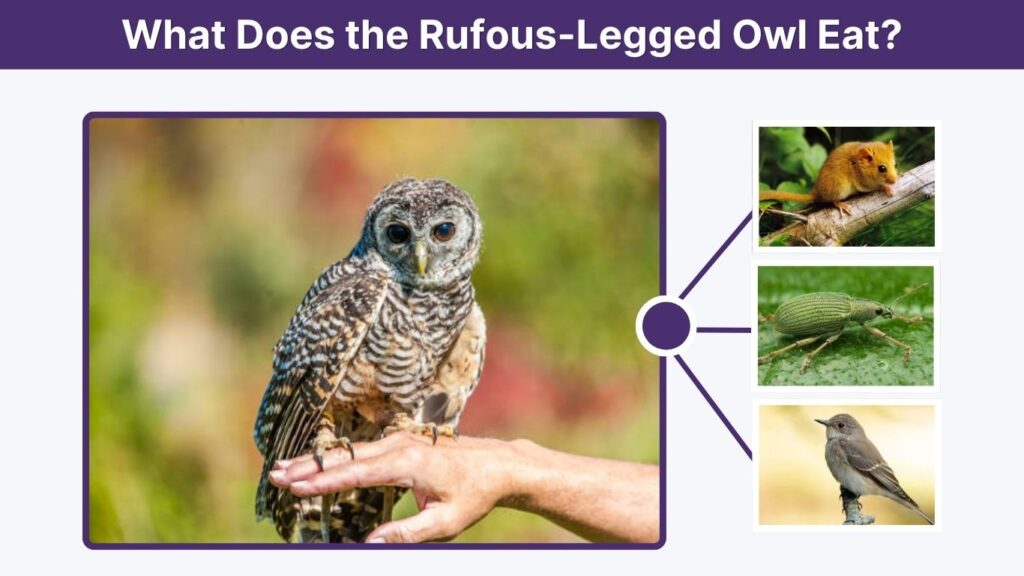
The rufous-legged owl is a carnivorous bird that hunts various small animals. Its diet depends on prey availability, habitat conditions, and local ecosystems. Like other woodland owls, it uses sensitive hearing, sharp talons, and quiet flight to locate and capture prey, making it an effective nighttime predator within its forest environment.
Common Food Sources
Its diet includes several animal groups:
- Small rodents and other mammals
- Insects and other arthropods
- Small birds
- Frogs and other amphibians
- Occasionally other small invertebrates
Research from southern Chile found that insects could account for many individual prey items, while small mammals contributed most of the total prey biomass.
Hunting Behavior
The rufous-legged owl generally hunts during nighttime hours.
It may wait quietly on a branch before moving toward prey detected through sound or movement. Its specialized wing feathers reduce flight noise, helping it approach unsuspecting animals.
Sharp talons allow it to grasp prey securely, while its hooked beak helps tear food into manageable pieces.
Rufous-Legged Owl Breeding and Nesting
Breeding behavior is closely connected to the availability of mature woodland habitat. The rufous-legged owl commonly uses natural cavities in large trees, making suitable nesting sites an important resource. Pairs communicate through calls, and adults select sheltered locations that offer protection for eggs and developing chicks.
Nesting and Egg-Laying
The species typically nests in tree cavities, although abandoned nests built by other birds of prey may occasionally be used.
A typical clutch contains approximately two to three white eggs.
In Chile, egg-laying has been reported mainly during the Southern Hemisphere’s spring and early summer, from October into December or January.
Young Owls and Development
Newly hatched owlets have pale downy feathers and depend on their parents for warmth, protection, and food.
As they develop, their feathers gradually become more patterned, resembling those of adults.
Young owls eventually begin exploring nearby branches and practicing flight before becoming increasingly independent.
Rufous-Legged Owl Conservation Status and Threats
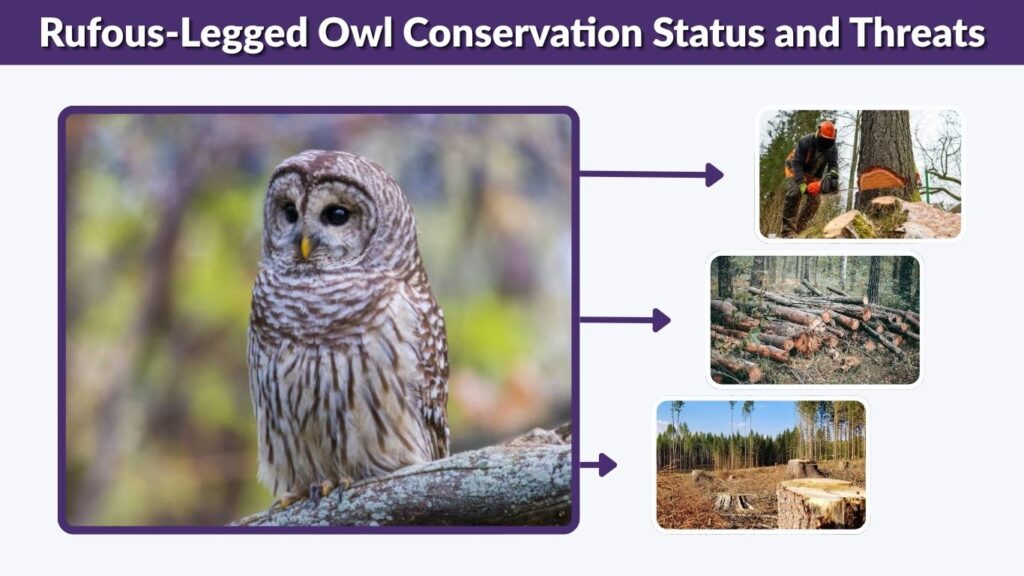
The rufous-legged owl is classified globally as Least Concern by the IUCN, although its population is believed to be decreasing. Chile’s national conservation assessment lists it as Near Threatened. This distinction highlights the importance of regional habitat conditions even when a species remains relatively widespread across its entire geographic range.
Major Threats
Forest clearing, fragmentation, and degradation can reduce available hunting and nesting habitat.
The removal of mature trees is particularly concerning because the species relies on suitable woodland structures for nesting and shelter.
Protecting native forests, maintaining habitat connectivity, and preserving mature trees can support the owl’s long-term survival.
Interesting Rufous-Legged Owl Facts
Beyond its appearance and nocturnal lifestyle, the rufous-legged owl has several interesting characteristics that distinguish it from other forest birds. Its specialized adaptations help it survive in challenging woodland environments.
- Its name comes from its reddish legs. The word “rufous” describes reddish-brown coloration.
- It has no ear tufts. Its smooth, rounded head distinguishes it from many tufted owl species.
- It is primarily nocturnal. Most hunting and territorial activity takes place after dark.
- It is an important woodland predator. Small mammals and insects are significant components of its diet.
- It relies on forest habitats. Mature trees provide important nesting and resting opportunities.
FAQs
1. Where does the rufous-legged owl live?
The rufous-legged owl inhabits forests in Chile and western Argentina, especially temperate rainforests, southern beech woodlands, and other wooded environments throughout Patagonia.
2. How big is a rufous-legged owl?
Adult rufous-legged owls generally measure 33–38 centimeters (13–15 inches) long and weigh approximately 300–400 grams. Females are usually larger than males.
3. What does the rufous-legged owl call sound like?
Its calls include repeated, rhythmic hoots resembling “coo-coo-coo.” Territorial vocalizations may also contain louder, rising, laughter-like notes.
4. Is the rufous-legged owl endangered?
The rufous-legged owl is globally classified as Least Concern, but its population is believed to be declining. It is also nationally classified as Near Threatened in Chile.
5. Is the rufous-legged owl active during the day?
The species is primarily nocturnal, spending much of the daytime resting in sheltered trees. It generally becomes more active after sunset, when it hunts and communicates.