Barn owl vs barred owl is a common comparison among birdwatchers because both species are nocturnal hunters with distinctive appearances and calls. However, these owls differ significantly in facial shape, feather patterns, habitat, size, and vocalizations. Barred owls have rounded heads and dark, striped plumage, while barn owls are recognized by their pale, heart-shaped faces. Understanding these differences also helps distinguish barred owls from spotted owls, great horned owls, and other similar species. This guide explains their identification features, behaviors, and important differences.
Barn Owl vs Barred Owl: Main Differences
Barn owls and barred owls belong to different owl families and occupy different ecological habitats. In North America, the American barn owl (Tyto furcata) belongs to Tytonidae, while the barred owl (Strix varia) belongs to Strigidae. Although both hunt primarily at night, their appearances, hunting techniques, and preferred environments provide reliable identification clues.
Key Identification Features
- Facial shape: Barn owls have heart-shaped faces, while barred owls have rounded facial disks.
- Eye color: Both possess dark eyes, making facial shape more useful for identification.
- Feather color: Barn owls are pale golden, buff, and white; barred owls are brown and cream with dark markings.
- Body size: Barred owls generally have heavier, stockier bodies.
- Habitat: Barn owls favor open fields and farmland; barred owls prefer mature woodlands.
- Vocalization: Barn owls produce harsh screams, while barred owls make recognizable rhythmic hoots.
Barn Owl vs Barred Owl Size
American barn owls generally measure 12.6–15.8 inches long, with wingspans of approximately 39–49 inches.
Barred owls typically measure 16.9–19.7 inches, with wingspans of approximately 39–43 inches.
Although barred owls are usually longer and heavier, barn owls can have equally broad or broader wings relative to their bodies.
Barn Owl vs Barred Owl: Sounds and Behavior
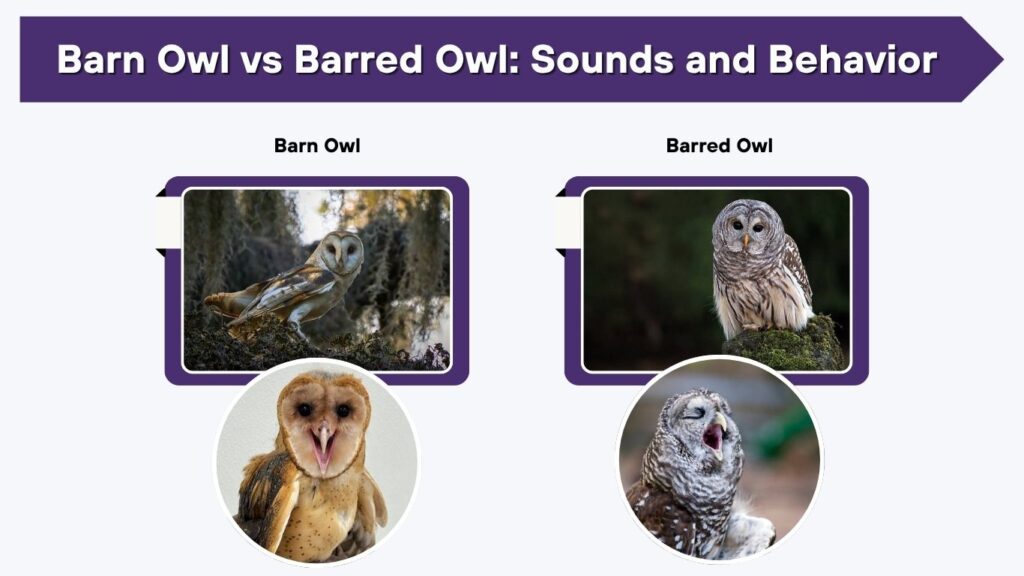
Vocalizations provide one of the easiest ways to distinguish barn owls from barred owls, especially when the birds remain hidden. Their calls serve important functions, including territorial communication, courtship, and contact between individuals. Habitat preferences also influence how these birds hunt, with barn owls favoring open landscapes and barred owls navigating wooded environments.
Barn Owl vs Barred Owl Sound
Barn owls produce long, harsh screams that may resemble shrieking or hissing. Their calls rarely sound like traditional owl hooting.
Barred owls are famous for an eight- or nine-note hooting sequence commonly described as “Who cooks for you? Who cooks for you-all?”
During courtship, barred owls may also produce monkey-like cackles and elaborate vocal duets.
Habitat and Hunting Differences
Barn owls primarily hunt small mammals across grasslands, agricultural fields, and other open spaces.
Barred owls favor mature forests, wooded wetlands, and areas near streams. Their diet includes rodents, amphibians, fish, and small birds.
Both rely heavily on their hearing when locating prey.
Spotted Owl vs Barred Owl: Identification Guide
Spotted owls and barred owls are closely related members of the genus Strix. They share rounded heads, dark eyes, and woodland habitats, making identification challenging. However, their feather markings, vocalizations, and geographical distributions differ. These differences are particularly important in the Pacific Northwest, where expanding barred owl populations threaten native spotted owls through habitat competition.
Spotted Owl vs Barred Owl Appearance
Spotted owls (Strix occidentalis) have predominantly dark-brown feathers covered with pale oval or rounded spots.
Barred owls have horizontal barring across the upper chest and vertical dark streaks on the lower breast and belly.
Spotted owls are generally somewhat smaller and lighter than barred owls, although their body measurements overlap.
Northern Spotted Owl vs Barred Owl
Northern spotted owls depend heavily on structurally complex, mature forests in the Pacific Northwest.
Barred owls, historically concentrated in eastern North America, expanded westward and now compete with spotted owls for nesting sites, food, and territory.
The U.S. Fish and Wildlife Service identifies this competition, alongside habitat loss, as a major threat to northern spotted owl survival.
Barred Owl vs Spotted Owl Calls
Barred owls produce their familiar eight- or nine-note hooting sequence.
Spotted owls commonly give a four-note territorial call, with the middle two notes close together.
Listening carefully to the number and rhythm of hoots can help distinguish these two forest-dwelling species.
Barred Owl vs Great Horned Owl
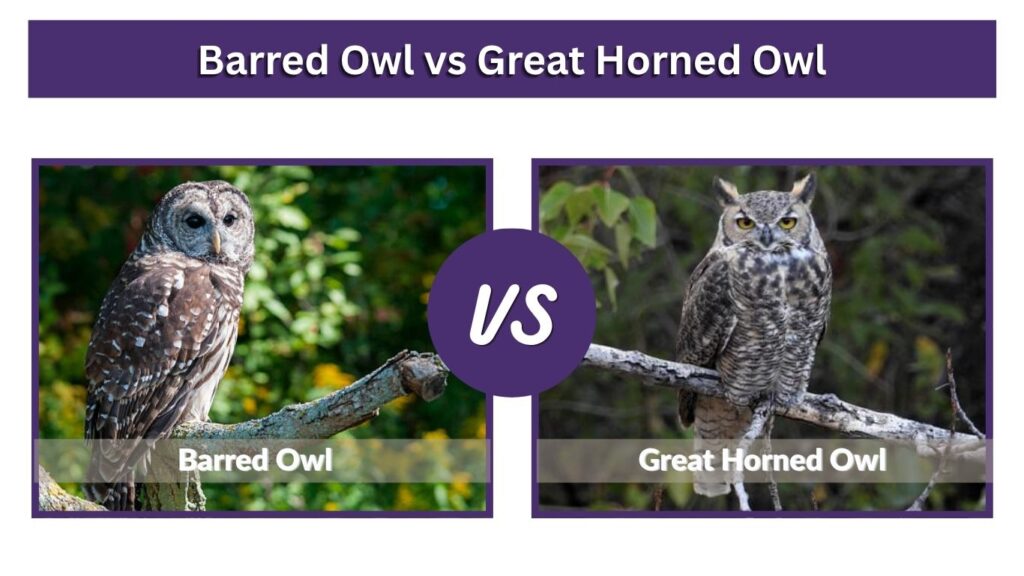
Barred owls and great horned owls are relatively large North American predators that sometimes occupy overlapping territories. Both hunt small mammals and birds, but their appearances differ considerably. Great horned owls are generally heavier and more powerful, while barred owls have rounded heads without ear tufts. Their eye colors and vocalizations offer additional identification clues.
Main Physical Differences
- Head shape: Great horned owls have prominent feathered ear tufts; barred owls have smooth, rounded heads.
- Eye color: Great horned owls have yellow eyes; barred owls have dark-brown eyes.
- Body size: Great horned owls are generally larger and substantially heavier.
- Feather patterns: Great horned owls have mottled gray-brown plumage, while barred owls display distinctive chest bars and belly streaks.
- Hunting behavior: Both capture small mammals, but great horned owls can take larger prey, including other raptors.
Great Horned Owl vs Barred Owl Size
Great horned owls (Bubo virginianus) typically measure approximately 18–25 inches long, with wingspans reaching about 57 inches.
Barred owls are generally smaller, measuring approximately 17–20 inches long.
The great horned owl’s stronger build and prominent ear tufts usually make identification straightforward.
Great Horned Owl Call vs Barred Owl
Great horned owls produce deep, resonant calls commonly arranged in a series of four or five hoots.
Barred owls give longer, more rhythmic sequences and occasionally produce loud, cackling duets.
Comparing the rhythm and number of notes is useful when identifying these species by sound.
Barred Owl Male vs Female: How to Tell Them Apart
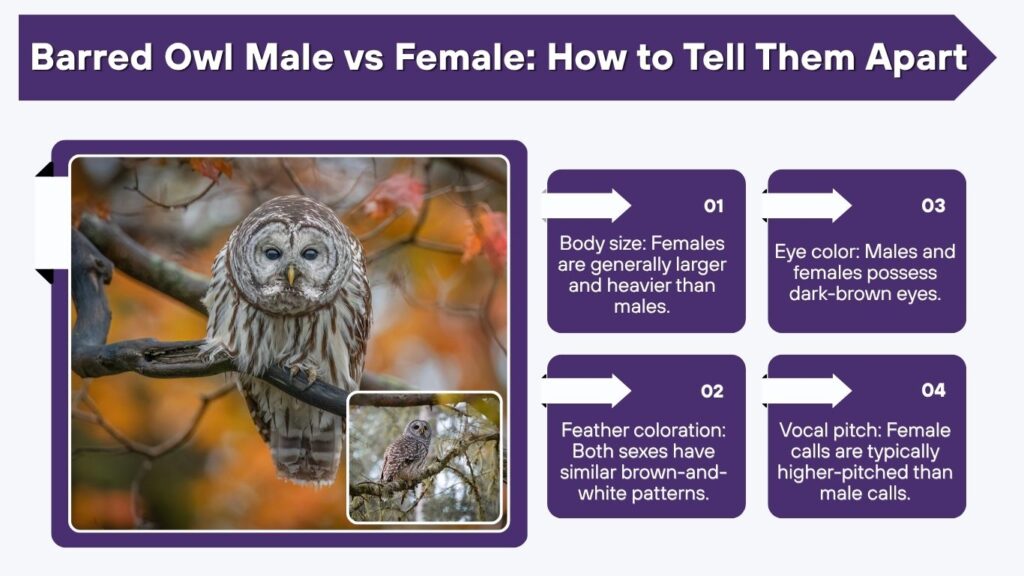
Male and female barred owls have nearly identical feather patterns and facial features. Unlike bird species with strongly contrasting male and female coloration, barred owls exhibit relatively subtle sexual differences. Females are generally larger, while males tend to produce deeper vocalizations. However, identifying an individual owl’s sex based solely on appearance can be difficult without direct comparisons.
Male vs Female Barred Owl Identification
- Body size: Females are generally larger and heavier than males.
- Feather coloration: Both sexes have similar brown-and-white patterns.
- Eye color: Males and females possess dark-brown eyes.
- Vocal pitch: Female calls are typically higher-pitched than male calls.
- Nesting behavior: Females perform most egg incubation, while males provide much of their food during early nesting.
Can You Identify Their Sex by Sound?
Voice can provide useful clues when a male and female barred owl call together.
Male vocalizations tend to have lower frequencies, while female calls generally have higher pitches and longer terminal notes.
However, pitch alone is not a guaranteed way to determine the sex of an unfamiliar individual.
Other Owl Comparisons and Feather Identification
Several North American owls resemble barred owls in size, shape, or feather coloration. Some are much smaller, while others share similar forest habitats and rounded heads. Feather identification can also create confusion because owls, hawks, and other birds sometimes possess overlapping brown-and-white patterns. Recognizing multiple physical characteristics provides more reliable identification than examining one feature alone.
Barred Owl vs Other Owl Species
- Eastern screech-owl: Much smaller, with ear tufts and variable gray or reddish plumage.
- Great gray owl: Significantly larger in length, with a broad facial disk, concentric facial rings, and yellow eyes.
- Snowy owl: Mostly white with dark markings and primarily associated with Arctic and open habitats.
- Short-eared owl: Yellow-eyed, with small ear tufts and a preference for open grasslands and marshes.
- Tawny owl: A Eurasian woodland species with dark eyes and mottled brown plumage, resembling the barred owl in general structure.
Barred Owl Feather vs Hawk Feather
Barred owl feathers frequently display alternating brown and pale bands that resemble markings found on hawk feathers.
Owl flight feathers have specialized soft edges and surfaces that reduce flight noise. Hawk feathers generally lack the same degree of sound-dampening adaptation.
However, feather appearance alone may not identify the species conclusively. Feather size, shape, pattern, and comparison with verified specimens are important.
Juvenile vs Adult Barred Owl
Juvenile barred owls initially have fluffy, pale down that gradually develops into the patterned feathers characteristic of adults.
Young birds may appear rounder and softer than mature owls, particularly shortly after leaving their nests.
Their darker facial features become more recognizable as their adult plumage develops.
FAQs
Comparing owl species becomes easier when examining several characteristics together rather than depending on body color alone. Facial structure, eye color, vocalizations, and habitat provide particularly useful clues. Understanding differences between barred owls and other woodland species also improves identification accuracy. The following questions address common concerns about appearance, size, sex differences, and relationships between these fascinating birds.
1. Are barn owls and barred owls the same species?
No. American barn owls belong to the family Tytonidae, while barred owls belong to Strigidae. They have different facial structures, plumage patterns, habitats, and vocalizations.
2. Which is bigger, a barred owl or a spotted owl?
Barred owls are generally slightly larger and heavier than spotted owls, although individual measurements overlap.
3. Can a great horned owl kill a barred owl?
Yes. Great horned owls are powerful predators capable of killing other owls, including barred owls. Such predation is possible where their territories overlap.
4. How can you tell a male barred owl from a female?
Female barred owls are generally larger and produce higher-pitched calls. However, their nearly identical plumage makes visual identification difficult.
5. What is the easiest way to identify a barred owl?
Look for dark-brown eyes, a rounded head without ear tufts, brown-and-white barred plumage, and its distinctive rhythmic hooting call.