The great horned owl (Bubo virginianus) is one of the largest and most powerful owls in North America. Adults have heavy bodies, broad wings, large heads, and strong talons that make them look even bigger than their measurements suggest. Great horned owl size varies by sex, geographic region, and individual condition, with females typically larger and heavier than males. This guide explains great horned owl height, weight, wingspan, male versus female size, comparisons with humans and other birds, talon size, prey size, and more.
How Big Is a Great Horned Owl?
A full-grown great horned owl is a large, robust bird with a body length of roughly 18 to 25 inches and a wingspan that can approach 5 feet in larger individuals. Although impressive in flight, much of that apparent size comes from long wings and thick feathers rather than body height alone.
Average Great Horned Owl Size
Typical measurements include:
- Body length: About 18–25 inches
- Wingspan: Roughly 3.3–4.8 feet
- Weight: Approximately 2–5.5 pounds
- Females: Usually larger than males
- Body shape: Broad-chested and heavily feathered
Individual measurements vary significantly across the owl’s broad North American range.
Great Horned Owl Size in Feet
Standing body length is generally around 1.5 to just over 2 feet from head to tail.
However, when an owl spreads its wings, it may span approximately 3.5 to nearly 5 feet from wingtip to wingtip.
This wide wingspan explains why a great horned owl flying directly overhead can appear much larger than one perched in a tree.
Great Horned Owl Full Size
Great horned owls reach nearly adult body size before they become completely independent.
Juveniles may look especially bulky because of fluffy plumage. As their feathers mature, their silhouette becomes more defined while overall body dimensions remain similar to adults.
Full-grown females generally appear more massive than males.
Great Horned Owl Male vs Female Size
Great horned owls show reverse sexual size dimorphism, meaning females are larger than males. This pattern is common among birds of prey. Although both sexes have similar colors and markings, differences in body mass and overall build can become noticeable when a male and female are seen together.
Female Great Horned Owl Size
Females may weigh approximately:
- 3 to over 5 pounds
- Around 20–25 inches long
- Up to nearly 5 feet across the wings
A female’s heavier body can be particularly noticeable during the nesting season.
Male Great Horned Owl Size
Males are typically:
- Lighter-bodied
- Slightly shorter
- Narrower through the chest
- Smaller overall than females
Many males weigh closer to 2–3.5 pounds, although geographic variation can produce considerable overlap.
Male vs Female Size Differences
Important differences include:
- Females are usually heavier.
- Females often have longer wings.
- Males tend to have slimmer bodies.
- Both sexes can have similar plumage.
- Size alone is not always enough to determine sex in the field.
Because there is overlap, observers usually cannot confidently determine sex unless the pair is seen together or other behavioral clues are available.
Great Horned Owl Size Compared to a Human
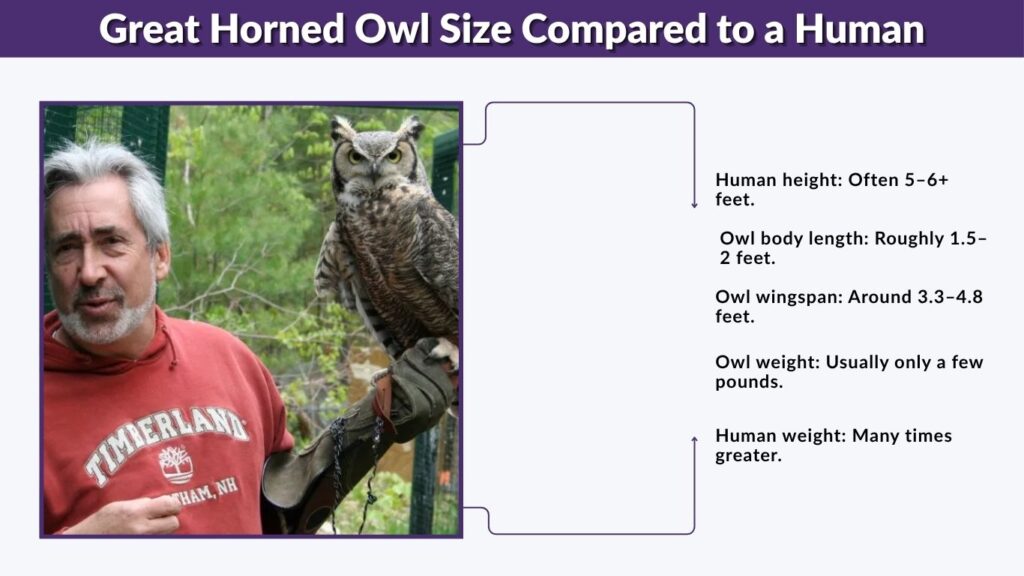
A great horned owl is much shorter and lighter than an adult human, but its wingspan can be surprisingly close to the height of a shorter person. Its broad feathers and large eyes also make the bird appear larger than its actual body mass.
Great Horned Owl vs Human
A simple comparison:
- Human height: Often 5–6+ feet
- Owl body length: Roughly 1.5–2 feet
- Owl wingspan: Around 3.3–4.8 feet
- Owl weight: Usually only a few pounds
- Human weight: Many times greater
An owl perched beside a person would therefore look relatively small, but an owl spreading its wings can create an impressive silhouette.
Why Do Great Horned Owls Look So Large?
Several features exaggerate their apparent size:
- Dense feathers
- Broad wings
- Large head
- Prominent ear tufts
- Thick-looking chest
- Wide facial disk
Underneath the feathers, the bird’s body is considerably slimmer than it appears.
Great Horned Owl Size Compared With Other Owls
Great horned owls are among the larger common owls in North America, but they are not always the tallest or heaviest species. Comparing body length, wingspan, and weight gives a more accurate picture than using one measurement alone.
Great Horned Owl vs Barred Owl Size
Great horned owls are generally heavier and more powerfully built than barred owls.
Compared with a barred owl, a great horned owl usually has:
- Greater body mass
- Broader chest
- Larger feet
- More powerful talons
- Similar or somewhat greater overall length
A barred owl often looks slimmer and less massive.
Great Horned Owl vs Barn Owl Size
Barn owls are noticeably lighter and more slender.
Great horned owls have:
- Heavier bodies
- Broader wings
- Larger feet
- Stronger-looking heads
- More substantial overall build
Barn owls may have long wings, but their body weight is much lower.
Great Grey Owl vs Great Horned Owl Size
The great grey owl can appear much larger because it is extremely tall and has thick plumage.
However, much of the great grey owl’s impressive size comes from feathers.
A great horned owl may be:
- Shorter in length
- More compact
- Heavier-bodied
- More muscular-looking
So the great grey owl can look larger while the great horned owl remains a very powerful bird for its size.
Snowy Owl vs Great Horned Owl Size
Snowy owls and great horned owls can overlap considerably in size.
Snowy owls may be:
- Heavier on average in some populations
- Similar in wingspan
- Longer-bodied in some cases
Both are among North America’s most impressive large owls.
Great Horned Owl vs Bald Eagle Size
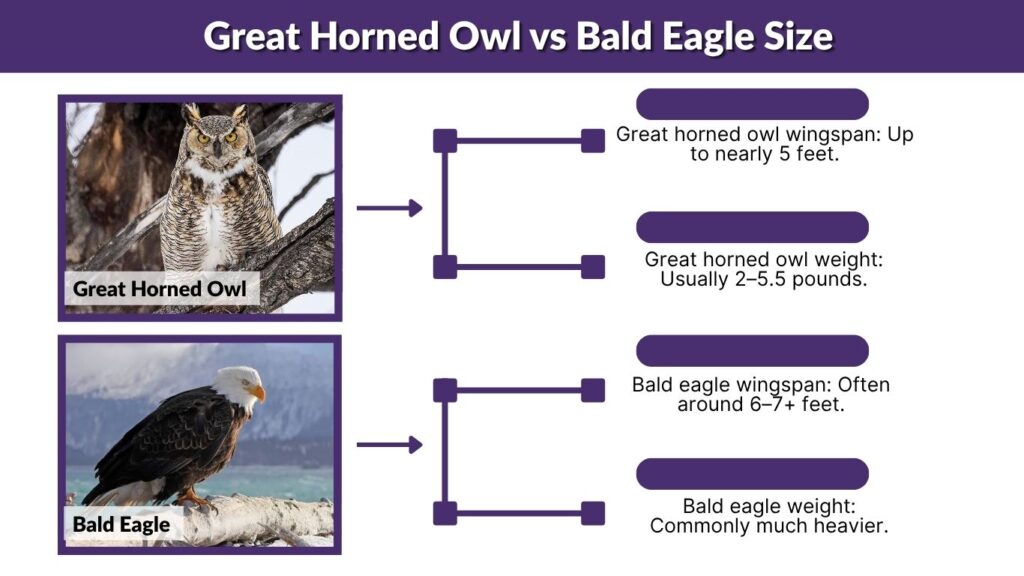
A bald eagle is significantly larger than a great horned owl in overall body size and wingspan. However, great horned owls possess extremely strong feet and talons relative to their body size.
Size Comparison
Approximate differences include:
- Great horned owl wingspan: Up to nearly 5 feet
- Bald eagle wingspan: Often around 6–7+ feet
- Great horned owl weight: Usually 2–5.5 pounds
- Bald eagle weight: Commonly much heavier
The eagle is clearly larger, but both are formidable predators.
Great Horned Owl vs Red-Tailed Hawk
Great horned owls and red-tailed hawks have somewhat comparable body dimensions.
The owl often appears:
- Bulkier
- Larger-headed
- More heavily feathered
Red-tailed hawks may have a similar wingspan, but great horned owls possess especially strong feet adapted for gripping and killing prey.
Great Horned Owl Talon and Claw Size
The feet of a great horned owl are among its most impressive features. Powerful toes end in sharply curved talons that help the owl capture mammals and birds.
Great Horned Owl Talons
Their talons are:
- Long and sharply curved
- Extremely strong
- Designed for gripping prey
- Positioned on powerful feet
- Capable of penetrating fur and feathers
The exact talon length varies among individuals, with females generally having larger feet because of their greater body size.
Why Are Their Talons So Powerful?
Great horned owls hunt animals that may struggle aggressively.
Strong feet allow them to seize:
- Rabbits
- Rodents
- Birds
- Squirrels
- Reptiles
- Other medium-sized prey
Their combination of large feet, curved claws, and powerful leg muscles makes them highly effective predators.
Great Horned Owl Prey Size
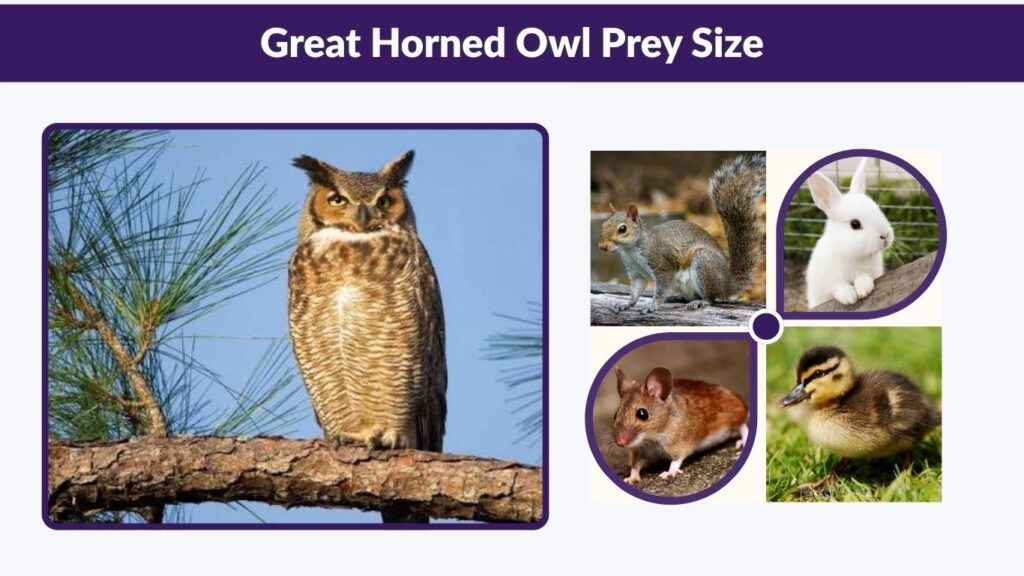
Great horned owls can take prey ranging from tiny insects to surprisingly large mammals and birds. Their powerful feet allow them to capture animals much larger than those targeted by smaller owl species.
Common Prey
Great horned owls may hunt:
- Mice
- Rats
- Voles
- Rabbits
- Squirrels
- Ducks
- Pigeons
- Snakes
- Other birds
- Skunks
Prey choice depends on habitat and local availability.
Can They Carry Large Prey?
Like other flying birds, great horned owls cannot simply carry animals far heavier than themselves.
They may kill relatively large prey and feed at the location rather than flying away with the entire animal.
Smaller prey can be transported back to a perch or nest.
Great Horned Owl Egg and Clutch Size
Great horned owls typically begin nesting earlier in the year than many other birds. Females lay large white eggs in nests built by other birds or in natural cavities and platforms.
Great Horned Owl Clutch Size
A typical clutch often contains:
- 1–4 eggs
- Commonly around 2 eggs
- White, rounded eggs
- Eggs laid several days apart
Because incubation begins before all eggs are laid, chicks may hatch at different times.
Great Horned Owl Nest Size
Great horned owls often reuse large nests originally built by hawks, crows, ravens, or other large birds.
Therefore, nest dimensions vary significantly.
They may also use:
- Tree cavities
- Cliff ledges
- Broken tree tops
- Artificial platforms
- Abandoned nests
The nest must be large and sturdy enough to support the female and growing owlets.
Great Horned Owl Territory Size
Great horned owl territory size varies dramatically depending on habitat quality, prey abundance, nesting sites, and competition.
What Determines Territory Size?
Important factors include:
- Availability of rodents and rabbits
- Forest density
- Open hunting areas
- Nesting opportunities
- Nearby owl territories
- Seasonal conditions
In areas with abundant food, an owl may need a smaller hunting range than one living where prey is scarce.
FAQs
1. How big is a great horned owl?
A great horned owl is typically around 18–25 inches long with a wingspan of roughly 3.3–4.8 feet.
2. How much does a great horned owl weigh?
Adults generally weigh around 2–5.5 pounds, with females usually heavier than males.
3. Is a great horned owl bigger than a barred owl?
Great horned owls are generally heavier and more powerfully built than barred owls, although their body lengths can overlap.
4. Is a great horned owl bigger than a bald eagle?
No. Bald eagles are substantially larger and heavier, with wingspans that commonly exceed those of great horned owls.
5. How big is a great horned owl compared to a human?
Its body is only around 1.5–2 feet long, but its wingspan can reach nearly 5 feet, making it appear surprisingly large when flying near a person.