Barred owl sounds are among the most recognizable bird calls in North American forests. These large owls produce deep hoots, unusual screams, barking noises, and monkey-like calls that can surprise anyone listening at night. Their famous “Who cooks for you?” hoot is especially distinctive, but barred owls use many other vocalizations to communicate. Understanding these sounds can help you identify their presence, recognize mating behavior, and distinguish them from other owl species. This guide explores different barred owl sounds, their meanings, and when you are most likely to hear them.
What Does a Barred Owl Sound Like?
The barred owl (Strix varia) produces a variety of vocalizations, ranging from rhythmic hoots to loud, chaotic screams. Its most recognizable sound is a series of eight or nine notes resembling a spoken phrase. However, these birds also make barking, cackling, and gurgling noises. Their calls can travel considerable distances through forests, particularly during quiet nighttime conditions.
The Famous “Who Cooks for You?” Hoot
The classic barred owl hoot sounds like “Who cooks for you? Who cooks for you-all?”
This rhythmic sequence usually contains eight or nine notes, with the final note often drawn out. Both males and females produce this call to communicate and advertise their presence.
The distinctive pattern makes the barred owl relatively easy to recognize by sound, even when the bird remains hidden.
Do Barred Owls Make Screeching Sounds?
Yes. Barred owls can produce harsh screams, shrieks, and high-pitched calls that sound very different from their usual hooting.
These noises may occur during alarm, interactions between adults, or communication involving young birds.
A sudden barred owl scream can resemble another animal, making identification difficult without hearing the complete sequence.
Different Types of Barred Owl Sounds
Barred owls have a surprisingly extensive vocal repertoire. Their sounds change depending on age, social interactions, and environmental circumstances. While their familiar hooting call is associated with territorial communication, other vocalizations occur during courtship, family interactions, and defensive behavior. Learning the differences makes it easier to recognize barred owls when they are active in nearby forests.
Common Barred Owl Calls and Noises
- Classic hooting: A deep, rhythmic series resembling “Who cooks for you?”
- Monkey-like calls: Loud combinations of cackles, gurgles, and wild hoots.
- Barking sounds: Short, rough calls that may resemble distant dogs.
- Screaming sounds: Harsh, piercing vocalizations associated with agitation or alarm.
- Juvenile begging calls: Higher-pitched cries produced by young owls requesting food.
- Bill clicking: Sharp snapping noises sometimes heard during stressful encounters.
What Is the Barred Owl Caterwauling Sound?
Caterwauling is a particularly dramatic vocal display involving loud, overlapping calls.
Mated pairs may produce combinations of hoots, cackles, and squalls, creating a sound that resembles monkeys calling from trees.
These noisy performances commonly occur during courtship and interactions between paired birds.
Barred Owl Sounds and Their Meanings
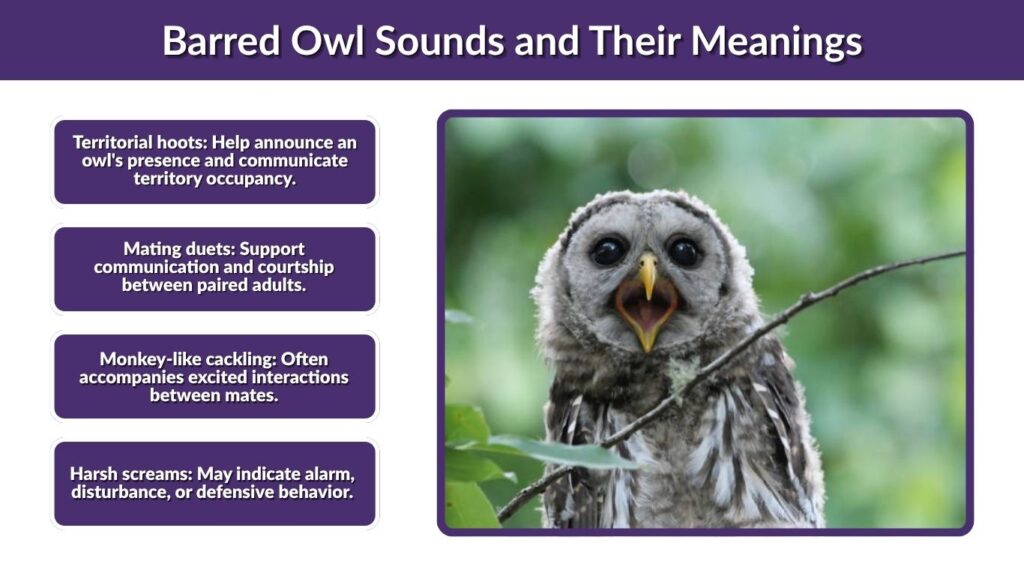
Different barred owl sounds serve important communication functions. These vocalizations help adults establish territories, maintain contact with their mates, and respond to threats. Young owls also produce distinctive calls when requesting food. However, individual sounds do not always have one exact meaning, and researchers often interpret their purpose based on surrounding behavior and circumstances.
Barred Owl Calls and Possible Meanings
- Territorial hoots: Help announce an owl’s presence and communicate territory occupancy.
- Mating duets: Support communication and courtship between paired adults.
- Monkey-like cackling: Often accompanies excited interactions between mates.
- Harsh screams: May indicate alarm, disturbance, or defensive behavior.
- Juvenile cries: Commonly function as food-begging calls.
- Bill snapping: Can occur during squabbles or stressful encounters.
Does Barred Owl Hooting Mean Danger?
Not necessarily. Hooting is normal communication and does not automatically indicate an approaching threat.
A barred owl may call while defending its territory, communicating with a mate, or responding to another owl.
Repeated nighttime hooting usually reflects ordinary behavior rather than danger to nearby people.
Why Do Barred Owls Sound Like Monkeys?
One of the strangest barred owl vocalizations resembles a group of monkeys laughing or shouting. These sounds are produced through rapid combinations of hoots, cackles, and other unusual calls. Their unpredictable rhythm makes them difficult to recognize as owl vocalizations. Such performances are particularly associated with paired adults and can become remarkably loud during the breeding season.
Barred Owl Monkey Sounds During Courtship
During courtship, a male and female barred owl may participate in an elaborate vocal duet.
One bird begins calling, and its partner responds with overlapping hoots, caws, and gurgles.
Together, these sounds can resemble monkeys, laughing people, or several animals calling simultaneously.
Do Barred Owls Make Monkey Sounds While Hunting?
Monkey-like vocalizations are more closely associated with social communication than with hunting.
Barred owls usually rely on excellent hearing and relatively quiet flight to capture prey. Loud calls are not a necessary part of their hunting strategy.
Hearing monkey-like noises at night may indicate that paired owls are interacting nearby.
Baby and Juvenile Barred Owl Sounds
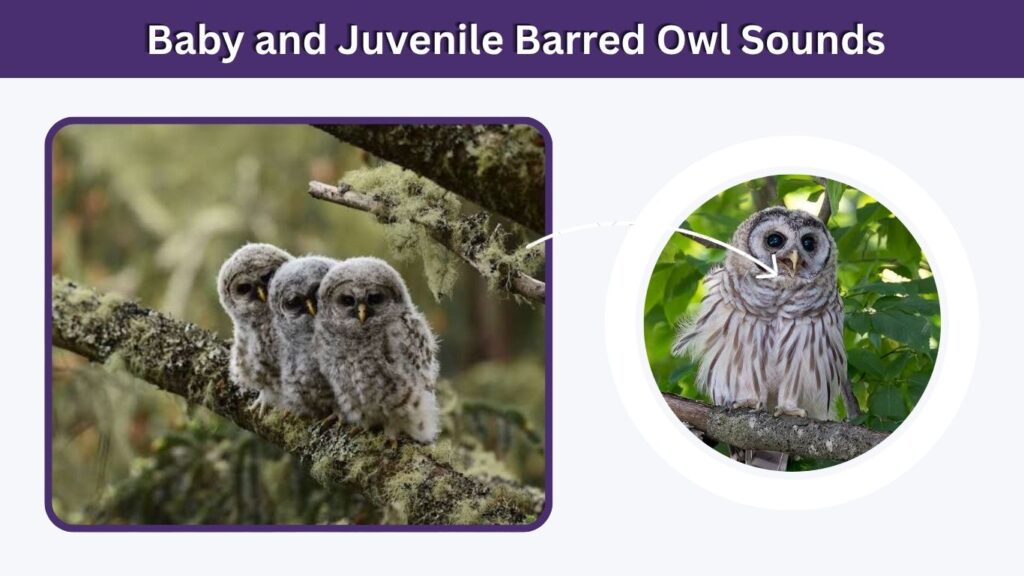
Young barred owls sound noticeably different from adults. Rather than producing the familiar eight-note hoot, juveniles commonly make piercing, raspy, or high-pitched begging calls. These sounds help parents locate their offspring and respond to their food requests. Juvenile vocalizations are especially noticeable during the nesting and post-fledging periods, when young owls remain dependent on adults.
What Does a Juvenile Barred Owl Sound Like?
Juvenile barred owls frequently produce loud, drawn-out cries that resemble squealing or screeching.
These calls may be repeated as young birds wait for food from their parents.
As they mature, juveniles gradually develop more adult-like vocalizations while continuing to communicate with family members.
Barred Owl Hissing and Clicking Sounds
Barred owls may hiss, give harsh calls, or snap their bills when disturbed or during close interactions.
Bill snapping creates a brief clicking sound rather than a typical vocal call.
These noises should not automatically be interpreted as aggression, although they may indicate that a bird is uncomfortable with nearby activity.
Barred Owl Sounds at Night and During the Day
Barred owls are primarily nocturnal, making nighttime one of the best periods for hearing their calls. Their vocal activity can increase during courtship and territorial interactions. However, unlike some nocturnal birds, barred owls also call during daylight hours. Weather, season, local habitat, and breeding behavior can influence how frequently their sounds are heard.
Why Do Barred Owls Hoot at Night?
Barred owls use nighttime hooting to communicate across wooded territories.
Paired birds may exchange calls, while neighboring individuals can respond from different parts of the forest.
Although these owls remain active throughout the year, vocal activity may become especially noticeable during late winter and spring courtship periods.
Do Barred Owl Sounds Vary by Location?
Barred owls occur throughout much of eastern North America, including Florida, Texas, Wisconsin, and Ontario. They also inhabit parts of the Pacific Northwest.
Their recognizable hooting pattern remains broadly similar across these regions, although individual calls and seasonal activity can vary.
In warm southern habitats, barred owl calls may be heard during much of the year.
Barred Owl vs. Other Owl Sounds
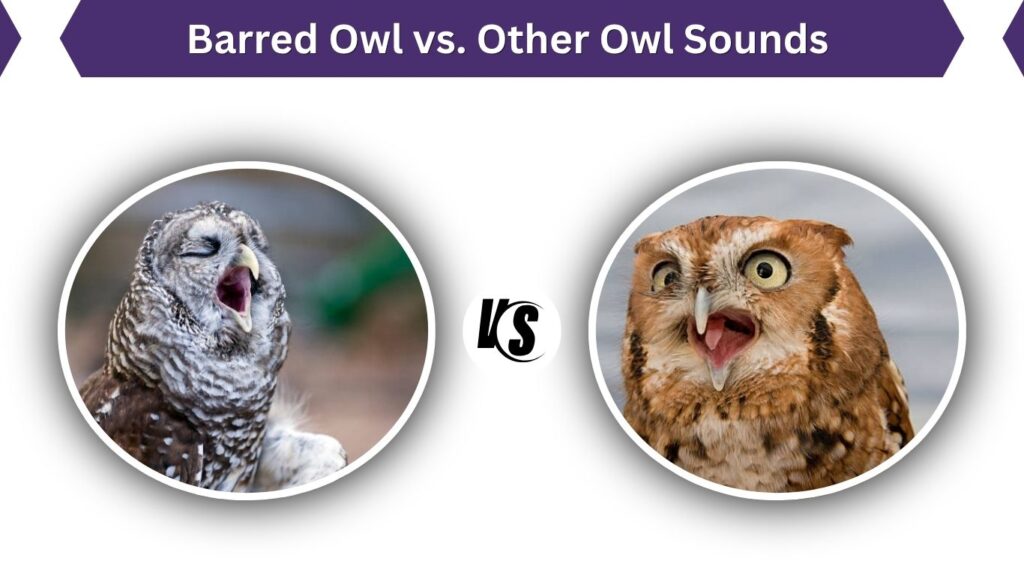
Barred owl sounds can be confused with those of other North American owls, especially when birds call from a distance. Great horned owls produce deep, powerful hoots, while barn owls are famous for harsh screams. Comparing call rhythm, pitch, and overall structure provides useful identification clues. Listening to complete recordings is more reliable than judging individual notes.
Key Differences Between Owl Calls
- Barred owl: Rhythmic eight- or nine-note hoots, often followed by a drawn-out ending.
- Great horned owl: Deep, resonant hoots delivered in a shorter, stuttering pattern.
- American barn owl: Long, harsh screaming calls rather than conventional rhythmic hooting.
- Eastern screech-owl: Trembling trills and descending whinny-like sounds.
Can Barred Owls Sound Like Coyotes?
Some barred owl screams and caterwauling duets resemble distant animal howls.
However, their calls generally contain distinctive hoots, cackles, and abrupt changes in pitch.
Listening for the classic barred owl rhythm before or after unusual noises can help confirm the identification.
How to Listen to Barred Owl Sounds
Listening to authentic recordings is one of the easiest ways to learn barred owl vocalizations. Professional bird-sound libraries contain examples of adult songs, mating duets, and juvenile begging calls. Comparing these recordings with sounds heard outdoors can improve identification accuracy. Quiet observation in suitable woodland habitat also offers opportunities to hear barred owls naturally.
Tips for Identifying Barred Owl Calls
- Listen for the classic “Who cooks for you?” rhythm.
- Notice whether one owl or multiple owls are calling.
- Compare high-pitched juvenile cries with deeper adult hoots.
- Pay attention to repeated cackling or monkey-like duets.
- Record unfamiliar calls from a distance for later comparison.
Where Can You Hear Barred Owl Audio?
The Cornell Lab of Ornithology’s Macaulay Library provides authentic barred owl recordings, including songs, duets, and juvenile calls.
Audubon also offers examples of different vocalizations. These recordings are useful for recognizing calls heard in forests or residential areas.
Avoid repeatedly playing recorded owl calls outdoors, particularly near nesting birds, because playback can disturb territorial behavior.
FAQs
Barred owl vocalizations can be confusing because a single bird may produce several very different sounds. Their hoots, screams, and unusual duets often lead listeners to mistake them for other animals. Understanding the purpose of these calls helps explain why barred owls are so vocal. Here are answers to five common questions about their nighttime noises and behavior.
1. What is the most common barred owl sound?
The best-known barred owl sound is an eight- or nine-note hoot resembling “Who cooks for you? Who cooks for you-all?” It is used for territorial and social communication.
2. Why do barred owls scream at night?
Barred owls may scream during alarm, disturbance, or social interactions. Their loud duets can also contain shrieking and cackling sounds.
3. What do barred owl mating calls sound like?
Mating and courtship vocalizations often involve overlapping hoots, gurgles, cackles, and monkey-like noises exchanged between paired birds.
4. What sounds do baby barred owls make?
Baby and juvenile barred owls produce high-pitched begging cries, raspy squeals, and screeching sounds to communicate with their parents.
5. Do barred owls hoot during the daytime?
Yes. Although barred owls are most active at night, they sometimes hoot and hunt during daylight hours, especially in wooded habitats.