The striped owl is a striking medium-sized owl recognized by its long ear tufts, boldly streaked chest, dark-edged facial disc, and brown-and-cream plumage. Scientifically known as Asio clamator, it occurs from southern Mexico through Central America and across parts of South America. This nocturnal hunter prefers open or semi-open landscapes rather than dense forests. In this guide, you’ll learn how to identify a striped owl, where it lives, what it eats, what its call sounds like, how it breeds, and other fascinating facts.
What Is a Striped Owl?
The striped owl is a member of the typical owl family, Strigidae. Its combination of prominent ear tufts, strongly streaked underparts, and dark facial markings gives it a distinctive appearance. It is mainly active after sunset and inhabits grasslands, savannas, marsh edges, farmland, and other relatively open habitats with scattered trees or shrubs.
Scientific Name and Classification
The striped owl’s scientific name is Asio clamator. Some references have placed the species in the genus Pseudoscops, so the name Pseudoscops clamator may also appear in older or alternative classifications.
Birds of the World currently lists the species as Asio clamator and recognizes four subspecies. It belongs to the order Strigiformes and family Strigidae.
Key Identification Features
A striped owl can be recognized by several characteristics:
- Body length of approximately 30–38 cm
- Weight of roughly 320–556 grams
- Long, prominent dark ear tufts
- Brownish-white facial disc bordered with black
- Brown to cinnamon-colored eyes
- Blackish bill
- Tawny-buff or cinnamon-brown upperparts
- Pale underparts with strong dark vertical streaks
- Barred brown-and-pale flight feathers and tail
- Females generally heavier than males
What Does a Striped Owl Look Like?
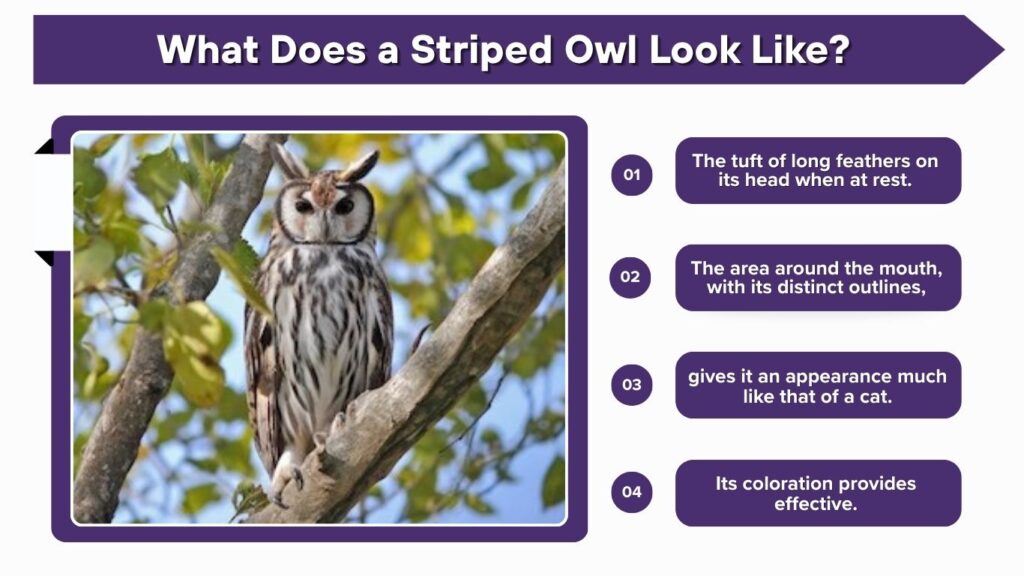
The striped owl’s name comes from the conspicuous streaking across its body. At rest, its long ear tufts and strongly outlined facial disc can give it an almost cat-like appearance. Its coloration provides effective camouflage among dry grass, tree trunks, branches, and dense vegetation where it spends daylight hours concealed from predators and disturbance.
Black, White, and Brown Striped Appearance
People searching for a black and white striped owl or a brown and white striped owl may be describing this species. Its underparts range from pale tawny to buff-white and contain long dark brown or nearly black streaks.
The upperparts are warmer brown or cinnamon with darker streaks and mottling. A pronounced dark border surrounding the pale facial disc further strengthens the striped owl’s high-contrast appearance.
Striped Owl Feathers and Tail
The wing and tail feathers show alternating pale and darker brown bars. When the bird flies, these patterns may appear as stripes across the wings and tail.
A dark patch near the wrist area of the wing can also be particularly noticeable during flight. Individual loose feathers, however, should not be identified as striped owl feathers solely from color because several owl species have similar brown-and-cream barring.
Striped Owl Habitat and Range
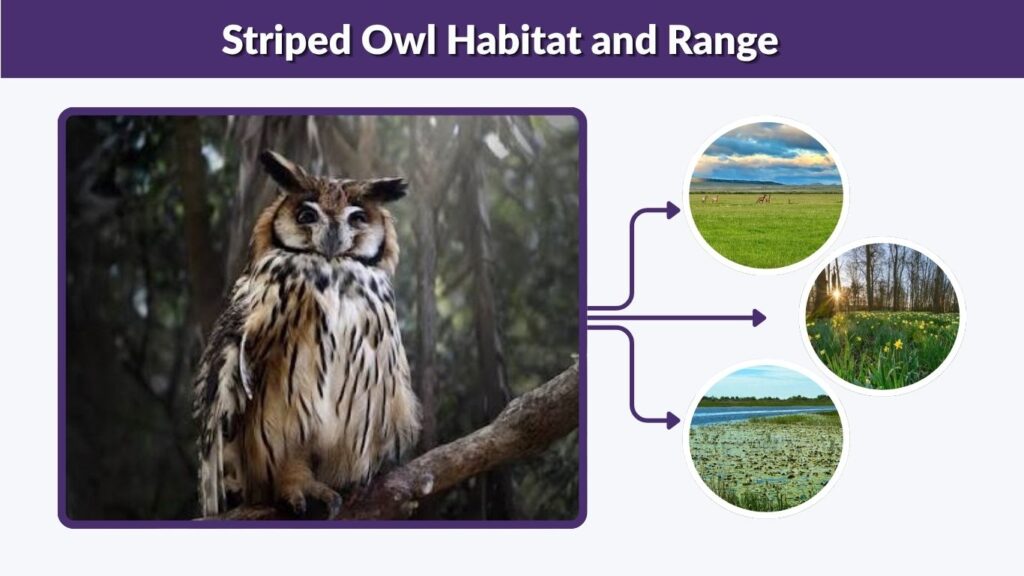
Striped owls have an extensive Neotropical distribution but are strongly associated with open landscapes. They generally avoid continuous dense rainforest, including much of the Amazon Basin. Their preferred environments provide both open hunting areas and nearby shrubs, trees, or tall vegetation where the owls can hide and roost during daylight hours.
Mexican Striped Owl
The northern portion of the striped owl’s range reaches southern Mexico and continues through Central America to Panama. In these regions, the species may inhabit savannas, pastures, agricultural landscapes, marshy areas, and other open environments.
It is primarily a resident species rather than a long-distance migrant, although individuals can naturally move within suitable landscapes.
Peruvian Striped Owl
Striped owls also occur in South America, including Peru. Documented observations exist from places such as Pisco in Peru. Their broader South American range extends through suitable areas east of the Andes toward Uruguay and northern Argentina.
Preferred Habitats
Typical striped owl habitats include:
- Open grasslands
- Savannas with scattered trees
- Pastures and agricultural fields
- Marshlands with shrubs
- Small woodland patches
- Wooded suburban areas
- Shrubby open country
- Habitats from sea level to roughly 1,600 meters elevation
Striped Owl Call, Sound, and Behavior
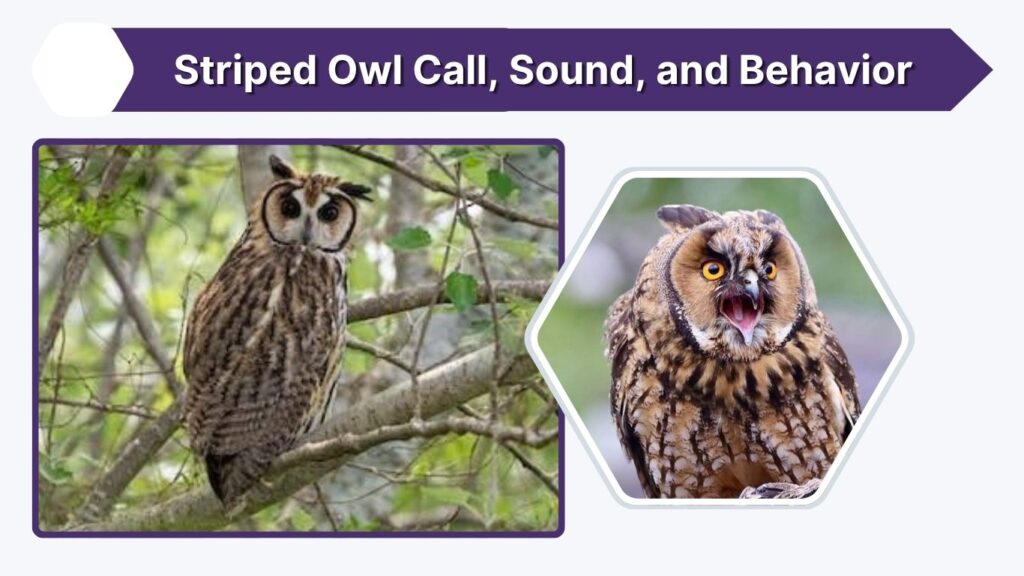
The striped owl is mainly nocturnal, becoming active around sunset and continuing to hunt after dark. During daytime it usually remains hidden among dense foliage, shrubs, small trees, or occasionally vegetation close to the ground. Its vocalizations are useful for detecting the species because a hidden owl can be difficult to locate visually.
What Does a Striped Owl Call Sound Like?
One characteristic striped owl sound is a long, sharp, hawk-like whistle described approximately as “wheeyoo.” Males can also produce a series of separated nasal hoots.
Females give a similar but generally higher or shriller song. Both males and females can make barking calls, while fledged young produce high-pitched begging screams. Recordings of striped owl whistles are documented from Brazil.
Nocturnal Behavior
Striped owls begin becoming active near dusk. During nonbreeding periods, several individuals may sometimes roost together during daylight.
When hunting, they can fly low across open ground with relatively rapid, shallow wingbeats. They also use elevated perches, watching the ground carefully before diving toward detected prey.
What Do Striped Owls Eat?
Their diet includes a surprisingly broad range of prey:
- Rice rats and other small rodents
- Spiny rats
- Cavies
- Bats
- Small opossums
- Doves and other small birds
- Grassquits and flycatchers
- Thrushes and sparrows
- Large insects
- Occasional reptiles
They are capable predators and may capture relatively large prey compared with their own body weight.
Striped Owl Breeding and Baby Owls
Compared with many familiar temperate-zone owls, some aspects of striped owl breeding remain less extensively documented. Available observations show that they use simple nesting locations on or close to the ground rather than constructing elaborate tree nests. Females perform incubation, while young remain dependent on adults after hatching and later become noticeably vocal as fledglings.
Are Striped Owls Monogamous?
Striped owls form breeding pairs, but there is not enough widely published evidence to confidently describe the species as lifelong monogamous. It is safer to describe them as pair-forming during reproduction rather than assuming that the same male and female remain together permanently.
Their courtship communication includes vocalizations, with males and females producing related but distinguishable calls.
How Many Eggs Do Striped Owls Lay?
Basic breeding characteristics include:
- A typical clutch of two to four eggs
- Rudimentary nests placed in long grass or dense vegetation
- Nesting commonly occurs close to or on the ground
- The female incubates the eggs
- Incubation lasts approximately 33 days
- One chick may commonly survive to fledging, although two fledglings have been observed
What Does a Baby Striped Owl Look Like?
Young striped owls are initially much fluffier and paler than adults. As they develop, juvenile feathers gradually replace the soft down and the characteristic facial pattern and body streaking become more recognizable.
Fledged youngsters may produce conspicuous high-pitched calls while still depending on their parents for food.
Lifespan, Predators, and Conservation
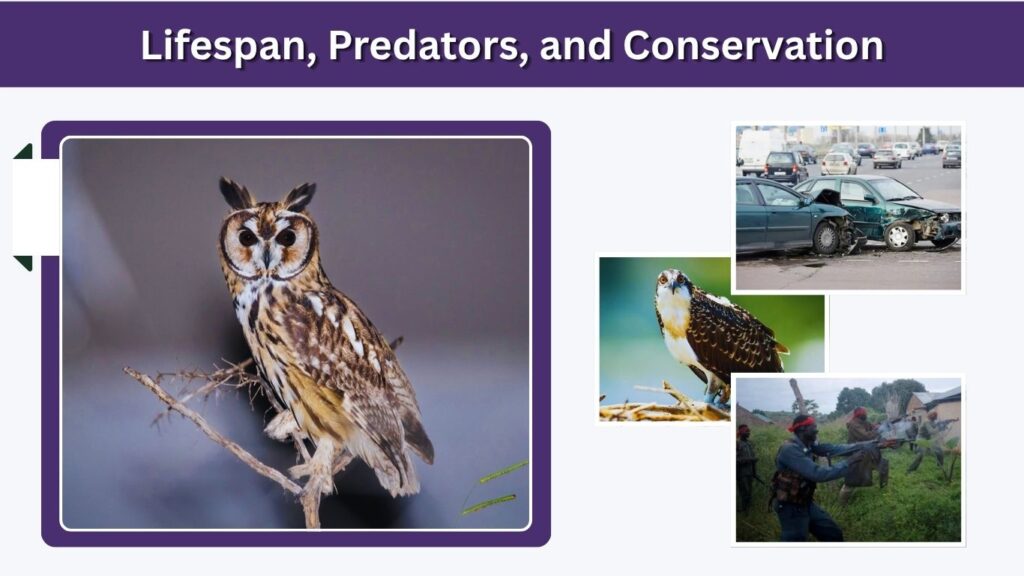
The striped owl is not currently regarded as globally threatened. Nevertheless, individuals face natural predation and human-related dangers such as road collisions and shooting. Because the species uses agricultural and suburban landscapes as well as natural habitats, its survival can also depend on maintaining suitable open hunting areas together with safe vegetation for daytime roosting.
How Long Do Striped Owls Live?
A dependable species-specific average lifespan for wild striped owls is not well established in the widely available scientific literature. It is therefore better not to assign them a precise lifespan based on estimates from unrelated owl species.
Longevity can be influenced by prey availability, habitat conditions, disease, predators, vehicle collisions, and other environmental pressures.
Main Threats and Predators
Potential threats include:
- Larger owls
- Other birds of prey
- Vehicle collisions
- Shooting and direct persecution
- Loss or alteration of suitable habitat
Birds of the World lists the striped owl as Least Concern, indicating that it is not presently classified among globally threatened species.
Striped Owl vs Other Owls With Stripes
Many owl species show streaks, bars, or mottled feathers, so seeing an owl with stripes does not automatically mean it is an Asio clamator. Location, facial pattern, ear tufts, eye color, body proportions, and the direction of feather markings should all be considered before identifying an unfamiliar owl.
Is Every Brown and White Striped Owl a Striped Owl?
No. Numerous owls have brown-and-white patterns for camouflage. Barred Owls, Great Horned Owls, Long-eared Owls, and several tropical species can display prominent bars or streaks.
A true striped owl is best identified by the combination of long dark ear tufts, brown eyes, a pale black-bordered facial disc, heavily streaked chest, and its Central and South American distribution.
What About a White Owl With Black Stripes?
A pale owl with dark markings may belong to another species or may simply appear unusually pale because of lighting, age, or individual plumage variation. The striped owl itself is generally tawny, brown, buff, and cream rather than predominantly white.
Geographic location is one of the fastest clues when narrowing down an identification.
FAQs
The striped owl’s prominent markings lead to many identification questions, especially when people see a brown or white owl with streaks at night. Its scientific identity, vocalizations, range, breeding behavior, and preferred habitat provide much stronger identification clues than stripe patterns alone.
What is the scientific name of the striped owl?
The striped owl’s accepted scientific name is Asio clamator. Some classifications and older references use Pseudoscops clamator. It belongs to the family Strigidae and is closely associated with other eared owls. Birds of the World currently places the species in the genus Asio.
Where do striped owls live?
Striped owls occur from southern Mexico through Central America and across substantial portions of South America east of the Andes, extending toward Uruguay and northern Argentina. They favor savannas, grasslands, pasture, marshy habitats, farmland, and open areas containing scattered shrubs or trees.
What does a striped owl sound like?
A striped owl can produce a long, piercing whistle as well as nasal hooting calls. Female calls tend to be more shrill than those of males. Both sexes may also make barking sounds, while fledged juveniles produce higher-pitched begging calls when communicating with adults.
How many eggs does a striped owl lay?
A striped owl usually lays two to four eggs. The nest is relatively simple and may be situated on the ground among long grass or dense bushes. The female performs incubation for roughly 33 days. Observations suggest that one or sometimes two young may successfully reach the fledgling stage.
Is the striped owl endangered?
No. The striped owl is currently categorized as Least Concern, meaning it is not considered globally endangered. However, individuals can still be affected by road collisions, shooting, habitat alteration, and natural predators. Protecting open hunting habitat and suitable daytime roosting vegetation benefits local populations.