The Stygian owl is a mysterious, dark-colored owl known for its long ear tufts, intense stare, nocturnal habits, and unusual reputation. Scientifically called Asio stygius, this medium-sized owl occurs from Mexico through parts of Central and South America and the Caribbean. Although photographs sometimes make it appear to have glowing red eyes, its actual eye color is usually yellow. From hunting birds and bats at night to resting silently in dense vegetation, the Stygian owl has many fascinating characteristics worth exploring.
What Is a Stygian Owl?
The Stygian owl is a member of the true owl family Strigidae and belongs to the genus Asio, alongside species such as the long-eared and short-eared owls. Its extremely dark plumage and prominent ear tufts give it an imposing appearance. The word “Stygian” refers to darkness and is derived from Styx in Greek mythology.
Stygian Owl Scientific Name
The scientific name of the Stygian owl is Asio stygius. Its basic classification includes:
- Common name: Stygian owl
- Scientific name: Asio stygius
- Family: Strigidae
- Genus: Asio
- Order: Strigiformes
- Type: True owl
Several recognized subspecies occur across different parts of its broad but fragmented range.
Why Is It Called the Stygian Owl?
“Stygian” means extremely dark or gloomy and originates from the River Styx of Greek mythology. The name describes the owl’s exceptionally dark plumage rather than indicating any biological connection with mythology.
Its blackish face, dark body, prominent ear tufts, and nighttime behavior have nevertheless inspired supernatural stories in some cultures.
Stygian Owl Identification and Appearance
Identifying a Stygian owl is relatively easy when its face and plumage can be clearly seen. It is noticeably darker than many related owls and has long feather tufts that can resemble horns when raised. Its face is dark with lighter borders, while pale streaking and barring break up the otherwise brownish-black plumage.
Key Stygian Owl Characteristics
Look for these identification features:
- Very dark brown to blackish plumage
- Long, prominent ear tufts
- Dark facial disk with a pale border
- Whitish or pale markings on the forehead
- Yellowish eyes
- Strong dark streaks on the underparts
- Relatively long wings
- Powerful feathered legs and sharp talons
When relaxed, the ear tufts may lie flatter and become much less obvious.
Male vs. Female Stygian Owl
Male and female Stygian owls have broadly similar coloration, so separating them visually can be difficult.
Females are generally larger and heavier than males. This size difference follows a pattern found in many owl species, where females tend to be somewhat larger. Plumage alone is usually not a dependable way to identify the sex.
Do Stygian Owls Have Red Eyes?
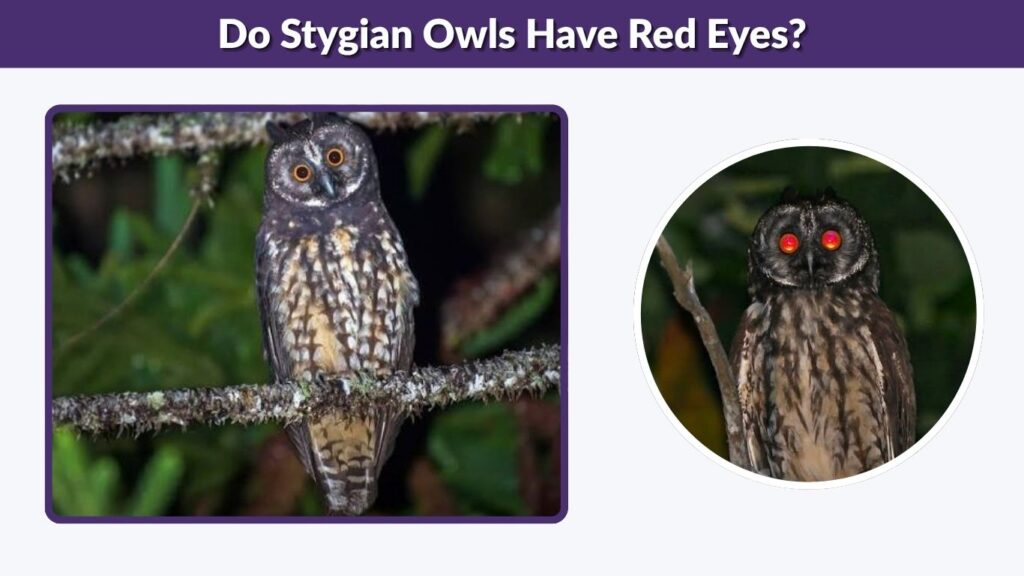
Searches for Stygian owl red eyes are common because many nighttime photographs show these birds with dramatic crimson or fiery-looking eyes. However, Stygian owls do not naturally have bright red irises. Their eyes are normally shades of yellow. Red coloration can appear when light reflects from structures inside the eye during nighttime photography.
Why Do Stygian Owl Eyes Look Red?
The red appearance is essentially an eyeshine effect. Artificial lighting or a camera flash can reflect from the owl’s eyes and produce a red or reddish-orange glow.
This effect becomes especially dramatic because the owl has such a dark face, creating strong contrast between its plumage and the reflected light.
Is the Stygian Owl the Only Owl With Red Eyes?
No. More importantly, the Stygian owl does not actually have naturally red irises.
Several nocturnal animals can display red, orange, green, or other colored eyeshine depending on lighting conditions, viewing angle, and eye structure. Therefore, glowing red eyes in a photograph should not be treated as the owl’s normal daytime eye color.
Stygian Owl Size and Wingspan
The Stygian owl is considered a medium-sized owl. Adults are usually around 38 to 46 centimeters, or approximately 15 to 18 inches, in length. Their relatively long wings and substantial body give them an impressive appearance in flight, especially when viewed against a night sky. Females generally occupy the larger end of the size range.
Stygian Owl Measurements
Typical measurements include:
- Length: About 15–18 inches
- Length in centimeters: Roughly 38–46 cm
- Weight: Approximately 400–675 grams
- Wingspan: Roughly 40–46 inches in some reported measurements
- Female size: Generally larger than males
Measurements vary somewhat according to sex, subspecies, and geographic population.
Where Do Stygian Owls Live?
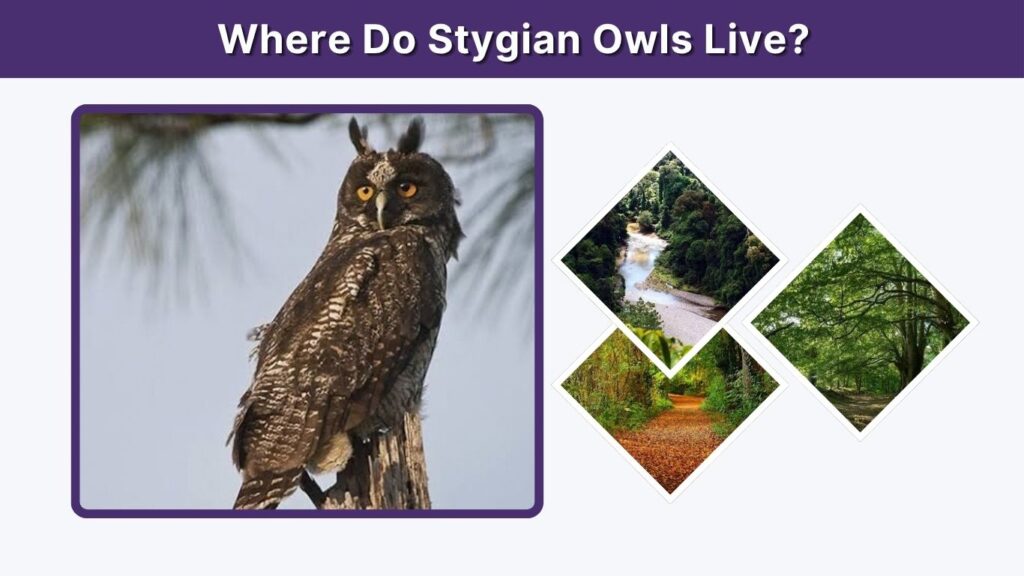
The Stygian owl range covers portions of Mexico, Central America, the Caribbean, and South America. Populations are often scattered rather than continuously distributed across this enormous area. The species has been recorded from Mexico south through countries such as Brazil, Bolivia, Paraguay, and northern Argentina, as well as Cuba and Hispaniola.
Stygian Owl Habitat
Stygian owls may inhabit:
- Pine forests
- Pine-oak woodland
- Montane forest
- Cloud forest
- Tropical woodland
- Forest edges
- Savannas with trees
- Pine plantations
- Wooded urban parks
They often use forested landscapes containing openings where hunting is easier. The species occurs from low elevations into mountainous areas approaching about 3,000 meters.
Stygian Owls in the United States
The Stygian owl is not a regular breeding bird across the United States. Its normal range lies primarily farther south.
However, rare vagrant records have occurred in places such as Texas and Florida. Such sightings are exceptional and should not be interpreted as evidence of a widespread resident U.S. population.
What Does a Stygian Owl Eat?
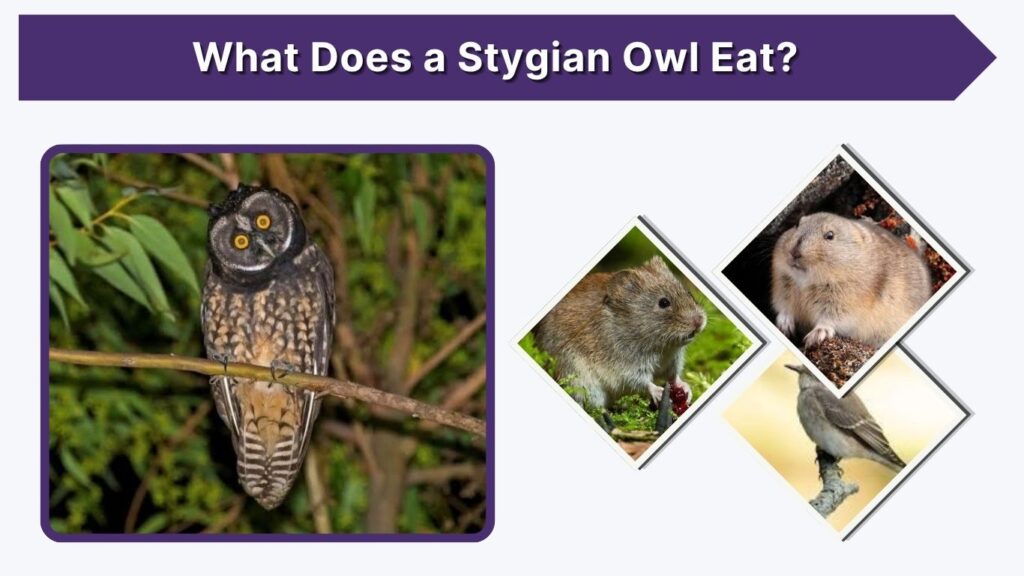
The Stygian owl diet is particularly interesting because birds can form a major portion of its prey. It also hunts bats, small mammals, insects, and occasionally other small animals. Hunting occurs primarily at night, when the owl can locate roosting birds and active nocturnal prey using its sharp vision and hearing.
Common Stygian Owl Prey
Its diet may include:
- Small and medium-sized birds
- Doves and other roosting birds
- Bats
- Small mammals
- Beetles and other insects
- Frogs and similar small vertebrates
A Belize study found passerine birds, bats, and beetles among identified prey, demonstrating how diet can vary with location and season.
Do Stygian Owls Eat Bats?
Yes. Bats are documented prey of Stygian owls and can form a meaningful part of the diet in some locations.
The owl’s ability to hunt at night places it in the same active period as many bats. However, birds may still dominate the diet in some populations; a Colombian study found birds constituted most identified prey items.
Stygian Owl Call and Behavior
Stygian owls are strongly nocturnal and normally remain concealed in dense vegetation during daylight. Once darkness arrives, they become active and hunt in more open areas. Their calls are useful for communication because visual contact can be difficult at night, particularly in forested environments.
What Does a Stygian Owl Sound Like?
The male Stygian owl can produce a deep, descending call repeated at intervals. Females use different vocalizations, including higher-pitched responses, while excited birds can produce repeated harsher notes.
Like many owls, their sounds can seem eerie when heard at night, but they are normal communication signals used between individuals.
Nocturnal Hunting Behavior
Stygian owls spend much of the daytime resting among dense branches where their dark feathers provide effective camouflage.
At night they move into more open hunting areas. Their broad wings enable controlled flight, while powerful talons help capture birds, bats, and other prey. Their strongly nocturnal lifestyle also makes them difficult to observe.
Stygian Owl Nesting and Reproduction
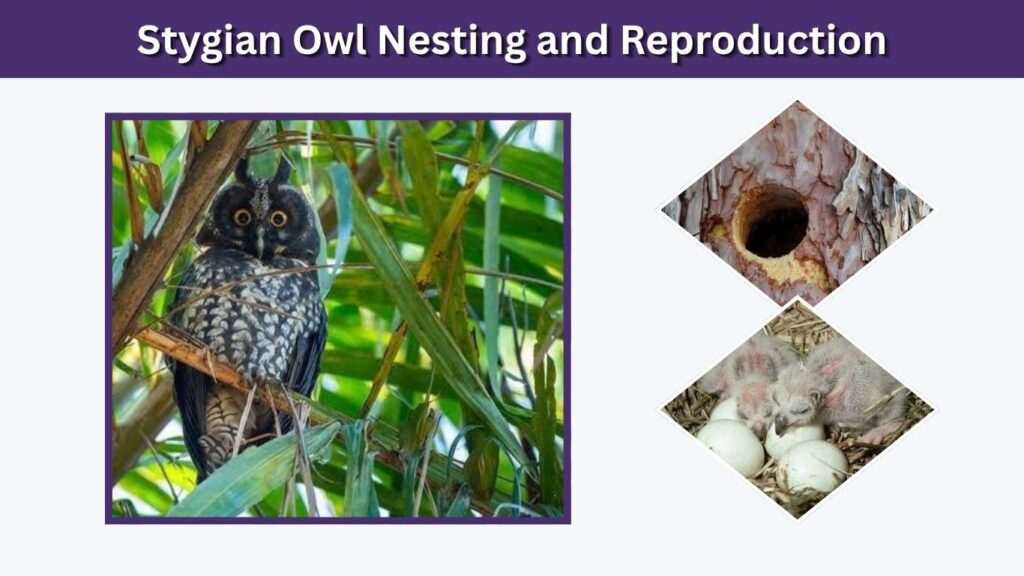
Compared with many familiar owl species, the breeding biology of the Stygian owl remains relatively poorly documented. Nesting habits can vary geographically, and observations suggest these owls may use different types of sites depending on local habitat. Their secretive nighttime behavior makes detailed studies of courtship, nesting, and raising young particularly challenging.
Where Do Stygian Owls Nest?
Recorded nesting situations have included sites associated with trees as well as ground nesting in particular populations.
A documented observation from Isla de la Juventud, Cuba, confirmed a Stygian owl nesting on the ground. Such records demonstrate that nesting behavior may be more flexible than people expect from a medium-sized forest owl.
Stygian Owl Mythology and Meaning
The owl’s unusual name and appearance have created an association with darkness, demons, and supernatural stories online. These interpretations come from human culture rather than the bird’s biology. The species is simply a specialized nocturnal predator, and its dark plumage and horn-like feather tufts are natural adaptations rather than signs of anything supernatural.
Why Is It Called a Devil Owl?
Several characteristics explain this nickname:
- Extremely dark feathers
- Long ear tufts resembling horns
- Apparent red eyes in flash photography
- Secretive nighttime behavior
- Deep or eerie vocalizations
- A name connected linguistically with the mythological Styx
Despite its intimidating appearance, the Stygian owl is a normal wild predator with an important role in its ecosystem.
Interesting Stygian Owl Facts
The Stygian owl remains less familiar than many North American and European owls because much of its range lies in tropical and subtropical regions. Its unusual diet, highly nocturnal behavior, dark appearance, and scattered distribution make it particularly interesting to birdwatchers and researchers.
Quick Facts About Stygian Owls
- Its scientific name is Asio stygius.
- “Stygian” refers to darkness.
- Its natural eye color is yellowish, not fiery red.
- Camera lighting can make its eyes appear crimson.
- Adults measure about 15–18 inches long.
- Females are generally larger than males.
- It has prominent feather ear tufts.
- It is primarily nocturnal.
- Birds can make up a large proportion of its diet.
- It also hunts bats and small mammals.
- Its range extends from Mexico into South America and the Caribbean.
- BirdLife currently lists the species as Least Concern.
FAQs
These commonly asked questions focus on the Stygian owl’s unusual eyes, habitat, diet, size, and reputation. Understanding the biological explanation behind these traits helps separate factual information about this fascinating nocturnal bird from myths created by its dark appearance.
1. Do Stygian owls really have red eyes?
No. Stygian owls normally have yellowish eyes rather than naturally bright red ones. Their eyes can appear deep red or crimson when illuminated at night because reflected light produces eyeshine. Camera flash and viewing angle can make this effect particularly dramatic against the bird’s very dark facial feathers.
2. Where do Stygian owls live?
Stygian owls occur from Mexico through portions of Central America, the Caribbean, and South America as far south as northern Argentina. They inhabit pine and pine-oak forests, montane forests, tropical woodland, plantations, and some wooded urban environments. Their distribution is broad but often fragmented.
3. What does a Stygian owl eat?
Stygian owls eat birds, bats, small mammals, insects, and some other small animals. Birds appear especially important in several studied populations, with owls likely capturing many while they are roosting at night. Bats can also form a notable part of the diet in certain locations.
4. How big is a Stygian owl?
An adult Stygian owl is generally about 38–46 centimeters, or 15–18 inches, long and usually weighs roughly 400–675 grams. Females are typically larger than males. Its long wings, prominent ear tufts, and dark plumage can make the bird appear particularly large and imposing when seen at night.
5. Is the Stygian owl dangerous?
Stygian owls are predators equipped with sharp talons and a strong beak, but they are not supernatural or inherently dangerous animals. They generally avoid people and focus on natural prey such as birds, bats, and small mammals. Like any wild raptor, they should be observed from a respectful distance.