The hawk owl is a distinctive owl known for combining the appearance and hunting behavior of both owls and hawks. The best-known species, the northern hawk owl, has a long tail, rounded head, sharp eyesight, and an unusual habit of hunting during daylight. Found mainly across northern forests of North America, Europe, and Asia, it feeds largely on small mammals and birds. This guide explains hawk owl identification, habitat, range, diet, size, sounds, nesting behavior, adaptations, lifespan, and other interesting facts.
What Is a Hawk Owl?
The term hawk owl is most commonly used for the northern hawk owl, scientifically known as Surnia ulula. Its slim body, long tail, rapid flight, and daytime hunting make it resemble a hawk more than many other owls. It belongs to the true owl family, Strigidae, and inhabits northern forests across a broad geographic range.
Hawk Owl Scientific Name and Family
The northern hawk owl belongs to the order Strigiformes and family Strigidae. Its scientific name is Surnia ulula.
Unlike typical round-bodied owls, it has a relatively elongated shape. Its long tail, pointed-looking wings during flight, and upright perching posture help create the hawk-like appearance that inspired its common name.
Why Is It Called a Hawk Owl?
The name comes primarily from its behavior and body shape. Hawk owls often perch prominently on exposed tree branches and scan large areas for prey, much like hawks.
They can also pursue prey in fast, direct flight. Unlike many strongly nocturnal owls, northern hawk owls commonly remain active during daylight, especially in northern regions.
Hawk Owl Identification and Appearance
A hawk owl can usually be recognized by its rounded head, yellow eyes, dark facial border, long tail, and heavily barred lower body. Its compact facial disk is less prominent than that of many other owls. From a distance, its posture and long-tailed silhouette may even cause observers to mistake it for a small hawk.
Key Hawk Owl Identification Features
Look for these characteristics:
- Eyes: Bright yellow eyes with an intense expression.
- Head: Rounded head without ear tufts.
- Face: Pale facial disk surrounded by a darker border.
- Upperparts: Dark brown with numerous pale spots.
- Underparts: White with strong horizontal brown barring.
- Tail: Noticeably long for an owl.
- Posture: Frequently sits upright on exposed perches.
- Flight: Fast and direct compared with many woodland owls.
Male and Female Hawk Owls
Male and female northern hawk owls have similar plumage, making them difficult to distinguish by coloration alone.
Females are generally larger and heavier than males, a pattern commonly seen among birds of prey. Behavioral differences become easier to observe during the breeding season, when females spend more time associated with the nest while males provide much of the food.
Northern Hawk Owl Size and Wingspan
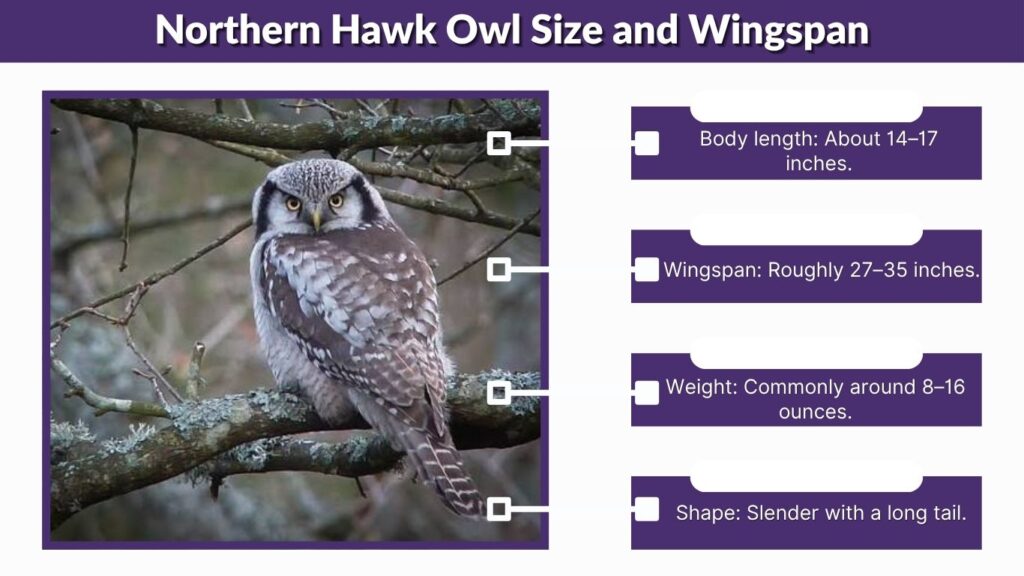
The northern hawk owl is a medium-sized owl, although its long tail can make it appear larger. Adults are generally around 14 to 17 inches long. Their size allows them to hunt small mammals effectively while remaining agile enough to maneuver through open forests and woodland edges.
Hawk Owl Size at a Glance
Typical measurements include:
- Body length: About 14–17 inches
- Wingspan: Roughly 27–35 inches
- Weight: Commonly around 8–16 ounces
- Shape: Slender with a long tail
- Female size: Usually larger than the male
Individual measurements can vary by sex, geographic population, and condition.
What Does a Hawk Owl Look Like in Flight?
During flight, the bird’s long tail becomes particularly noticeable. Its wingbeats can be quick and purposeful, followed by short glides.
Instead of the broad, floating appearance associated with some large owls, the hawk owl can look surprisingly similar to a small hawk as it travels between exposed perches or pursues prey across open ground.
Hawk Owl Habitat and Range
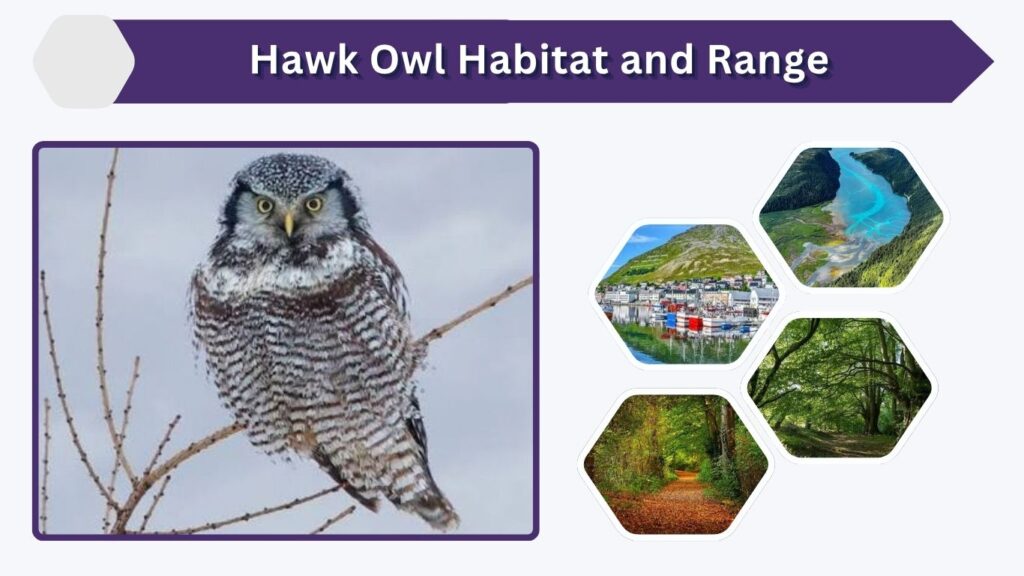
Northern hawk owls are strongly associated with boreal and subarctic environments. They usually favor open coniferous forests, forest edges, burned areas, bogs, and landscapes containing scattered trees. These habitats provide both elevated hunting perches and open ground where small mammals can be detected and captured.
Northern Hawk Owl Range
Northern hawk owls occur across:
- Alaska
- Canada
- Scandinavia
- Russia
- Northern Europe
- Northern Asia
- Other parts of the circumpolar boreal region
During some winters, individuals move south of their typical breeding range, particularly when prey becomes scarce farther north.
Northern Hawk Owl Habitat
The species often chooses relatively open woodland rather than extremely dense forest.
Dead trees, burned forests, clearings, bog edges, and young regenerating woodland can provide excellent hunting conditions. Tall trees or snags serve as observation posts from which the owl watches for movement in snow, grass, or low vegetation.
What Do Hawk Owls Eat?
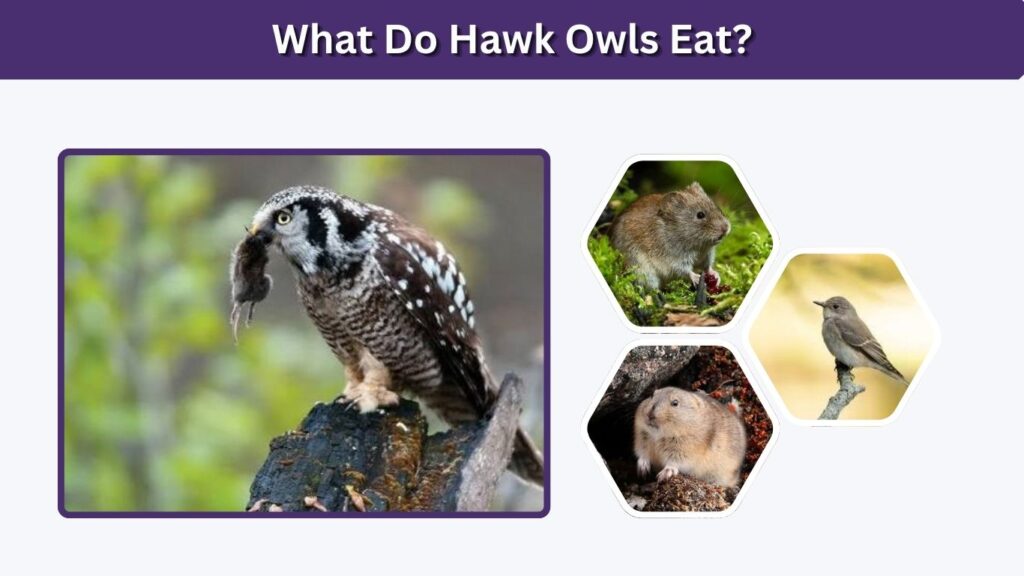
The hawk owl diet consists mainly of small mammals, although birds and other prey may also be taken. Food availability changes with the season, and populations of small rodents can strongly influence where these owls occur. Their exceptional eyesight and hearing allow them to locate prey from surprisingly long distances.
Common Hawk Owl Prey
Hawk owls may hunt:
- Voles
- Mice
- Lemmings
- Shrews
- Small squirrels
- Small birds
- Young or vulnerable larger rodents
- Occasionally other small animals
Voles are especially important prey in many parts of the northern hawk owl’s range.
How Does a Hawk Owl Hunt?
A northern hawk owl often hunts from an exposed perch. It watches and listens carefully before launching rapidly toward prey.
It may capture rodents on open ground or plunge into snow after prey hidden below the surface. Excellent hearing helps it locate small mammals even when vegetation or snow makes them difficult to see.
Hawk Owl Call and Sounds
The hawk owl call varies depending on season and situation. These owls use vocalizations for territory defense, courtship, communication between mates, and interactions around the nest. Calls can sound very different from the familiar deep hooting people often associate with larger owl species.
What Does a Northern Hawk Owl Sound Like?
Common sounds can include:
- Rapid whistling notes
- Rolling or trilling calls
- High-pitched alarm sounds
- Short repeated whistles
- Harsh calls during defensive encounters
During breeding season, males may produce repeated calls to advertise territory and communicate with females.
When Are Hawk Owls Most Vocal?
Vocal activity generally increases during courtship and nesting. Calls help pairs maintain contact and warn other owls away from occupied territory.
Parents may also become vocal when predators or people approach a nest. Outside the breeding season, hawk owls can be considerably quieter and may be detected visually before they are heard.
Hawk Owl Nesting and Life Cycle
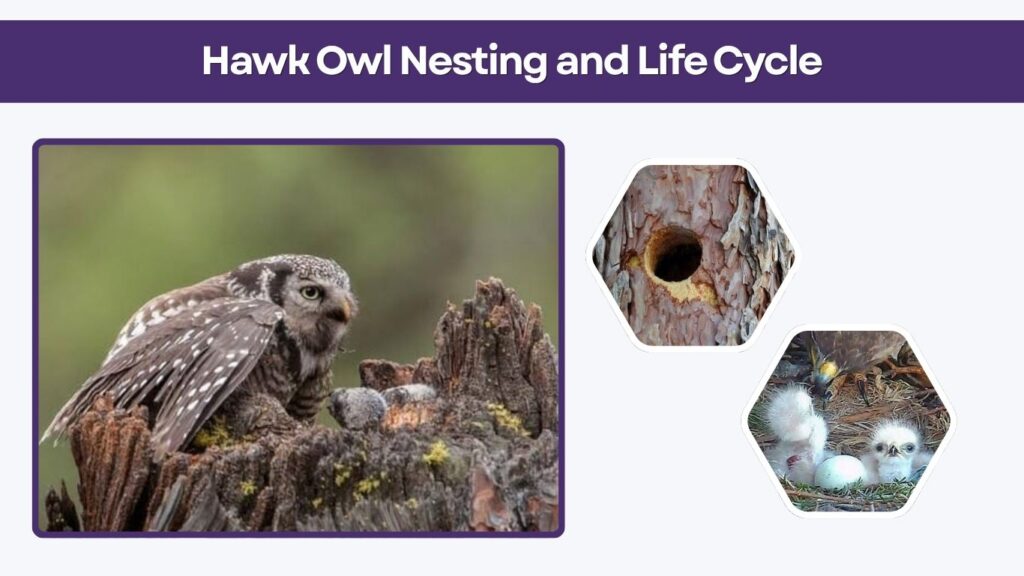
Northern hawk owls begin breeding while northern landscapes may still contain considerable snow. They usually nest in tree cavities or other protected sites rather than building elaborate nests themselves. Availability of suitable nesting locations, together with prey abundance, can influence reproductive success in different years.
Hawk Owl Nest and Eggs
Potential nesting places include:
- Natural tree cavities
- Broken tree trunks
- Old woodpecker cavities
- Hollow snags
- Occasionally suitable artificial nest structures
The female lays a clutch of white eggs and performs most incubation duties. The male typically supplies food during much of this period.
Raising Young Hawk Owls
After hatching, young owls remain dependent on their parents for food and protection. The female initially spends considerable time near the young while the male hunts.
As the nestlings grow, both parents may participate more actively in supplying prey. Young birds gradually become capable of leaving the nest and developing independent hunting skills.
Hawk Owl Adaptations for Hunting
Living in northern environments requires adaptations for cold weather, seasonal daylight, deep snow, and changing prey populations. The northern hawk owl combines excellent vision, sensitive hearing, rapid flight, and strategic use of exposed perches to locate food efficiently across relatively open landscapes.
Important Hawk Owl Adaptations
- Exceptional eyesight: Helps detect prey at considerable distances.
- Sensitive hearing: Allows prey to be located beneath vegetation or snow.
- Daylight hunting: Useful during long northern summer days.
- Strong talons: Provide a firm grip on captured prey.
- Insulating feathers: Help conserve body heat in cold environments.
- Long tail: Improves control and maneuverability during flight.
- High perching behavior: Allows broad areas to be scanned efficiently.
Can Hawk Owls Hunt During the Day?
Yes. This is one of their most recognizable characteristics.
Northern hawk owls regularly hunt during daylight and may be active around dawn, dusk, or even the middle of the day. In their northern range, seasonal daylight patterns make strict nighttime hunting impractical, so flexibility provides an important survival advantage.
Interesting Hawk Owl Facts
The northern hawk owl is unusual even among owls because of its hawk-like appearance, daytime activity, northern lifestyle, and hunting strategy. It can remain motionless on an exposed treetop while scanning the landscape, then suddenly launch into fast flight when prey is detected.
Quick Hawk Owl Facts
- The northern hawk owl is scientifically called Surnia ulula.
- It belongs to the true owl family Strigidae.
- It has no visible ear tufts.
- Adults have bright yellow eyes.
- Its tail is unusually long for an owl.
- It frequently hunts during daylight.
- Small mammals form most of its diet.
- It inhabits northern boreal forests.
- It often hunts from exposed treetops.
- Females are generally larger than males.
- Its range extends across North America, Europe, and Asia.
- Some individuals move south during winters when northern prey is scarce.
FAQs
1. Where does the northern hawk owl live?
Northern hawk owls mainly inhabit boreal and subarctic forests across Alaska, Canada, Scandinavia, Russia, and northern Asia. They favor relatively open forests, bog edges, burned woodland, and areas with scattered trees. During some winters, individuals move farther south when food becomes difficult to find in their normal range.
2. What does a hawk owl eat?
Hawk owls primarily eat small mammals such as voles, mice, lemmings, and shrews. They may also capture small birds and other appropriately sized prey. Their diet changes depending on season and local availability, but rodent populations are particularly important for maintaining breeding and wintering populations.
3. How big is a northern hawk owl?
A northern hawk owl is generally about 14 to 17 inches long, with a wingspan of roughly 27 to 35 inches. Females are typically larger than males. Its long tail and upright posture can make the bird appear larger than its actual body weight would suggest.
4. What does a northern hawk owl sound like?
Northern hawk owls produce several vocalizations rather than one simple hoot. Calls may include rapid whistles, rolling notes, trills, and sharper alarm sounds. Vocalizations become especially noticeable during the breeding season when males advertise territories and pairs communicate around their nesting area.
5. Are hawk owls active during the day?
Yes. Northern hawk owls are well known for hunting during daylight, although they may also be active around dawn and dusk. Their northern environment experiences extremely long summer days, so daytime hunting is advantageous. They often perch conspicuously on treetops while scanning open ground for small mammals.