The Brown Hawk-Owl (Ninox scutulata), also called the Brown Boobook or Oriental Hawk-Owl, is a medium-sized Asian owl recognized by its bright yellow eyes, rounded head, long tail, and chocolate-brown plumage. Unlike many heavily built owls, it has a slim, hawk-like shape and fast flight. This nocturnal hunter inhabits forests and wooded landscapes from the Indian subcontinent into Southeast Asia. Its distinctive call, insect-rich diet, cavity nests, breeding behavior, and regional movements make it an interesting member of the Ninox owl group.
What Is a Brown Hawk-Owl?
The Brown Hawk-Owl belongs to the typical owl family Strigidae and the genus Ninox. It lacks obvious ear tufts and has a relatively indistinct facial disc compared with many familiar owls. Modern classifications separate several birds once included within the Brown Hawk-Owl complex, including the Northern Boobook and Chocolate Boobook.
Brown Hawk-Owl Identification
Important identification characteristics include:
- Scientific name: Ninox scutulata
- Bright yellow eyes
- Rounded head without ear tufts
- Chocolate-brown upperparts
- Whitish underparts with brown markings
- Small white patch above the bill
- Relatively long barred tail
- Yellowish-green feet
- Slim, hawk-like body shape
The underparts typically show large brown or rufous drop-shaped markings, while the tail carries broad pale bars.
Why Is It Called a Hawk-Owl?
Its long tail, comparatively narrow wings, and rapid flight give it a hawk-like appearance.
Brown Hawk-Owls also hunt from exposed perches, watching for prey before making quick flights to capture it. However, they remain true owls and are primarily active from dusk through the night rather than behaving exactly like daytime hawks.
Brown Hawk-Owl Size and Appearance
Brown Hawk-Owls are medium-sized rather than large, but their long tails can make them look elongated when perched. Their body proportions distinguish them from rounder, bulkier forest owls. Size varies somewhat across the species’ extensive geographic range, while males and females are generally similar enough that determining sex by appearance alone can be difficult.
Brown Hawk-Owl Size
Typical measurements include:
- Body length: About 27–33 cm
- Weight: Roughly 170–230 g
- Wing length: Approximately 145–233 mm
- Head: Rounded and without ear tufts
- Tail: Relatively long and strongly barred
The Owl Pages notes considerable variation across the range and reports that males may average larger than females.
Plumage and Eyes
The upper body is predominantly rich chocolate brown.
Its underparts are much paler and patterned with reddish-brown or dark brown markings. Large yellow eyes stand out strongly against the darker face, giving the bird an intense expression.
Young birds may look softer and fluffier than adults, but gradually develop the more streamlined adult plumage.
Brown Hawk-Owl Habitat and Range
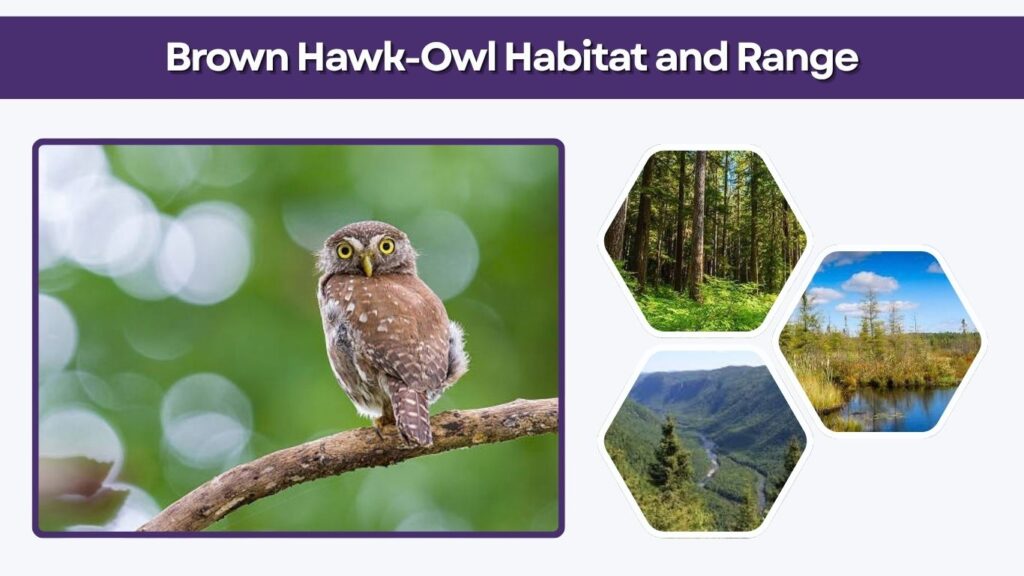
The species occupies a broad part of South and Southeast Asia, although habitat use varies between regions. Western populations may occur in wooded countryside, forests, groves, and even well-treed areas near human habitation. In parts of Southeast Asia, Brown Hawk-Owls are much more closely associated with lowland rainforest and other forested environments.
Where Does the Brown Hawk-Owl Live?
Its range includes areas of:
- India
- Sri Lanka
- Bangladesh
- Nepal
- Southern China
- Thailand and the Malay Peninsula
- Singapore
- Sumatra
- Borneo
- Other parts of western Indonesia
Current Singapore records recognize Ninox scutulata as a native resident, particularly associated with forested areas.
Brown Hawk-Owl in Singapore
In Singapore, the bird is also known as the Brown Boobook.
It is considered an uncommon resident and is most closely associated with central forest areas. NParks records it from forest, parks, and gardens, including sites such as Bukit Timah and Pulau Ubin.
Its nocturnal habits mean it is heard more often than seen.
Does the Brown Hawk-Owl Live in Australia?
The Brown Hawk-Owl is not considered a regular native Australian owl.
Australia has its own members of the Ninox group, including the Australian Boobook. Similar names and appearance can create confusion, but Australian boobooks belong to different species.
Brown Hawk-Owl Diet
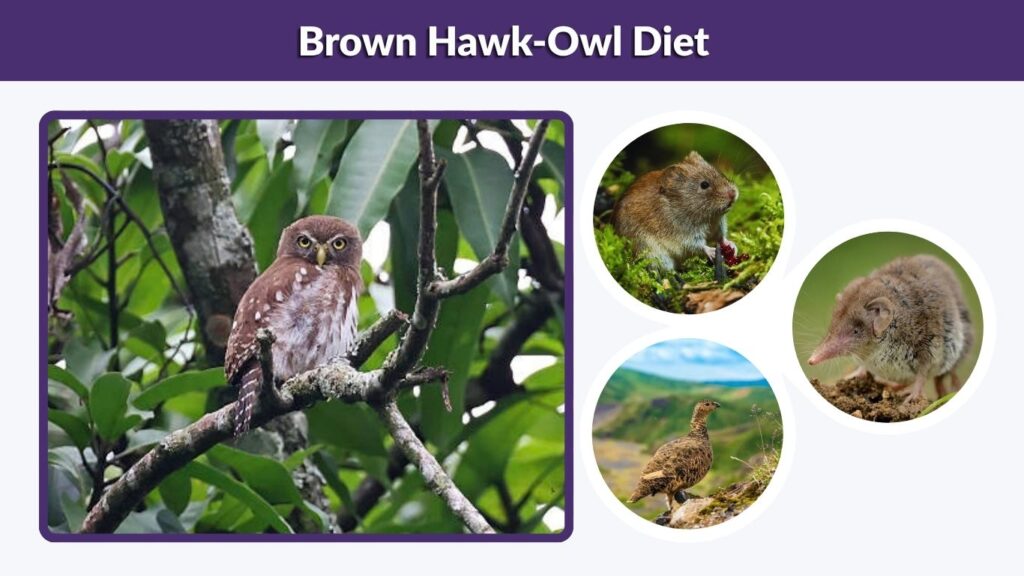
The Brown Hawk-Owl is a carnivore, but unlike some larger owls that specialize heavily in rodents, this species frequently takes large insects. Its diet changes according to local prey availability. It hunts mainly during dusk and darkness and often uses an elevated perch from which it watches the surrounding vegetation or ground.
What Does a Brown Hawk-Owl Eat?
Recorded foods include:
- Beetles
- Grasshoppers
- Other large insects
- Frogs
- Lizards
- Small birds
- Mice
- Small bats
- Occasionally crabs
Large insects form an especially important part of its diet. In Singapore, NParks describes insects in the forest canopy as major prey.
How Does It Hunt?
A Brown Hawk-Owl commonly sits quietly on a branch, stump, or similar perch and waits for prey.
It may drop quickly onto prey below or pursue flying insects in the air. The species has even been observed capturing insects with its feet while flying.
Its rapid wingbeats and short glides contribute to its hawk-like impression.
Brown Hawk-Owl Call and Sound
The voice of the Brown Hawk-Owl is one of the best ways to detect it after dark. Birds often sing from relatively high tree branches, and a favored calling perch may be used repeatedly. Calls differ somewhat across the species’ range, so listeners in India may hear a slightly different pattern from birds in parts of Malaysia or Indonesia.
What Does a Brown Hawk-Owl Sound Like?
The western form produces a mellow two-note call often rendered roughly as “whoowup-whoowup.”
The second part rises slightly in pitch, and repeated pairs can continue in long sequences.
Other vocalizations include sharper nasal sounds, low rolling calls, and cat-like notes. Pairs may also duet, particularly during the breeding period.
When Are They Most Vocal?
Brown Hawk-Owls can become especially vocal during breeding.
They may call repeatedly for long periods, particularly on suitable nights. Neighboring birds sometimes answer one another, creating a loose chorus across forest habitat.
Because the owl spends the day hidden in foliage, nighttime calls are often the first clue that one occupies an area.
Brown Hawk-Owl Behavior and Activity
This species is primarily crepuscular and nocturnal. During daylight it usually roosts quietly on shaded branches, sometimes hidden among thick leaves or climbing vegetation. It may remain alone or with a mate. Although normally inactive during daylight, cloudy weather can occasionally encourage movement before dusk.
Daytime Roosting
A roosting Brown Hawk-Owl relies heavily on camouflage and concealment.
Its brown feathers blend well with branches and shaded vegetation. If disturbed, it may quietly move to another branch rather than flying a long distance.
Its large eyes and upright posture can make it conspicuous once detected, but finding a resting bird among dense foliage can be challenging.
Nocturnal Activity
Activity increases around sunset.
The owl leaves its roost, calls, and begins hunting from perches along forest edges or within the canopy.
Singapore observations similarly describe it as a dusk and nighttime hunter that pounces on prey from a perch.
Brown Hawk-Owl Nest and Breeding
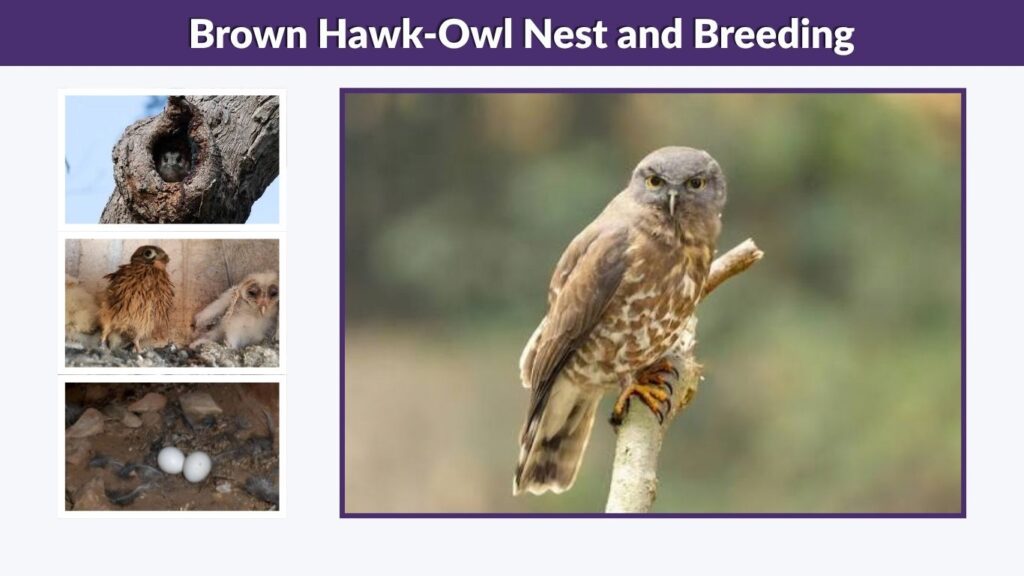
Brown Hawk-Owls are cavity nesters. Rather than constructing a stick nest, a pair usually depends on an existing hollow in a mature tree. Suitable nesting trees therefore play an important role in forest habitat. Breeding timing varies geographically because seasonal conditions differ considerably between South Asia and equatorial Southeast Asia.
Nest and Eggs
Typical breeding characteristics include:
- Nesting in hollow trees
- Nest height commonly around 5–20 m
- Natural debris used at the bottom
- Usually about two white eggs
- Female performs incubation
- Male brings food to the female
- Incubation lasts at least about 25 days
- Both parents eventually feed the young
The same cavity may sometimes be reused in later breeding seasons.
Brown Hawk-Owl Chick
Young owls remain dependent on their parents after hatching.
The female initially spends much of her time caring for the chicks, while the male provides food. As the young grow, both adults participate in feeding.
The Owl Pages reports that young typically leave the nest cavity approximately 24–27 days after hatching.
Does the Brown Hawk-Owl Migrate?
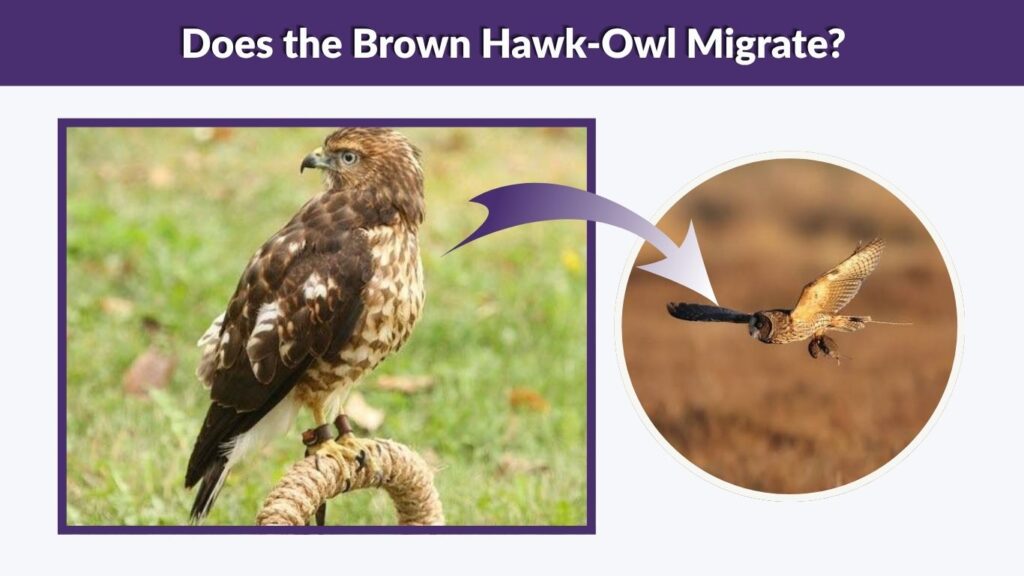
Migration depends partly on which Ninox species is being observed. The Brown Hawk-Owl itself is largely resident through much of its range. This is important because the closely related Northern Boobook (Ninox japonica), once treated as part of the Brown Hawk-Owl, is migratory in parts of its range.
Brown vs Northern Boobook
The Northern Boobook breeds farther north in eastern Asia and some populations migrate south into Southeast Asia.
In Singapore, the Brown Boobook is an uncommon resident, whereas the Northern Boobook is treated as a rare migrant. The two can look similar, but underpart markings, proportions, calls, and seasonal status help separate them.
Brown Hawk-Owl Conservation Status
The Brown Hawk-Owl remains widespread across a large Asian range. BirdLife currently lists Ninox scutulata as Least Concern, indicating that it is not considered globally threatened at present. Local populations can still depend on the availability of suitable forest, mature nesting trees, and productive feeding habitat.
Habitat Importance
Protecting mature trees is particularly valuable because these owls depend on cavities for nesting.
Forested corridors, established parks, and other wooded landscapes can also maintain hunting and roosting opportunities.
In places where the species is strongly associated with primary rainforest, extensive forest loss may reduce locally suitable habitat even when the global species remains widespread.
FAQs
1. What is the scientific name of the Brown Hawk-Owl?
Its scientific name is Ninox scutulata. It is also commonly called the Brown Boobook or Oriental Hawk-Owl.
2. What does a Brown Hawk-Owl eat?
It feeds heavily on large insects such as beetles and grasshoppers, along with frogs, lizards, mice, small birds, bats, and other small animals.
3. What does a Brown Hawk-Owl sound like?
Its typical call is a mellow, musical series of short notes. Western populations often produce a repeated rising two-note call that can carry over considerable distance.
4. Where does the Brown Hawk-Owl live?
It occurs from the Indian subcontinent through parts of South and Southeast Asia into southern China and western Indonesia. It is also a resident bird in Singapore.
5. Is the Brown Hawk-Owl endangered?
No. BirdLife currently categorizes the Brown Hawk-Owl as Least Concern, although conservation of forest and mature nesting trees remains important.