
The Philippine Scops Owl is a nocturnal forest owl recognized by its prominent ear tufts, reddish-brown eyes, and finely patterned brown plumage. Scientifically known as Otus megalotis, it is endemic to the Philippines and, under current taxonomy, occurs mainly on Luzon, Marinduque, and Catanduanes. During daylight it remains well hidden among branches, becoming active after sunset to hunt insects and other small prey. This guide covers its identification, size, call, habitat, diet, breeding, chicks, lifespan, conservation status, and ecological importance.
What Is the Philippine Scops Owl?
The Philippine Scops Owl is a member of the typical owl family Strigidae and the genus Otus. It is also called the Luzon Lowland Scops Owl or Whitehead’s Scops Owl in some references. Modern classifications separate it from the Everett’s and Negros Scops Owls, which explains why older publications sometimes give the species a much wider Philippine distribution.
Scientific Name
Its scientific name is Otus megalotis. The species name reflects its conspicuous ear tufts, which give the owl a distinctive horned appearance.
These tufts are feathers rather than true external ears. The actual ear openings are hidden by feathers on the sides of the head and help the owl locate prey in darkness.
Where Is It Found?
Under current treatment, the Philippine Scops Owl occurs on Luzon, Marinduque, and Catanduanes. It is endemic to the Philippines and is considered resident rather than a long-distance migrant.
Older accounts that include Mindanao, Negros, or other southern islands may reflect earlier taxonomy in which related scops owls were included within O. megalotis.
Philippine Scops Owl Identification and Size
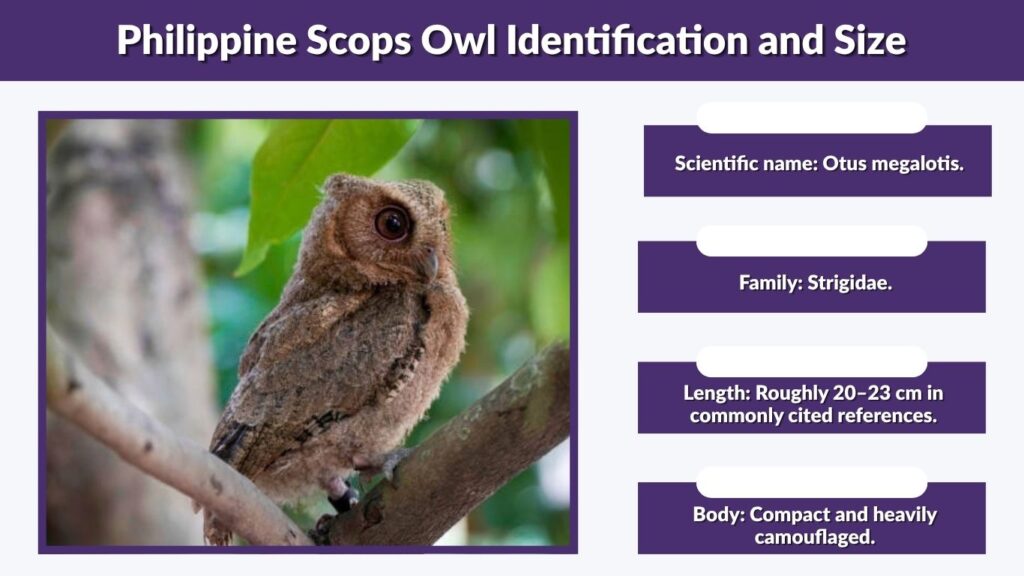
This owl is relatively compact but is considered medium-sized for a scops owl. Its mottled feathers closely resemble bark, providing excellent camouflage while it rests during daylight. Long upright ear tufts, a pale facial area, dark streaking, and striking reddish or orange-toned eyes are among the most useful characteristics for recognizing an adult in the field.
Key Identification Features
- Scientific name: Otus megalotis
- Family: Strigidae
- Length: Roughly 20–23 cm in commonly cited references
- Body: Compact and heavily camouflaged
- Ear tufts: Long and conspicuous
- Eyes: Dark to reddish-orange in appearance
- Plumage: Brown, gray-brown, or rufous with dark markings
- Facial disc: Pale with a darker border
- Activity: Mainly nocturnal
- Movement: Resident rather than strongly migratory
Sources differ somewhat on exact measurements, but descriptions consistently characterize it as a medium-sized Otus with prominent ear tufts.
Philippine Scops Owl Chick and Juvenile
Young Philippine Scops Owls generally appear softer and fluffier than adults, with less sharply defined plumage. Their ear tufts and facial pattern become clearer as their feathers develop.
Juveniles remain dependent on their parents after hatching and gradually learn to perch, move through vegetation, and capture prey. Detailed information about juvenile development remains relatively limited compared with better-studied owl species.
Philippine Scops Owl Call and Sound
The Philippine Scops Owl is often detected by sound before it is seen. Its bark-like camouflage and nighttime activity make visual observation difficult, whereas vocalizations can carry through dense forest. Recorded calls are available from locations such as Subic Bay on Luzon and are an important tool for field identification and population surveys.
What Does Its Call Sound Like?
A commonly described vocalization consists of a short series of separated hooting notes, sometimes rendered approximately as “oik, oik, oik.”
The exact tone, rhythm, and number of notes can vary. Because other Philippine scops owls can also produce short repetitive calls, location and appearance should be considered along with sound.
When Does It Call?
Calling is mainly associated with nighttime activity. Owls may vocalize to advertise territory, communicate with a mate, or maintain contact.
During daytime hours, they typically remain quiet and motionless in dense vegetation, depending on camouflage rather than movement for protection.
Philippine Scops Owl Habitat
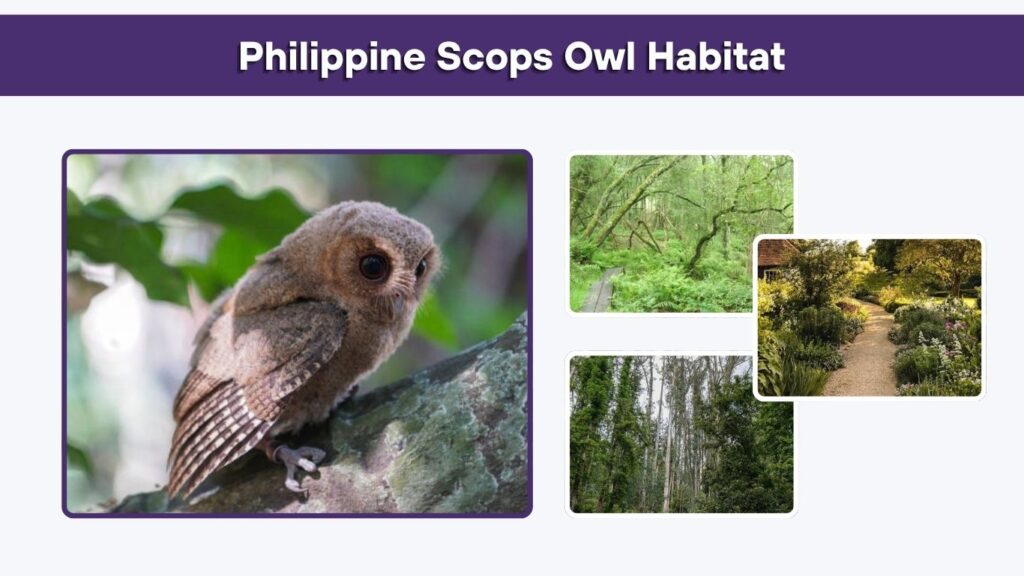
The Philippine Scops Owl is closely associated with wooded environments. Forest provides roosting cover, prey, and cavities that can be used for nesting. It occurs in tropical forest and secondary woodland and can also be encountered near forest edges. Philippine government records show that individuals occasionally turn up around built-up or suburban areas near suitable tree cover.
Forest and Woodland Habitat
Typical habitat includes lowland forest, mature secondary woodland, forest edges, and other areas containing dense trees.
During the day, the owl usually hides among branches or foliage. Its mottled feathers blend with trunks and bark, making it remarkably difficult to see even when it is sitting nearby.
Daily Behavior
The species is mainly nocturnal. Once darkness arrives, it leaves its resting site and begins searching for prey.
Like many small forest owls, it can hunt from a perch, watching and listening before making a short flight toward prey on vegetation or the ground.
What Does the Philippine Scops Owl Eat?

The Philippine Scops Owl is a carnivorous predator whose known diet is strongly associated with invertebrates. Insects provide an abundant nighttime food supply in tropical forests. Reports also document spiders, while small vertebrate prey may occasionally be taken. Its compact body and sharp talons allow it to capture prey quickly in relatively dense vegetation.
Common Foods
Its diet may include:
- Beetles
- Crickets and other large insects
- Moths
- Grasshoppers
- Spiders
- Other arthropods
- Occasional small vertebrates
A published observation has specifically documented the species feeding on huntsman spiders, while general species accounts emphasize insects as important prey.
How Does It Hunt?
The owl usually waits quietly before attacking rather than continuously flying after prey. Its hearing and low-light vision help it detect movement at night.
Silent flight feathers allow it to approach prey with little warning, while its curved bill and sharp feet are adapted for capturing and consuming animal food.
Breeding, Nesting and Lifespan
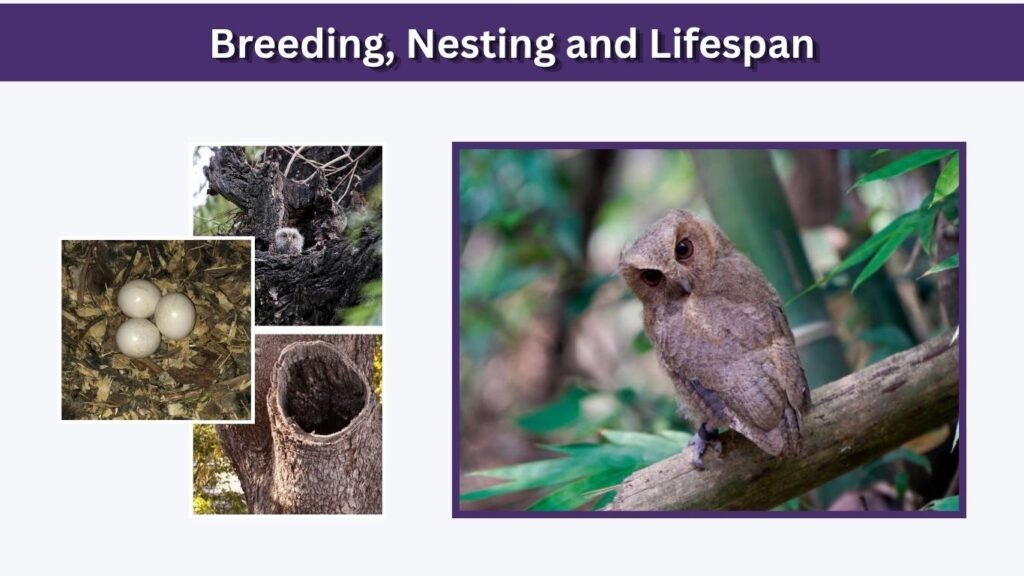
Much less is known about the breeding biology of the Philippine Scops Owl than about its appearance and distribution. Available accounts indicate that it nests in cavities and may form monogamous pairs. Forests containing mature trees are therefore valuable not only as feeding habitat but also because they provide protected spaces in which eggs and young can develop.
Nest and Eggs
Philippine Scops Owls use cavities in trees rather than constructing large open nests. Some accounts describe clutches of approximately one or two eggs, although detailed breeding studies remain limited.
Both adults may be involved in caring for young people. The concealed nest helps reduce exposure to rain and predators.
How Long Does a Philippine Scops Owl Live?
A dependable species-specific lifespan for wild Philippine Scops Owls has not been well established in the available literature. Therefore, precise lifespan figures found on general animal websites should be treated cautiously.
Survival likely varies according to food supply, habitat quality, disease, predation, human disturbance, and other environmental conditions.
Conservation Status and Importance
Although restricted geographically, the Philippine Scops Owl is not currently classified as globally endangered. BirdLife lists Otus megalotis as Least Concern, and some sources describe it as locally common. Nevertheless, because it depends heavily on wooded habitat and is endemic to a limited group of Philippine islands, maintaining forests remains important for its long-term conservation.
Why the Species Is Important
The Philippine Scops Owl contributes to forest ecosystems by:
- Feeding on insects and other small animals
- Helping regulate populations of nocturnal prey
- Serving as part of the forest food web
- Acting as an indicator of functioning wooded habitat
- Adding to the Philippines’ unique endemic bird diversity
Its restricted geographic distribution also makes Philippine populations globally important because the species naturally occurs nowhere else.
Can You Keep a Philippine Scops Owl as a Pet?
A wild Philippine Scops Owl should not be treated like an ordinary pet or purchased simply because online searches show terms such as “price” or “for sale.” Philippine Republic Act No. 9147 regulates the collection, possession, transport, and trade of wildlife, and possession requires lawful sourcing and appropriate authorization and capability.
Anyone dealing with native wildlife should confirm current DENR/Biodiversity Management Bureau requirements rather than capturing or purchasing a wild owl without documentation.
FAQs
1. What is the scientific name of the Philippine Scops Owl?
Its scientific name is Otus megalotis. It belongs to the typical owl family Strigidae and is endemic to the Philippines.
2. How big is a Philippine Scops Owl?
Adults are generally around 20–23 cm long, although measurements vary somewhat between references. It is a compact owl with unusually prominent ear tufts.
3. What does the Philippine Scops Owl eat?
Its diet consists mainly of insects and other invertebrates, including spiders. Small vertebrates may also occasionally be captured when available.
4. Is the Philippine Scops Owl endangered?
No. BirdLife currently lists the Philippine Scops Owl as Least Concern. However, protecting forest habitat remains important because the species has a restricted endemic range.
5. Where does the Philippine Scops Owl live?
Under current taxonomy, it occurs primarily on Luzon, Marinduque, and Catanduanes. It mainly inhabits wooded environments, including tropical forest, secondary woodland, and forest edges.