The Indian Scops Owl is a small nocturnal owl known for its prominent ear tufts, dark eyes, bark-like plumage, and distinctive frog-like call. Scientifically named Otus bakkamoena, it occurs across much of the Indian subcontinent, including India, Pakistan, Nepal, and Sri Lanka. During daylight, this well-camouflaged owl usually rests quietly among dense foliage or inside tree cavities. This guide covers Indian Scops Owl identification, size, call, habitat, diet, breeding, juveniles, range, conservation status, and differences from the Collared Scops Owl.
What Is an Indian Scops Owl?
The Indian Scops Owl belongs to the typical owl family Strigidae and the genus Otus. It is a resident owl across much of South Asia and was historically grouped more broadly with related scops owls. Modern BirdLife taxonomy recognizes Otus bakkamoena as a separate species from birds such as the Collared Scops Owl, Otus lettia.
Scientific Name and Classification
Its scientific name is Otus bakkamoena. BirdLife lists the species in the order Strigiformes and family Strigidae. Earlier taxonomic treatments grouped O. bakkamoena, O. lettia, O. semitorques, and O. lempiji together, which explains why older books and websites can use different names or classifications.
Why Is It Called a Scops Owl?
Scops owls are small members of the genus Otus characterized by cryptic plumage and erectile feather tufts above the head. These “ear tufts” are feathers, not actual ears.
When resting against tree bark, an Indian Scops Owl’s mottled gray-brown plumage and raised tufts help break up its outline, making the bird extremely difficult to notice during daylight.
Indian Scops Owl Identification and Size
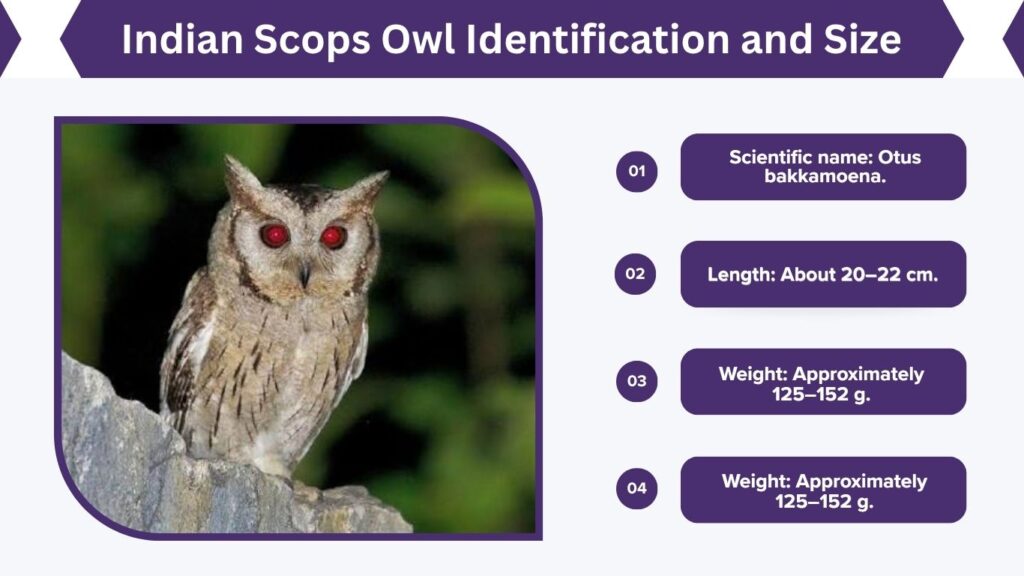
The Indian Scops Owl has a compact body, long and conspicuous ear tufts, a pale facial disc bordered by darker feathers, and strongly camouflaged plumage. Unlike several small Asian scops owls with bright yellow eyes, its eyes are generally hazel-brown to dark brown. Adults measure roughly 20–22 cm in length.
Key Identification Features
- Scientific name: Otus bakkamoena
- Length: About 20–22 cm
- Weight: Approximately 125–152 g
- Eyes: Hazel-brown to dark brown
- Ear tufts: Long and prominent
- Facial disc: Pale gray-brown with a darker border
- Upperparts: Gray-brown with dark streaking
- Underparts: Pale ochre-buff with dark markings
- Legs: Feathered to the base of the toes
- Activity: Primarily nocturnal
Females are generally somewhat larger and heavier than males.
Indian Scops Owl Juvenile
Young Indian Scops Owls are generally paler and fluffier than fully developed adults, particularly soon after leaving the nest. Their facial features and ear tufts become more adult-like as the juvenile plumage develops.
Like adult birds, juveniles depend heavily on camouflage and may remain very still on branches during daylight.
Indian Scops Owl Call and Sound
The call is one of the easiest ways to detect an Indian Scops Owl because the bird itself may remain completely hidden in foliage. Calling is primarily associated with nighttime activity and communication. The male’s characteristic song consists of regularly spaced notes with a questioning quality, while other vocalizations include bubbling or chattering sequences.
What Does the Indian Scops Owl Call Sound Like?
The typical male call has been described as a repeated, frog-like questioning note. Each call is separated by a pause, creating a slow and deliberate rhythm.
The species can also produce a rising series of chattering notes lasting several seconds. Because scops owl species can sound similar, combining call, location, size, and visual features produces a more reliable identification.
When Does It Call?
Indian Scops Owls are nocturnal, so calling is generally heard after dusk and during the night. Vocal activity can increase during courtship and territorial periods.
During the daytime, the owl normally remains quiet and hidden in thick foliage, where its bark-colored feathers provide excellent camouflage.
Indian Scops Owl Habitat and Range
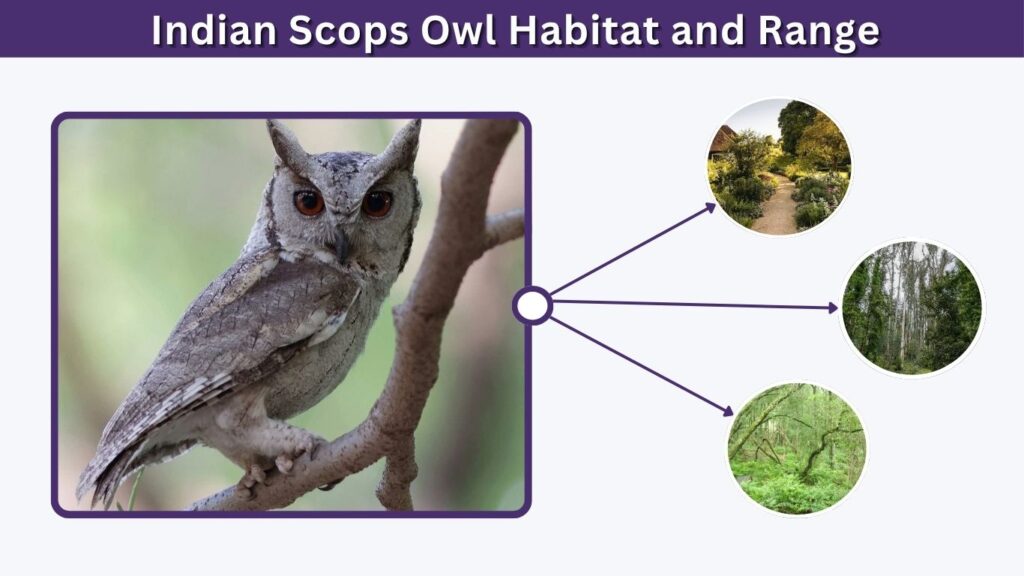
This owl is adaptable and does not depend entirely on untouched forest. It occupies woodland, secondary growth, dry vegetation, orchards, gardens, and groups of mature trees near villages and cultivated land. BirdLife records it from India, Nepal, Pakistan, and Sri Lanka, with suitable habitat extending from low elevations into hill country.
Where Does the Indian Scops Owl Live?
Common habitats include:
- Dry and moist woodland
- Secondary forest
- Mango orchards and other fruit-tree areas
- Rural gardens
- Tree-covered agricultural landscapes
- Dense groups of mature trees
- Some urban and suburban green areas
BirdLife identifies plantations, rural gardens, urban areas, and several forest types as suitable habitats.
Geographic Distribution
The species occurs widely in India and is also native and resident in Nepal, Pakistan, and Sri Lanka. BirdLife estimates its resident/breeding extent of occurrence at about 4.2 million square kilometers.
The species is generally considered an altitudinal migrant rather than a long-distance migrant, meaning some individuals may shift elevation seasonally.
What Does the Indian Scops Owl Eat?
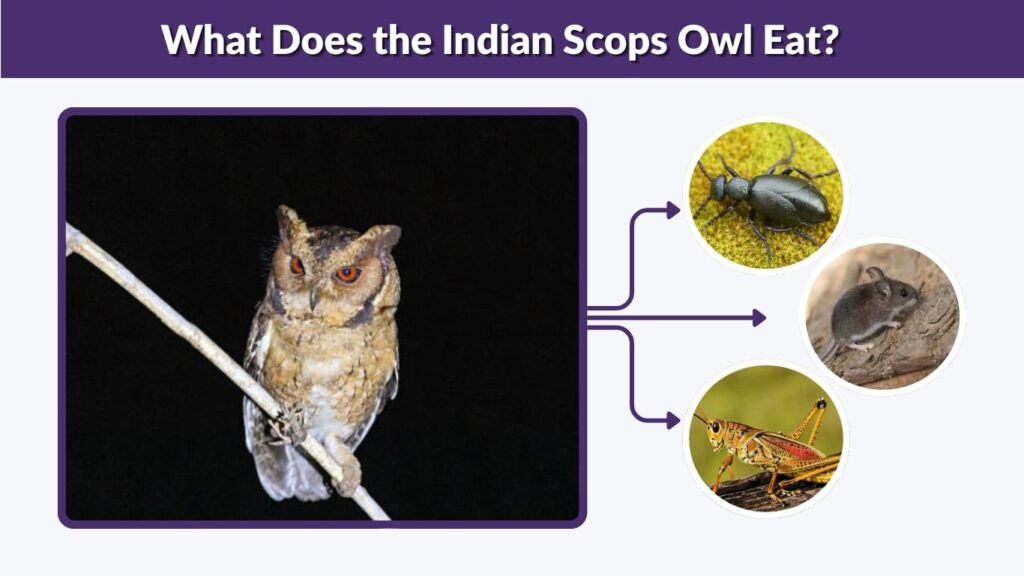
Indian Scops Owls are mainly insect hunters. Their small body size makes beetles, grasshoppers, and similar invertebrates particularly suitable prey, although they are capable of taking small vertebrates as well. Hunting begins after dark, when the owl leaves its concealed daytime roost and searches vegetation, woodland edges, orchards, and similar habitats for prey.
Common Foods
Its diet can include:
- Beetles
- Grasshoppers
- Other large insects
- Lizards
- Mice
- Small birds
Insects make up the main portion of the documented diet, while vertebrate prey is taken more occasionally.
How Does It Hunt?
Like many small owls, the Indian Scops Owl can wait quietly on a perch and then move quickly toward detected prey.
Its nocturnal lifestyle, strong hearing, vision adapted to low light, and sharp talons allow it to capture insects and small vertebrates after sunset while remaining largely unnoticed during the day.
Indian Scops Owl Nesting and Baby Owls
Indian Scops Owls are cavity nesters rather than birds that build an exposed stick nest. Mature trees containing natural holes are therefore valuable breeding resources. Published information on their breeding biology is less extensive than for some better-studied owl species, but documented nests occur in tree cavities and females usually produce a small clutch of white eggs.
Nest and Eggs
The Owl Pages reports nests in tree cavities at moderate heights, with females laying approximately three to four white, rounded eggs.
The protected cavity helps shelter eggs and young owls from weather and provides concealment from predators.
Baby Indian Scops Owls
After hatching, young owls depend entirely on their parents for food and protection. As they develop feathers and strength, they gradually become capable of leaving the cavity and perching nearby.
Juveniles may still rely on adults for food after leaving the immediate nest site while they develop effective hunting skills.
Indian Scops Owl vs. Collared Scops Owl
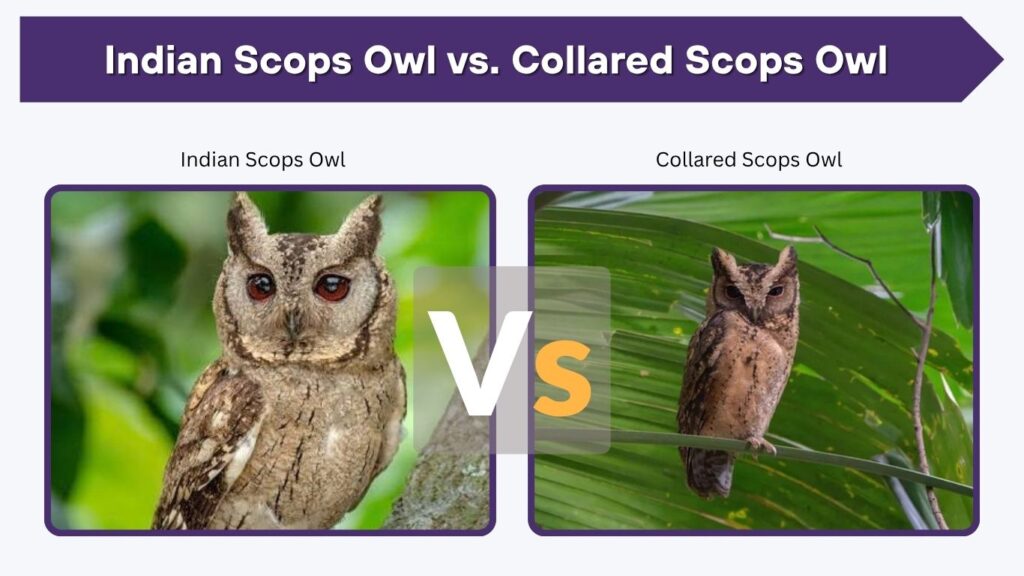
The Indian Scops Owl and Collared Scops Owl are closely related and were historically treated together in some classifications. They are now generally recognized as separate species: Otus bakkamoena and Otus lettia. This historical relationship explains why identification guides can sometimes seem contradictory, particularly when dealing with older records or range information.
Main Differences
The Indian Scops Owl averages about 20–22 cm and has prominent ear tufts, dark brownish eyes, and gray-brown plumage. The Collared Scops Owl is generally described as medium-sized, with pale ear tufts and a pale face strongly outlined in black.
Vocalizations are also useful because scops owls may be easier to separate by call than by a brief nighttime view.
Conservation Status and Keeping as a Pet
The Indian Scops Owl currently has a broad geographic range and is not considered globally threatened. However, owls remain wild predators with specialized dietary, behavioral, and habitat requirements. Searches for Indian Scops Owl pets, prices, or birds for sale should also be approached with wildlife-law considerations rather than treating the species as an ordinary companion animal.
IUCN Status
BirdLife’s 2025 assessment classifies the Indian Scops Owl as Least Concern. Its global population has not been quantified, but the species is described as widespread and locally common, with the overall population trend suspected to be stable.
Can You Keep an Indian Scops Owl as a Pet?
International trade in the species is regulated under CITES Appendix II, according to BirdLife. National wildlife laws can impose additional restrictions on capture, possession, sale, or transport.
For this reason, wild Indian Scops Owls should not be captured or purchased without confirming the applicable wildlife regulations and legitimate authorization.
FAQs
1. How big is an Indian Scops Owl?
An adult Indian Scops Owl is approximately 20–22 cm long and generally weighs around 125–152 grams. Females tend to be somewhat larger and heavier than males.
2. What is the scientific name of the Indian Scops Owl?
Its scientific name is Otus bakkamoena. It belongs to the typical owl family Strigidae.
3. What does an Indian Scops Owl sound like?
The male gives regularly spaced, frog-like questioning notes. It can also make a slowly repeated bubbling or chattering series of calls.
4. What does the Indian Scops Owl eat?
Its diet consists mainly of insects such as beetles and grasshoppers. It can occasionally capture lizards, mice, small birds, and other appropriately sized vertebrates.
5. Is the Indian Scops Owl endangered?
No. BirdLife’s current assessment lists the Indian Scops Owl as Least Concern, with a very large range and a population trend considered stable, although the total number of mature individuals remains unknown.