
The snowy owl (Bubo scandiacus) is a large Arctic owl famous for its white plumage, powerful flight, and ability to survive extremely cold environments. Adult males may become almost completely white, while females and younger birds usually have darker bars and spots. Snowy owls breed across the Arctic tundra and sometimes travel far south during winter. They mainly hunt lemmings and other small mammals but also take birds and fish. Their remarkable adaptations, impressive wingspan, hunting skills, and unpredictable movements make them fascinating birds.
Snowy Owl Identification and Size
Snowy owls are among the largest owls in North America. Their broad bodies, rounded heads, yellow eyes, and heavily feathered legs make them well adapted to Arctic life. Plumage varies according to age and sex, so not every snowy owl appears completely white. Females are generally larger and more heavily marked than adult males.
Snowy Owl Identification
Important identification features include:
- Scientific name: Bubo scandiacus
- Family: Strigidae
- Body length: About 20–28 inches
- Wingspan: Roughly 4–5 feet
- Eyes: Bright yellow
- Bill: Dark and partly hidden by facial feathers
- Body: Large and rounded
- Feet: Densely covered with feathers
- Male plumage: Mostly white when mature
- Female plumage: White with extensive dark barring
Snowy owls lack obvious ear tufts, giving their heads a smooth, rounded appearance.
Male vs Female Snowy Owl
Adult males usually become progressively whiter as they age. Some mature males have only a few dark spots remaining.
Females typically retain extensive black or dark-brown barring across the wings, back, and body.
Females are also usually larger than males. Juveniles of both sexes can be heavily marked, making young snowy owls appear considerably darker than older adult males.
Snowy Owl Habitat and Range
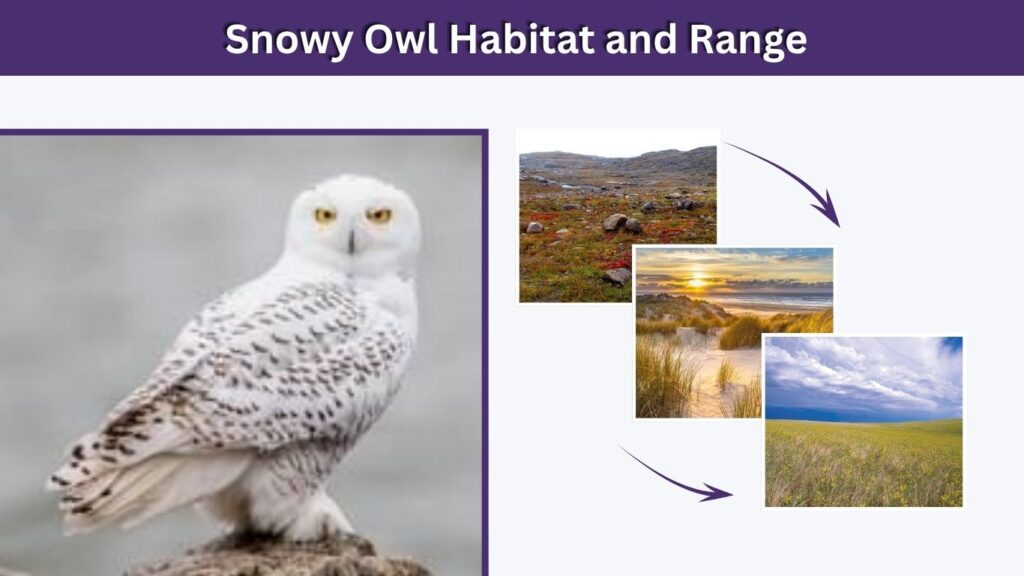
Snowy owls are strongly associated with open landscapes. During the breeding season, they inhabit Arctic tundra where trees are scarce and prey can be detected across long distances. During winter, some individuals remain in northern regions while others travel south into farmland, coastlines, airports, fields, and other open environments resembling their Arctic habitat.
Where Do Snowy Owls Live?
Snowy owls can inhabit:
- Arctic tundra
- Coastal dunes
- Open farmland
- Grasslands
- Marshes
- Beaches
- Frozen shorelines
- Airports
- Open fields
- Treeless islands
Their breeding range includes Arctic regions of North America, Greenland, Europe, and Asia.
Winter distribution varies greatly from year to year.
Snowy Owls in Winter
Snowy owls do not follow exactly the same migration pattern every year.
Some years, unusually large numbers travel south in events known as irruptions. During these movements, snowy owls may appear far outside their typical winter range.
Birds have occasionally been observed in locations such as the northern United States, including Michigan, Illinois, and areas around the Great Lakes.
Food availability and population conditions in the Arctic influence these movements.
What Do Snowy Owls Eat?
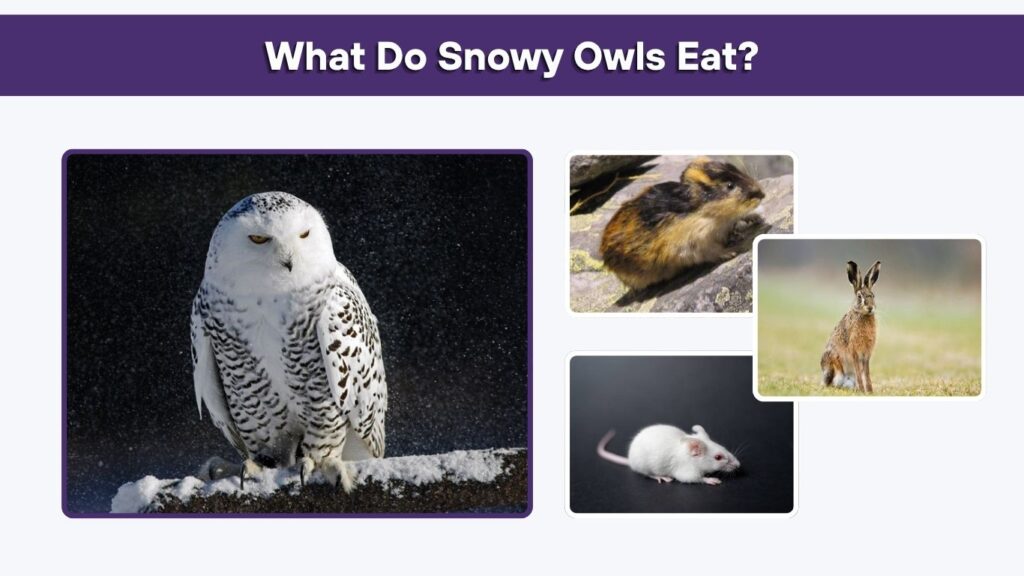
Snowy owls are powerful predators that depend heavily on small mammals, particularly in Arctic breeding areas. Their diet changes according to location and prey availability. They can hunt during daylight as well as darkness, an important adaptation in the Arctic, where summer days can remain bright for nearly 24 hours.
Snowy Owl Diet
Common prey includes:
- Lemmings
- Voles
- Mice
- Rabbits
- Hares
- Ducks
- Geese
- Shorebirds
- Gulls
- Ptarmigan
- Small fish
- Other small mammals and birds
Lemmings are particularly important during the breeding season.
A successful adult may catch several small rodents in a single day when prey is abundant.
How Do Snowy Owls Hunt?
Snowy owls often sit on elevated ground, posts, rocks, or other low perches while watching for prey.
Once an animal is detected, the owl flies rapidly toward it and grabs it with powerful talons.
They can also pursue birds and sometimes hunt close to shorelines.
Unlike many woodland owls, snowy owls frequently hunt in open daylight rather than relying exclusively on darkness.
Snowy Owl Adaptations to Arctic Life
Surviving on exposed Arctic tundra requires specialized adaptations. Snowy owls must conserve body heat, remain capable of flying in strong winds, detect prey beneath vegetation or snow, and survive periods when food is difficult to find. Their dense feathers, broad wings, powerful feet, and pale coloration all contribute to their success in extreme northern environments.
Important Snowy Owl Adaptations
Snowy owls have:
- Thick insulating body feathers
- Heavily feathered legs and toes
- White camouflage
- Powerful talons
- Excellent hearing
- Sharp eyesight
- Broad wings for controlled flight
- Ability to hunt during daylight
- Large body size that reduces heat loss
Their feathers cover much more of the legs and feet than in many other birds.
Why Are Snowy Owls White?
White feathers provide effective camouflage against snow and ice.
However, coloration also varies according to age and sex. Females need darker markings that may help conceal them while nesting on the ground.
Young birds are also heavily barred.
The nearly pure-white appearance most people associate with the species is usually seen in older adult males.
Snowy Owl Nest and Life Cycle
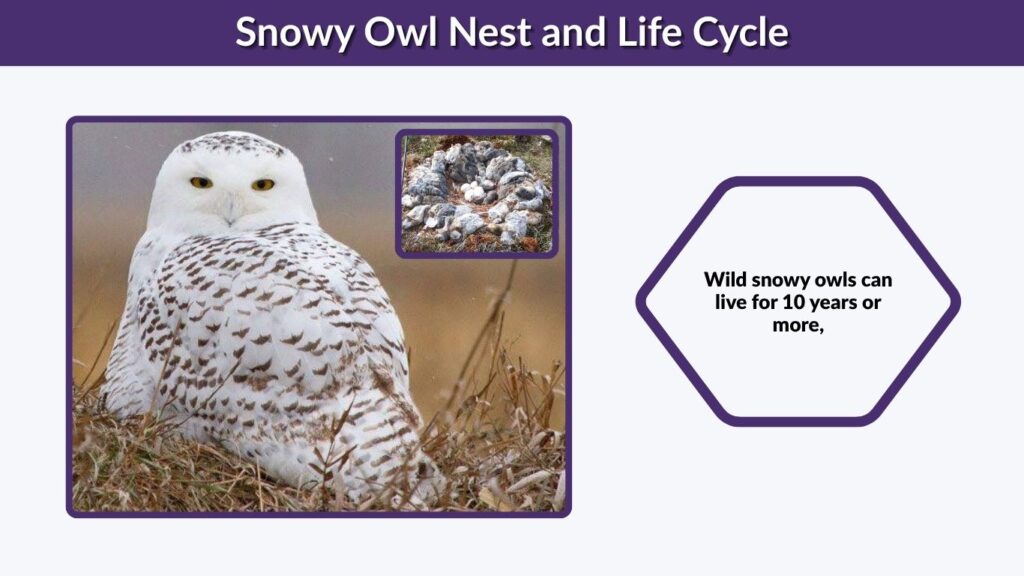
Snowy owls do not build nests in trees. Instead, females create simple nesting scrapes directly on the Arctic ground. Breeding success is strongly connected to prey availability. In years when lemmings are abundant, pairs may raise relatively large broods, while reproduction can be much lower when prey populations decline.
Snowy Owl Nesting
Snowy owl nesting typically involves:
- Ground nests on open tundra
- Slightly elevated locations
- Shallow scrapes made by the female
- Several white eggs
- Female incubation
- Male food delivery
- Both parents protecting young
The female may begin incubating before all eggs are laid, so chicks can hatch at different times.
This creates noticeable size differences among nestlings.
Snowy Owl Lifespan
Wild snowy owls can live for 10 years or more, although many young birds do not survive to old age.
Their survival depends on prey availability, weather, disease, collisions, and other threats.
Some individuals have lived substantially longer under protected conditions.
Once young owls leave the nest, they gradually develop stronger hunting and flying abilities before becoming fully independent.
Snowy Owl Predators and Threats
Adult snowy owls have relatively few natural predators because of their large size and powerful talons. Eggs, chicks, and vulnerable young birds face greater danger. Arctic foxes and other predators may approach nesting areas, where adult snowy owls can become extremely defensive and aggressively protect their young.
What Animals Eat Snowy Owls?
Possible predators or threats include:
- Arctic foxes
- Red foxes
- Wolves in rare circumstances
- Large raptors
- Other large owls
- Skuas and gulls targeting eggs or chicks
Humans are not natural predators, but human activities create significant risks.
Vehicle collisions, aircraft strikes, power-line accidents, and disturbance around wintering owls can cause injuries or deaths.
Defensive Behavior
A snowy owl near a nest may dive at animals or people approaching too closely.
Parents use calls, threatening postures, and aerial attacks to protect chicks.
Outside the breeding season, snowy owls generally avoid humans rather than confronting them.
People observing one should maintain distance and avoid repeatedly approaching or surrounding the bird.
Snowy Owl Call and Sounds
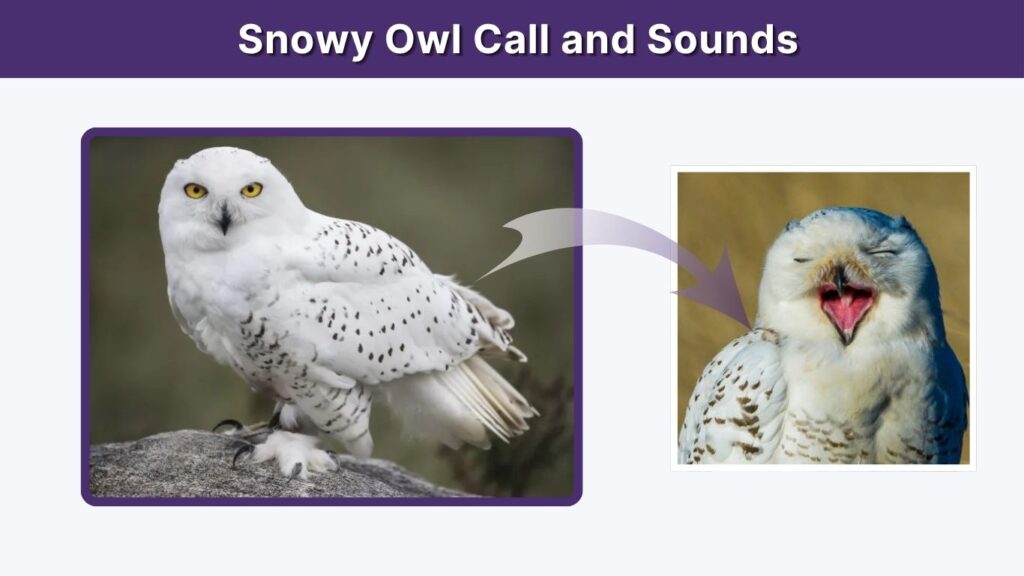
Snowy owls are often quieter than many familiar woodland owls, but they produce several vocalizations for communication and territorial defense. Males become especially vocal during breeding periods. Their calls carry across open tundra, where dense vegetation and forests do not block sound.
What Does a Snowy Owl Sound Like?
A male’s territorial call is often described as a deep, booming “hoo” repeated at intervals.
Snowy owls may also produce:
- Hoots
- Barks
- Hisses
- Whistles
- Screeches
- Bill-snapping sounds
Females and young birds can produce higher-pitched calls, especially around nests.
Snowy Owl in Flight
Snowy owls have broad, powerful wings that allow them to travel efficiently across large open landscapes. Their flight may look slow and deliberate, but they can accelerate quickly when pursuing prey. Feather structure also helps reduce noise, allowing them to approach animals without producing the loud wing sounds made by many other large birds.
Snowy Owl Wings and Feet
Their wingspan can approach 5 feet in large individuals.
Large wings provide lift while allowing the owl to fly relatively slowly when scanning for prey.
Strong feet end in sharp curved talons capable of gripping rodents and birds.
Dense feathers around the toes insulate the feet from snow and freezing ground temperatures.
Snowy Owl Facts
Snowy owls have attracted human attention for centuries because they combine striking appearance with unusual Arctic behavior. Unlike many owls, they may be active in full daylight. Their population movements can also be unpredictable, with large numbers occasionally appearing far south of their breeding range.
Interesting Snowy Owl Facts
- Snowy owls nest directly on the ground.
- Females are usually larger than males.
- Older males can become almost completely white.
- Their feet are heavily covered with feathers.
- They can hunt during both daylight and darkness.
- Lemmings are one of their most important prey animals.
- Winter movements can vary dramatically between years.
- They can travel hundreds or thousands of miles.
- Snowy owls have bright yellow eyes.
- They are among the heaviest North American owl species.
FAQs
Snowy owls generate many questions because their Arctic lifestyle differs greatly from that of familiar forest owls. Their white coloration, large size, seasonal movements, unusual ground nests, and dependence on lemmings have all developed around life in open northern landscapes. These five answers cover some of the most common questions about the species.
What Is the Scientific Name of the Snowy Owl?
The scientific name of the snowy owl is Bubo scandiacus.
How Big Is a Snowy Owl?
Adults are roughly 20–28 inches long and can have a wingspan approaching 4–5 feet. Females are generally larger than males.
What Do Snowy Owls Eat?
They mainly eat small mammals such as lemmings, voles, mice, and rabbits, but they also capture birds and occasionally fish.
Where Do Snowy Owls Live?
They breed across Arctic tundra in North America, Greenland, Europe, and Asia. During winter, some travel south into open farmland, coastal areas, and grasslands.
How Long Do Snowy Owls Live?
Wild snowy owls can survive for more than 10 years, although lifespan varies greatly depending on food, weather, accidents, and other environmental conditions.