A great horned owl flying through the night is an impressive sight. With broad wings, powerful muscles, and specially adapted feathers, this large owl can move through forests with surprisingly little sound. Great horned owls usually become active around dusk and continue hunting throughout the night. Their flight combines strength, silence, and maneuverability, allowing them to capture rabbits, rodents, birds, and other prey. Here is a closer look at great horned owl flight speed, nighttime behavior, hunting techniques, and how young owls learn to fly.
What Does a Great Horned Owl Look Like While Flying?
A flying great horned owl has a broad, powerful silhouette. Its wings appear wide and rounded rather than long and narrow, helping it maneuver through forests and wooded areas.
During flight, the famous feather tufts or “horns” on its head may flatten against the skull, making the bird look different from a perched owl.
Great Horned Owl Flying Identification
- Broad, rounded wings
- Large head and heavy body
- Relatively short, rounded tail
- Mottled brown, gray, black, and white feathers
- Pale underside with dark barring
- Wingspan commonly around 3 to nearly 5 feet
- Slow, deep wingbeats during normal flight
- Quiet movement compared with many other large birds
From below, its broad wings and bulky body can make it appear considerably larger than expected.
Great Horned Owl Flying Side View
From the side, the owl’s powerful body and relatively wide wings are especially noticeable.
Its head may appear almost level with its back while moving forward. During active hunting, the legs remain tucked against the body until the bird approaches prey. Just before making contact, it extends its feet and spreads its sharp talons.
Great Horned Owl Flying Silhouette
At dusk or at night, identification may depend almost entirely on silhouette.
The combination of a large head, broad wings, and short tail distinguishes a great horned owl from many hawks. Its wingbeats are generally slower and deeper than those of smaller owls.
How Fast Can a Great Horned Owl Fly?
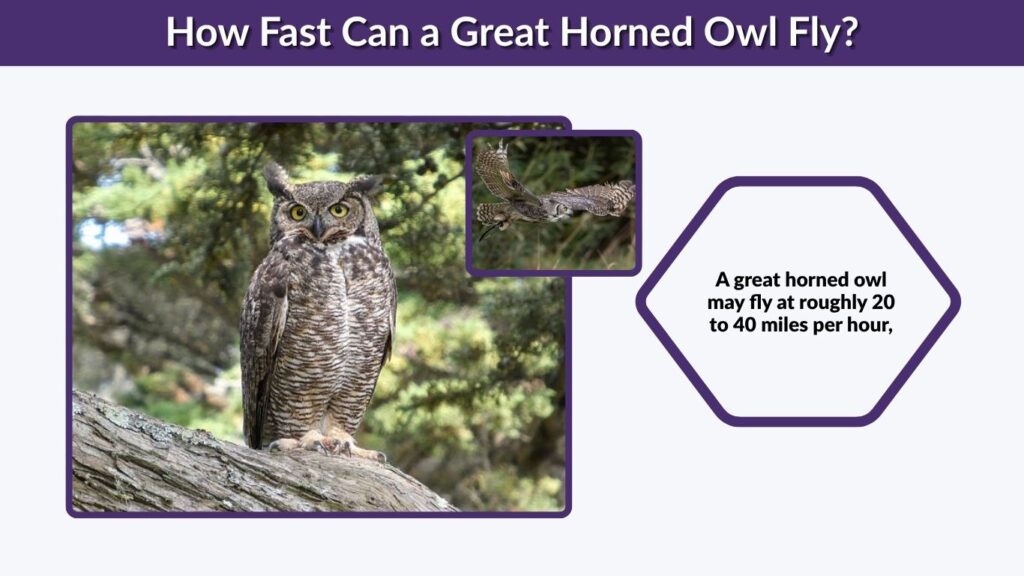
Great horned owls are capable flyers, although they are designed more for stealth and power than extreme speed.
During ordinary flight, they often travel at moderate speeds while searching for prey or moving between perches.
Great Horned Owl Flying Speed
A great horned owl may fly at roughly 20 to 40 miles per hour, depending on the situation.
Normal hunting flight is often slower because the owl needs time to listen for prey and maneuver around trees. During a pursuit, escape, or direct movement across an open area, it can fly faster.
Exact speeds vary according to wind, terrain, age, and what the owl is doing.
Why Great Horned Owls Do Not Need Extreme Speed
Unlike falcons that rely heavily on high-speed aerial pursuits, great horned owls often hunt by waiting from a perch.
Once prey is detected, the owl launches toward it and uses a combination of surprise, quiet flight, and powerful talons.
Because many of its prey animals never hear the owl approaching, stealth can be more useful than raw speed.
Great Horned Owl Flying at Night
Great horned owls are mainly nocturnal, meaning much of their activity occurs after sunset.
Their excellent night vision and hearing allow them to hunt successfully when many other birds are inactive.
Does a Great Horned Owl Fly at Night?
Yes. Great horned owls frequently fly at night while hunting, defending territory, communicating with mates, or moving between resting areas.
They often become active around dusk. Some may also be seen around dawn, and occasional daytime activity is possible.
Night flight helps them take advantage of animals such as mice, rats, rabbits, and other nocturnal prey.
How Great Horned Owls Navigate in Darkness
Their large eyes collect available light efficiently, but hearing is also extremely important.
Great horned owls can detect sounds made by prey moving through vegetation or across the ground. Once they locate the sound, they may leave their perch and fly directly toward its source.
Strong spatial awareness also helps experienced owls maneuver between trees in low light.
Great Horned Owl Flying Into Headlights
An owl may occasionally cross a road or fly through the beam of vehicle headlights while pursuing prey or moving between hunting locations.
Headlights can suddenly illuminate an owl that was already nearby, creating the impression that it deliberately flew toward the vehicle.
Drivers should slow down whenever a large bird is seen near the roadway, especially at night.
Why Can Great Horned Owls Fly So Quietly?
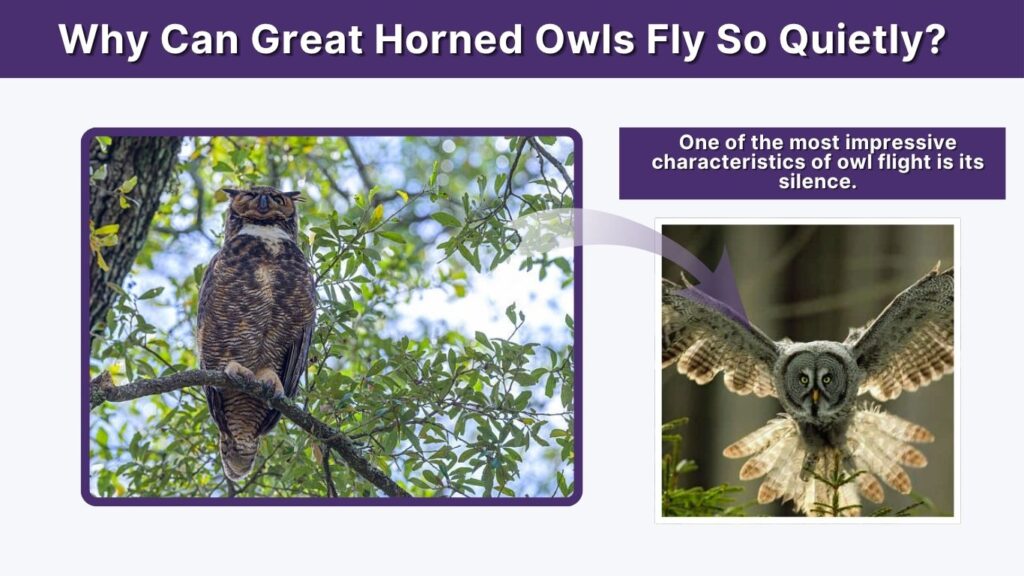
One of the most impressive characteristics of owl flight is its silence.
Great horned owls have specialized feathers that reduce the sound created as air passes over the wings.
Specialized Flight Feathers
The leading edges of owl flight feathers contain comb-like structures that help break up turbulent airflow.
The feather surfaces are also relatively soft compared with those of many other birds.
Together, these adaptations reduce aerodynamic noise and help conceal the owl’s approach.
Silent Flight Helps With Hunting
Quiet flight provides two important advantages.
First, prey animals are less likely to detect the owl before it attacks. Second, reducing the owl’s own flight noise makes it easier for the bird to continue listening for prey while airborne.
This combination helps explain why great horned owls are such successful nighttime predators.
How Does a Great Horned Owl Hunt While Flying?
Great horned owls typically combine patient observation with short, powerful flights.
They may sit quietly on a branch, utility pole, or other elevated perch while listening and watching for movement.
Flying Toward Food
Once prey is located, the owl leaves its perch and approaches rapidly.
As it closes the distance, it extends its legs forward. The toes spread and powerful talons prepare to seize the target.
Great horned owls can capture prey ranging from small rodents to rabbits and birds.
Flying Directly Toward Prey
During the final stage of an attack, the owl may adjust its wings and tail repeatedly to maintain precise control.
These small corrections allow it to follow prey moving through vegetation or across uneven ground.
Its broad wings also allow relatively tight turns for such a large bird.
Carrying Prey in Flight
Smaller prey can often be carried away in the owl’s talons.
Large prey may be eaten where it is captured or transported in portions. The amount an owl can comfortably carry depends on the prey’s weight and flying conditions.
How High Can a Great Horned Owl Fly?
Great horned owls are fully capable of flying high above the ground, but they often remain relatively low while hunting.
Flying close to trees and open ground allows them to detect potential prey more effectively.
Typical Flight Height
Many hunting flights occur between trees, across clearings, or just above the landscape.
When traveling longer distances, great horned owls may fly higher and cross open spaces.
There is no single standard altitude because flight height changes according to habitat, weather, destination, and behavior.
Tight Flying Maneuvers
Broad wings provide excellent lift and help the owl make controlled movements at relatively slow speeds.
This is particularly valuable in forests where the bird may need to pass between trunks and branches.
Its tail functions like a steering surface, helping with braking and directional changes.
Great Horned Owl Learning to Fly
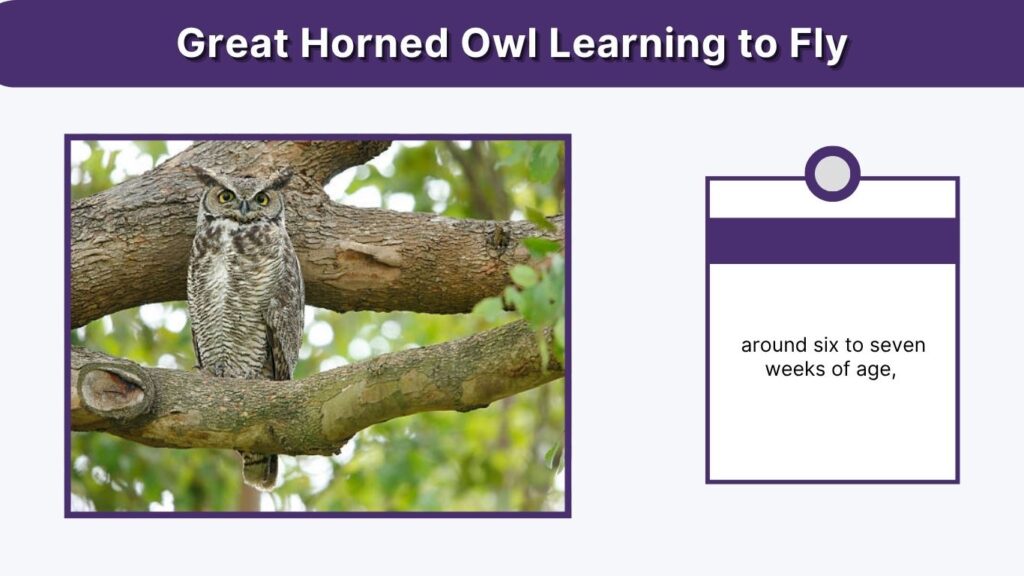
Young great horned owls do not become expert flyers immediately.
After leaving the nest, they spend time developing coordination, wing strength, and landing skills.
When Do Young Great Horned Owls Start Flying?
Young great horned owls usually begin leaving the nest at around six to seven weeks of age, although their first movements may involve climbing and short hops rather than strong sustained flight.
This stage is often called branching because young owls spend time moving around nearby branches.
Learning Flight Skills
Early flights can look awkward.
Young owls may make short trips from branch to branch and sometimes struggle with landings. Their parents continue feeding and protecting them while these skills develop.
Over the following weeks, they become stronger and more capable of controlled flight.
Great Horned Owl Flying Photography
Photographing a great horned owl in flight can be challenging because these birds are most active in low-light conditions.
Dawn and dusk often provide the best opportunities to observe natural flight behavior.
Best Times to See One Flying
Look near woodland edges, open fields, wetlands, or agricultural areas close to mature trees.
Great horned owls frequently use prominent perches before beginning a hunting flight.
Watching from a respectful distance is important, especially around active nests or recently fledged owlets.
Recognizing a Great Horned Owl in Flight
Pay attention to broad wings, a heavy body, slow wingbeats, and a large head.
If the owl is close enough, the barred underside and mottled wing feathers may also be visible.
Its quiet approach can make it surprisingly difficult to notice until the bird is already passing overhead.
FAQs
How fast can a great horned owl fly?
A great horned owl can generally reach around 20 to 40 mph depending on its activity and conditions. Hunting flights may be slower because stealth and maneuverability are important.
Do great horned owls fly at night?
Yes. They are primarily nocturnal and commonly fly after sunset while hunting, patrolling territory, and communicating with other owls.
Why is great horned owl flight so quiet?
Specially structured and soft-edged feathers reduce turbulence and wing noise. This helps the owl approach prey without being easily detected.
When can a young great horned owl fly?
Young owls usually begin leaving the nest at roughly six to seven weeks old. Their first flights may be short and unsteady before they become proficient.
Can a great horned owl make tight turns while flying?
Yes. Its broad wings and tail provide excellent maneuverability, allowing it to make controlled turns and fly through wooded environments.