The female great horned owl is a powerful nocturnal predator known for her large size, deep hooting calls, and important role in nesting and raising young. Female and male great horned owls look extremely similar, which can make telling them apart difficult in the wild. However, females are generally larger and heavier, while males usually produce lower-pitched hoots. Understanding differences in size, calls, behavior, and breeding roles can make identification much easier.
What Does a Female Great Horned Owl Look Like?
Female great horned owls have the same general appearance as males. They have large yellow eyes, prominent feather tufts or “horns,” broad wings, and mottled brown, gray, black, and white plumage. Their barred underside and camouflaged feathers help them remain nearly invisible while resting against tree bark.
Female Great Horned Owl Identification
- Large, bulky body with broad wings
- Prominent feather tufts above the head
- Bright yellow eyes
- White patch on the throat
- Brown, gray, and black mottled plumage
- Strong feathered legs and powerful talons
- Usually larger and heavier than the male
- Rounded facial disk surrounding the eyes
Because males and females share almost identical plumage, body size is one of the most useful clues when both birds are seen together.
How Tall Is a Female Great Horned Owl?
A female great horned owl is generally around 18 to 25 inches tall, although measurements vary among individuals and geographic populations. Great horned owls also have impressive wingspans that can reach approximately 3 to 5 feet.
Their upright posture can make females appear particularly large when perched on an exposed branch or nest.
Female Great Horned Owl Weight
Female great horned owls commonly weigh approximately 3 to 4 pounds, with some individuals becoming even heavier.
This may not sound especially heavy compared with mammals, but birds have lightweight skeletons adapted for flight. A four-pound owl is therefore an exceptionally powerful flying predator capable of capturing relatively large prey.
Great Horned Owl Male vs Female
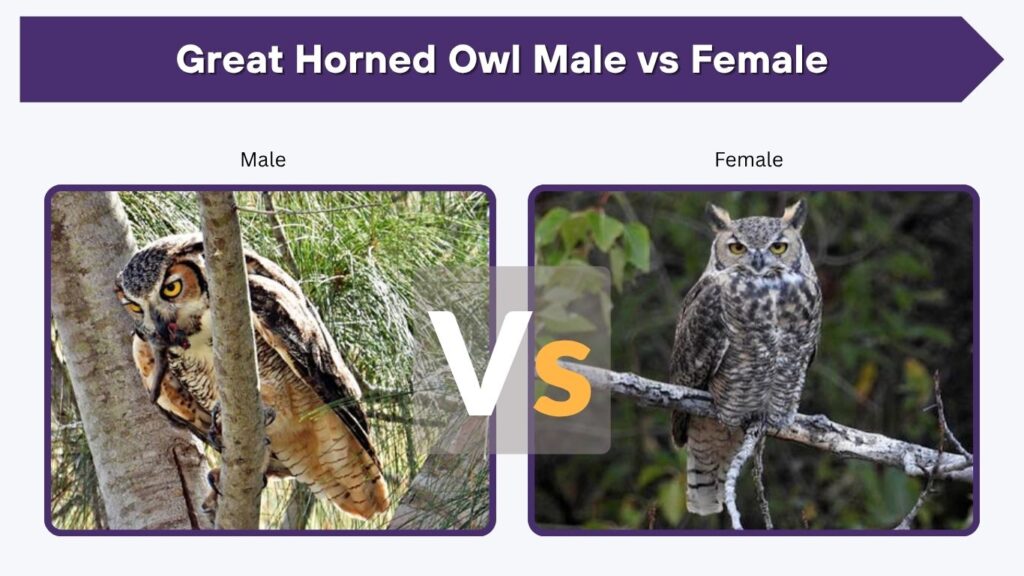
Distinguishing a male vs female great horned owl is difficult when only one bird is visible. Their colors, facial markings, feather tufts, and body proportions are almost identical.
The most noticeable differences involve size, weight, voice, and behavior during the breeding season.
Size Difference Between Male and Female Great Horned Owls
Female great horned owls are generally larger than males, a pattern called reverse sexual size dimorphism.
A female may appear broader through the chest, heavier-bodied, and slightly larger overall. When a male and female are perched beside each other, the difference can sometimes be noticeable.
However, size alone is unreliable when observing a single owl because individual sizes overlap.
Male vs Female Great Horned Owl Call
Interestingly, the smaller male normally has the deeper, lower-pitched hoot, while the larger female usually produces a slightly higher-pitched call.
During a duet, listeners may hear the male’s deep hoots followed by the female’s somewhat higher response. This difference in pitch can be one of the best ways to distinguish a male and female great horned owl when both are calling.
Male and Female Behavioral Differences
During breeding season, males and females can take somewhat different roles.
The female performs most of the incubation after eggs are laid. She remains near the nest for long periods while the male hunts and brings food. After the chicks hatch, both parents help protect and feed their young.
Outside the breeding period, behavior alone usually cannot reliably determine sex.
Female Great Horned Owl Call and Sounds
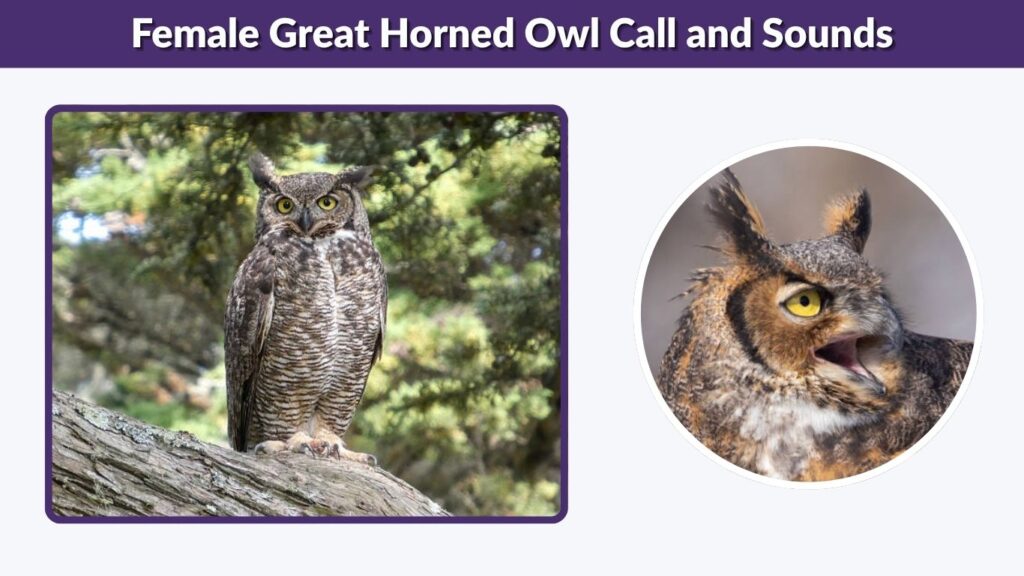
The famous great horned owl hoot is often described as a series of deep, rhythmic “hoo” notes. However, females can produce much more than the familiar territorial hoot.
They may also make screams, squawks, whistles, growls, and other unusual vocalizations.
What Does a Female Great Horned Owl Call Sound Like?
A female’s typical hoot is usually strong and resonant but slightly higher in pitch than a male’s.
She may call repeatedly from a tree, especially during the evening or early morning. Vocal activity often increases during courtship and breeding season when paired owls communicate with one another.
Hooting can serve several purposes, including defending territory, communicating with a mate, and maintaining contact.
Female Great Horned Owl Mating Call
During courtship, a male and female may engage in coordinated hooting known as a duet.
The male generally produces deeper notes, while the female answers with a higher voice. These exchanges may occur repeatedly as the pair strengthens its bond and establishes territory.
Courtship calling often becomes noticeable during fall and winter, before nesting begins.
Female Great Horned Owl Screech and Squawk
Great horned owls do not only hoot. A female may produce sharp screeches, squawks, hisses, or screams when alarmed, threatened, interacting with another owl, or communicating near a nest.
Young great horned owls also make loud begging sounds, so not every strange owl-like scream heard at night necessarily comes from an adult female.
How to Tell Male From Female Great Horned Owl
Visual identification becomes easier when two adult owls are together, particularly a bonded pair.
A combination of body size, vocal pitch, and breeding behavior provides much stronger evidence than any single feature.
Best Ways to Tell Them Apart
- Compare body size: Females are usually larger.
- Listen to pitch: Males generally have deeper hoots.
- Watch the nest: The bird performing most incubation is normally the female.
- Compare body build: Females may appear broader and heavier.
- Observe a pair together: Differences are easier to recognize side by side.
Plumage color is generally not a dependable way to determine whether a great horned owl is male or female.
Is the Female Great Horned Owl Bigger Than the Male?
Yes. Female great horned owls are typically larger and heavier than males.
This size difference occurs in many birds of prey, including hawks, falcons, eagles, and owls. Scientists have proposed several explanations, including differences in hunting roles, competition between members of a pair, and advantages associated with protecting eggs and chicks.
Female Great Horned Owl Nesting Behavior
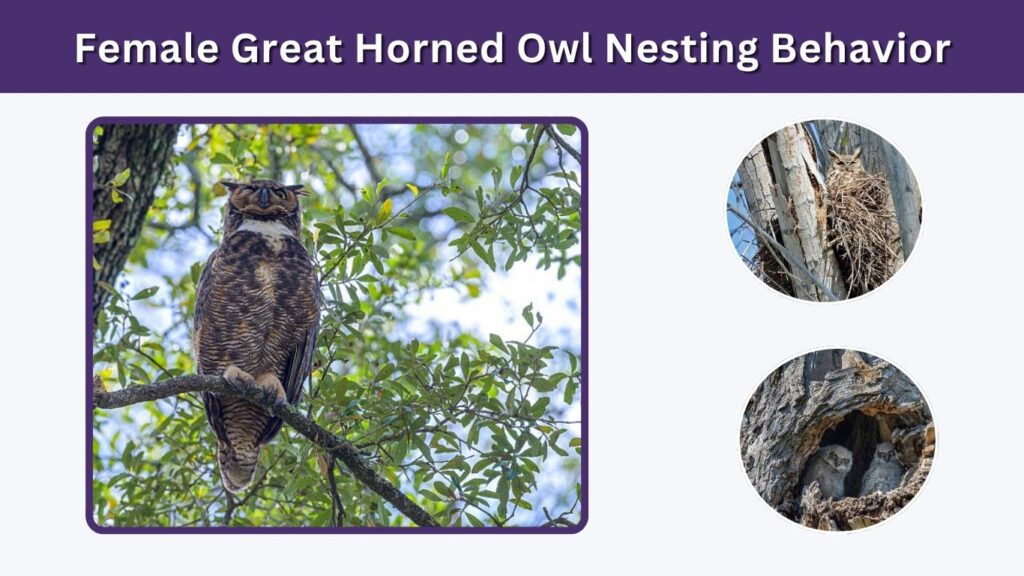
Female great horned owls become particularly noticeable during the breeding season because they spend considerable time incubating eggs and caring for young.
Great horned owls generally do not construct elaborate nests themselves. Instead, they frequently use abandoned nests built by hawks, crows, ravens, or squirrels.
Incubation and Raising Owlets
The female normally lays about two eggs, although clutch size can vary. She performs most incubation while the male delivers food.
Great horned owls can begin nesting remarkably early in the year, sometimes while winter conditions are still present.
Once the owlets hatch, the female remains close to them during their vulnerable early stages. As they become larger, both parents increasingly participate in providing food.
Why Does a Female Great Horned Owl Puff Her Throat?
A great horned owl may appear to puff or expand the white throat area while hooting because movement of the throat accompanies vocalization.
The bright white throat patch can become especially noticeable as the feathers move during calling. Under low-light conditions, this contrasting patch may also help nearby owls visually locate the calling bird.
Female Great Horned Owl Diet and Hunting
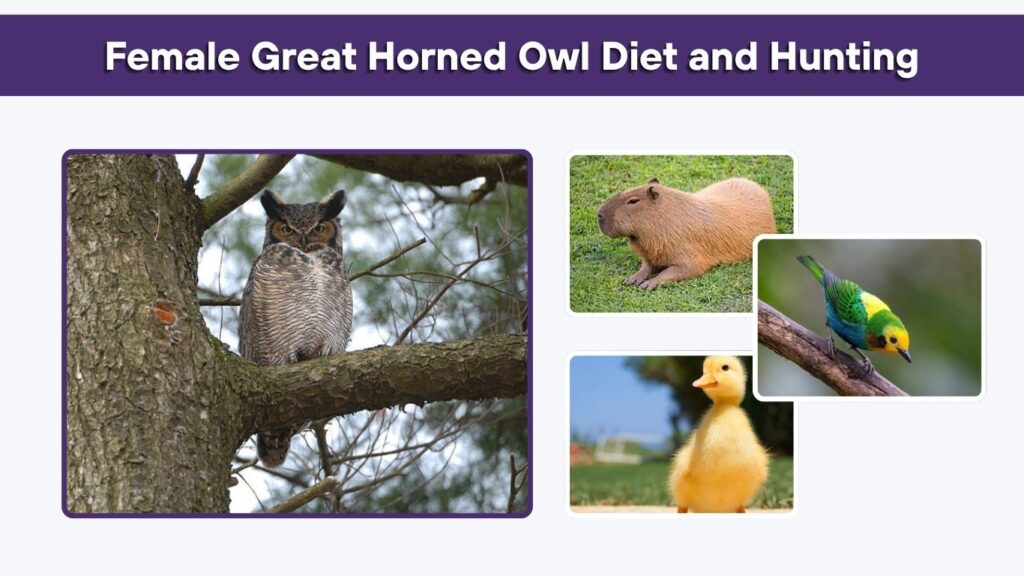
Female great horned owls are formidable hunters capable of taking mammals, birds, reptiles, and other animals.
Their diet may include rabbits, rodents, squirrels, ducks, snakes, and occasionally other birds of prey. Great horned owls are also among the few predators known to regularly hunt skunks.
Females possess extremely powerful feet and talons that allow them to seize and restrain struggling prey.
Despite their size, their specialized feathers allow remarkably quiet flight, helping them approach prey with little warning.
FAQs
What is a female great horned owl called?
There is no widely used special name exclusively for a female great horned owl. She is normally simply called a female great horned owl.
Are female great horned owls bigger than males?
Yes. Females are generally larger and heavier than males, although their plumage looks extremely similar.
Do female great horned owls hoot?
Yes. Females hoot for territorial communication, courtship, and interaction with their mates. Their hoots are usually slightly higher-pitched than those of males.
What is the difference between male and female great horned owl calls?
The male generally has a deeper, lower-pitched voice, while the female usually produces a somewhat higher-pitched hoot. This difference is particularly noticeable during duets.
Can you identify a female great horned owl from a picture?
Sometimes, but it can be difficult. Plumage is nearly identical between the sexes. A female may appear larger and heavier, but identifying sex from a single photograph without a size comparison is usually uncertain.