The Australian masked owl (Tyto novaehollandiae) is a powerful nocturnal hunter recognized by its heart-shaped facial disc, dark eyes and strongly spotted plumage. It is Australia’s largest member of the Tyto owl group and is found mainly in forests and woodlands near the coast. Although secretive and rarely seen, its deep rasping call can reveal its presence after dark.
Australian Masked Owl Facts
The Australian masked owl is closely related to barn owls but is generally larger, darker and more heavily built. Several regional subspecies occur, including distinctive populations in Tasmania, northern Australia and the Tiwi Islands.
| Feature | Information |
| Scientific name | Tyto novaehollandiae |
| Bird family | Tytonidae |
| Length | Approximately 40–50 cm |
| Activity | Nocturnal |
| Main food | Small mammals |
| Nesting place | Large tree hollows and occasionally caves |
| Typical call | Deep, harsh rasping screech |
| Clutch size | Usually 2–3 eggs |
The owl’s large feet, fully feathered legs and strong talons help distinguish it from smaller barn owls. Plumage varies considerably between pale, intermediate and dark forms.
Australian Masked Owl Identification and Appearance
The most noticeable feature is the broad, heart-shaped facial disc bordered by darker feathers. Its upperparts range from grey and brown to almost blackish-brown, decorated with pale spots and rufous markings. The breast and belly may be white, buff, reddish-brown or heavily spotted.
Identification Features
- Broad heart-shaped facial mask
- Large, dark brown or black eyes
- Grey-brown, dark brown or rufous upperparts
- Spotted or speckled underparts
- Fully feathered legs
- Powerful feet and long talons
- Broad, rounded wings
- Short, barred tail
The facial disc helps collect faint sounds and direct them toward the ears. Combined with sensitive hearing and quiet flight, this adaptation allows the owl to locate prey in darkness or dense vegetation.
Australian Masked Owl Size
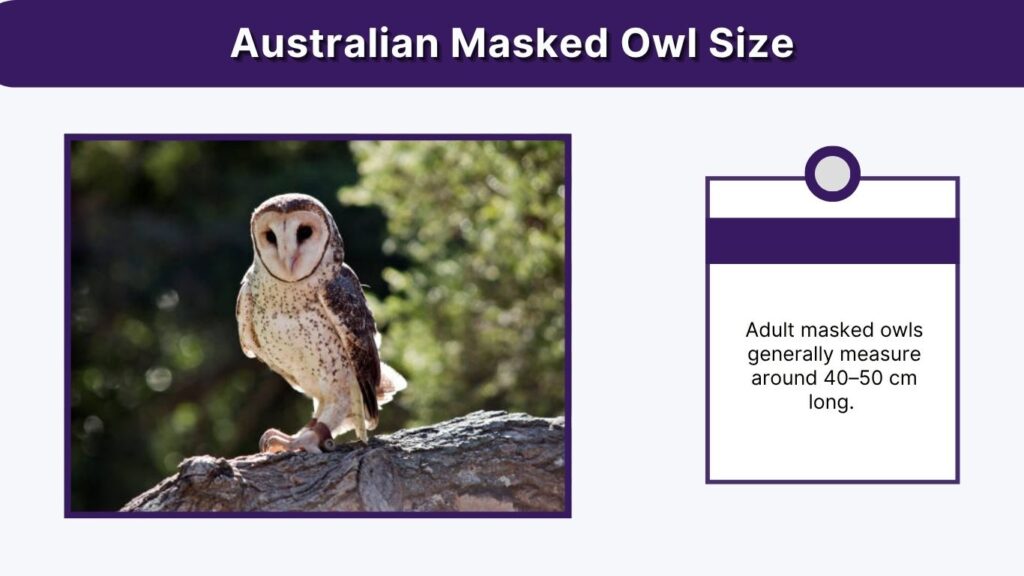
Adult masked owls generally measure around 40–50 cm long. Their size varies geographically, with southern birds tending to be larger than tropical populations. Tasmanian masked owls are particularly large and are among the biggest barn-owl relatives in the world.
Female vs Male Australian Masked Owl
Female Australian masked owls are noticeably larger and usually darker than males. A female may have a deeper chestnut facial disc and richer brown underparts, while males are often smaller and paler. However, colour alone cannot always determine sex because the species occurs in several plumage forms.
Where Do Australian Masked Owls Live?
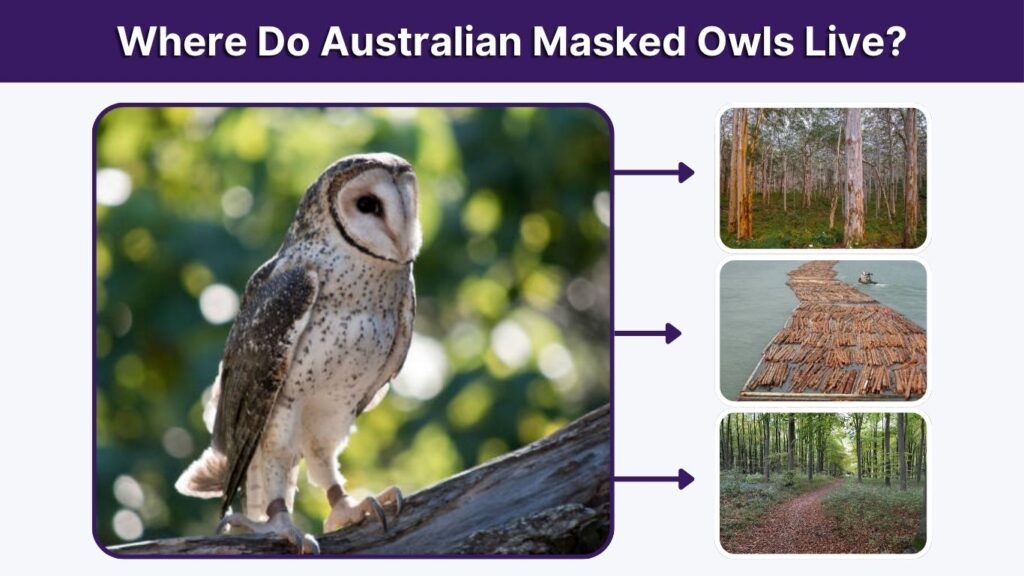
Australian masked owls occur through a broad coastal band around much of mainland Australia and throughout Tasmania. They are uncommon in the dry interior and are generally recorded within approximately 300 kilometres of the coast.
They can be found in:
- Dry eucalypt forests
- Open woodlands
- Timbered waterways
- Moist forest gullies
- Farmland beside native forest
- Forest edges and roadside vegetation
- Open hunting areas near mature trees
In New South Wales, the species occurs from coastal regions to parts of the western plains and has been recorded from sea level to around 1,100 metres.
Habitat Requirements
Masked owls need two connected habitat features: large old trees for roosting and nesting, and open areas where they can hunt. Nesting hollows suitable for large owls may take more than 200 years to form, making mature hollow-bearing trees extremely valuable.
A breeding pair may occupy a home range of 1,000 hectares or more, depending on habitat quality and the availability of prey.
What Do Australian Masked Owls Eat?
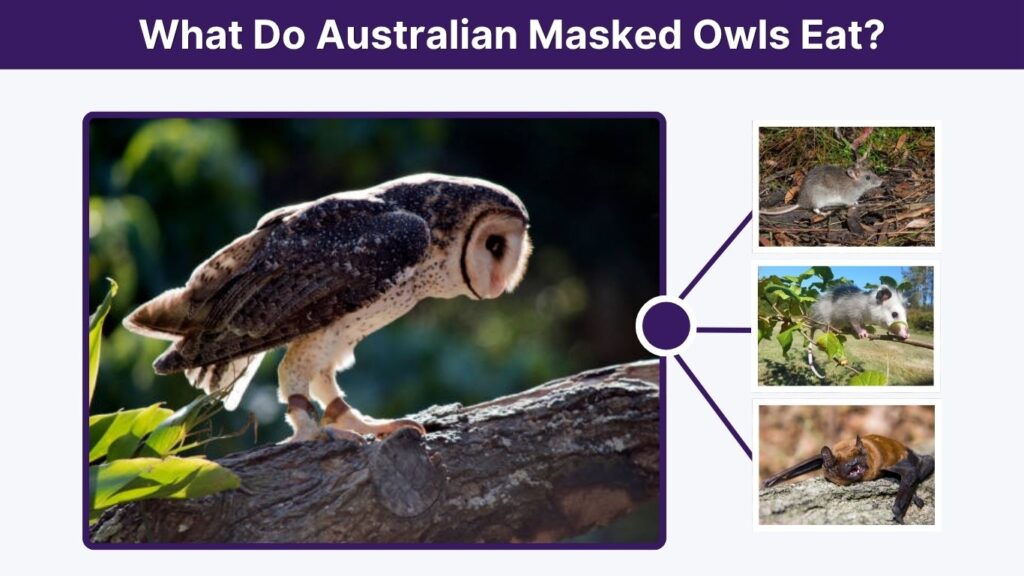
The Australian masked owl is primarily a mammal hunter. Rats and other small ground-dwelling mammals often form the largest part of its diet.
Common food includes:
- Native rats and introduced rodents
- Rabbits
- Bandicoots
- Small possums
- Antechinus
- Gliders
- Bats
- Small birds
- Reptiles
- Large insects
The owl usually begins hunting during the early part of the night. It watches from a low perch, listens for movement and then drops quickly onto prey on the ground or among branches.
Australian Masked Owl Call and Sound
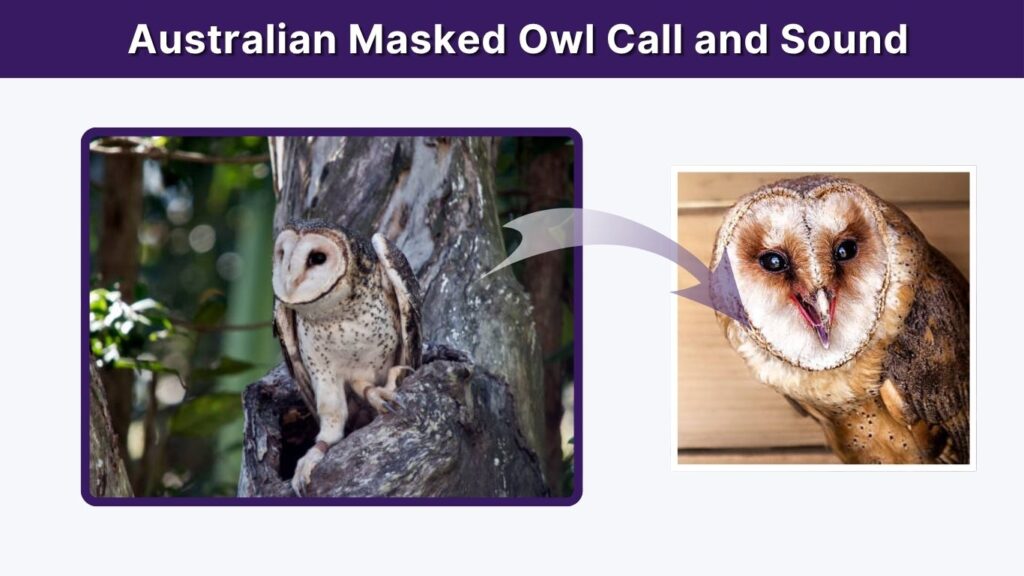
The best-known Australian masked owl call is a deep, rasping screech. It is rougher and lower than the familiar shriek of many barn owls.
Other sounds may include:
- Harsh screeches
- Hissing notes
- Chattering calls
- Squeals
- Short contact calls
Males may produce chattering sounds during courtship, while females can answer with louder screeches. Calls may be difficult to separate from those of related Tyto owls, so sound alone does not always provide a certain identification.
Australian Masked Owl Life Cycle and Breeding
Australian masked owls can breed at different times of year when food is abundant. The pair usually nests deep inside a large tree hollow, although caves and rock crevices may occasionally be used.
The female normally lays two or three eggs and performs the incubation. During this period, the male supplies food. After hatching, the female tears prey into small pieces for the chicks. Young masked owls remain in the nest for approximately 84 days and continue receiving food from their parents for about another month after fledging.
The exact average lifespan of wild Australian masked owls is not well documented. Their survival depends heavily on secure nesting hollows, reliable prey populations and protection from human-related threats.
Is the Australian Masked Owl Endangered?
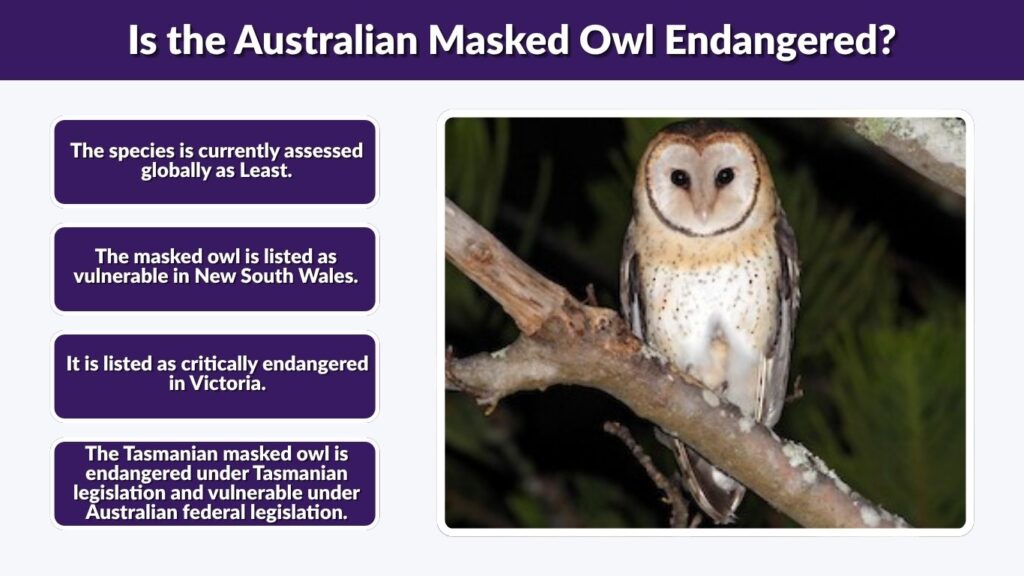
The species is currently assessed globally as Least Concern because of its extensive overall range. However, this does not mean every Australian population is secure.
Conservation status varies by location:
- The masked owl is listed as vulnerable in New South Wales.
- It is listed as critically endangered in Victoria.
- The Tasmanian masked owl is endangered under Tasmanian legislation and vulnerable under Australian federal legislation.
An exact Australia-wide population figure is unavailable, partly because these owls are nocturnal, widely dispersed and difficult to survey.
Predators and Major Threats
Healthy adult masked owls have few natural predators, although eggs and young birds may be vulnerable to other large birds, climbing animals or competitors for tree hollows. Human-related pressures are a much greater concern.
Major threats include habitat clearing, removal of hollow-bearing trees, logging, intense bushfires, reduced prey availability, vehicle collisions and secondary poisoning after eating rodents exposed to anticoagulant rat poison.
Protecting old trees, maintaining connected native vegetation and reducing the use of harmful rodenticides can support local populations.
Can You Keep an Australian Masked Owl as a Pet?
An Australian masked owl is a protected wild bird, not a normal household pet. There is no standard legitimate “pet price” for this species. Wildlife-keeping regulations differ between Australian states, but native birds generally require appropriate authorization, and threatened raptors are not ordinary species sold by pet shops or hobby breeders.
People should not attempt to catch or handle a healthy wild owl. Its powerful talons can cause serious injury. Sick, injured or orphaned owls should be handled by a veterinarian or licensed wildlife rehabilitator.
FAQs
Why is it called the Australian masked owl?
It is named for the large heart-shaped facial disc surrounding its eyes and bill. A dark border around the disc creates the appearance of a clearly defined mask.
Are Australian masked owls aggressive?
They generally avoid people, but a frightened, trapped or nesting owl may defend itself. Its strong feet and talons make close handling dangerous.
Do Australian masked owls live in Western Australia?
Yes. They occur in suitable forest and woodland habitats in parts of Western Australia, particularly outside the driest interior regions.
Is a masked owl bigger than a barn owl?
Yes. Australian masked owls are usually heavier, more powerful and more heavily built than Australian barn owls, although their overall appearance can be similar.
Why are Australian masked owls difficult to see?
They are nocturnal, naturally uncommon and usually remain concealed in tree hollows or dense vegetation during daylight. Their large territories also mean individual birds may be widely separated.