
The Barred Owl (Strix varia) is a large woodland owl native to North America. It is most strongly associated with mature forests, wooded swamps, river valleys, and other habitats containing large trees, especially areas close to water. Historically concentrated in eastern North America, Barred Owls expanded westward during the twentieth century and are now established through parts of the Pacific Northwest and northern California. Unlike many birds, they generally do not migrate and may remain within the same home range throughout their lives.
Where Do Barred Owls Live?
Barred Owls live primarily in large forests with mature trees, particularly where wetlands, rivers, streams, lakes, or swamps are nearby. Large old trees provide cavities for nesting and sheltered branches for daytime roosting, while forests and wetlands support the rodents, amphibians, birds, and other prey the owls hunt.
Their habitat can range from southern cypress swamps to northern mixed forests and western conifer forests.
Preferred Barred Owl Habitat
Barred Owls commonly use:
- Mature deciduous forest
- Mixed deciduous-coniferous woodland
- Wooded swamps
- Bottomland hardwood forest
- River valleys
- Streamside forests
- Forested wetlands
- Mature conifer forest
- Large wooded parks
- Occasionally wooded suburban areas
They especially favor large, relatively continuous forests because mature woodland tends to provide more prey and more large cavities suitable for nesting.
Where Do Barred Owls Live in the United States?
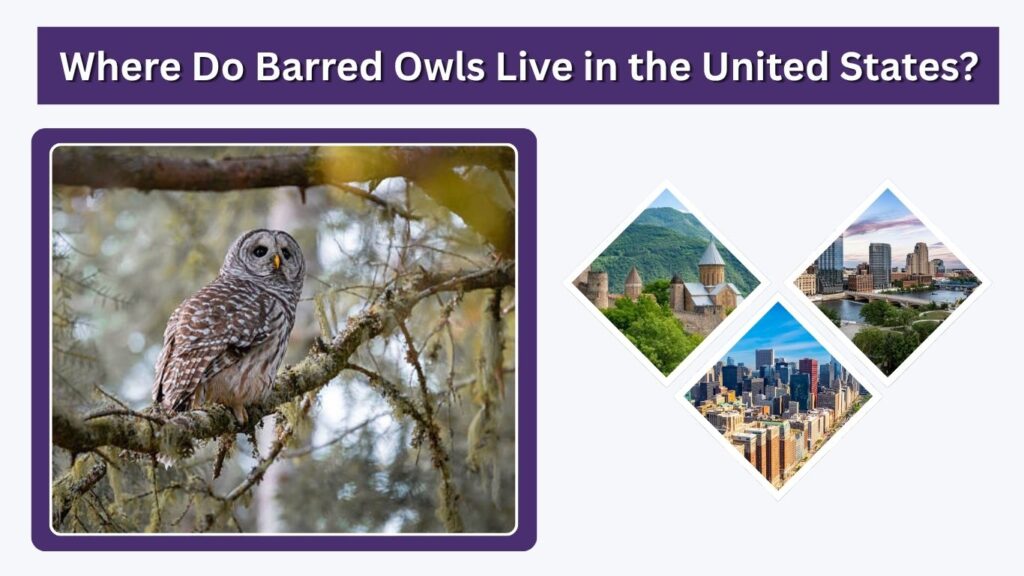
Barred Owls have traditionally been birds of the eastern United States, but their modern range is considerably larger.
They occur throughout much of the eastern half of the country, from the Southeast north through the Great Lakes and Northeast. Their range extends westward through parts of the central United States and Canada and into Washington, Oregon, and northern California.
Barred Owls by State
Florida: Yes. Barred Owls are established residents, particularly around wooded wetlands, swamps, and mature forests.
Georgia: Yes. They are regular residents of wooded wetlands and mature forests.
Illinois: Yes. Barred Owls live year-round in suitable forests, particularly along rivers and wetlands.
Ohio: Yes. They are established residents in mature wooded habitats.
Michigan: Yes. Michigan lies within their regular range.
Iowa: Yes. They occur in forested landscapes, especially around waterways.
Oklahoma: Yes, particularly where suitable mature woodland is available.
Texas: Yes. Barred Owls are established across wooded portions of the state, including bottomland and riparian forests. Texas Parks and Wildlife lists them as year-round residents at several woodland and wetland sites.
Oregon: Yes. Barred Owls are now widespread enough in western Oregon to compete seriously with native Northern Spotted Owls.
Northern California: Yes. Their westward expansion eventually continued south from the Pacific Northwest into northern California.
Colorado: Barred Owls are outside the main core of their established North American range, so they are far less typical than in eastern states.
Arizona: Arizona is also outside the species’ principal established range. An owl observed there should be identified carefully rather than automatically assumed to be a Barred Owl.
Why Did Barred Owls Spread West?
Historically, Barred Owls were concentrated in eastern North America. During the twentieth century, they expanded across Canada and the northern Great Plains into the Pacific Northwest.
Changes to the landscape likely helped make this possible. Fire suppression, tree planting, changes in Great Plains ecosystems, and altered boreal forest conditions created additional wooded corridors through areas that had once acted as barriers.
Barred Owls in the Pacific Northwest
Barred Owls reached British Columbia around the middle of the twentieth century and were documented in Washington during the 1970s. They subsequently spread through Oregon and into California.
This expansion has become an important conservation issue because Barred Owls compete with the smaller Northern Spotted Owl for habitat and food. The U.S. Fish and Wildlife Service reports that Barred Owls now outnumber Northern Spotted Owls through much of their overlapping western range.
Why Do Barred Owls Live Near Water?
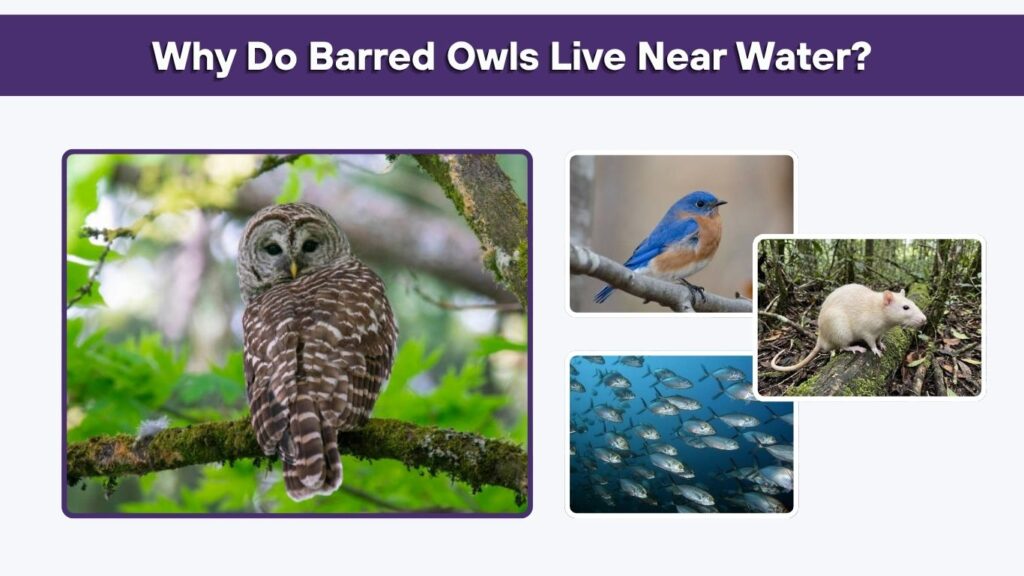
Water itself is not the only attraction. Wet forests typically provide dense vegetation, mature trees, nesting cavities, and abundant prey.
Barred Owls may hunt:
- Mice
- Voles
- Squirrels
- Rabbits
- Small birds
- Frogs
- Salamanders
- Snakes
- Crayfish
- Fish
- Large insects
They can even hunt directly around shallow water, occasionally capturing fish or crayfish.
Bottomland forests along rivers are therefore among the best habitats for finding them.
Do Barred Owls Live in Nests?
Barred Owls use nests mainly for breeding and raising young. They do not spend their entire lives sitting inside a nest.
During ordinary daytime resting, an adult typically roosts on a sheltered tree branch or occasionally inside a cavity.
Where Do Barred Owls Nest?
They usually nest in:
- Large natural tree cavities
- Hollow sections of old trees
- Abandoned hawk nests
- Old crow or raven nests
- Large squirrel nests
- Artificial owl nest boxes
Natural cavities are often around 20–40 feet above the ground. Barred Owls do little actual nest construction and may simply use an existing cavity with wood debris already inside.
Large mature trees are therefore particularly important to breeding populations.
Do Barred Owls Live in Pairs?
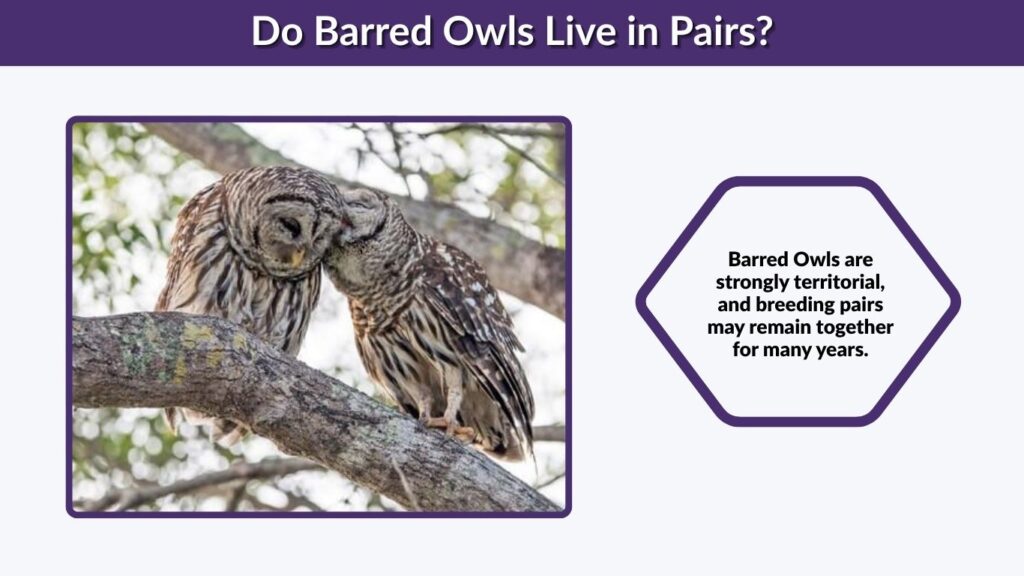
Barred Owls are strongly territorial, and breeding pairs may remain together for many years. Cornell notes that pairs probably mate for life.
A male and female share overlapping territory and communicate with their famous hooting calls, particularly during courtship and territorial encounters.
Do Barred Owls Live in Groups?
Normally, no.
They are not social flocking birds. Outside the breeding season they are largely solitary, although a mated pair occupies overlapping areas.
For part of the year, parents and recently fledged young may temporarily form a family group. As the young become independent, this group breaks apart.
Therefore, hearing two Barred Owls calling to each other usually indicates a pair or territorial interaction rather than a permanent flock.
Do Barred Owls Migrate?
Barred Owls are primarily nonmigratory residents.
Most individuals remain in the same general region year-round instead of making long seasonal migrations. Cornell notes that most remain within a relatively small area throughout their lives, although occasional individuals wander farther when food becomes scarce.
This explains why people may repeatedly hear a Barred Owl in the same woodland year after year.
How Long Do Barred Owls Live?
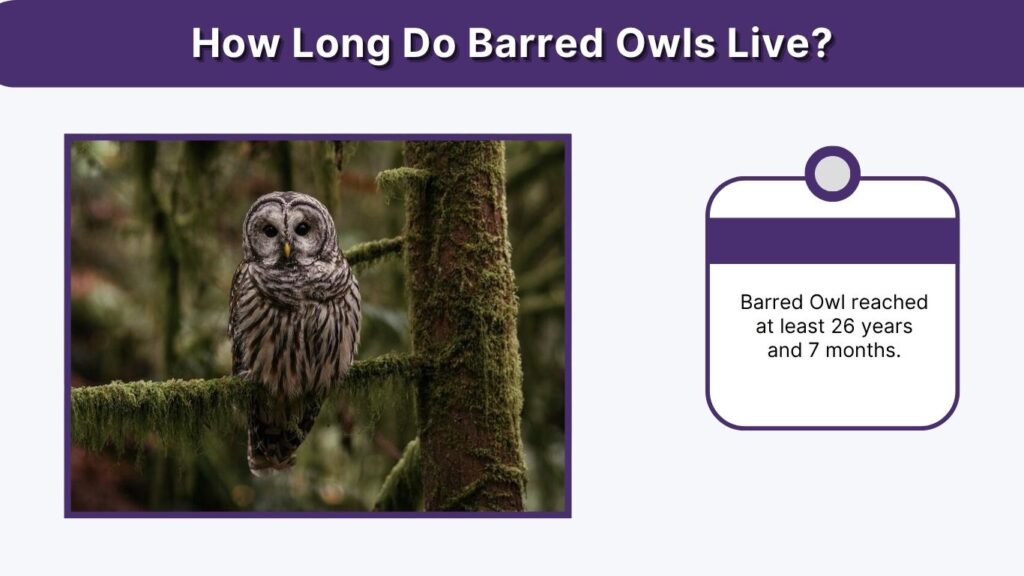
Barred Owls can be surprisingly long-lived birds.
Current U.S. Geological Survey Bird Banding Laboratory records show that the oldest verified wild Barred Owl reached at least 26 years and 7 months. It had originally been banded in North Carolina in 1993 and was encountered again in 2019.
Barred Owl Lifespan in the Wild
A wild Barred Owl should not be expected to live 26 years simply because one individual reached that age. A longevity record represents an exceptional verified individual, not the average lifespan.
Young owls face particularly high mortality, while adults that successfully establish territories can survive for many years.
Threats include:
- Great Horned Owl predation
- Vehicle collisions
- Habitat loss
- Starvation
- Disease
- Human-related injuries
- Fishing-line entanglement
USGS records include other wild individuals that survived more than 18 and 24 years, demonstrating the species’ potential for considerable longevity.
What Does a Barred Owl Territory Look Like?
A suitable territory usually contains mature forest for roosting and nesting along with enough hunting habitat to provide food throughout the year.
Home-range size varies greatly according to location and habitat quality. Research summarized by Cornell’s Barred Owl Cam information estimates a home range of roughly 620 acres, or around one square mile, in one Indiana population.
Pairs defend their territory with loud calls and may chase away other Barred Owls.
Where Can You Find a Barred Owl?
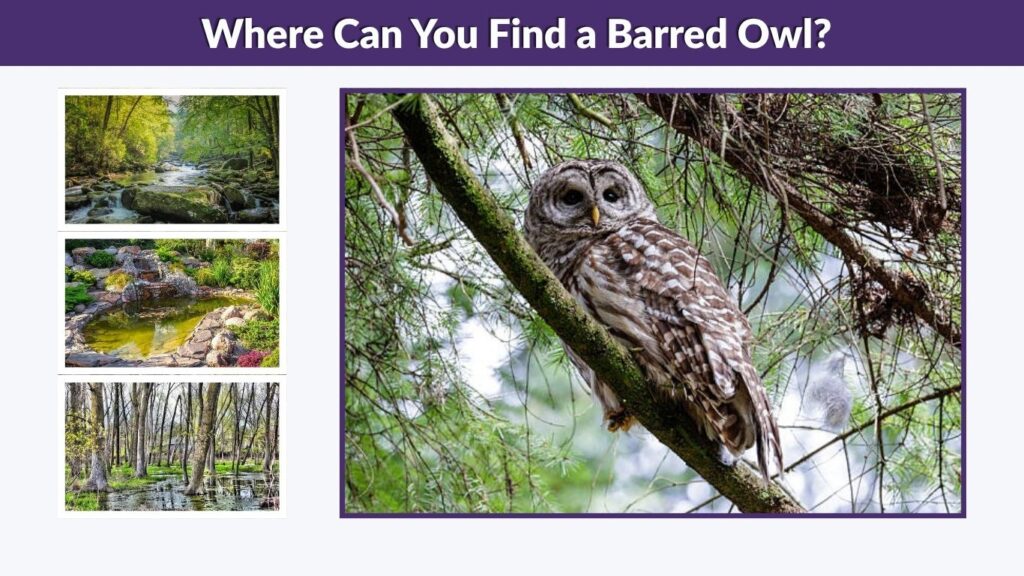
The best places to search are mature woods near rivers, creeks, ponds, swamps, and wetlands.
Barred Owls are usually easier to hear than see.
Best Ways to Find One
Visit suitable forest:
- Around dusk
- Shortly after sunset
- Before sunrise
- On quiet evenings
Listen for their classic rhythmic call often described as sounding like “Who cooks for you? Who cooks for you-all?”
During daylight, check large horizontal branches in mature forests for a resting owl. Their brown-and-white plumage provides excellent camouflage against tree trunks.
FAQs
1. Where do most Barred Owls live?
Most live in mature forests, wooded swamps, river bottoms, and other forested habitats, particularly in eastern North America. They are also established in the Pacific Northwest.
2. How long can a Barred Owl live?
The current verified North American longevity record for a wild Barred Owl is at least 26 years and 7 months.
3. Do Barred Owls live in Florida?
Yes. Florida is within their regular range, and wooded swamps and other mature wet forests provide especially suitable habitat.
4. Do Barred Owls live together?
Adults generally do not form groups. Mated pairs maintain overlapping territories, and parents temporarily remain with young during the breeding season.
5. Do Barred Owls stay in the same place all year?
Usually, yes. Barred Owls are primarily nonmigratory and often remain within the same general home range year-round.