
Verreaux’s eagle-owl is Africa’s largest owl and one of the continent’s most powerful nighttime predators. Also called the giant eagle-owl or milky eagle-owl, it is easily recognized by its enormous body, dark eyes, pale gray plumage, strong talons, and distinctive pink eyelids. It inhabits wooded savannas and open country across sub-Saharan Africa, where it hunts mammals, birds, reptiles, amphibians, and large invertebrates.
What Is a Verreaux’s Eagle-Owl?
The Verreaux’s eagle-owl is a large member of the typical owl family, Strigidae. Its current scientific name is commonly listed as Ketupa lactea, although many older field guides and scientific resources use Bubo lacteus. The species was named after French naturalist Jules Verreaux.
| Feature | Verreaux’s Eagle-Owl |
| Scientific name | Ketupa lactea |
| Former scientific name | Bubo lacteus |
| Length | Around 60–65 cm |
| Weight | Approximately 1.6–3.1 kg |
| Wingspan | Around 1.4 metres |
| Diet | Mammals, birds, reptiles and insects |
| Habitat | Savanna, open woodland and riverine forest |
| Conservation status | Least Concern |
Published measurements vary slightly, but females are noticeably larger and heavier than males.
Verreaux’s Eagle-Owl Identification and Appearance
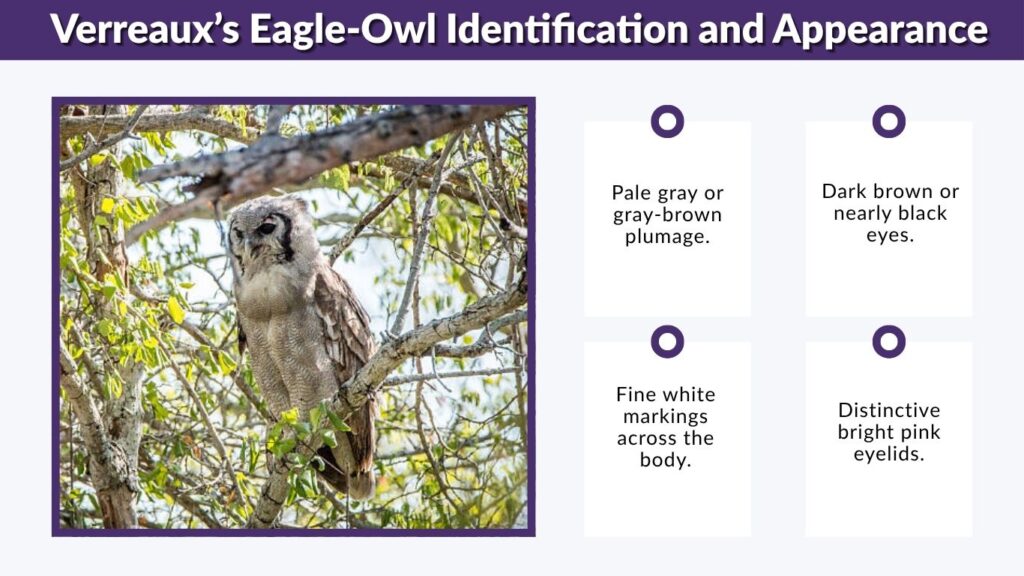
Verreaux’s eagle-owls have a large, broad-headed appearance with prominent feather tufts above the head. These tufts resemble ears but do not have a hearing function. Their true ears are hidden beneath the feathers on the sides of the head.
Important identification features include:
- Pale gray or gray-brown plumage
- Fine white markings across the body
- Dark brown or nearly black eyes
- Distinctive bright pink eyelids
- Large feather tufts on the head
- A pale cream-colored hooked bill
- A white throat patch visible during calling
- Strong, partly feathered feet
- Large, sharply curved talons
The pink eyelids are the owl’s most recognizable characteristic and are considered unique among living owl species. Juveniles are fluffier and more heavily barred, with less obvious head tufts than adults.
Verreaux’s Eagle-Owl Size and Wingspan
Verreaux’s eagle-owls normally measure around 60–65 cm from the bill to the end of the tail. Their weight ranges from approximately 1,615 to 3,115 grams. Females can weigh considerably more than males and may appear about 13% larger.
Their wingspan is generally reported at around 140–160 cm. The long, broad wings allow the owl to fly with slow, powerful wingbeats and glide quietly toward unsuspecting prey. Despite its heavy body, it can maneuver effectively between trees and through open woodland.
Verreaux’s Eagle-Owl Habitat and Distribution
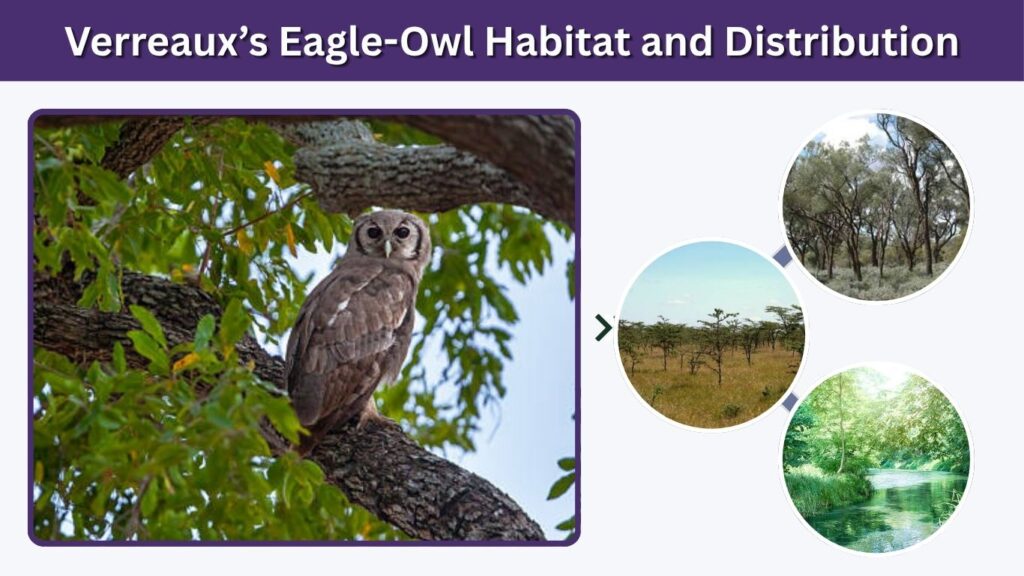
Verreaux’s eagle-owls are widely distributed across sub-Saharan Africa. They occur in countries such as Kenya, Tanzania, Uganda, Ethiopia, South Africa, Namibia, Botswana, Zimbabwe, Zambia, Mozambique, Senegal, Ghana, Nigeria, Angola and Cameroon.
They prefer landscapes that combine open hunting grounds with large trees for nesting and daytime roosting. Suitable habitats include:
- Dry wooded savanna
- Acacia woodland
- Thorny shrubland
- Riverine forest beside open country
- Semi-desert with scattered trees
- Floodplains and open countryside
- Lightly wooded farmland
The species generally avoids dense tropical rainforest, completely treeless desert and heavily closed woodland. It can live from sea level to elevations of approximately 3,000 metres.
Behavior and Flying
This eagle-owl is primarily nocturnal, becoming active around sunset and hunting during the early part of the night. During daylight hours, it usually rests on a shaded branch inside a large tree. The same roost may be used repeatedly for an extended period.
Its plumage helps it blend with tree bark, making such a large bird surprisingly difficult to notice. Pairs and their older offspring may occasionally roost close together and groom one another.
Verreaux’s eagle-owls normally hunt by watching from an exposed perch and then gliding rapidly toward their target. They can also chase insects in flight, enter vegetation to seize sleeping birds and wade into shallow water to catch fish.
Verreaux’s Eagle-Owl Call and Sound
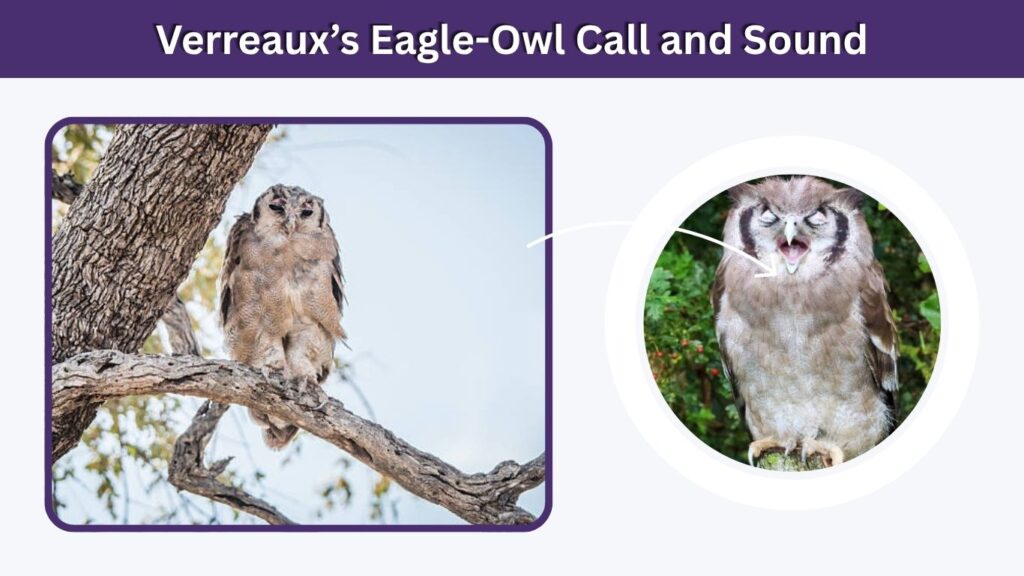
The call is deeper and less musical than the classic hooting associated with many owls. A calling male produces a series of low, grunting notes that may sound like:
“Gwonk, gwok-gwok, gwonk.”
Another common vocalization is a repeated deep “whuuc” or “hok” sound. Pairs sometimes call together after emerging from their daytime roosts at dusk. Their territorial calls can carry for several kilometres under suitable conditions.
Females and young birds also produce long, high-pitched whistles when requesting food. Alarmed adults may make a loud, forceful bark or single gruff note.
Verreaux’s Eagle-Owl Diet and Hunting
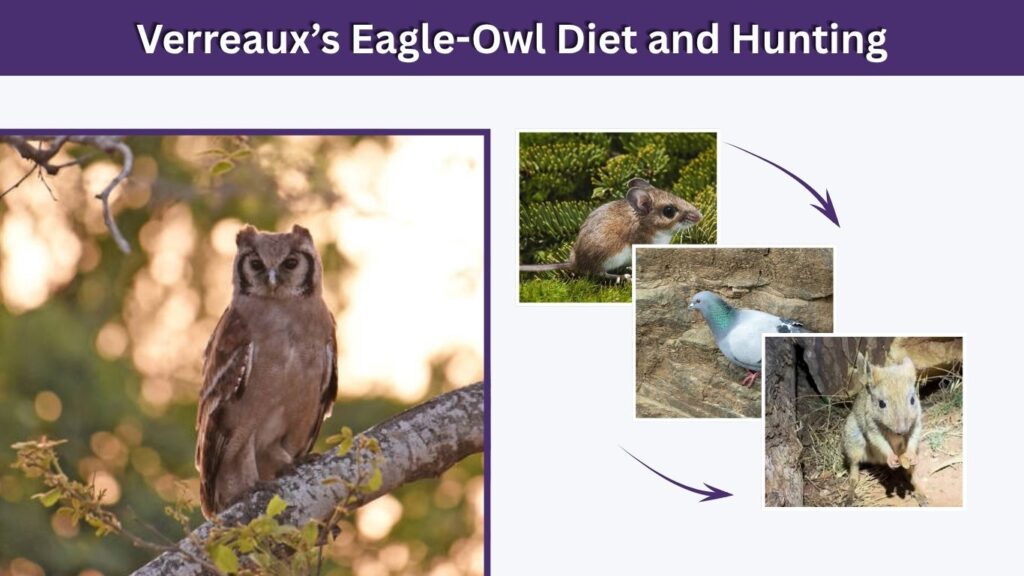
Verreaux’s eagle-owls are opportunistic carnivores with one of the broadest diets among African owls. They use their powerful feet to capture prey and their hooked beak to tear meat into manageable pieces.
Mammals
Common mammalian prey includes rats, mice, hedgehogs, hares, springhares, bats, mongooses, genets, ground squirrels and hyraxes. They may also capture young monkeys, bushbabies, small antelope, domestic cats and warthog piglets.
Hedgehogs are particularly notable prey. The owl attacks the exposed face and underside before removing or avoiding much of the spiny skin.
Birds and Other Prey
Bird prey includes pigeons, doves, ducks, guineafowl, francolins, crows, herons, egrets, hornbills and young cranes. They may raid nests or capture adult birds while the birds are sleeping.
Their diet can also contain:
- Snakes and lizards
- Frogs and toads
- Fish
- Scorpions and spiders
- Beetles and grasshoppers
- Millipedes and other invertebrates
The exact diet varies according to location and which animals are locally abundant.
Beak, Feet and Talon Functions
The pale, sharply hooked beak is used to bite prey, remove fur or feathers and tear larger animals into smaller portions. Small prey may be swallowed whole.
Its feet provide the owl’s main killing power. Strong toes and curved talons help it grip struggling mammals and birds securely. Feathering on the legs provides protection and insulation, while the owl’s powerful strike can quickly subdue relatively large prey.
Verreaux’s Eagle-Owl Nest, Eggs and Chicks
Verreaux’s eagle-owls do not normally build their own nests. They occupy abandoned stick nests created by vultures, eagles, crows, hamerkops and other large birds. They may also nest in large tree hollows or on top of enormous communal weaver nests.
The female usually lays two white eggs. She performs most or all of the incubation, which lasts approximately 32–39 days, while the male delivers food.
Because the eggs can hatch around a week apart, the first chick is significantly larger than the second. When food is limited, the younger chick frequently fails to survive. Young owls leave the nest at approximately 62–63 days old but may not fly properly for another two weeks. They can remain within their parents’ territory for as long as two years and normally reach breeding maturity at three or four years.
Male vs Female Verreaux’s Eagle-Owl
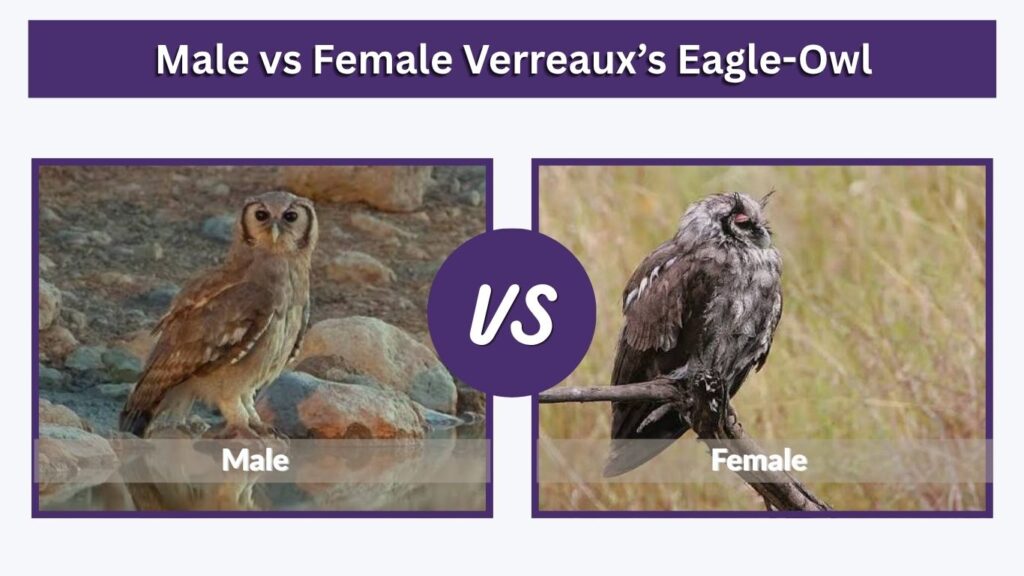
Males and females have almost identical plumage, dark eyes and pink eyelids. Size is the primary visible difference: females are generally heavier and larger.
Behavior may provide additional clues during breeding. The female incubates and broods the chicks, while the male supplies most of the food during the early nesting period. However, determining an individual’s sex from appearance alone can be difficult without directly comparing a pair.
Verreaux’s vs Spotted Eagle-Owl
| Feature | Verreaux’s Eagle-Owl | Spotted Eagle-Owl |
| Body size | Very large and heavy | Medium-sized |
| Eyes | Dark brown | Bright yellow |
| Eyelids | Pink | Not pink |
| Plumage | Pale gray with fine markings | More prominently spotted |
| Feet | Extremely strong and large | Smaller and less powerful |
| Habitat | Open savanna and large woodland | Savanna, farmland and urban areas |
The pink eyelids, dark eyes and enormous size make an adult Verreaux’s eagle-owl difficult to confuse with a spotted eagle-owl. The spotted eagle-owl is smaller, more heavily spotted and has conspicuous yellow eyes.
Predators and Threats
Healthy adults are top predators and are not regularly hunted by another species. Human-related dangers are generally more significant than natural predators.
Important threats include:
- Deliberate persecution
- Loss of large nesting and roosting trees
- Collisions with electrical infrastructure
- Pesticide and rodenticide poisoning
- Eating contaminated prey
- Disturbance around active nests
The species remains classified as Least Concern because of its broad African distribution, although it occurs at relatively low densities and may decline locally.
Lifespan
The maximum lifespan of wild Verreaux’s eagle-owls is not clearly documented. Captive individuals have survived for approximately 30 years or longer when provided with suitable food, shelter and veterinary care. Wild birds may have shorter average lives because of accidents, food shortages, poisoning and human persecution.
Verreaux’s Eagle-Owl England Sighting
A female Verreaux’s eagle-owl was reported around Wightwick Manor in Wolverhampton, England, in 2026. Because this owl is native to Africa, the sighting was associated with an escaped captive bird rather than natural migration or a native British population.
FAQs
Why does the Verreaux’s eagle-owl have pink eyelids?
The exact biological purpose of its pink eyelids is not fully understood. However, they provide the easiest way to distinguish this species from other large African owls, especially when the bird partly closes its dark eyes.
What does a Verreaux’s eagle-owl eat?
It eats rodents, hedgehogs, hares, bats, monkeys, birds, reptiles, frogs, fish and large invertebrates. Its diet changes according to habitat and prey availability, making it one of Africa’s most adaptable owl predators.
How large is a Verreaux’s eagle-owl?
Adults are approximately 60–65 cm long and weigh between 1.6 and 3.1 kg. Their wingspan is generally around 1.4 metres or more. Females are larger and heavier than males.
Are Verreaux’s eagle-owls dangerous to humans?
They do not normally attack people, but their powerful talons can cause serious injuries. A nesting or cornered bird may defend itself, so observers should maintain a safe distance and avoid approaching chicks.
Is the Verreaux’s eagle-owl endangered?
It is currently listed as Least Concern because it remains widespread across sub-Saharan Africa. However, local populations may face habitat loss, poisoning, power-line collisions and deliberate persecution.