
The Pharaoh eagle owl is a powerful desert owl found across North Africa and parts of the Middle East. Its sandy plumage, orange-yellow eyes, feathered feet, and short ear tufts make it well adapted to rocky, arid landscapes. Also called the desert eagle owl or Sahara eagle owl, this nocturnal hunter feeds on rodents, reptiles, birds, and other desert animals. Here is everything to know about its appearance, size, habitat, diet, call, breeding, and conservation.
Pharaoh Eagle Owl Overview
The Pharaoh eagle owl’s scientific name is Bubo ascalaphus. It belongs to the family Strigidae, which contains typical owls. It was once frequently treated as a subspecies of the Eurasian eagle owl but is now generally recognized as a separate species.
| Characteristic | Information |
| Scientific name | Bubo ascalaphus |
| Other names | Desert eagle owl, Sahara eagle owl |
| Body length | Approximately 45–50 cm |
| Weight | Around 1.9–2.3 kg |
| Activity | Primarily nocturnal |
| Diet | Carnivorous |
| Typical clutch | 2–4 eggs, usually 2 |
| Incubation | Approximately 31–36 days |
| Conservation status | Least Concern |
Females are generally larger and heavier than males. However, both sexes have similar sandy coloration and may be difficult to distinguish without direct measurements.
What Does a Pharaoh Eagle Owl Look Like?
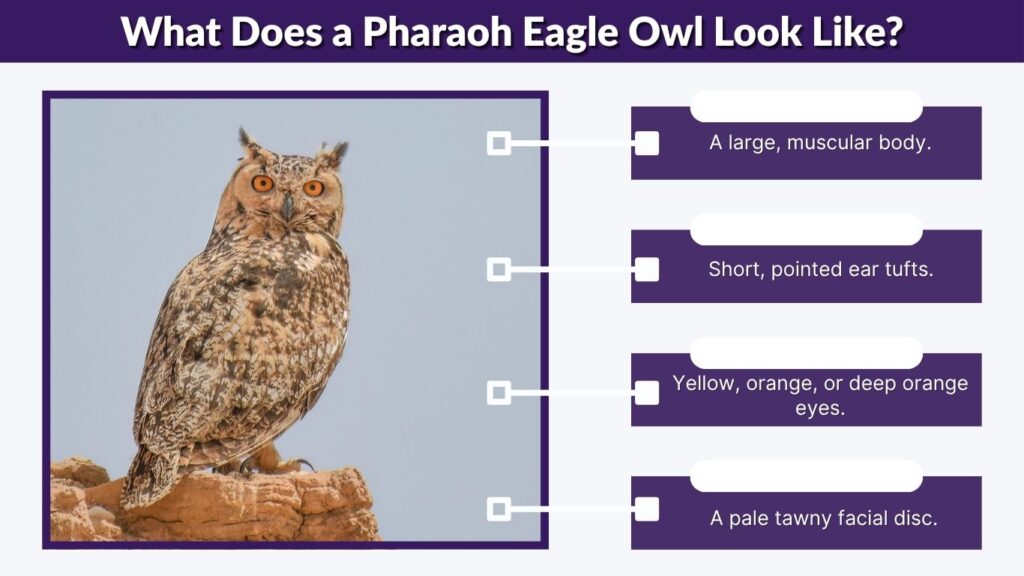
The Pharaoh eagle owl has pale, desert-colored plumage that helps it disappear against cliffs, sand, and exposed stone. Its upperparts are tawny or reddish-brown with dark streaks, bars, and pale spots. The underparts are lighter and marked with fine dark lines.
Identification
A Pharaoh eagle owl can be identified by:
- A large, muscular body
- Short, pointed ear tufts
- Yellow, orange, or deep orange eyes
- A pale tawny facial disc
- A dark, strongly curved bill
- Sandy-brown or reddish upperparts
- A white throat patch
- Dark streaks across the upper breast
- Fully or mostly feathered legs and toes
- Broad wings and strong blackish talons
Its facial disc is not as bold or sharply outlined as that of many woodland owls. The pale body and finely patterned feathers are particularly suited to desert and semi-desert terrain.
Pharaoh Eagle Owl Size
Adult Pharaoh eagle owls measure approximately 45–50 centimeters, or 18–20 inches, from the bill to the end of the tail. Reported weights are around 1.9–2.3 kilograms, equivalent to roughly 4.2–5.1 pounds. Females tend to be larger than males.
The wing of an adult may measure approximately 32–43 centimeters, while the tail can measure around 16–23 centimeters. A standard species-wide wingspan is not consistently published, but the bird’s broad wings make it look especially imposing when it takes off from a cliff or desert perch.
Although substantial, it is generally smaller than the Eurasian eagle owl. The Pharaoh eagle owl also tends to appear paler and more lightly built, reflecting its life in hot, dry regions.
Where Do Pharaoh Eagle Owls Live?
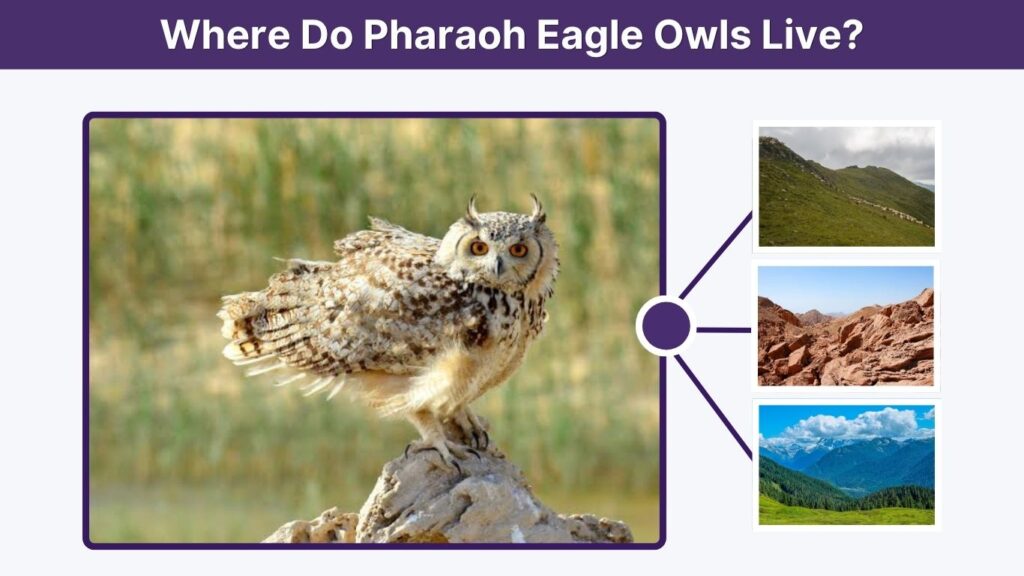
Pharaoh eagle owls are resident across northern Africa and the Arabian Peninsula. Their range extends from countries such as Morocco, Algeria, Tunisia, Libya, Egypt, Mauritania, Mali, Niger, Chad, and Sudan eastward through parts of the Middle East to Oman.
Preferred Habitat
They occupy dry landscapes containing:
- Rocky deserts
- Semi-deserts
- Mountain slopes
- Canyons and gorges
- Cliffs and rocky outcrops
- Oasis edges
- Dry savannas
- Desert wadis
- Areas with scattered shrubs or trees
Rock formations are particularly important because they provide elevated hunting perches, protected daytime roosts, and safe nesting crevices. The owls may also occur near farms and settlements when suitable prey and quiet roosting locations are available.
Pharaoh Eagle Owls in Saudi Arabia and the UAE
The species occurs naturally in Saudi Arabia and the United Arab Emirates. In Abu Dhabi, it is monitored through long-term bird-monitoring programs. Local birds may nest on cliffs or occasionally reuse old raven nests in trees.
They should not be confused with captive eagle owls used in falconry demonstrations or displayed at wildlife facilities in Dubai and other cities.
What Does the Pharaoh Eagle Owl Eat?
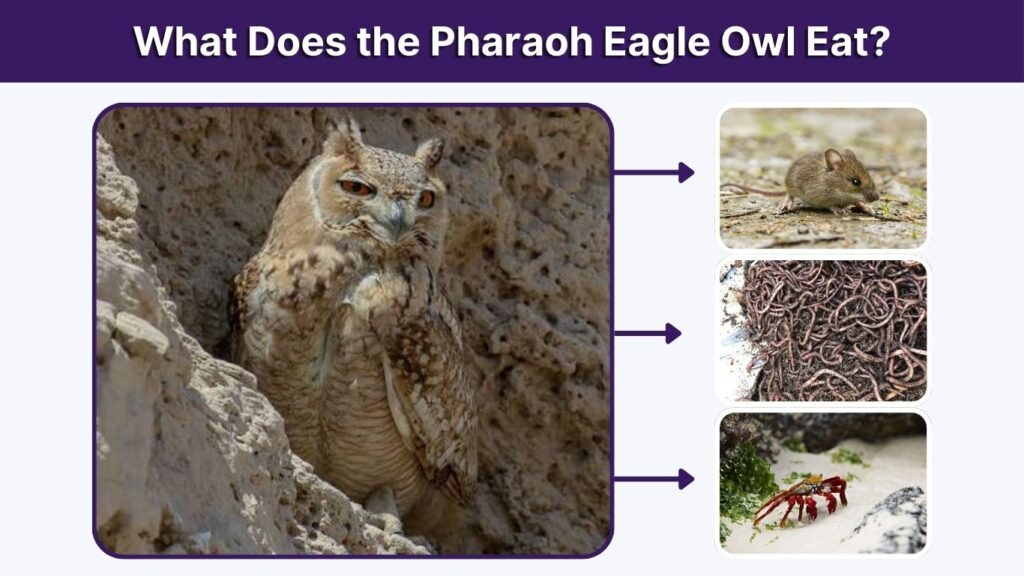
The Pharaoh eagle owl is a carnivore and a highly adaptable predator. Rodents form an important part of its diet, but it captures a broad range of animals depending on habitat and availability.
Its prey can include:
- Mice, rats, gerbils, and jirds
- Hares
- Hedgehogs
- Bats
- Small foxes
- Lizards
- Snakes
- Small and medium-sized birds
- Scorpions
- Beetles and other large insects
Research from Algeria found that mammals, particularly rodents, dominated the prey remains examined in owl pellets. Studies from Saudi Arabia have also investigated how its diet changes between agricultural and natural environments.
Hunting Behavior
The Pharaoh eagle owl normally becomes active after sunset. During daylight, it rests between rocks, inside cliff crevices, near cave entrances, or occasionally in trees. An owl sitting at the entrance of a nest or roost during the day is not necessarily hunting.
How It Hunts
The owl often watches from a rock, branch, post, or cliff ledge before flying down to capture prey. Its hunting success depends on several adaptations:
- Large eyes gather light in dark conditions.
- Sensitive hearing helps locate moving animals.
- Broad wings allow controlled flight over uneven terrain.
- Specialized feather edges reduce flight noise.
- Powerful feet and curved talons restrain prey.
- Sandy plumage provides camouflage at daytime roosts.
Its silent approach allows it to surprise rodents, reptiles, and birds before they can escape.
Pharaoh Eagle Owl Call and Sound
The male’s main song is a short, deep, descending “buo” or “boo.” The female produces a similar but usually higher-pitched call. Compared with the much larger Eurasian eagle owl, the Pharaoh eagle owl’s voice sounds higher.
During courtship, pairs may produce a three-part phrase that sounds approximately like “hu-hu-hoooh.” The first note is emphasized, and the pair may call back and forth in a duet. These calls help mates communicate and advertise an occupied territory.
Breeding and Baby Pharaoh Eagle Owls
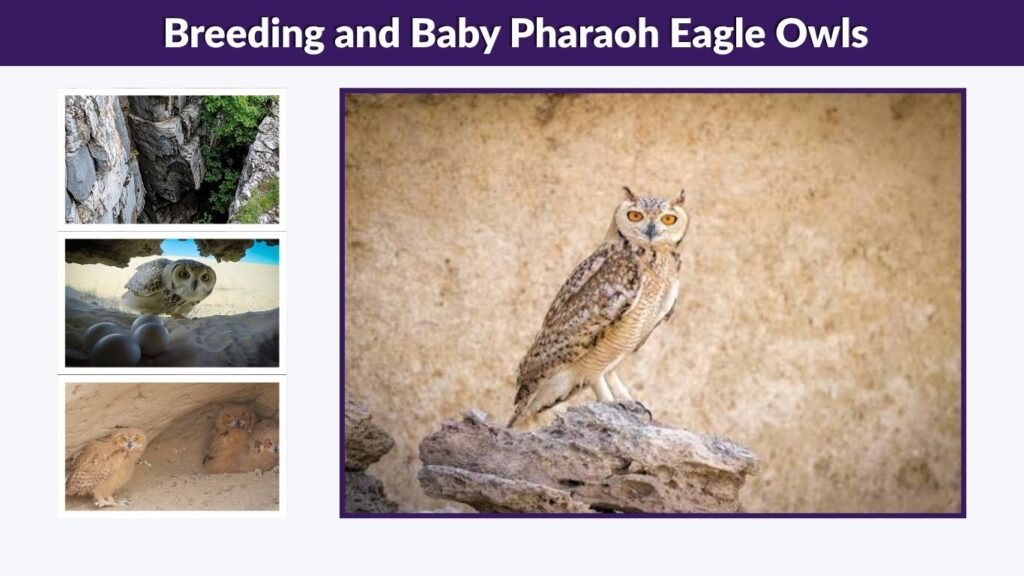
Pairs are generally monogamous and may retain the same territory for several years. Rather than constructing a complex nest, they commonly create a shallow scrape in a protected location.
Nesting Sites
Nests may be placed:
- Among rocks
- Inside a cliff crevice
- At a cave entrance
- In a sheltered ground depression
- Inside an old well
- In a tree cavity
- In an abandoned nest built by a raven or another large bird
The female normally lays two to four white eggs, although two is common. Each egg measures approximately 55–62 millimeters long and 45–50 millimeters wide.
Development of the Chicks
The eggs are laid several days apart, and the female incubates them for around 31–36 days. The male brings food while she remains at the nest.
Newly hatched babies are covered in pale down and depend entirely on their parents. Young owls may leave the immediate nest site at 20–35 days, but they cannot yet live independently. They become fully feathered for flight at approximately 52 days and may continue receiving food and guidance from their parents for several months.
Lifespan and Predators
A reliable species-wide lifespan for wild Pharaoh eagle owls has not been firmly established. Survival varies with food supply, nesting success, habitat quality, persecution, disease, collisions, poisoning, and other local conditions.
Healthy adults have few regular natural predators because of their strength, nocturnal behavior, and protected nesting sites. However, eggs and young chicks may be vulnerable to large snakes, carnivorous mammals, and other birds of prey. Competition or conflict with larger raptors can also occur.
Conservation Status
The Pharaoh eagle owl is currently classified as Least Concern, meaning it is not considered globally threatened. Its wide distribution across North Africa and the Arabian Peninsula contributes to that classification.
However, regional populations may still face:
- Deliberate hunting or persecution
- Poisoning intended for other predators
- Loss of cliffs and nesting locations
- Disturbance near breeding sites
- Electrocution or collision with infrastructure
- Reduction of natural prey populations
- Illegal capture and wildlife trade
Abu Dhabi’s Environment Agency identifies hunting, habitat destruction, and poisoning as important threats. Owls offered for sale may also be subject to wildlife laws, permit requirements, and international trade restrictions, so they should never be purchased from unverified sellers.
FAQs
Is the Pharaoh eagle owl the same as the Eurasian eagle owl?
No. They are closely related but generally recognized as separate species. The Pharaoh eagle owl is smaller, paler, and associated mainly with North African and Middle Eastern deserts. The Eurasian eagle owl is larger and occupies a much broader range of habitats across Europe and Asia.
Is the Pharaoh eagle owl a carnivore or an omnivore?
It is a carnivore. It eats rodents, hares, hedgehogs, bats, birds, reptiles, scorpions, and large insects. Although its prey varies by location, it does not normally depend on fruit, seeds, or other plant foods.
Does the Pharaoh eagle owl live in the Sahara Desert?
Yes. It inhabits suitable rocky parts of the Sahara and neighboring semi-desert regions. It is more strongly associated with cliffs, mountains, gorges, rocky outcrops, and oasis edges than with open sand dunes lacking shelter and nesting sites.
What are the Pharaoh eagle owl’s main adaptations?
Its adaptations include sandy camouflage, large light-sensitive eyes, strong hearing, quiet flight feathers, powerful talons, and the ability to roost and nest in protected rock crevices. Together, these features help it survive and hunt in dry desert environments.
What does a Pharaoh eagle owl sound like?
The male gives a short, low, downward call resembling “buo” or “boo.” The female’s version is usually higher. Courting pairs may also exchange a longer three-note phrase and participate in vocal duets.