
The Little Owl is a small, compact owl known for its bright yellow eyes, rounded head, and bold personality. Despite its small size, this bird is an efficient hunter that feeds on insects, small mammals, reptiles, and other prey. Little Owls are commonly associated with open farmland, grasslands, orchards, and rural areas where hunting opportunities are plentiful. Their habit of perching openly during the daytime also makes them easier to spot than many other owl species. Understanding their appearance, habitat, diet, behavior, breeding habits, and lifespan provides a fascinating look at this adaptable bird.
What Is a Little Owl?
The Little Owl (Athene noctua) is a small owl belonging to the family Strigidae. Native to parts of Europe, Asia, and North Africa, it has also been introduced into some regions outside its original range. Unlike many strongly nocturnal owls, Little Owls can sometimes be seen hunting, resting, or watching their surroundings during daylight.
Little Owl Identification
Several physical features make Little Owls relatively easy to recognize:
- Scientific name: Athene noctua
- Body length: About 21–23 cm
- Wingspan: Approximately 54–58 cm
- Weight: Commonly around 140–220 grams
- Eyes: Large and bright yellow
- Head: Broad and rounded without ear tufts
- Plumage: Brown with cream or white spotting
- Underparts: Pale with darker brown streaks
- Legs: Relatively long compared with many small owls
Their stocky body and intense facial expression are particularly distinctive.
Male vs Female Little Owl
Male and female Little Owls look very similar. Females are generally slightly larger and heavier, but differences can be difficult to notice without direct comparison. Both sexes share the same brown-and-white plumage and yellow eyes.
Behavior can provide additional clues during breeding season. Males often defend territories and call more frequently, while females spend more time incubating eggs and caring for recently hatched chicks.
Little Owl Habitat and Distribution
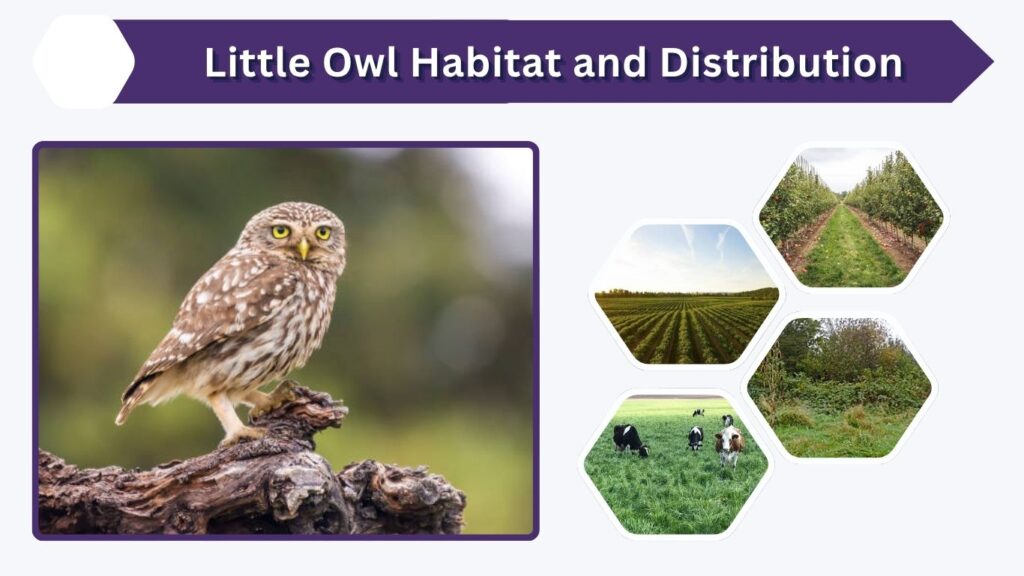
Little Owls favor open landscapes that provide both hunting grounds and secure places for nesting. They usually avoid dense forests because they depend heavily on low vegetation and exposed ground for locating prey. Their ability to live near farms, villages, and human structures has helped them adapt to many modified environments.
Where Do Little Owls Live?
Typical Little Owl habitats include:
- Agricultural fields
- Grazing pasture
- Orchards
- Open woodland edges
- Rocky countryside
- Semi-desert areas
- Rural villages
- Old farm buildings
- Grasslands with scattered trees
They commonly choose areas containing fence posts, trees, rocks, or buildings that provide elevated hunting perches.
Little Owl Nesting Sites
Little Owls do not usually build elaborate nests. Instead, they take advantage of existing cavities. Tree holes are commonly used, but old buildings, stone walls, cliffs, and abandoned structures can also provide suitable nesting locations.
In agricultural landscapes, cavities in mature orchard trees can be especially important. Nest boxes designed for small owls may also be accepted where natural cavities are limited.
Geographic Range
The natural distribution of the Little Owl extends through large portions of Europe, North Africa, the Middle East, and Central Asia.
Humans introduced the species into Britain during the nineteenth century. It subsequently established breeding populations in parts of England and Wales. Its adaptability to farmland and rural environments has allowed populations to persist well outside heavily wooded landscapes.
What Do Little Owls Eat?
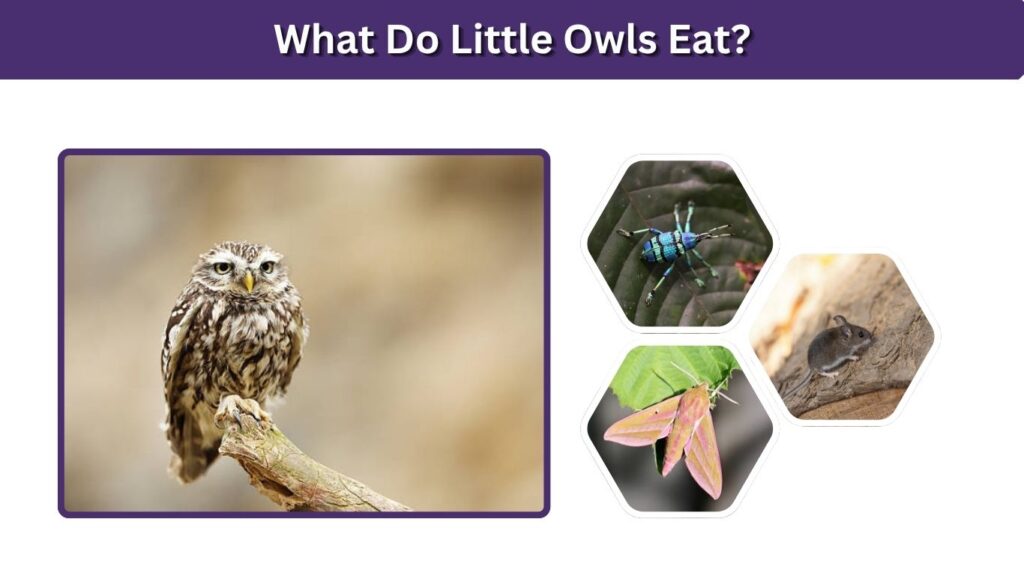
Little Owls are opportunistic predators with a varied diet. Their food choices depend heavily on what is available locally and seasonally. Although they are capable of catching vertebrate prey, insects and other invertebrates can form an important part of their diet, particularly during warmer months.
Main Foods of Little Owls
Their diet may include:
- Beetles
- Crickets
- Grasshoppers
- Earthworms
- Moths
- Spiders
- Mice
- Voles
- Shrews
- Small birds
- Lizards
- Frogs
This wide food range helps Little Owls survive in environments where the availability of individual prey species changes throughout the year.
How Little Owls Hunt
Little Owls frequently hunt from a perch. A bird may sit on a fence post, tree branch, rock, rooftop, or other elevated position while scanning the ground. Once prey is detected, the owl quickly flies down to capture it.
They may also hunt while walking or hopping across the ground, particularly when searching for insects and worms. Their large eyes and sensitive hearing help them detect prey in dim evening conditions.
When Do Little Owls Hunt?
Little Owls are most active around dusk and dawn, but they are not exclusively nocturnal. They may hunt during daylight, especially when feeding chicks or when prey is abundant.
This daytime activity is one reason people sometimes notice Little Owls sitting openly on posts, walls, or tree branches.
Little Owl Behavior and Communication
Despite being small, Little Owls can be confident and territorial. They spend considerable time watching their surroundings from prominent perches and may become very familiar with particular trees, posts, and buildings inside their territory. Their alert posture and frequent head movements help them monitor potential prey and threats.
Little Owl Calls
Little Owls use several different vocalizations. Their calls may include repeated whistles, sharp alarm notes, and softer communication sounds.
Males become particularly vocal when establishing territories and attracting mates. Calls are often heard around dusk or during the night, although vocal activity can also occur during daylight.
Territorial Behavior
Breeding pairs defend territories against other Little Owls. A male may call repeatedly from prominent perches to advertise ownership of an area.
Physical confrontations are usually avoided when vocal warnings are effective. Established pairs may continue using the same general territory for several breeding seasons when nesting sites and food remain suitable.
Daytime Behavior
During daylight, Little Owls often rest in sheltered locations while remaining alert. They may sit close to tree trunks, inside cavities, on rooftops, or among branches.
When disturbed, an owl may bob its body up and down while watching the source of danger. This characteristic movement is frequently associated with alert or defensive behavior.
Little Owl Breeding and Life Cycle
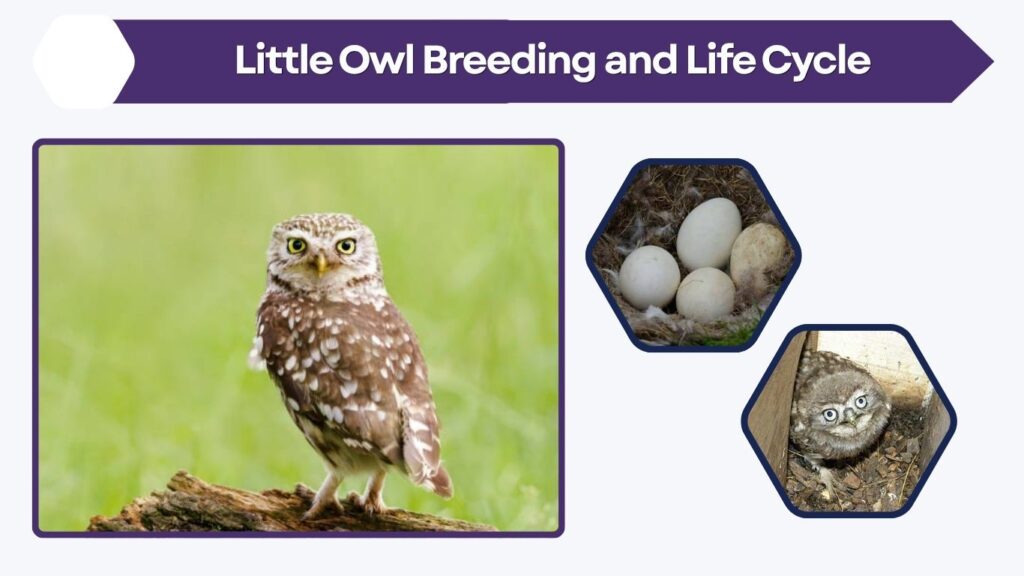
The breeding season becomes particularly active during spring. Established pairs locate a suitable cavity and prepare to raise their young. Because Little Owls depend on holes rather than constructing exposed nests, the availability of mature trees, old buildings, or artificial nest boxes can strongly influence breeding opportunities.
Eggs and Incubation
A typical clutch may contain approximately:
- 2–5 eggs
- White, rounded eggs
- Eggs laid over several days
- Incubation lasting around 27–30 days
The female performs most of the incubation while the male provides food. Clutch size can vary according to food supply and environmental conditions.
Little Owl Chicks
Newly hatched chicks are covered with soft down and depend entirely on their parents. Both adults eventually contribute food as the chicks grow.
Young owls remain in the nesting cavity for several weeks. After leaving the nest, they continue relying on their parents while developing stronger flight and hunting abilities.
Juvenile Development
Young Little Owls gradually explore areas surrounding the nest. At first, they may remain close to branches, walls, or nearby structures.
Their ability to fly and hunt improves over time. Eventually, juveniles disperse from their parents’ territory and establish areas of their own.
Little Owl Size, Lifespan, and Adaptations
Although Little Owls are relatively small birds of prey, they possess several adaptations that make them successful hunters. Strong feet, sharp talons, excellent eyesight, and sensitive hearing allow them to capture prey efficiently. Their compact size also enables them to use cavities and hunting locations unavailable to larger owl species.
How Big Is a Little Owl?
Adult Little Owls usually measure around 21–23 cm from head to tail. Their wingspan is considerably greater, reaching roughly 54–58 cm.
Their compact proportions make them appear stocky rather than slender. Females may be somewhat larger than males, although both sexes have a similar overall appearance.
How Long Do Little Owls Live?
Many wild Little Owls live for several years, although survival varies considerably. Young birds face especially high risks from predators, harsh weather, food shortages, vehicles, and other hazards.
Individuals that survive their early years may live considerably longer under favorable conditions.
Adaptations for Survival
Important Little Owl adaptations include:
- Excellent low-light vision
- Sensitive hearing
- Sharp curved talons
- Strong hooked bill
- Camouflaged brown plumage
- Ability to hunt both insects and vertebrates
- Use of natural and artificial nesting cavities
These adaptations allow the species to exploit a broad range of rural habitats.
Threats and Conservation of Little Owls
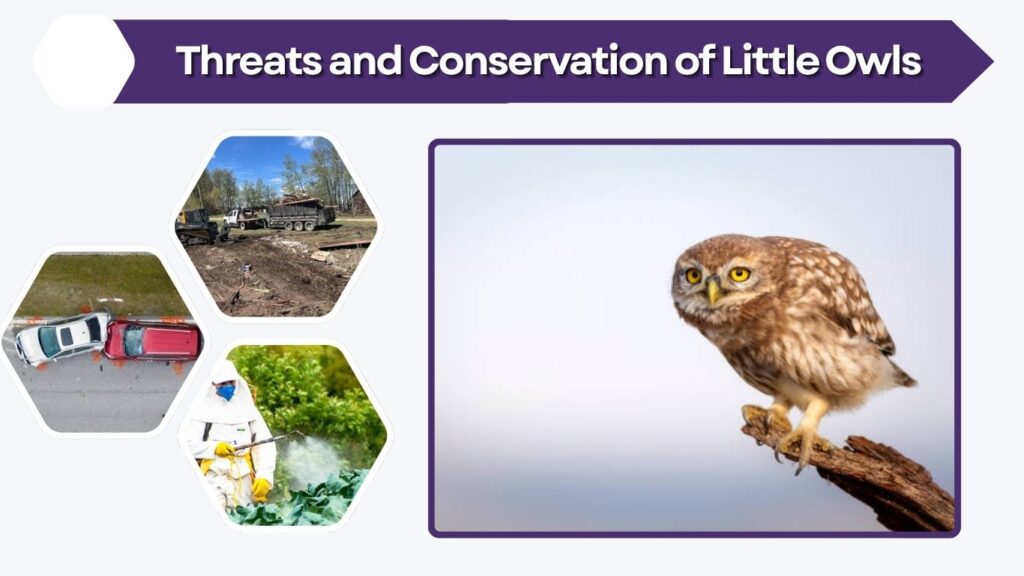
Little Owls remain widespread across much of their range, but local populations can decline when suitable habitats disappear. Changes in agricultural practices may reduce insects, small mammals, nesting trees, and other resources. Conservation therefore often focuses on preserving diverse farmland and maintaining safe nesting opportunities.
Major Threats
Little Owls may face several environmental pressures:
- Loss of mature nesting trees
- Removal of old farm buildings
- Declining insect populations
- Intensive pesticide use
- Road collisions
- Habitat simplification
- Predation
- Severe winter weather
Juvenile owls can be particularly vulnerable during the period shortly after leaving the nest.
How People Can Help Little Owls
Maintaining old trees, hedgerows, rough grassland, and insect-rich areas can improve Little Owl habitat. Farmers and landowners can also retain suitable cavities whenever doing so is safe.
Specially designed nest boxes can provide alternative breeding sites where natural cavities are scarce. Reducing unnecessary pesticide use may also support the insects and small animals on which these owls depend.
Interesting Facts About Little Owls
Little Owls have several characteristics that separate them from many familiar owl species. Their daytime activity, small body size, and willingness to live near agricultural areas have made them one of the more recognizable small owls in parts of their range.
Fascinating Little Owl Facts
- Little Owls often hunt during daylight.
- Their bright yellow eyes are highly noticeable.
- They frequently perch on fence posts and buildings.
- The species is strongly associated with the Greek goddess Athena.
- They may hunt insects directly from the ground.
- Little Owls use tree holes rather than constructing traditional nests.
- Their brown spotted feathers provide effective camouflage.
- Breeding pairs can remain within the same territory for several years.
FAQs
Are Little Owls nocturnal?
Little Owls are mainly active around dusk, dawn, and nighttime, but they can also be active during the day. Daylight hunting becomes particularly noticeable during the breeding season when adults need additional food for their chicks.
What does a Little Owl eat?
Little Owls eat insects, earthworms, spiders, small mammals, reptiles, amphibians, and occasionally small birds. Their diet changes depending on habitat, season, and local prey availability.
Where do Little Owls nest?
They usually nest inside cavities in trees, stone walls, cliffs, farm buildings, and similar structures. They may also use appropriately designed owl nest boxes.
Are Little Owls dangerous to humans?
Little Owls generally pose little danger to humans. Like other wild birds, however, they can defend themselves or their young if handled or approached too closely.
How can you identify a Little Owl?
Look for a small, stocky owl with a rounded head, bright yellow eyes, brown plumage covered with pale spots, and streaked underparts. Its habit of sitting openly on posts, walls, or trees during daylight can also help with identification.