
The Great Horned Owl (Bubo virginianus) is one of North America’s most powerful birds of prey, recognized by its prominent feather tufts, yellow eyes, and impressive wingspan. But how big is a Great Horned Owl’s wingspan? Adult birds typically measure 39.8–57.1 inches (101–145 cm) across their fully extended wings, equivalent to approximately 3.3–4.8 feet. This broad wingspan helps them fly quietly, navigate wooded areas, and hunt various animals at night. Understanding their wing measurements, male and female differences, and size compared to humans reveals how these remarkable predators are adapted for flight.
How Big Is a Great Horned Owl’s Wingspan?
The wingspan of a Great Horned Owl ranges from approximately 39.8 to 57.1 inches, depending on the bird’s size, sex, and geographical population. Wingspan is measured from the tip of one fully extended wing to the tip of the other. These large, rounded wings provide excellent maneuverability and help the owl hunt effectively in different environments.
Great Horned Owl Wingspan in Feet and Inches
An adult Great Horned Owl has a wingspan of approximately 3 feet 4 inches to 4 feet 9 inches. In metric measurements, this equals 101–145 centimeters. Its body length is considerably shorter, typically measuring 18–25 inches.
Great Horned Owl measurements:
- Wingspan: 39.8–57.1 inches (101–145 cm).
- Wingspan in feet: Approximately 3.3–4.8 feet.
- Body length: 18.1–24.8 inches (46–63 cm).
- Body weight: Approximately 2–5.5 pounds (0.9–2.5 kg).
- Scientific name: Bubo virginianus.
The wings can extend more than twice the owl’s body length, giving it a broad silhouette during flight.
Male vs. Female Great Horned Owl Wingspan
Female Great Horned Owls are generally larger and heavier than males. This size difference is called reverse sexual size dimorphism, a characteristic observed in many birds of prey.
Consequently, females tend to have longer wings and greater wingspans. However, individual measurements overlap, so wingspan alone cannot reliably determine an owl’s sex. Both males and females use similar flight techniques and hunting behaviors.
Great Horned Owl Wingspan Compared to Humans

A Great Horned Owl’s wingspan is impressive when compared with its relatively compact body. Although its extended wings may appear enormous in photographs, they are generally shorter than the outstretched arms of an average adult human. The comparison helps illustrate how much flying surface the owl has relative to its overall size.
Great Horned Owl vs. Human Arm Span
An adult human’s arm span is usually close to their height. Someone approximately 5 feet 8 inches tall may have an arm span near 68 inches, although individual proportions vary.
A large Great Horned Owl with a 57-inch wingspan would measure approximately 11 inches less across than that example human arm span. Despite this difference, the owl’s broad feathers make its wings appear particularly impressive when fully extended.
Great Horned Owl Compared to Other Birds
The Great Horned Owl is among the larger owl species in North America, although several other birds have comparable or greater wingspans.
| Bird species | Wingspan |
| Great Horned Owl | 39.8–57.1 inches |
| Barred Owl | 39.0–43.3 inches |
| Snowy Owl | 49.6–57.1 inches |
| Red-tailed Hawk | 44.9–52.4 inches |
These measurements show that Great Horned Owls have a broader wingspan range than Barred Owls. Their maximum wingspan is similar to that of Snowy Owls, while Red-tailed Hawks also have considerable wing overlap.
What Affects the Great Horned Owl’s Wingspan?
Several biological factors influence the wingspan of individual Great Horned Owls. Sex, age, inherited body proportions, and geographical variation can all affect wing measurements. However, adults of the same species generally have similar wing shapes, featuring broad surfaces and rounded tips designed for controlled flight.
Does Age Affect Great Horned Owl Wingspan?
Young Great Horned Owls hatch with small, developing wings covered in soft down. As they grow, their flight feathers gradually emerge, and their wings increase in length.
Juveniles begin leaving their nests and climbing nearby branches at approximately five to six weeks of age. They develop short-flight abilities afterward and generally become capable of stronger flight by around nine to ten weeks. Once fully grown, their wings approach adult dimensions.
Does Location Affect Their Wingspan?
Great Horned Owls inhabit an enormous geographical range extending from northern North America into South America. Populations can differ in overall body size, feather coloration, and physical proportions.
Birds from different regions may therefore show some variation in wing measurements. Nevertheless, individual size and sex remain important factors, and a location alone cannot reliably predict the exact wingspan of a particular owl.
How Does a Great Horned Owl Use Its Wings?

Great Horned Owls rely on their broad, rounded wings for quiet hunting and precise movements. Their flight adaptations help them approach unsuspecting prey, navigate between trees, and maintain control during short hunting flights. Unlike birds that primarily depend on extended soaring, these owls frequently use deliberate wingbeats and short glides.
Silent Flight and Feather Structure
Great Horned Owls possess specialized wing feathers that help reduce noise during flight. The leading edges of certain flight feathers have comb-like structures, while soft feather surfaces help dampen sound.
These adaptations make their flight quieter than that of many other birds. Combined with excellent hearing and low-light vision, their silent wingbeats allow them to approach rodents, rabbits, and other animals with less chance of detection.
Wingspan and Hunting Performance
A Great Horned Owl typically hunts by watching from an elevated perch before flying toward its prey. Its broad wings provide control during takeoff, descent, and sudden changes in direction.
Although capable of powerful flight, these owls usually do not need prolonged high-speed pursuits. Instead, they rely on stealth, accurate strikes, and strong talons to capture prey.
Their wing shape is particularly useful in forest edges, wooded neighborhoods, and other habitats containing obstacles.
Great Horned Owl Wingspan in Arizona
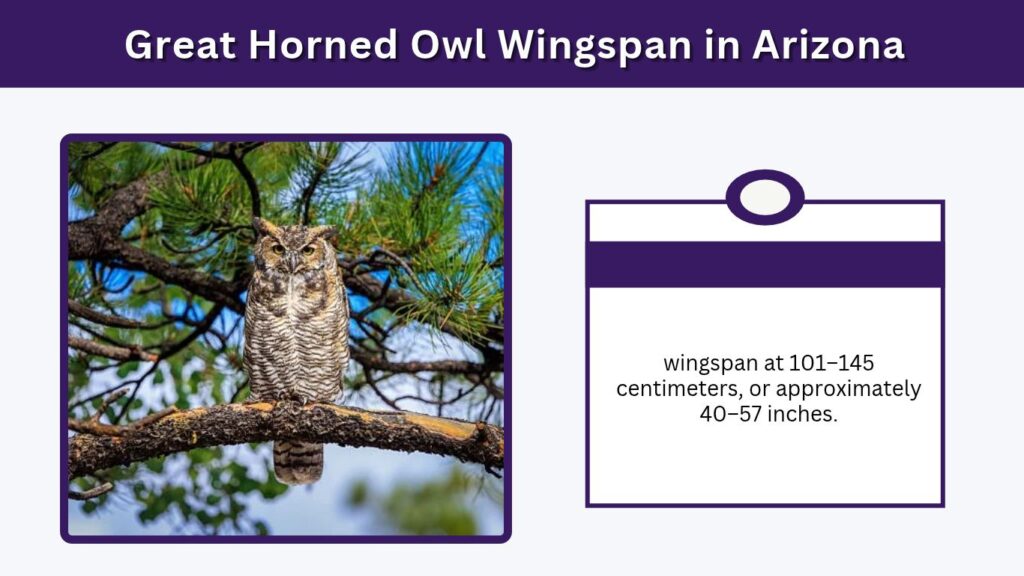
Great Horned Owls are widespread throughout Arizona, occupying desert environments, wooded areas, agricultural landscapes, and mountain forests. Their adaptability allows them to survive in both warm desert regions and cooler, elevated habitats. Arizona birds possess the same general broad-winged structure found throughout the species’ range.
Are Arizona Great Horned Owls Smaller?
Great Horned Owls found in Arizona may differ somewhat in body coloration and size from populations inhabiting other regions. However, there is no single wingspan measurement that applies to every Arizona bird.
The Arizona-Sonora Desert Museum lists the species’ wingspan at 101–145 centimeters, or approximately 40–57 inches. This falls within the standard range reported for Great Horned Owls across North America.
FAQs
1. What Is the Average Wingspan of a Great Horned Owl?
Great Horned Owls have a reported wingspan range of approximately 39.8–57.1 inches, or 3.3–4.8 feet. Their exact measurements depend on individual size, sex, and population. The midpoint of this range is around 48.5 inches, although that mathematical midpoint should not be confused with a scientifically measured population average.
2. Can a Great Horned Owl Have a 5-Foot Wingspan?
Most published measurements place Great Horned Owl wingspans below five feet, with standard references reporting a maximum of around 57 inches. Five feet equals 60 inches, slightly exceeding this commonly reported range. Exceptional individuals or different measurement methods may produce variations, but five feet is not typical.
3. What Is the Wingspan of a Juvenile Great Horned Owl?
A juvenile Great Horned Owl’s wingspan depends on its developmental stage. Newly hatched owlets have very small wings, but their flight feathers grow rapidly. By the time young owls develop sustained flight abilities, their wings are approaching adult proportions. No single wingspan measurement applies to every juvenile age.
4. Is a Great Horned Owl’s Wingspan Bigger Than a Hawk’s?
It depends on the hawk species. Great Horned Owls have wingspans of about 40–57 inches, while Red-tailed Hawks measure approximately 45–52 inches. Their ranges overlap considerably, meaning a large Great Horned Owl can have a greater wingspan than some hawks, but not necessarily every individual.
5. Why Do Great Horned Owls Have Such Large Wings?
Great Horned Owls have broad wings that help generate lift, maintain stability, and maneuver during hunting flights. Their specialized feathers also reduce flight noise, making it easier to approach prey undetected. These adaptations support successful nighttime hunting across forests, grasslands, deserts, and suburban environments.