
The fearful owl is a mysterious forest bird native to the Solomon Islands archipelago in the southwestern Pacific. Known for its large eyes, brown plumage, and haunting vocalizations, this uncommon owl lives primarily in tropical forests. Scientifically called Asio solomonensis, and formerly classified as Nesasio solomonensis, it is a powerful nocturnal predator that feeds on mammals and birds. Despite its unusual name, the fearful owl is not necessarily timid. Understanding its identification, habitat, behavior, diet, reproduction, and conservation challenges reveals why this elusive species deserves greater attention.
What Is a Fearful Owl?
The fearful owl is a medium-sized to large forest owl belonging to the family Strigidae. It occurs naturally on only a few islands in the Solomon Islands archipelago. Its secretive behavior and preference for densely forested environments make observations uncommon. Unlike familiar barn owls, this species has a rounded facial disc and heavily patterned plumage.
Fearful Owl Scientific Classification
- Common name: Fearful Owl
- Scientific name: Asio solomonensis
- Former classification: Nesasio solomonensis
- Family: Strigidae
- Order: Strigiformes
- Original description: Ernst Hartert, 1901
- Native region: Solomon Islands archipelago
Fearful Owl Identification
The fearful owl has distinctive facial markings, strong talons, and brown feathers that provide camouflage among forest branches. Its relatively large body and powerful appearance help distinguish it from smaller forest owls. However, identification can be challenging because several regional owl species share similar coloration, rounded heads, and nocturnal habits. Careful observation of facial patterns is particularly useful.
Physical Characteristics
- Body length: Approximately 38 cm (15 inches).
- Plumage: Predominantly mottled brown with darker streaks.
- Facial disc: Rounded and reddish-brown, bordered by lighter markings.
- Eyebrows: Distinctive pale or whitish markings above the eyes.
- Underparts: Ochre-brown with dark streaking.
- Talons: Strong, curved claws adapted for capturing prey.
Fearful Owl vs. Solomon Hawk-Owl
The Solomon hawk-owl is another forest-dwelling owl found in the region.
However, the fearful owl is generally larger and more robust, with different facial markings and proportions. Observing body shape, facial pattern, and vocalizations can help distinguish the species.
Fearful Owl Habitat and Distribution
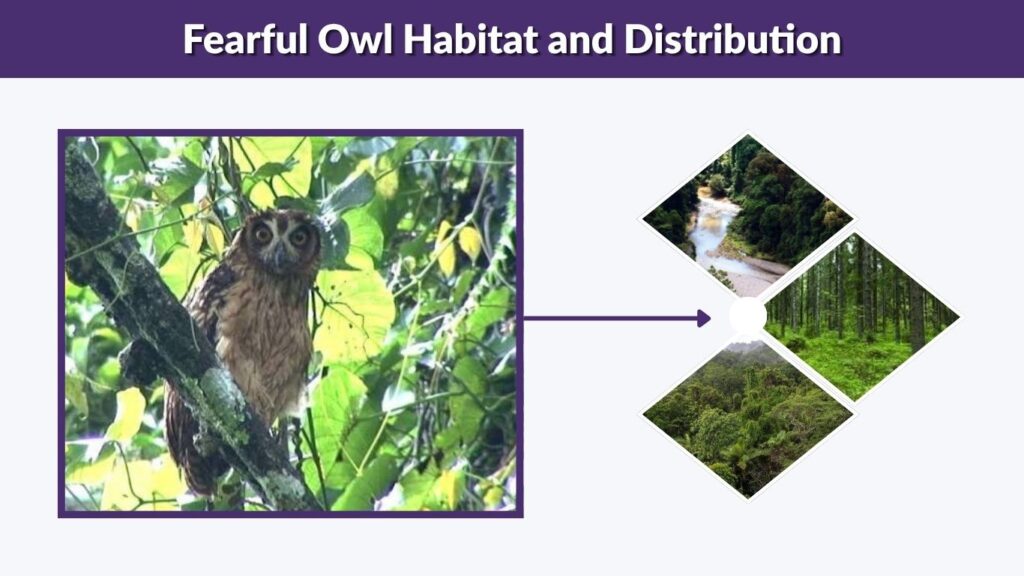
Fearful owls inhabit tropical forests with tall trees and suitable nesting locations. These environments provide sheltered roosting sites and opportunities to hunt mammals and birds. The species has a restricted geographical distribution, making forest protection particularly important. Although it is associated primarily with mature forests, some observations also come from secondary forest and nearby woodland edges.
Where Do Fearful Owls Live?
The fearful owl occurs on Bougainville in Papua New Guinea and on Choiseul and Santa Isabel in the Solomon Islands.
These islands contain tropical forest environments that support the bird’s feeding and nesting requirements. The species is largely resident rather than regularly migratory.
Preferred Forest Habitat
Fearful owls mainly occupy primary lowland and hill forests, although they can also use tall secondary woodland.
Large trees provide sheltered daytime roosts and potential nesting cavities. Forest edges may also be used where suitable vegetation and prey remain available.
Fearful Owl Behavior and Hunting Habits
Fearful owls are secretive predators that spend much of their time concealed within tropical vegetation. Their nocturnal habits make direct observation difficult, and relatively little is known about their daily activities. Like other forest owls, they rely on specialized hearing, vision, and strong talons to locate and capture prey, particularly during low-light conditions.
Nocturnal Activity
The fearful owl is primarily active at night, when it searches for food within forest habitats.
During daylight, it generally remains hidden among trees. Its mottled feathers help it blend into the surrounding vegetation, making it difficult for observers to locate.
Hunting Techniques
Fearful owls are believed to hunt mainly from elevated perches, watching and listening for prey.
Their strong feet and curved talons allow them to capture animals. The species is particularly notable for hunting relatively large vertebrate prey.
What Do Fearful Owls Eat?
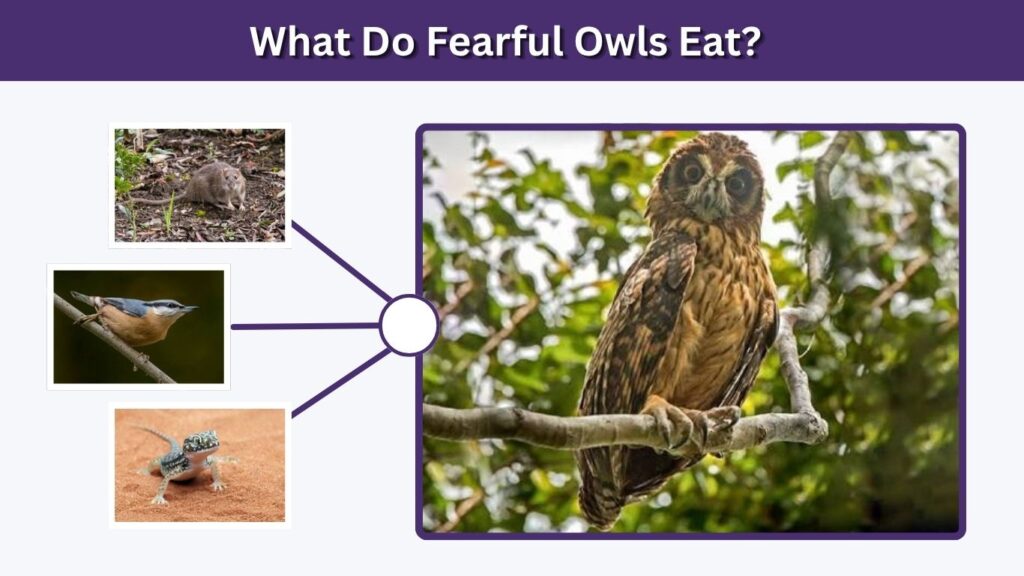
Fearful owls are carnivorous birds that feed mainly on vertebrate animals. Unlike smaller owl species that consume large quantities of insects, this owl is adapted to capturing comparatively substantial prey. Its powerful talons and forest-hunting behavior allow it to exploit food resources within the tropical ecosystem. However, detailed scientific studies of its complete diet remain limited.
Main Food Sources
- Cuscuses: Arboreal marsupials, including the northern common cuscus, are important recorded prey.
- Medium-sized birds: Forest birds can form part of the diet.
- Other vertebrates: Additional small animals may be taken when available, although records are limited.
Role in the Forest Ecosystem
As a predator, the fearful owl participates in the tropical forest food web.
Its dependence on native prey illustrates the connection between owl conservation and maintaining healthy forest ecosystems.
Fearful Owl Sound and Call
The fearful owl is known for its unusual, sometimes eerie vocalizations. Its calls are particularly important because the bird is difficult to observe in dense tropical forests. Bird researchers may use vocal activity to detect its presence and study its distribution. However, calling frequency and behavior are not yet documented as thoroughly as those of many widespread owl species.
What Does a Fearful Owl Sound Like?
The fearful owl produces a distinctive, drawn-out call that has sometimes been compared to a human scream.
Reports describe a note that rises in pitch and intensity. Repeated calls may carry through the surrounding forest, helping observers recognize the species.
Why Do Fearful Owls Call?
Like other owls, fearful owls likely use vocalizations for communication between individuals and during territorial or reproductive interactions.
However, the functions of their different calls remain incompletely studied.
Fearful Owl Breeding and Life Cycle
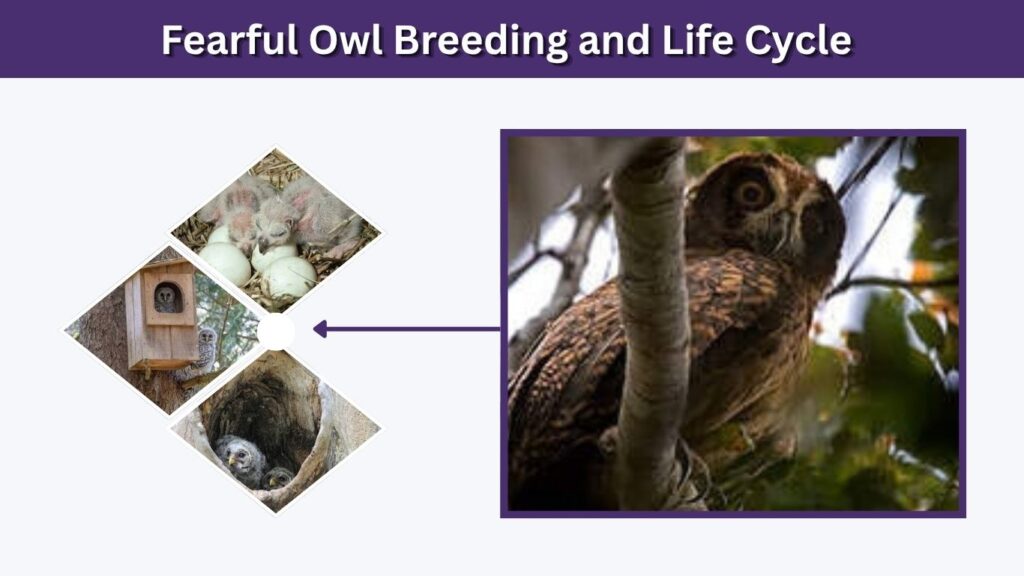
The reproductive behavior of fearful owls remains poorly understood because their nesting sites are difficult to locate. Available observations indicate that they use sheltered locations in large forest trees. Like other owls, they reproduce by laying eggs and caring for dependent young. Their breeding schedule, clutch size, and reproductive success require further scientific investigation.
Nesting Locations
Fearful owl nests have been reported in tree cavities, cracks in large branches, and locations among epiphytic plants.
Large fig trees and other mature forest trees can provide important nesting opportunities. Protecting these trees helps preserve potential breeding habitat.
Eggs, Chicks, and Lifespan
Young fearful owls depend on parental care before becoming independent.
However, reliable species-specific information about incubation periods, clutch sizes, and average lifespan remains limited. Figures reported for other owls should not automatically be applied to this species.
Fearful Owl Conservation Status
The fearful owl has attracted conservation concern because of its restricted distribution and dependence on tropical forest habitats. Habitat loss, forest degradation, and changes in prey availability may threaten its populations. Historical assessments classified the species as Vulnerable, while the 2023 IUCN assessment classified it as Near Threatened. Continued research is important for understanding population trends.
Major Threats to Fearful Owls
- Deforestation: Logging can remove essential nesting and roosting trees.
- Habitat fragmentation: Forest clearing can separate suitable living areas.
- Prey reduction: Hunting pressure on native mammals may reduce available food.
- Limited distribution: The species occurs naturally on only a small number of islands.
- Research gaps: Limited monitoring makes population trends difficult to assess.
Conservation Efforts
Protecting mature tropical forests is an important step toward maintaining suitable fearful owl habitat.
Conservation research, responsible forest management, and monitoring of native prey populations can improve understanding of the species and help guide future protection efforts.
FAQs
1. What Is a Fearful Owl?
The fearful owl (Asio solomonensis, formerly Nesasio solomonensis) is a nocturnal forest owl native to the Solomon Islands archipelago.
2. Where Are Fearful Owls Found?
They occur on Bougainville, Choiseul, and Santa Isabel, where they inhabit tropical forests.
3. What Do Fearful Owls Eat?
Fearful owls prey on mammals, particularly cuscuses, and medium-sized birds. Their full diet is not extensively documented.
4. Why Is It Called the Fearful Owl?
The common name does not establish that the bird experiences unusual fear. Its eerie calls and mysterious appearance may contribute to that impression, but the exact naming origin is uncertain.
5. Is the Fearful Owl Endangered?
The species has experienced conservation concern because of forest loss and its restricted distribution. The 2023 IUCN assessment classified it as Near Threatened, rather than Endangered.