
The Eurasian scops owl (Otus scops) is one of Europe’s smallest owls, recognized by its yellow eyes, small ear tufts, and remarkable bark-like camouflage. This nocturnal species inhabits open woodlands, orchards, farmland, parks, and Mediterranean landscapes across Europe, western Asia, and parts of North Africa. Many populations migrate to sub-Saharan Africa for winter. Despite its tiny size, the Eurasian scops owl is an effective nighttime hunter that feeds mainly on insects, along with occasional small vertebrates.
Eurasian Scops Owl Facts and Identification
The Eurasian scops owl, sometimes called the common scops owl, belongs to the typical owl family Strigidae. Its scientific name is Otus scops. Although small, its intricate plumage provides extraordinary camouflage against tree bark. During daylight, an owl sitting motionless beside a trunk can be surprisingly difficult to notice even at relatively close range.
Quick Eurasian Scops Owl Facts
- Scientific name: Otus scops
- Family: Strigidae
- Length: Approximately 16–20 cm
- Weight: Around 60–135 g
- Wing length: Approximately 145–168 mm
- Eyes: Bright yellow
- Diet: Mainly insects, plus occasional small vertebrates
- Activity: Nocturnal
- Typical habitat: Semi-open woodland and landscapes with scattered trees
- Conservation status: Least Concern
- Maximum reported age: About 12.5 years in some longevity records
What Does a Eurasian Scopus Owl Look Like?
This owl has a compact body with gray-brown plumage covered in blackish streaks, fine cross-bars, and intricate markings. The pattern resembles rough tree bark and provides excellent daytime camouflage. A much rarer reddish color form also occurs.
Its facial disc is not strongly defined, while the bright yellow eyes are particularly noticeable when the bird is alert. Small erectile ear tufts may be obvious when raised but almost disappear when relaxed.
When threatened, a Eurasian scops owl may stretch its body vertically, raise its ear tufts, and remain almost motionless, making its outline resemble a broken branch.
Eurasian Scops Owl Size and Physical Adaptations
Despite being a true owl and an efficient predator, the Eurasian scops owl is remarkably small. Its lightweight body is well suited to catching insects in flight or dropping quickly from a perch. Long wings relative to its compact body are also useful for populations that migrate considerable distances between European and Asian breeding areas and African wintering grounds.
How Big Is a Eurasian Scopus Owl?
An adult is typically around 16–20 cm long and weighs approximately 60–135 grams. Females tend to be heavier than males. Individual wing length is roughly 145–168 mm. Some secondary references report an overall wingspan in roughly the 42–64 cm range, but published figures vary depending on measurement source.
Its small size helps distinguish it from much larger owls such as the Eurasian eagle owl. However, identifying scops owls visually can still be challenging because several closely related species have similar plumage.
Adaptations for a Nocturnal Life
Several characteristics help this tiny owl hunt and remain hidden:
- Bark-patterned plumage provides daytime camouflage.
- Large yellow eyes help it function under low-light conditions.
- Powerful feet and talons secure larger prey.
- Small ear tufts help break up its outline while roosting.
- Nocturnal activity helps it encounter night-flying insects.
- Relatively long wings support both hunting and seasonal migration.
Eurasian Scops Owl Habitat and Range
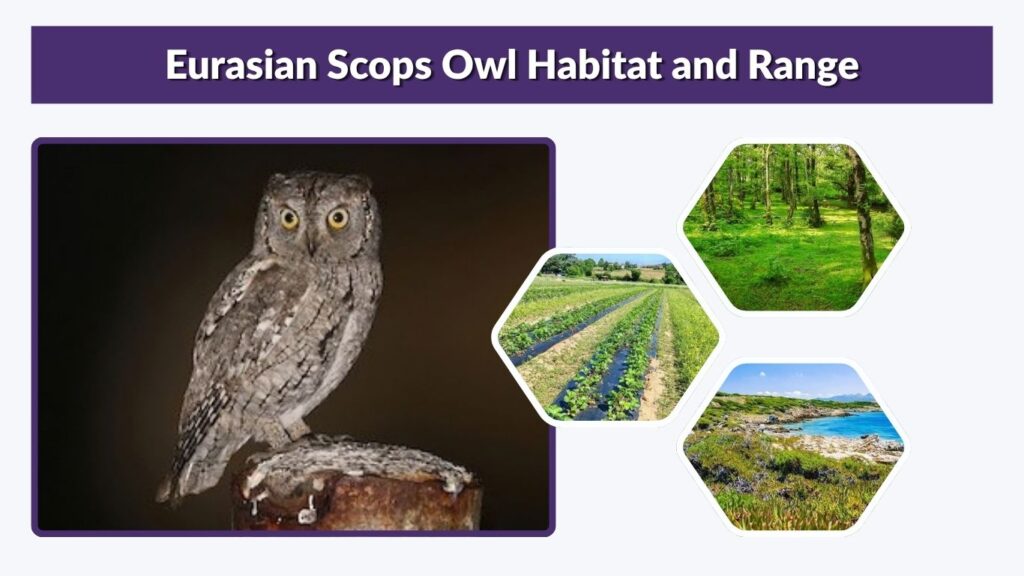
The Eurasian scops owl habitat differs from the dense forests people often associate with owls. It generally prefers open or semi-open environments containing mature trees. Trees provide nesting cavities and daytime shelter, while nearby open ground supplies hunting opportunities. Gardens, orchards and cultivated landscapes may therefore support the species when suitable old trees and abundant insect prey remain available.
Where Do Eurasian Scops Owls Live?
Typical environments include:
- Open and semi-open woodland
- Orchards and cultivated farmland
- Mediterranean scrub and garrigue
- Parks and large gardens
- Rocky landscapes with scattered trees
- Tree-lined roads
- Wooded areas near villages
- Mountainous habitats in warmer regions
The breeding range stretches through southern Europe, parts of central and eastern Europe, North Africa, Asia Minor and eastward into Central Asia.
Eurasian Scops Owl Migration and Winter Range
Many Eurasian scopus owls are migratory. European populations generally leave breeding areas between late summer and autumn, with many wintering in wooded savannas of sub-Saharan Africa. They typically return between March and late April, although timing varies geographically.
Some populations in warmer Mediterranean areas may be resident or make shorter seasonal movements. Migration explains why the species can suddenly become noticeable again in European habitats during spring, especially once males begin calling.
Eurasian Scops Owl Diet and Hunting
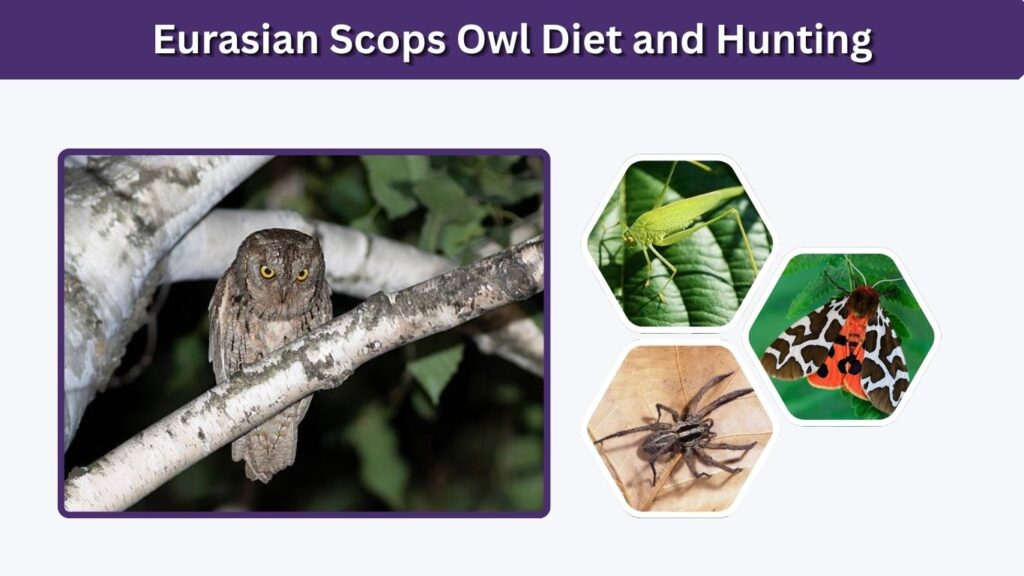
The Eurasian scops owl diet is unusual compared with that of many larger European owls because insects form much of its food. The owl usually begins hunting after sunset and can remain active until around midnight. It commonly watches from a perch before swooping down or flying after prey, taking advantage of insects active during warm evenings.
What Does a Eurasian Scops Owl Eat?
Common prey includes:
- Grasshoppers
- Beetles
- Moths
- Cicadas
- Caterpillars
- Spiders
- Earthworms
- Small rodents
- Small birds
- Lizards and other small reptiles
- Frogs
The owl may even hunt around artificial lights because moths and other insects gather there.
How Does It Hunt?
Small prey can be picked up using the bill, while larger animals are usually caught with the talons. The owl often hunts from a low perch, watching for movement before dropping toward its target.
Its reliance on insects means productive grasslands, orchards and open woodland can be particularly valuable feeding areas.
Eurasian Scops Owl Call and Sound
For many birdwatchers, the Eurasian scops owl call is easier to detect than the bird itself. Its tiny body and excellent camouflage make visual sightings difficult, but males repeatedly vocalize during the breeding season. On calm spring and summer nights, this repetitive sound can travel through orchards, villages and open woodland for considerable distances.
What Does a Eurasian Scopus Owl Sound Like?
The male produces a simple, flute-like whistle often represented as “kyoot… kyoot… kyoot.” Individual notes usually last only a fraction of a second and are repeated every few seconds.
Females can produce a similar but higher-pitched call. During courtship, paired birds may duet, creating alternating higher and lower notes.
The species also produces a softer contact call and a sharper alarm call. Because the territorial song is repetitive and distinctive, sound is often one of the most effective ways to locate a Eurasian scops owl without disturbing its daytime roost.
Breeding, Nesting and Young Scops Owls
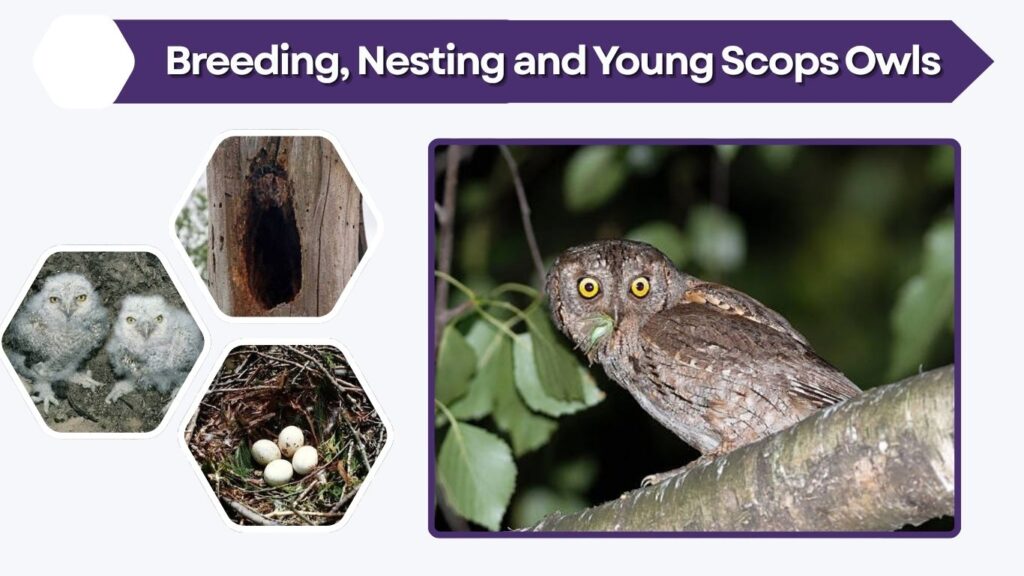
Breeding usually begins after migratory birds return from their African wintering areas. Males advertise territories through repeated calling and may sing near potential nest cavities. Eurasian scops owls normally raise one brood each year and rely heavily on existing holes rather than constructing conventional nests from twigs or other materials.
Eurasian Scops Owl Breeding Facts
- Nests are often placed in natural tree cavities.
- Old woodpecker holes may be used.
- Holes in walls, rocks and buildings can also provide nests.
- Nest boxes are readily accepted in some areas.
- The usual clutch contains about 3–4 eggs, though 2–6 are possible.
- The female performs most incubation.
- The male supplies food while the female incubates.
- Incubation lasts approximately 20–31 days.
- Young leaves the nest after about 3–4 weeks.
- Both parents continue feeding juveniles for several more weeks.
Lifespan and Conservation Status
The Eurasian scops owl is classified as Least Concern globally, meaning it is not currently considered a globally threatened species. BirdLife’s 2021 European assessment likewise classified Otus scops as Least Concern and estimated a stable European trend at that time. However, conservation conditions can differ regionally, and populations near the edge of the species’ range may be relatively scarce.
How Long Does a Eurasian Scopus Owl Live?
Longevity figures depend on how they are measured. The Owl Pages reports a maximum recorded age of approximately 12.5 years, while Animal Diversity Web cites a wild longevity record of about 6 years and 8 months from one study and survival beyond 12 years in captivity. These figures should be understood as longevity records rather than a typical life expectancy for every wild owl.
Potential pressures include removal of old cavity-bearing trees, habitat alteration and reductions in large insect prey. Maintaining mature trees and insect-rich semi-open habitats can therefore benefit local breeding populations.
FAQs
The Eurasian scops owl often attracts attention because of its tiny size, repetitive nighttime whistle and seasonal movements. It can also be confused with other Otus species, particularly where their geographic ranges approach one another. These answers address common searches concerning its size, diet, migration, conservation status and vocalizations.
1. Is the Eurasian scops owl endangered?
No. Otus scops is currently classified as Least Concern globally, although the status and abundance of individual regional populations can differ.
2. What does a Eurasian scopus owl eat?
It primarily eats insects such as grasshoppers, moths, beetles and cicadas. It can also capture spiders, earthworms, frogs, reptiles, small mammals and small birds.
3. How big is a Eurasian scops owl?
Adults are generally about 16–20 cm long and weigh approximately 60–135 grams, making the species one of Europe’s smallest owls.
4. What does the Eurasian scops owl call sound like?
Its best-known song is a repeated, flute-like whistle sounding roughly like “kyoot”, usually separated by intervals of two or three seconds.
5. Where do the Eurasian scops owls live?
It breeds across southern Europe and parts of central and eastern Europe, North Africa, Asia Minor and Central Asia. Many European birds migrate to sub-Saharan Africa for winter.