A full-grown barred owl measures approximately 17–20 inches long, with a 39–43-inch wingspan and a weight of roughly 1–2.3 pounds. Its broad wings, rounded head, and thick plumage can make it look heavier than it actually is.
Barred owls are substantial woodland birds, but they are generally smaller and lighter than great horned owls. Understanding length, wingspan, and body shape together makes identification much easier than judging size alone.
How Big Is a Full-Grown Barred Owl?
The Cornell Lab of Ornithology lists these adult measurements for both sexes combined:
| Measurement | Imperial | Metric |
| Body length | 16.9–19.7 inches | 43–50 centimeters |
| Wingspan | 39.0–43.3 inches | 99–110 centimeters |
| Weight | 16.6–37.0 ounces | 470–1,050 grams |
These figures describe a range, not a single average. Individual birds differ, and females tend to be larger than males.
Body length and wingspan also measure different things. Length refers to the bird from its head to the end of its tail; wingspan measures the distance between the tips of its extended wings.
A perched owl’s apparent height changes with posture, so it may not match its published body length.
Barred Owl Size in Feet
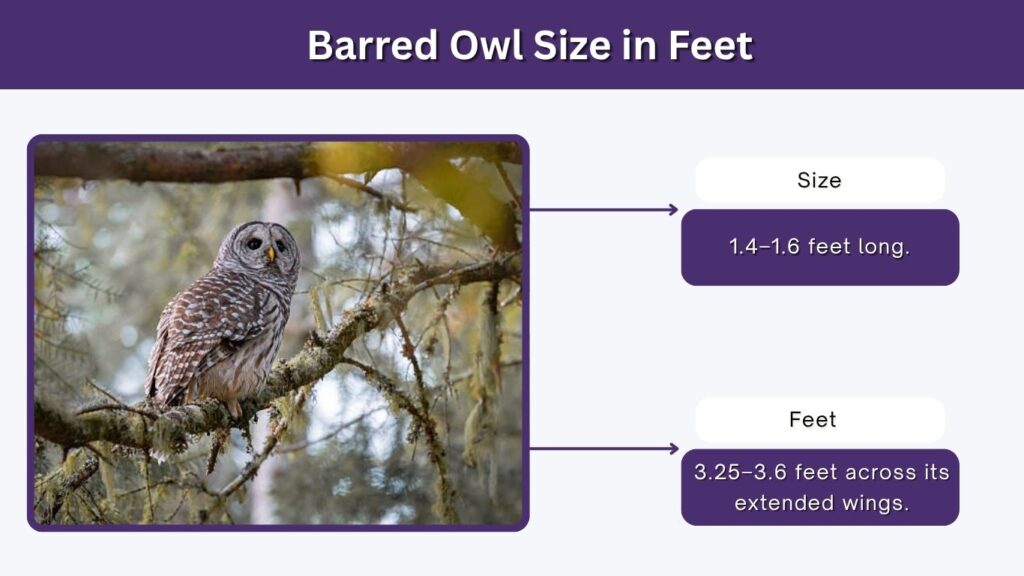
For an easier mental picture, a barred owl is approximately:
- 1.4–1.6 feet long
- 3.25–3.6 feet across its extended wings
That means its wingspan is a little longer than a yardstick, even though its body is well under two feet long.
This difference explains why a barred owl can look relatively compact on a branch and much larger when it opens its wings.
Barred Owl Size Comparison
The following rounded measurements show how barred owls compare with two similar woodland owls.
| Species | Body length | Wingspan | Weight |
| Barred owl | 17–20 inches | 39–43 inches | 1–2.3 pounds |
| Great horned owl | 18–25 inches | 40–57 inches | 2–5.5 pounds |
| Spotted owl | About 18.5–19 inches | About 40 inches | 1.1–1.5 pounds |
Measurements overlap, particularly in body length. The spotted owl figures above are Cornell’s published identification measurements, not absolute limits for every individual.
Barred Owl vs Great Horned Owl Size
Great horned owls are generally heavier and more powerfully built. Their wingspan can also be considerably greater, although smaller individuals overlap with barred owls.
For identification, combine size with other features:
- Barred owls have dark eyes and rounded heads without prominent ear tufts.
- Great horned owls have yellow eyes and conspicuous feather tufts.
- Barred owls show vertical streaking on the belly; great horned owls have a different barred pattern.
Do not assume every large-looking owl is a great horned owl. Posture, viewing distance, and fluffed feathers can distort impressions of size.
Barred Owl vs Spotted Owl Size
Barred and spotted owls can look similar in overall length. Both have dark eyes and rounded heads, making size alone especially unreliable.
The underside provides a better clue. Barred owls have horizontal bars across the upper chest and vertical streaks below. Spotted owls have conspicuous pale spots against darker underparts.
Female vs Male Barred Owl Size
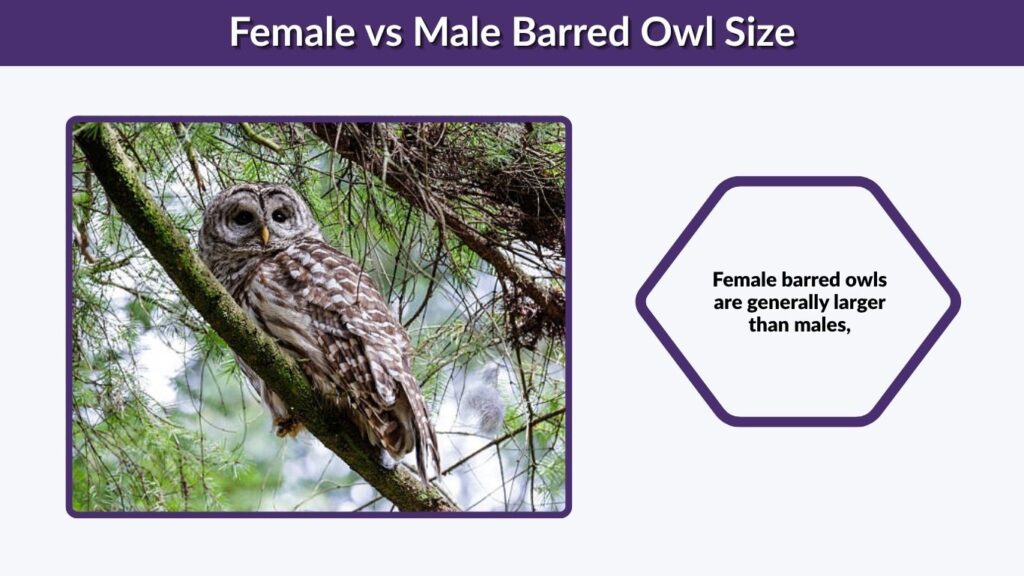
Female barred owls are generally larger than males, a pattern found in many birds of prey.
However, both sexes have similar plumage, and their measurements overlap. Seeing one owl without a reliable size reference usually does not reveal its sex.
Even a photograph of two birds can be misleading if one sits closer to the camera or has its feathers raised. Size is useful supporting evidence, not a dependable stand-alone method for sexing barred owls.
Juvenile Barred Owl Size
There is no single measurement for a juvenile barred owl because young birds grow rapidly.
Recently hatched chicks are small and covered in down. Older owlets become bulky and fluffy, but their appearance does not necessarily indicate adult body mass or mature flight ability.
Young barred owls commonly leave the nest before they can fly well. They climb and move among branches, with short flights beginning at approximately six weeks. Their flying skills continue developing afterward.
An owl outside its nest is therefore not automatically independent. Parents continue feeding their young for months after they leave the nest.
Barred Owl Egg Size and Clutch Size
Barred owl eggs measure approximately:
- Length: 1.7–2.2 inches, or 4.3–5.6 centimeters.
- Width: 1.5–1.8 inches, or 3.8–4.5 centimeters.
The eggs are white. Cornell lists a clutch range of one to five eggs, with incubation lasting approximately 28–33 days.
A group of eggs is called a clutch, not a litter. Egg dimensions and clutch size describe different aspects of nesting: one measures each egg, while the other counts them.
What Size Prey Can a Barred Owl Catch?
Barred owls eat a varied diet rather than targeting one fixed prey size. Small mammals are important, but they also take birds, amphibians, reptiles, and invertebrates.
Their diet includes animals such as mice, voles, squirrels, frogs, and crayfish. Availability and habitat influence what they catch.
An owl’s own weight should not be treated as a precise carrying-capacity measurement. Catching prey, eating it where it was caught, and carrying it through the air are different tasks.
Barred Owl Nest Box Size
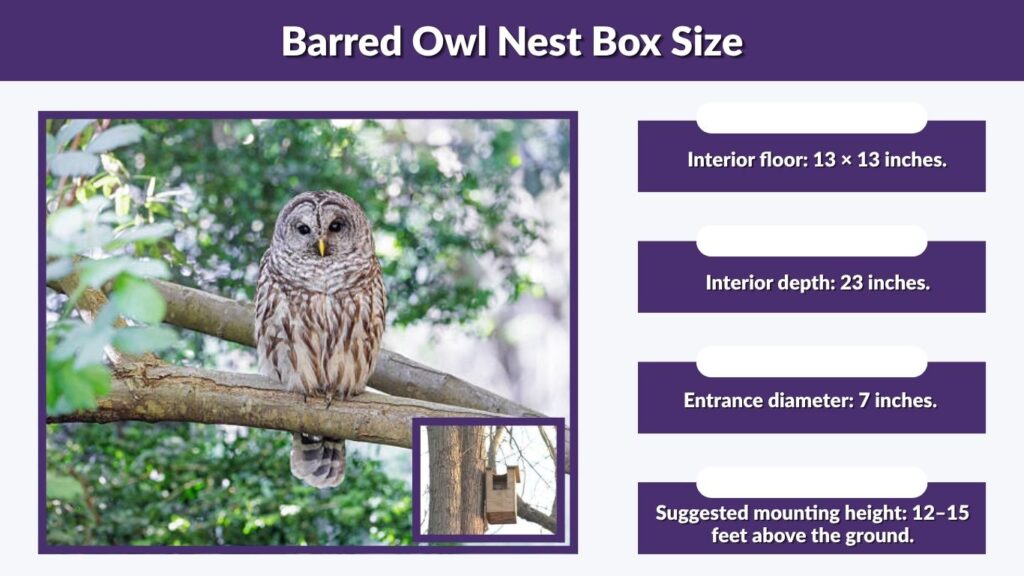
A barred owl needs a substantial nesting cavity. Cornell’s NestWatch gives these dimensions for a suitable nest box:
- Interior floor: 13 × 13 inches.
- Interior depth: 23 inches.
- Entrance diameter: 7 inches.
- Suggested mounting height: 12–15 feet above the ground.
Use a complete, established construction plan rather than relying on these measurements alone. Secure mounting, drainage, ventilation, and safe placement also matter.
Before installing a box, check with local wildlife specialists. In parts of western North America, encouraging barred owls can conflict with efforts to protect spotted owls, which face competition from the expanding barred owl population.
How Large Is a Barred Owl’s Territory?
Barred owl home ranges vary with habitat, food supply, location, and season.
One Michigan estimate cited by University of Florida Extension places the average annual home range at about one square mile, or 640 acres. This is a regional example, not a universal requirement.
A home range is the area an animal routinely uses; a territory is an area it defends. The terms are related but not interchangeable.
FAQs
1. Is a barred owl a large owl?
Yes. It is a large, broad-winged woodland owl, although generally lighter than a great horned owl.
2. Can a barred owl have a four-foot wingspan?
Cornell’s listed range is approximately 39–43 inches, below four feet. A rough field estimate should not be mistaken for an exact measurement.
3. Are female barred owls bigger than males?
Generally, yes. However, individual sizes overlap, and plumage alone does not reliably distinguish the sexes.
4. Why do barred owls look so heavy?
Their dense plumage, broad bodies, and rounded heads create a bulky outline. Fluffed feathers can exaggerate that appearance.
5. Can you identify a barred owl by size alone?
No. Combine size with dark eyes, a rounded head, chest barring, belly streaks, and other identification clues.