
A barred owl house provides a safe nesting space for these beautiful woodland birds. Barred owls naturally prefer large tree cavities, but they may also use properly designed wooden nesting boxes. Building a barred owl house requires the right dimensions, durable materials, and careful placement to attract nesting pairs. Whether you want free barred owl house plans, DIY building instructions, or advice on purchasing a ready-made nesting box, understanding their nesting requirements is essential. This guide explains everything you need to create a suitable barred owl house.
What Is a Barred Owl House?
A barred owl house is a large wooden nesting box designed for barred owls (Strix varia). Unlike ordinary birdhouses, these structures feature spacious interiors, wide entrance openings, and sturdy construction. They imitate the natural tree cavities barred owls use for breeding and raising their young.
Barred owls typically inhabit mature forests near streams, wetlands, and wooded residential areas. They prefer nesting in hollow trees but may accept artificial boxes when suitable natural cavities are limited.
A properly installed nesting house can provide an alternative breeding location. However, successful occupancy depends on local owl populations, surrounding habitat, and the availability of food.
Barred Owl House Dimensions and Size Requirements
Choosing the correct barred owl house dimensions is essential for creating a comfortable nesting environment. These owls are considerably larger than screech owls, requiring deeper cavities and wider entrance openings. An undersized house may discourage nesting, while poor construction can expose eggs and young owls to unfavorable weather.
Recommended Barred Owl House Dimensions
The following measurements follow Cornell Lab of Ornithology’s NestWatch recommendations.
| House Feature | Recommended Size |
| Interior floor | 13 × 13 inches |
| Interior depth | 23 inches |
| Entrance opening | 7 inches |
| Mounting height | 12–15 feet |
| Nesting material | 3–4 inches of wood chips |
| Spacing between boxes | Approximately 0.5 mile |
| Water proximity | Within 200 feet, if possible |
Some traditional barred owl house plans recommend mounting boxes 20–30 feet high. These differences reflect different nesting-box recommendations rather than a single mandatory height.
Important Design Features
A good barred owl house should provide protection against weather while allowing adult birds and owlets to move safely inside.
The entrance should be large enough for adult barred owls without creating unnecessary exposure. A sufficiently deep nesting chamber helps protect eggs and young birds from the elements.
The roof should extend beyond the entrance to reduce rainwater entering the box. Small drainage openings near the bottom help prevent moisture accumulation.
Use rough interior surfaces or securely attached climbing grooves below the entrance to help developing owlets reach the opening.
Barred Owl House Plans: Materials and Design
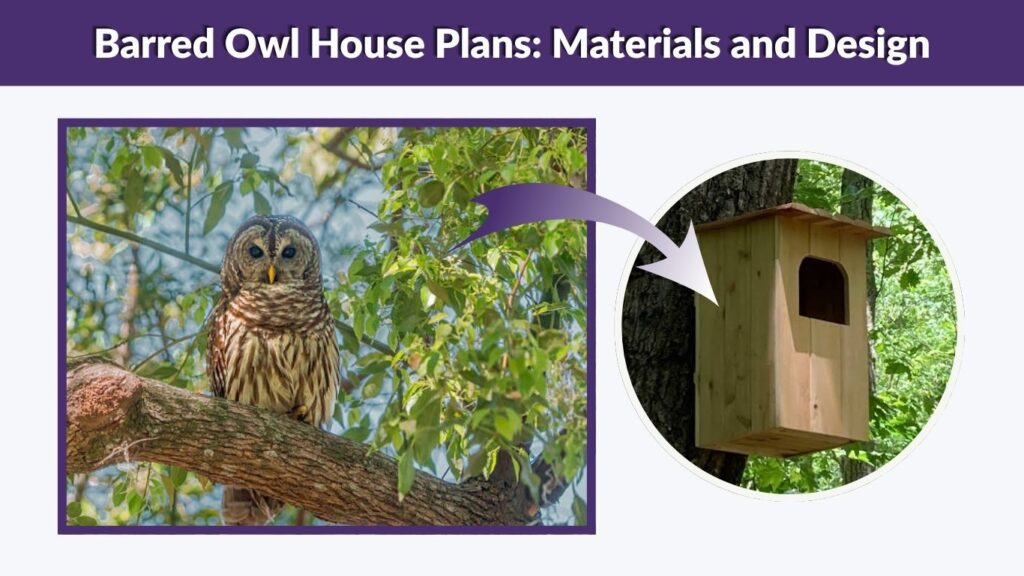
Building a barred owl bird house requires durable materials that can withstand outdoor conditions for several years. Since these nesting boxes are relatively large, their structural strength matters as much as their appearance.
A practical barred owl house design uses untreated wood, weather-resistant fasteners, and a simple rectangular structure. The house should blend naturally with its woodland surroundings.
Materials Needed
- Untreated exterior-grade plywood, approximately ¾ inch thick
- Exterior-grade screws
- Measuring tape and carpenter’s square
- Circular saw or handsaw
- Drill and appropriate drill bits
- Jigsaw for the entrance opening
- Sandpaper for sharp exterior edges
- Heavy-duty mounting brackets
- Untreated wood chips for nesting material
- Optional exterior-safe finish for outer surfaces only
Avoid pressure-treated wood, strong chemical preservatives, and paint on interior surfaces.
Basic Barred Owl House Design
A rectangular box with a large front entrance is a practical design. The interior should have enough space for an adult owl to incubate eggs and accommodate growing chicks.
The main structure consists of a bottom panel, four walls, and an overhanging roof. A removable or hinged access panel can make future maintenance easier, provided it closes securely.
Follow an established construction blueprint when cutting panels. Internal measurements must account for wood thickness, so the exterior panels will be larger than the finished interior dimensions.
How to Build a Barred Owl House: Step-by-Step
Building a DIY barred owl house is manageable with basic woodworking skills. However, precise measurements and secure assembly are important because the finished structure must support its weight while mounted above the ground.
Use an established barred owl nest box plan as your cutting reference before beginning construction.
Step 1: Measure and Cut the Wood
Measure each panel according to your selected barred owl house blueprint. Cut the front, back, sides, floor, and roof.
Ensure the finished nesting chamber provides approximately 13 × 13 inches of interior floor space and 23 inches of depth.
Step 2: Create the Entrance Opening
Cut an entrance approximately 7 inches across near the upper section of the front panel.
Smooth sharp edges without making every interior surface slippery. Position the entrance so the nest has sufficient depth below it.
Step 3: Assemble the Main Structure
Attach the side panels to the back panel using exterior-grade screws. Install the floor securely before attaching the front.
Check that all panels fit tightly without leaving large gaps that could admit rain.
Step 4: Install the Roof
Attach a slightly sloping, overhanging roof to reduce water accumulation. Allow the roof to extend beyond the front and sides.
A secure roof is especially important in areas experiencing heavy rain or snowfall.
Step 5: Add Drainage and Nesting Material
Drill several small drainage holes through the floor, keeping them clear of debris.
Add approximately 3–4 inches of untreated wood chips. Barred owls generally do not construct elaborate nests, so suitable nesting material helps create a usable cavity.
Step 6: Prepare the Mounting System
Install strong mounting hardware on the back panel. Ensure the mounting arrangement can safely support the nesting box during strong winds and changing weather conditions.
Because these boxes are heavy and installed high above the ground, use appropriate professional assistance where necessary.
Where to Hang a Barred Owl House
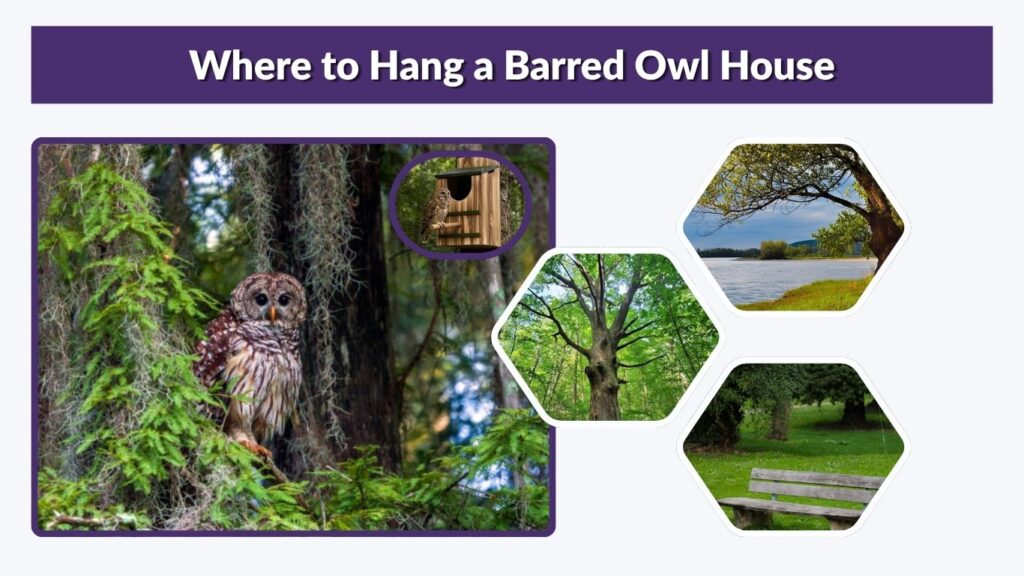
Proper barred owl house placement can influence whether a nesting pair investigates or occupies the box. Barred owls favor quiet, wooded habitats with mature trees, sufficient prey, and minimal human disturbance.
The location should provide a clear flight path to the entrance while retaining the protection offered by surrounding forest vegetation.
Best Locations for Barred Owl Houses
- Mature forests: Select woodland areas containing large established trees.
- Near water: Locations close to streams, wetlands, or ponds can provide suitable habitat.
- Quiet wooded properties: Choose areas away from frequently used patios and playgrounds.
- Large healthy trees: Mount the box on a structurally sound tree capable of supporting its weight.
- Protected locations: Avoid sites exposed to persistent strong winds or excessive sunlight.
- Clear entrance areas: Remove only branches that directly obstruct access to the opening.
Which Direction Should a Barred Owl House Face?
Barred owl houses do not have one universally required compass direction.
Instead, the entrance should face away from severe prevailing weather whenever practical. Orienting it toward a relatively open flight path is generally more important than choosing a particular direction.
Avoid placing the entrance where nearby branches or dense foliage prevent an owl from approaching comfortably.
When to Install a Barred Owl House
Timing matters because barred owls may inspect suitable nesting locations well before laying eggs. Installing a nesting box early gives local pairs an opportunity to become familiar with the structure.
In much of eastern North America, late fall and winter are practical installation periods. Ideally, the box should be available before local breeding activity begins.
Barred owls sometimes investigate nesting sites months in advance and may inspect a location during one year before nesting there the following year.
Consequently, an unused box during its first breeding season does not necessarily indicate a problem. Cornell notes that barred owls can investigate nest sites as early as a year before occupying them.
How to Attract Barred Owls to Your House
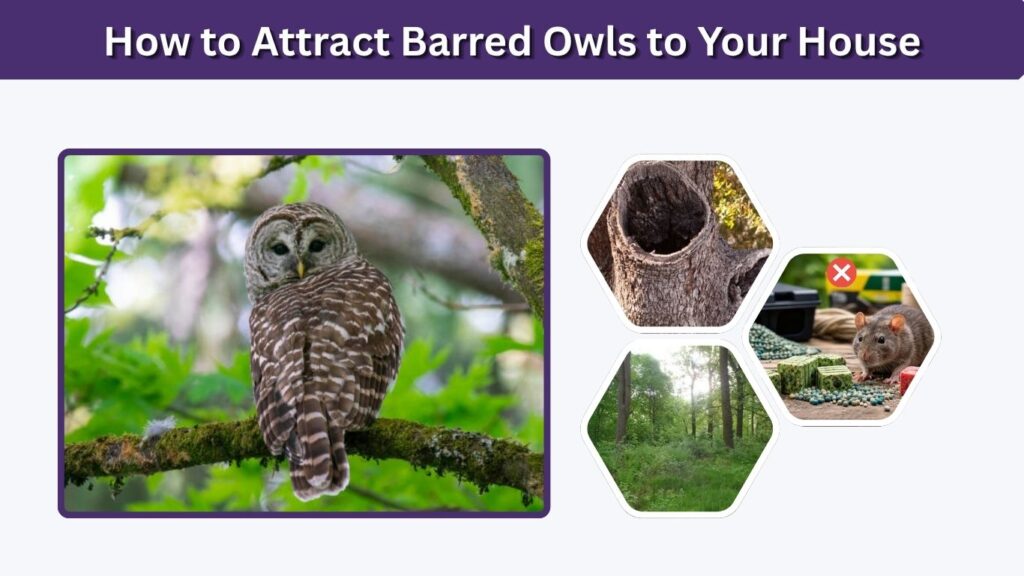
Attracting barred owls requires more than simply installing a wooden nesting box. These birds select territories based on habitat quality, natural food availability, and access to protected nesting locations.
Improving the surrounding woodland environment can make a suitable nesting site more appealing without disturbing the birds.
Ways to Encourage Natural Nesting
- Preserve mature trees: Large trees provide roosting locations and natural cavities.
- Maintain woodland habitat: Keep native vegetation and forest cover wherever possible.
- Avoid rodenticides: Poisoned rodents can harm predatory wildlife, including owls.
- Reduce nighttime disturbances: Limit unnecessary bright lighting and activity near the nesting site.
- Protect natural prey habitat: Healthy woodland ecosystems support mice, amphibians, and other prey animals.
- Keep domestic animals away: Prevent pets from disturbing nesting areas.
Do not attempt to attract owls by releasing rodents, placing live prey near the box, or repeatedly broadcasting owl calls.
Important regional consideration: Barred owls threaten native spotted owls in parts of Washington, Oregon, and California. Consult the appropriate wildlife agency before installing a barred owl nesting box in those regions.
Barred Owl House Maintenance and Cleaning
Maintaining a barred owl house helps preserve its structural condition and usability. Although barred owls may reuse nesting locations, homeowners should avoid disturbing occupied nests.
Maintenance is best performed when the box is confirmed inactive and outside the local breeding season.
Essential Maintenance Tips
- Inspect mounting hardware: Check screws, brackets, and supports for deterioration.
- Examine the roof: Repair leaks or damaged panels.
- Check drainage: Ensure water can escape through the bottom openings.
- Assess nesting material: Replace excessively wet or contaminated material when appropriate.
- Monitor from a distance: Use binoculars rather than approaching active nests.
- Avoid unnecessary cleaning: Some nesting material can remain if the box is dry and suitable.
Active nests, eggs, and young barred owls are protected under U.S. federal law. Never remove or disturb an occupied nesting box without appropriate authorization.
Barred Owl House for Sale: DIY vs. Ready-Made Boxes
A ready-made barred owl house can be convenient for homeowners who lack woodworking tools or construction experience. Commercial nesting boxes are available in different designs, including fully assembled wooden structures and kits requiring basic assembly.
However, not every product marketed as an owl house is suitable for barred owls.
What to Look for When Buying
Choose a nesting box with adequate interior dimensions, a roughly 7-inch entrance opening, and durable untreated materials. The design should also include drainage openings, weather protection, and dependable mounting hardware.
A barred owl house kit may be suitable when it contains correctly measured panels and clear assembly instructions.
Products sold as screech owl houses are usually too small for barred owls. Decorative miniature owl houses are also unsuitable for actual nesting.
For most homeowners, a properly dimensioned DIY house offers flexibility, while an assembled commercial box can simplify construction. Neither option guarantees that barred owls will occupy it.
FAQs
1. How high does a barred owl house need to be?
Cornell NestWatch recommends mounting barred owl nesting boxes approximately 12–15 feet above the ground. Some older plans suggest 20–30 feet. The ideal mounting location also depends on tree stability, surrounding habitat, safe installation, and accessibility for future maintenance.
2. Do barred owls use the same birdhouses as screech owls?
No. Barred owls are substantially larger than screech owls and need more spacious nesting cavities. A barred owl house typically has a much wider entrance and deeper interior. Ordinary screech owl nesting boxes generally cannot accommodate breeding barred owls.
3. How long does it take for barred owls to use a nesting box?
Barred owls may discover a nesting box during their first breeding season, but occupancy can take considerably longer. Some pairs investigate sites well before nesting. Suitable habitat, local owl populations, and the availability of natural cavities all influence the likelihood of occupancy.
4. Should I put branches on a barred owl house?
Branches should not obstruct the entrance to a barred owl house. Nearby natural branches may provide convenient resting places, but adding an external perch is generally unnecessary. The most important considerations are a clear entrance, a safe nesting cavity, and secure installation.
5. Can I place a barred owl house in my backyard?
Yes, if your backyard lies within a suitable part of the barred owl’s range and contains appropriate mature woodland habitat. Large, quiet wooded properties are more promising than small urban yards. Check regional conservation guidance before encouraging barred owls to nest.