
The Greater Sooty Owl (Tyto tenebricosa) is a mysterious nocturnal bird known for its dark, speckled feathers and haunting, descending whistle. Native to eastern Australia and New Guinea, this medium-to-large owl inhabits dense rainforests and moist eucalyptus forests. Its large black eyes, distinctive facial disc, and powerful talons make it an impressive nighttime predator. Unlike many other owls, the Greater Sooty Owl primarily hunts mammals, including tree-dwelling possums and gliders. Understanding its appearance, size, habitat, vocalizations, feeding habits, and conservation status reveals why this elusive forest owl is so fascinating.
What Is a Greater Sooty Owl?
The Greater Sooty Owl is a medium-to-large species belonging to the barn owl family, Tytonidae. Its scientific name is Tyto tenebricosa, and it is sometimes called the Sooty Owl or Black Owl. This secretive species spends daylight hours hidden in forest vegetation, tree hollows, or sheltered rock formations. Its dark plumage provides effective camouflage in dimly lit environments.
Greater Sooty Owl Identification
Greater Sooty Owls have distinctive physical characteristics that make them recognizable among Australian forest birds.
- Head: Large and rounded, without prominent ear tufts.
- Facial disc: Grayish, heart-shaped, and outlined with dark feathers.
- Eyes: Large, round, and nearly black.
- Body: Dark charcoal-gray or sooty-black plumage.
- Feathers: Numerous small white spots across the head, wings, and body.
- Beak: Pale cream-colored, curved, and partly concealed by facial feathers.
- Feet: Strong, heavily feathered legs with powerful talons.
- Tail: Relatively short with subtle darker bars.
The combination of dark feathers, small white spots, and a prominent facial disc makes this owl particularly distinctive.
Greater Sooty Owl Size and Wingspan
Adult Greater Sooty Owls generally measure approximately 37–45 cm (14.5–18 inches) in length, although measurements vary among populations and sources. Females are noticeably larger and heavier than males.
Australian males typically have wingspans of approximately 82–100 cm (32–39 inches), while females may reach 101–118 cm (40–46 inches). Adult body weights commonly range from about 450 g to more than 1 kg, depending on sex and individual size.
Where Do Greater Sooty Owls Live?

Greater Sooty Owls inhabit forested regions of eastern Australia and New Guinea. They prefer environments with mature trees, dense vegetation, and reliable populations of small mammals. Unlike migratory bird species, Greater Sooty Owls generally remain within established territories throughout the year, relying on suitable forest habitats for nesting, roosting, and hunting.
Greater Sooty Owl Habitat
Greater Sooty Owls primarily inhabit rainforest, warm temperate forest, and moist eucalyptus woodland. They particularly favor sheltered gullies containing large trees and thick vegetation.
Their preferred habitats include:
- Tropical rainforests: Dense forests with abundant wildlife.
- Temperate rainforests: Cool, moist woodlands offering protected roosts.
- Wet eucalyptus forests: Mature trees containing natural hollows.
- Forested gullies: Sheltered landscapes with dense vegetation.
- Mountain forests: Higher-elevation wooded habitats.
Large hollow-bearing trees are especially important because these birds use natural cavities for nesting and daytime shelter.
Greater Sooty Owl Distribution
In Australia, Greater Sooty Owls occur mainly along the eastern coastal ranges, from southeastern Queensland through New South Wales into eastern Victoria.
The species also occurs in New Guinea, including parts of Indonesia and Papua New Guinea, where it inhabits tropical and montane forests. Local distributions vary according to forest conditions, elevation, and suitable nesting sites.
What Do Greater Sooty Owls Eat?

Greater Sooty Owls are carnivorous predators that primarily hunt small and medium-sized mammals. Their powerful feet, sharp talons, and excellent nighttime vision allow them to capture animals moving through forest branches or along the ground. Their feeding habits make them important predators within Australian forest ecosystems.
Greater Sooty Owl Diet
Common prey animals include:
- Sugar gliders: Small, tree-dwelling marsupials.
- Ringtail possums: Arboreal mammals found in forest canopies.
- Small rodents: Mice and rats captured in wooded habitats.
- Other small marsupials: Additional mammalian prey where available.
- Small birds: Occasionally captured during nighttime hunting.
- Reptiles: Less frequent prey.
- Large insects: Occasionally eaten when available.
Tree-dwelling mammals form a particularly important component of their diet. The availability of these animals influences where the owls establish territories.
Greater Sooty Owl Hunting Behavior
Greater Sooty Owls hunt predominantly at night. They use their sensitive hearing and large eyes to detect prey in low-light conditions.
Unlike many barn owls that hunt rodents in open grasslands, Greater Sooty Owls frequently capture prey in forest environments. Their broad wings help them maneuver between trees, while their powerful talons securely grasp animals.
Greater Sooty Owl Call and Sound
The Greater Sooty Owl is especially famous for its unusual vocalizations. Rather than producing the familiar hooting associated with many other owls, it gives a high-pitched, descending whistle. This eerie sound can travel through dense forests and is often the first indication that a Greater Sooty Owl is nearby.
What Does a Greater Sooty Owl Sound Like?
The most recognizable Greater Sooty Owl call is known as the bomb whistle. It begins with a sharp, high-pitched note that gradually descends in pitch, resembling a falling object.
The call generally lasts around two seconds, although duration varies. Greater Sooty Owls also produce trills, screeches, and softer vocalizations. Their distinctive whistles are especially useful for identifying them during nighttime wildlife surveys.
Why Do Greater Sooty Owls Call at Night?
Greater Sooty Owls communicate through vocalizations to maintain contact, advertise territory, and interact with potential mates.
Calling may become more frequent during breeding activity. Males also produce softer sounds when communicating with females near nesting cavities. Because these owls are difficult to observe, researchers often use nighttime calls to detect their presence.
Greater Sooty Owl Breeding and Lifespan
Greater Sooty Owls depend heavily on mature forests for successful reproduction. Their nesting behavior centers on large tree cavities, which provide protected places for eggs and developing chicks. Breeding timing varies according to environmental conditions, while the species’ secretive lifestyle makes its longevity difficult to study.
Greater Sooty Owl Nesting and Eggs
Greater Sooty Owls usually nest inside large hollows in mature eucalyptus trees. Occasionally, they may use suitable caves or other sheltered cavities.
Females commonly lay one or two white eggs, with breeding recorded during different months of the year. The female performs incubation and initially cares for the chicks, while the male supplies food.
Young owls remain dependent on their parents after leaving the nest until they develop sufficient hunting abilities.
How Long Do Greater Sooty Owls Live?
The average lifespan of Greater Sooty Owls in the wild has not been reliably established. Their nocturnal behavior, low population densities, and large forest territories make long-term monitoring challenging.
Like other medium-to-large owls, they may survive for many years under favorable conditions. However, a precise average lifespan should not be assumed without species-specific survival data.
Greater Sooty Owl vs Lesser Sooty Owl
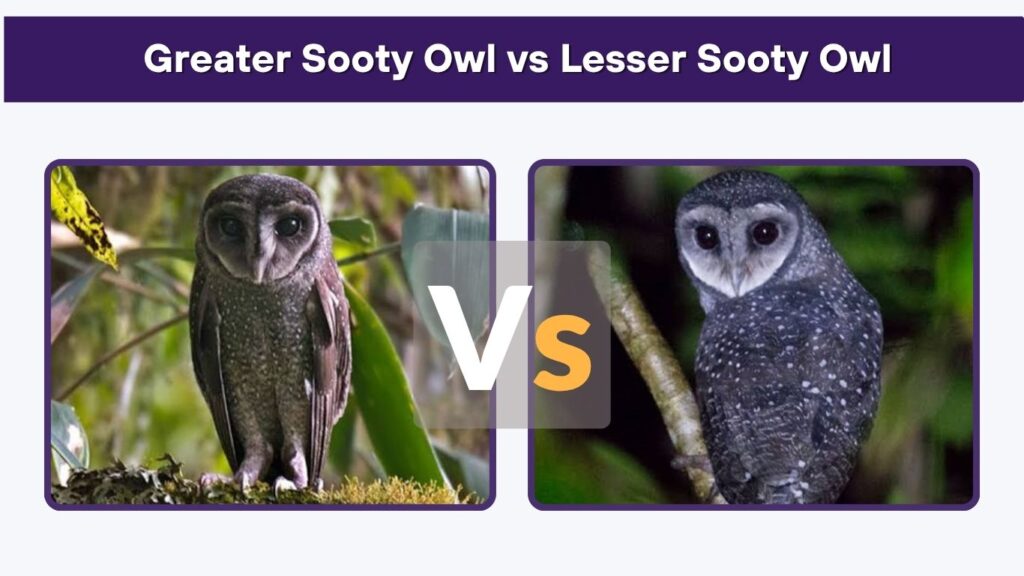
Greater and Lesser Sooty Owls share several characteristics, including dark feathers, pale markings, large eyes, and unusual descending calls. However, they differ in body size, feather patterns, and distribution. The Lesser Sooty Owl (Tyto multipunctata) is generally recognized as a separate species, although some classifications have previously grouped them together.
Key Differences Between Greater and Lesser Sooty Owls
| Feature | Greater Sooty Owl | Lesser Sooty Owl |
| Body size | Larger and heavier | Smaller and lighter |
| Plumage | Dark charcoal-gray | More silvery-gray |
| White spots | Finer and less prominent | More numerous and noticeable |
| Facial disc | Darker gray | Generally paler |
| Habitat | Eastern moist forests | Northeastern Queensland rainforests |
| Call | Descending bomb whistle | Similar descending whistle |
Greater Sooty Owls also have larger feet and more robust bodies. These differences can help birdwatchers identify the two species in areas where their ranges approach one another.
Greater Sooty Owl Threats and Conservation
Greater Sooty Owls face several environmental pressures, especially in areas experiencing forest clearing and degradation. Their dependence on mature trees makes them vulnerable when old forests disappear. Although the species is globally classified as Least Concern, certain Australian populations receive stronger regional conservation protections.
Important threats include habitat destruction, loss of hollow-bearing trees, inappropriate fire regimes, and secondary poisoning from rodenticides. Protecting mature forests, maintaining wildlife corridors, and preserving suitable nesting trees are important conservation measures.
FAQs
1. Is the Greater Sooty Owl Rare?
Greater Sooty Owls are uncommon and difficult to observe in many parts of their Australian range. Their nocturnal behavior and preference for dense forests make sightings relatively infrequent. Although globally classified as Least Concern, the species is listed as Vulnerable in New South Wales and Endangered in Victoria.
2. What Is the Scientific Name of the Greater Sooty Owl?
The scientific name of the Greater Sooty Owl is Tyto tenebricosa. It belongs to the family Tytonidae, which includes barn owls and related species. The owl was originally described by John Gould in 1845 and is recognized for its distinctive dark plumage and unusual vocalizations.
3. Can Greater Sooty Owls Fly Silently?
Greater Sooty Owls have specialized wing feathers that help reduce noise during flight. Like many other owl species, they rely on quiet movement to approach prey without being detected. Their broad wings and strong flight muscles also allow them to maneuver effectively through densely wooded environments.
4. What Does a Greater Sooty Owl Symbolize?
Greater Sooty Owls may be associated with mystery, nighttime wilderness, and the hidden natural world. Their dark appearance and haunting calls can make them particularly striking in wildlife artwork and storytelling. However, symbolic interpretations vary between cultures and individuals and should not be confused with scientific facts.
5. Are Greater Sooty Owls Dangerous to Humans?
Greater Sooty Owls generally avoid humans and do not normally pose a danger. However, like other birds of prey, they have sharp talons and may defend themselves if handled or threatened. Observing these owls from a respectful distance helps protect both the birds and people.