The black barn owl is an extremely rare color variation of the familiar barn owl, recognized for its unusually dark feathers, heart-shaped face, and mysterious appearance. Unlike typical barn owls with white and golden plumage, these remarkable birds develop dark brown, charcoal, or nearly black feathers because of a pigmentation condition called melanism. Black barn owls have attracted considerable attention among wildlife enthusiasts because of their striking appearance and unusual genetics. Understanding black barn owl facts, including their rarity, habitat, diet, behavior, and coloration, reveals what makes these extraordinary birds so fascinating.
What Is a Black Barn Owl?
A black barn owl is an unusually dark-colored barn owl, generally associated with a rare genetic condition called melanism. It is not a separate species but a color variation of the familiar barn owl.
Common barn owls, including the western barn owl (Tyto alba), belong to the family Tytonidae. They normally have pale facial discs, golden-brown upperparts, and white or cream-colored underparts.
Black barn owls retain the same basic body structure and hunting adaptations, but their darker plumage gives them a dramatically different appearance.
Although dark-colored barn owls occur naturally, exceptionally black individuals are unusual and are more frequently encountered in documented captive collections than in ordinary wildlife observations.
Black Barn Owl Facts
Here are some interesting facts about black barn owls:
- Scientific name: Often Tyto alba, particularly among documented European examples.
- Family: Tytonidae, commonly called barn owls.
- Color variation: Melanistic or unusually dark plumage.
- Appearance: Dark brown, charcoal-gray, or nearly black feathers.
- Facial shape: Distinctive heart-shaped facial disc.
- Eye color: Usually dark brown to black.
- Body length: Approximately 33–39 centimeters in typical western barn owls.
- Diet: Mice, voles, rats, shrews, and other small animals.
- Activity: Primarily nocturnal.
- Rarity: Exceptionally dark individuals are uncommon.
These characteristics make black barn owls fascinating examples of natural pigmentation variation.
Why Are Some Barn Owls Black?
The unusual appearance of black barn owls is primarily associated with changes in feather pigmentation. While ordinary barn owls display combinations of white, golden, and brown feathers, melanistic individuals can develop much darker coloration.
What Is Melanism in Barn Owls?
Melanism is a pigmentation condition involving increased dark coloration, often associated with the production or distribution of melanin.
Melanin is a natural pigment responsible for many black, brown, and gray colors found in animal feathers, fur, and skin.
In barn owls, inherited differences in pigmentation influence the darkness of feathers and the size or intensity of dark spots.
Extremely melanistic barn owls can appear almost entirely charcoal-gray or black, although some retain lighter facial markings.
Melanism should not be confused with albinism, which involves reduced or absent melanin pigmentation.
Are Black Barn Owls Genetically Different?
Black barn owls can carry inherited pigmentation differences, but this does not make them a separate species.
Their unusual coloration represents variation within the genetic characteristics of barn owls.
Research has demonstrated that melanin-based coloration in barn owls is heritable and may be associated with certain physiological characteristics.
However, the genetics of ordinary dark spotting should not automatically be treated as identical to the causes of exceptionally black plumage.
Black Barn Owl Appearance and Identification
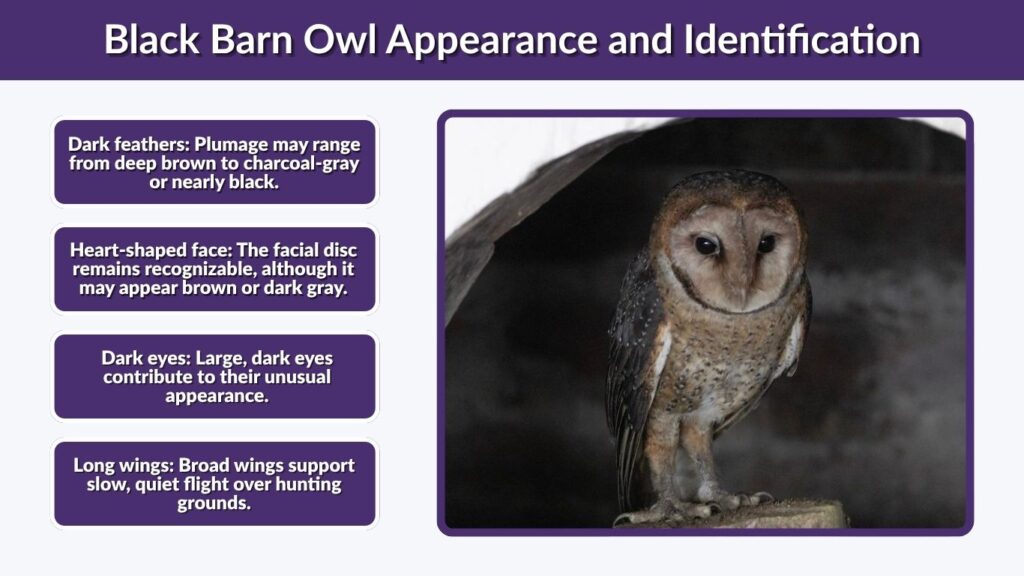
Black barn owls have the same recognizable physical structure as ordinary barn owls, but their unusual feathers make identification more interesting.
Their compact heads, heart-shaped faces, long wings, and slender bodies remain characteristic of the barn owl family.
Physical Characteristics of Black Barn Owls
The appearance of melanistic barn owls varies depending on the degree of pigmentation.
Common identification features include:
- Dark feathers: Plumage may range from deep brown to charcoal-gray or nearly black.
- Heart-shaped face: The facial disc remains recognizable, although it may appear brown or dark gray.
- Dark eyes: Large, dark eyes contribute to their unusual appearance.
- Long wings: Broad wings support slow, quiet flight over hunting grounds.
- Sharp talons: Strong claws help capture and hold prey.
- Curved beak: A hooked bill allows the owl to tear food efficiently.
Some individuals retain pale spots or golden-brown patches across the face and body.
Others have more uniform coloration, making their typical barn owl markings difficult to distinguish.
Black Barn Owl vs. Normal Barn Owl
The most obvious difference between black and ordinary barn owls is feather coloration.
Typical barn owls have white or buff-colored underparts and golden-brown upper wings, whereas melanistic individuals appear significantly darker.
Despite this difference, both possess specialized hearing, silent flight adaptations, and similar feeding behavior.
A black barn owl is therefore best understood as an unusual color variation rather than an entirely different kind of bird.
How Rare Is a Black Barn Owl?
Exceptionally black barn owls are considered extremely rare. Most naturally occurring barn owls display the familiar combination of white, golden, and brown plumage.
Some wildlife and falconry sources suggest that melanistic barn owls occur at rates approaching one in 100,000 individuals.
However, this figure has not been firmly established through comprehensive population studies and should be treated as an informal estimate.
Pure Black Barn Owl Rarity
An almost completely black barn owl is particularly unusual because ordinary pigmentation typically produces lighter feathers on the face and underside.
Even melanistic individuals often retain dark brown, gray, or buff-colored areas rather than displaying uniformly black plumage.
Their rarity makes verified photographs and documented examples especially interesting to bird enthusiasts.
Although rare pigmentation can occur naturally, photographs alone cannot reliably establish how frequently these birds appear in wild populations.
Where Do Black Barn Owls Live?
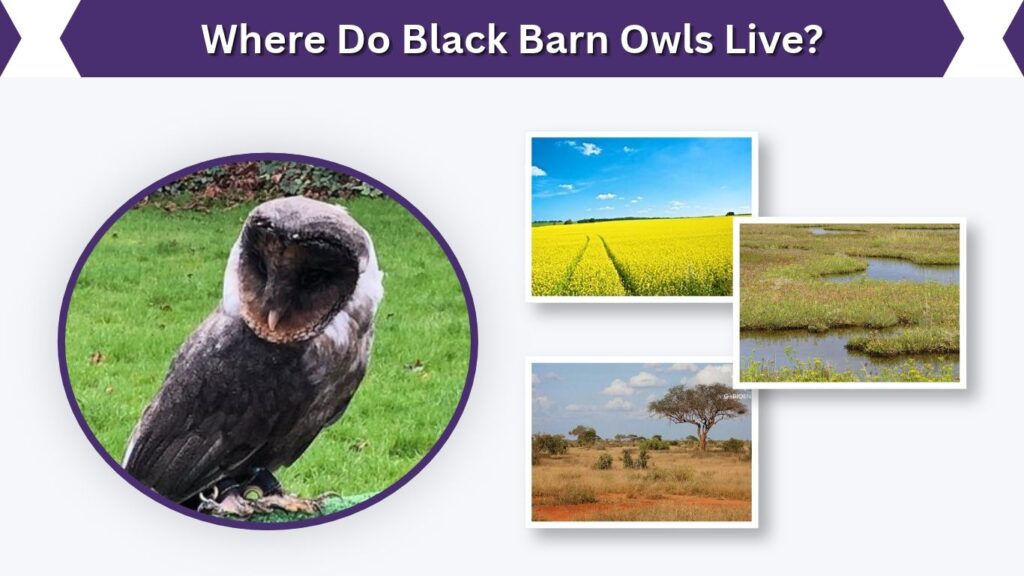
Black barn owls do not occupy a separate habitat from normally colored members of their species.
Their potential distribution follows the geographical range of the barn owl population in which the pigmentation variation occurs.
Barn owls commonly inhabit grasslands, agricultural landscapes, marshes, woodland edges, and other open environments where small mammals are abundant.
Black Barn Owl in the UK
Rare dark-colored barn owls have been documented in the United Kingdom, particularly among birds maintained by falconry centers and specialist collections.
The UK’s typical wild barn owls are much paler, with white undersides and golden upperparts.
Some naturally darker European barn owls may also occur in Britain, although ordinary dark coloration should not automatically be classified as extreme melanism.
Australian Black Barn Owl
The term Australian black barn owl sometimes causes confusion because Australia has several naturally dark-colored relatives in the barn owl family.
One example is the greater sooty owl (Tyto tenebricosa), a separate species found in parts of eastern Australia.
Unlike a melanistic barn owl, the greater sooty owl naturally possesses dark gray or sooty plumage with fine pale markings.
It is a forest-dwelling owl rather than simply a black variation of the familiar barn owl.
What Do Black Barn Owls Eat?
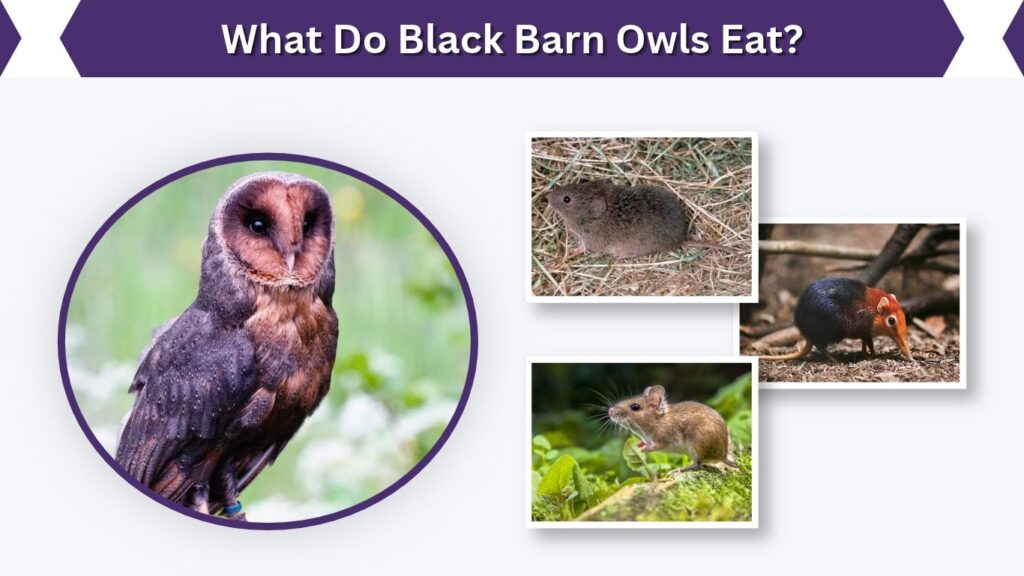
Black barn owls are carnivorous predators with feeding habits similar to those of normally colored barn owls.
Their diet consists primarily of small mammals, particularly rodents found in agricultural landscapes and grasslands.
Common Foods of Black Barn Owls
Their typical food sources include:
- Mice: Common prey in farmland and grassy habitats.
- Voles: Important small mammals in many barn owl diets.
- Rats: Usually smaller individuals that can be captured safely.
- Shrews: Frequently consumed in some regions.
- Small birds: Occasionally captured when suitable opportunities arise.
- Other animals: Occasionally insects or other small vertebrates.
Barn owls locate prey using their highly developed hearing and capture it with sharp talons.
They often swallow small animals whole and later regurgitate pellets containing bones, fur, and other indigestible material.
This feeding behavior helps researchers identify the prey species present in local habitats.
Black Barn Owl Flying and Hunting Behavior
Black barn owls retain the extraordinary hunting adaptations found in typical barn owls.
Their wing feathers have specialized structures that reduce flight noise, allowing them to approach prey quietly.
How Black Barn Owls Hunt at Night
Barn owls usually hunt by flying slowly over open ground while listening for movement beneath grass and vegetation.
Their heart-shaped facial discs help direct sound toward their ears, allowing accurate prey detection even under low-light conditions.
Once a target is located, the owl dives and captures the animal using its strong talons.
Although their feather coloration differs, there is insufficient evidence to conclude that extremely black barn owls consistently hunt better or worse than normally colored individuals.
Their hunting success depends on many factors, including experience, weather conditions, habitat, and prey availability.
Black Barn Owl Breeding and Lifespan
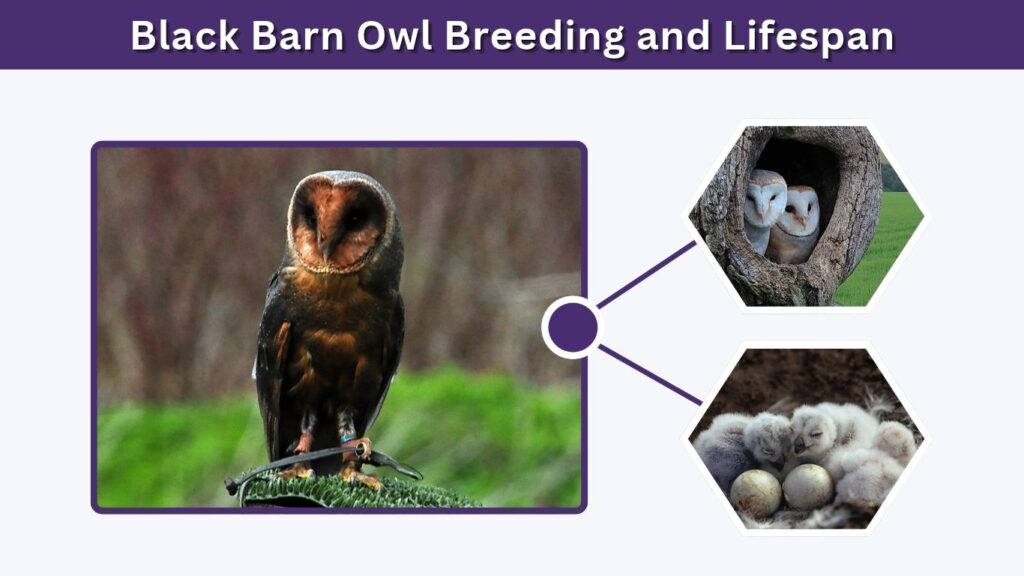
The breeding behavior of black barn owls is expected to follow the general reproductive patterns of their species.
Barn owls typically nest in sheltered cavities, abandoned buildings, tree hollows, and artificial nest boxes.
Eggs and Baby Black Barn Owls
Female barn owls commonly lay several white eggs, with clutch size influenced by food availability and environmental conditions.
Incubation generally lasts approximately one month.
Newly hatched chicks are covered in pale down and depend entirely on their parents for warmth and food.
As their permanent feathers develop, inherited pigmentation becomes more apparent.
Young barn owls typically begin leaving the nest at around seven to eight weeks, although development varies.
Wild barn owls often have relatively short average lifespans because juvenile mortality is high, while individuals receiving appropriate professional care in captivity may survive much longer.
Black Barn Owl Meaning and Symbolism
The unusual appearance of a black barn owl can inspire interpretations involving mystery, transformation, intuition, and the unknown.
However, these symbolic associations reflect cultural or personal beliefs rather than established biological meanings.
Spiritual Meaning of a Black Barn Owl
In some modern spiritual interpretations, black owls represent hidden knowledge, personal change, protection, or heightened awareness.
Their nocturnal behavior and unusual appearance may strengthen associations with darkness and mystery.
Symbolic interpretations differ considerably among cultures and individuals.
Scientifically, seeing a black barn owl indicates an unusual pigmentation pattern rather than a supernatural event or prediction.
Black Barn Owl Conservation and Threats
Melanistic barn owls belong to existing barn owl populations, so their conservation needs generally overlap with those of normally colored birds.
Habitat loss, declining prey availability, road collisions, and exposure to rodenticides can affect barn owl survival.
Protecting grasslands, maintaining suitable nesting areas, and reducing harmful rodenticide use can support local populations.
Because exceptionally dark barn owls are uncommon, documenting genuine sightings and distinguishing melanism from ordinary color variation can also help improve understanding of this unusual characteristic.
FAQs
1. Can Barn Owls Be Completely Black?
Yes, barn owls can develop exceptionally dark plumage associated with melanism. However, many so-called black barn owls retain brown, gray, or lighter markings rather than being uniformly black.
2. Are Black Barn Owls Rare?
Yes. Extremely melanistic barn owls are unusual. Although an estimate of one in 100,000 is sometimes reported, reliable population-wide frequency data are limited.
3. Are Black Barn Owls a Different Species?
No. A melanistic black barn owl is a color variation of a barn owl, not a separate species. However, naturally dark species such as Australia’s greater sooty owl should not be confused with melanistic barn owls.
4. Are Black Barn Owls Found in the UK?
Rare black barn owls have been documented in captive collections in the United Kingdom. Exceptionally melanistic birds are not a normal feature of the country’s wild barn owl population.
5. Are Black Barn Owls Dangerous to Humans?
Black barn owls are generally not dangerous to humans. Like ordinary barn owls, they mainly hunt rodents and typically avoid people. However, they may defend themselves when threatened or improperly handled.