The great grey owl (Strix nebulosa) is one of the tallest owl species in the world, famous for its enormous rounded face, piercing yellow eyes, and remarkable hunting abilities. Found across northern forests of North America, Europe, and Asia, this magnificent bird can detect small animals beneath deep snow. Despite its impressive appearance, much of its apparent size comes from thick feathers. Its fascinating adaptations make it one of the most recognizable woodland predators.
What Is a Great Grey Owl?
The great grey owl, also known as the great gray owl or Lapland owl, is a large bird of prey belonging to the family Strigidae. Its scientific name is Strix nebulosa. It inhabits northern forests and is known for its extraordinary hearing, quiet flight, and ability to survive harsh winters. Although enormous in appearance, it is considerably lighter than several other large owls.
Scientific Classification
- Common Name: Great Grey Owl
- Scientific Name: Strix nebulosa
- Family: Strigidae
- Order: Strigiformes
- Genus: Strix
- Diet: Carnivorous
- Primary Habitat: Boreal and mountain forests
- Conservation Status: Least Concern globally
Great Grey Owl Size and Physical Appearance
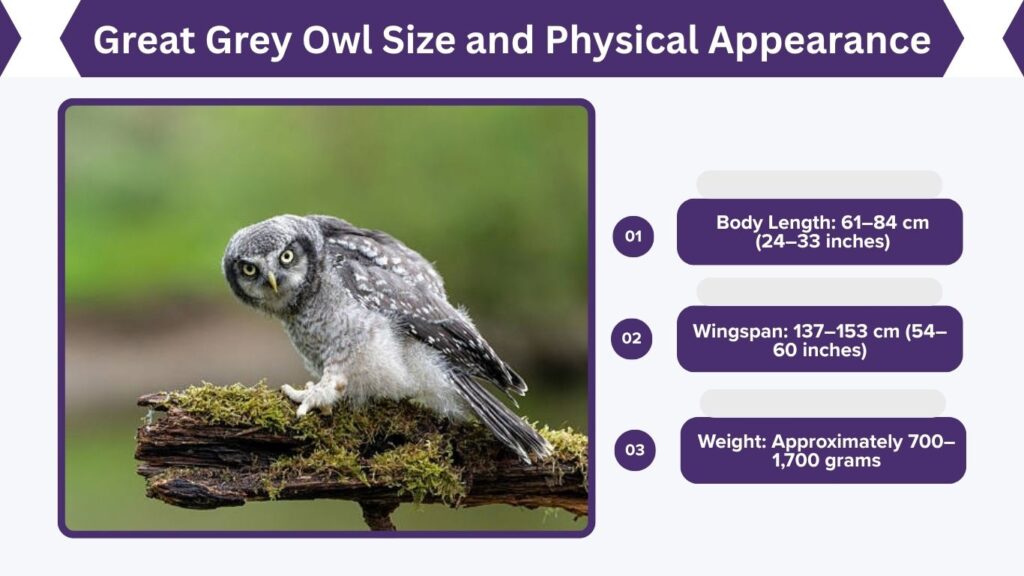
The great grey owl is among the tallest owls in North America, with a large head, long tail, and broad wings. Its thick grey feathers provide insulation against cold weather and create an impressive silhouette. However, its actual body mass is relatively low compared with its apparent size. Females are generally larger and heavier than males.
How Big Is a Great Grey Owl?
An adult great grey owl typically measures 61–84 centimeters (24–33 inches) in length.
Its physical measurements include:
- Body Length: 61–84 cm (24–33 inches)
- Wingspan: 137–153 cm (54–60 inches)
- Weight: Approximately 700–1,700 grams
- Eyes: Bright yellow
- Body Color: Silvery grey with brown and white markings
Despite its height, the great grey owl generally weighs less than a great horned owl because much of its bulk consists of feathers.
Great Grey Owl Next to a Human
When compared with an adult human, a great grey owl appears surprisingly tall for a bird. Its body can reach approximately 84 centimeters, making it especially impressive when perched upright.
An adult human is still considerably taller, but the owl’s broad wingspan can approach the height of many people.
Its oversized facial disc, long body feathers, and thick plumage further exaggerate its dimensions.
Distinctive Identification Features
The great grey owl has several recognizable characteristics:
- Large, circular facial disc with dark concentric rings
- Bright yellow eyes surrounded by grey feathers
- White markings resembling a bow tie beneath the face
- Rounded head without prominent ear tufts
- Long tail and broad, rounded wings
- Grey, white, and brown streaked plumage
These features distinguish it from the barred owl, which has dark eyes, and the great horned owl, which has prominent ear tufts.
Great Grey Owl Habitat and Geographic Range
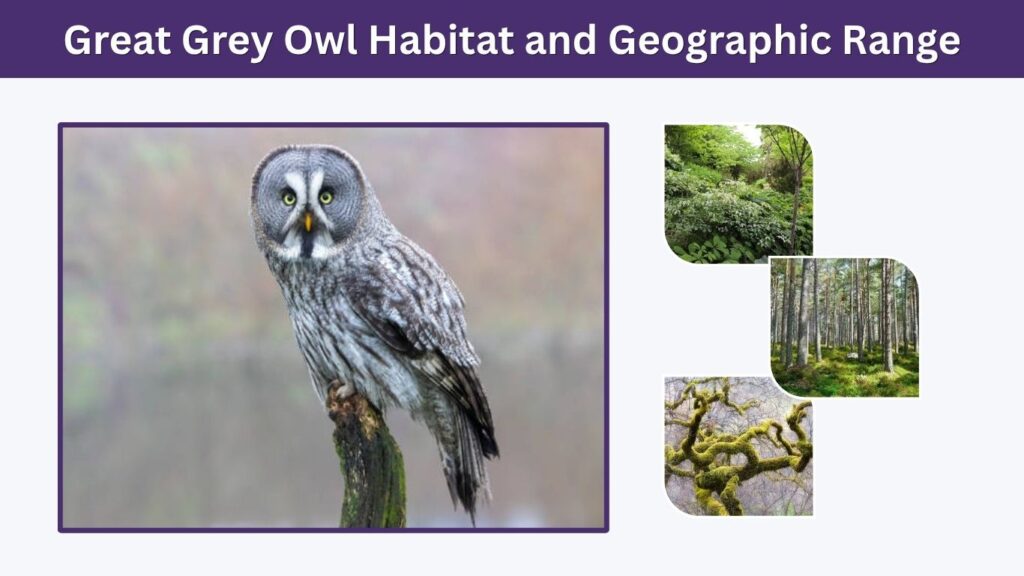
Great grey owls inhabit northern forests where tall trees provide nesting locations and nearby open areas offer hunting opportunities. They are particularly associated with boreal ecosystems, including evergreen forests, bogs, and wooded wetlands. Their distribution extends across much of the Northern Hemisphere, although local populations vary considerably depending on food availability and suitable forest habitat.
Where Does the Great Grey Owl Live?
The great grey owl occurs across several northern regions:
- North America: Alaska, Canada, and parts of the northern and western United States
- Europe: Finland, Sweden, Norway, and neighboring northern regions
- Asia: Russia, Siberia, Mongolia, and parts of northeastern China
In the United States, populations occur in mountain forests of the Pacific Northwest, northern Rocky Mountains, and California’s Sierra Nevada.
Preferred Habitat
Great grey owls favor mature coniferous forests near meadows, wetlands, or open woodland clearings.
These environments provide shelter and nesting sites while allowing access to rodents living in grassy or marshy areas.
The species generally remains within its breeding range throughout the year. However, food shortages may cause some northern populations to move considerable distances during winter.
Great Grey Owl Calls and Sounds
The great grey owl produces deep, resonant vocalizations that can travel through quiet northern forests. Although generally secretive, it becomes more vocal during territorial interactions and breeding activities. Its calls are particularly useful for identifying the species because the owl’s excellent camouflage often makes it difficult to locate among trees.
What Does a Great Grey Owl Sound Like?
The great grey owl’s characteristic territorial call consists of a series of deep, evenly spaced hoots.
These notes may sound like repeated “whoo-whoo-whoo” vocalizations, often gradually becoming lower in pitch.
Other sounds include:
- Territorial Hoots: Deep, repeated calls advertising territory
- Alarm Calls: Sharper vocalizations when disturbed or threatened
- Contact Calls: Softer sounds exchanged between individuals
- Juvenile Calls: Begging vocalizations produced by young owls
Calls can vary depending on age, sex, and circumstances.
When Do Great Grey Owls Call?
Great grey owls commonly vocalize during the breeding season when establishing territories or communicating with mates.
Calls may be heard after sunset, during nighttime hours, or around dawn.
Although they frequently remain quiet outside breeding activities, individuals can produce alarm sounds when their nests are disturbed.
Great Grey Owl Diet and Hunting Behavior
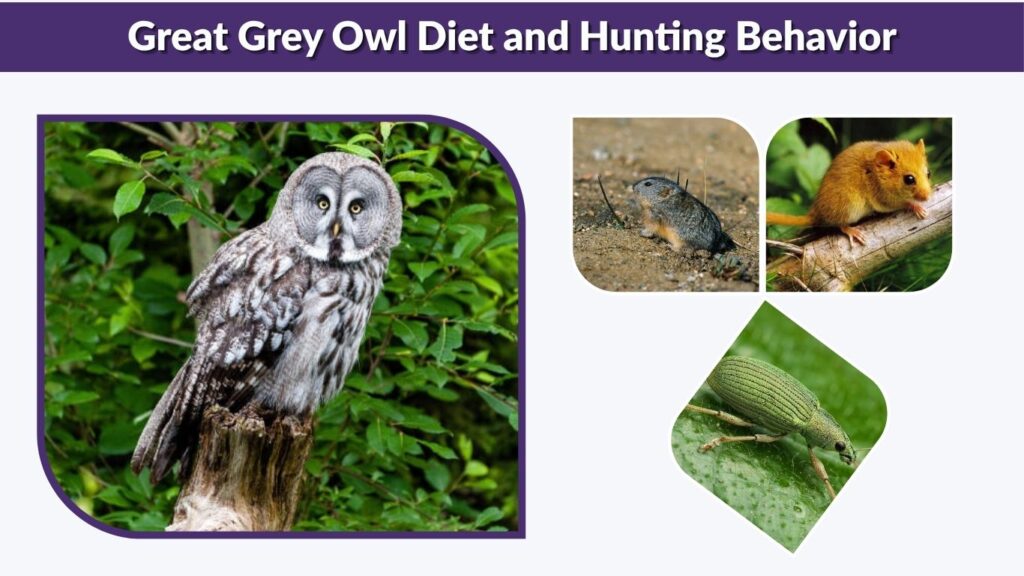
The great grey owl is a specialized predator that feeds primarily on small mammals. Its exceptional hearing allows it to locate animals moving beneath vegetation or snow. Unlike many larger birds of prey, it relies heavily on small rodents rather than large mammals. Its hunting success depends on careful listening, quiet movement, and accurate strikes.
What Does a Great Grey Owl Eat?
Common prey animals include:
- Voles
- Mice
- Pocket gophers
- Lemmings
- Shrews
- Other small mammals
- Occasionally small birds
Voles are particularly important in many northern habitats.
The availability of rodents can strongly influence breeding success, territorial movements, and the number of young raised each year.
How Does a Great Grey Owl Hunt in Snow?
Great grey owls possess exceptionally sensitive hearing and asymmetrically positioned ear openings.
Their large facial discs help direct sounds toward the ears, allowing them to locate prey beneath snow.
After detecting movement, the owl may hover briefly before plunging feet-first into the snow.
This technique allows it to capture rodents hidden more than 30 centimeters (12 inches) beneath the surface under suitable conditions.
Great Grey Owl in Flight
Despite its considerable size, the great grey owl flies with surprisingly quiet wingbeats.
Its broad wings provide lift, while specialized feather structures reduce flight noise.
This silent movement allows the owl to approach prey without creating excessive disturbance. It can also glide slowly above meadows while searching for food.
Great Grey Owl Breeding and Nesting
Great grey owls typically breed during spring, with nesting activity influenced by weather and prey abundance. Unlike many smaller birds, they do not construct elaborate nests. Instead, they depend on existing structures high above the ground. Suitable nest sites near hunting grounds help adults provide food for their developing chicks.
Nesting and Egg-Laying
Great grey owls commonly use abandoned nests built by ravens or other large birds.
They may also nest on broken tree trunks or artificial nesting platforms.
Females typically lay two to five white eggs, which hatch after approximately 28–36 days of incubation.
Great Grey Owl Chicks
Newly hatched chicks are covered in soft down and depend completely on their parents.
The female initially broods the young while the male provides food.
As the chicks grow, they begin exploring surrounding branches before developing the ability to fly. Parents continue feeding them after they leave the nest.
Great Grey Owl Conservation Status and Threats
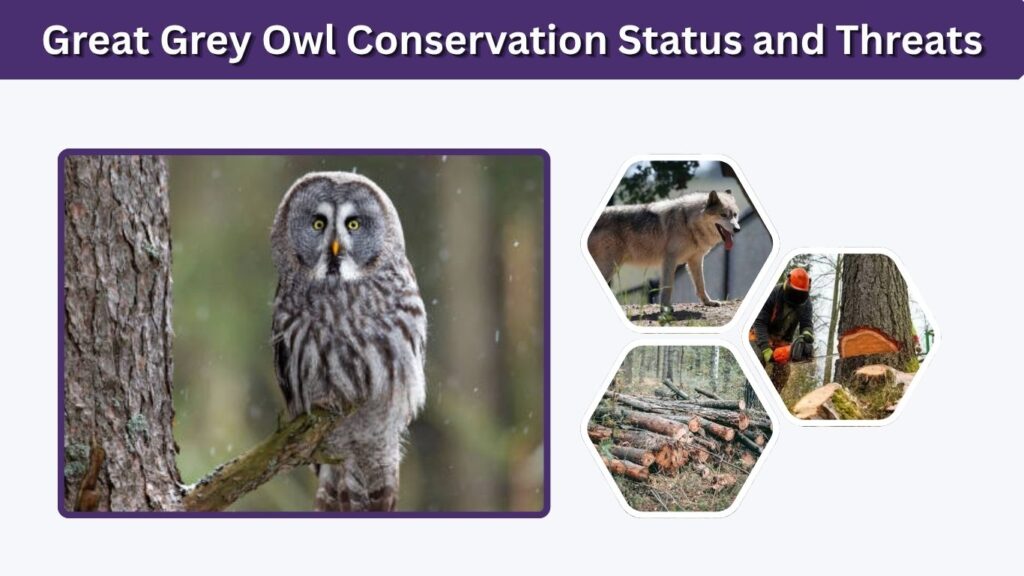
The great grey owl is currently classified as Least Concern globally. However, some regional populations face conservation challenges, particularly where suitable forest habitats have declined. Forest management practices, disturbance around nesting locations, and changing prey availability may affect breeding success. Protecting mature trees and nearby hunting meadows is important for maintaining healthy populations.
Major Conservation Concerns
Important threats include habitat fragmentation, loss of nesting trees, and changes to open hunting habitats.
The California population is particularly vulnerable and is protected as endangered under state law.
Conservation measures focus on preserving suitable forests, maintaining natural meadow ecosystems, and reducing disturbance around active nests.
Interesting Great Grey Owl Facts
The great grey owl possesses remarkable characteristics that make it particularly well adapted to northern forests. Its size, camouflage, sensitive hearing, and unusual hunting techniques have attracted the attention of ornithologists and birdwatchers worldwide.
- It is one of the tallest owls. Adults can reach approximately 84 centimeters in length.
- Much of its size comes from feathers. Its thick plumage makes it look heavier than it actually is.
- It can hunt beneath deep snow. Specialized hearing helps locate hidden rodents.
- It has no visible ear tufts. Its rounded head and enormous facial disc are distinctive identification features.
- It sometimes hunts during daylight. Activity is not restricted to nighttime, especially during winter and the breeding season.
FAQs
1. How big is a great grey owl?
A great grey owl usually measures 61–84 centimeters (24–33 inches) long and weighs approximately 700–1,700 grams. Females are generally larger than males.
2. What is the wingspan of a great grey owl?
The great grey owl has a wingspan of approximately 137–153 centimeters (54–60 inches), allowing it to glide efficiently while searching for prey.
3. What does a great grey owl call sound like?
Its characteristic call consists of deep, rhythmic hoots that may descend gradually in pitch. It also produces sharper alarm calls and softer contact vocalizations.
4. Where are great grey owls most commonly found?
Great grey owls primarily inhabit boreal forests in Canada, Alaska, northern Europe, and northern Asia, with smaller populations in mountain forests of the western United States.
5. Is the great grey owl endangered?
The species is not globally endangered and is classified as Least Concern. However, certain regional populations, including those in California, face greater conservation risks.