The collared scops owl is a small nocturnal owl known for its prominent ear tufts, dark eyes, mottled brown plumage, and soft repetitive hooting call. Under current IOC and eBird/Clements taxonomy, it is scientifically named Otus lettia and occurs across parts of South, Southeast, and East Asia. It inhabits forests, wooded countryside, parks, mangroves, and gardens, where its bark-like camouflage makes it difficult to spot during daylight. At night, it hunts insects, geckos, rodents, and other small animals.
Collared Scops Owl Identification and Size
The collared scops owl is larger than several other Asian scops owls but remains a relatively small owl overall. Its mottled feathers provide exceptional camouflage against tree bark. Adults occur in gray-brown and rufous forms, while juveniles generally look paler and more finely barred. Females are usually slightly larger and heavier than males.
Key Identification Features
Common identifying characteristics include:
- Scientific name: Otus lettia
- Length of about 23–25 cm
- Weight around 100–170 g
- Long, dark-spotted ear tufts
- Dark brown to orange-brown eyes
- Greenish-horn-colored bill
- Mottled brown, buff, gray, or rufous plumage
- Two pale collar-like markings on the hindneck
- Pale underparts with fine dark streaks
- Feathering extending down the legs
The combination of noticeable ear tufts, dark eyes, pale neck markings, and intricate bark-like patterning is particularly useful for identification.
Gray and Rufous Color Morphs
Both gray-brown and rufous morphs occur. Rufous birds have warmer reddish-brown plumage, while gray morphs blend more closely with gray and brown tree bark.
These color variations do not represent different species. Individual appearance can also vary because of lighting, feather wear, geographical variation, and age.
Collared Scops Owl Habitat and Range
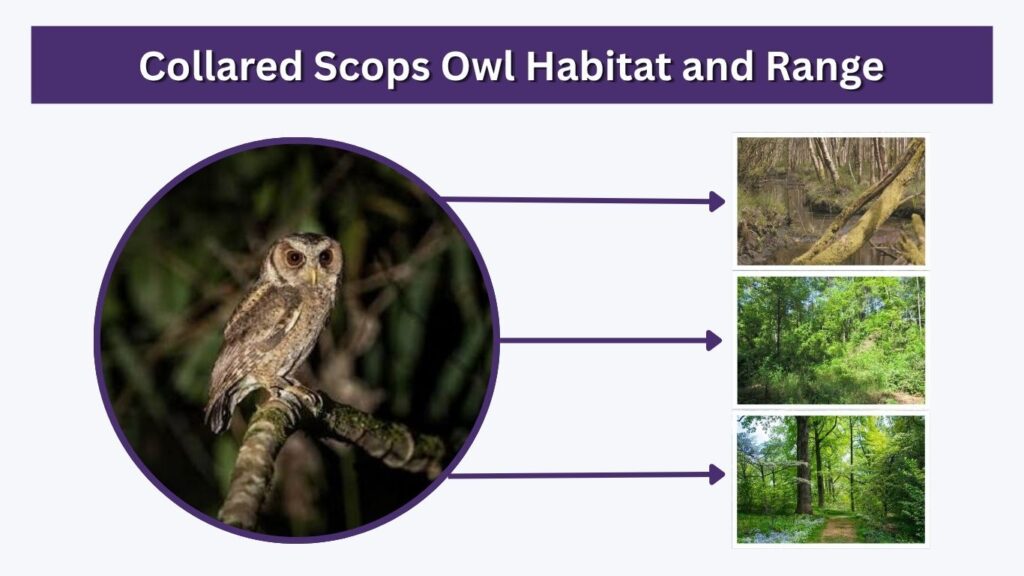
The collared scops owl habitat is surprisingly diverse. Although strongly associated with wooded environments, it does not require untouched primary forest. It can occupy secondary woodland, scrub, bamboo, mangroves, parks, gardens, orchards, and trees around settlements. This adaptability helps explain why it can persist close to people in many parts of tropical and subtropical Asia.
Where Do Collared Scops Owls Live?
Under the Otus lettia treatment, its range includes areas of:
- Nepal and parts of the Himalayan region
- Northeast India
- Bangladesh
- Myanmar
- Southern China
- Thailand
- Indochina
- Peninsular Malaysia
- Singapore
- Other neighboring parts of Southeast Asia
The Owl Pages records the species from lowlands to approximately 2,400 meters elevation.
Singapore, Sri Lanka, Japan, and Florida
In Singapore, the collared scops owl is considered a common resident and occurs in forests, mangroves, parks, and gardens.
Older references can create confusion about other locations. Current IOC/eBird-style taxonomy separates the Indian scops owl (Otus bakkamoena) and Japanese scops owl (Otus semitorques) from O. lettia. Therefore, birds in Sri Lanka traditionally associated with this complex are treated as Indian scops owls, while Japan has the Japanese scops owl. The collared scops owl is not a native Florida species.
Collared Scops Owl Call and Behavior
The collared scops owl call is one of the easiest ways to detect this secretive bird. During daylight, it usually sits motionless on a densely foliaged branch, relying heavily on camouflage. After darkness falls, it becomes active and vocal. Because individuals can remain almost invisible against bark, birders frequently hear a collared scops owl well before seeing it.
What Does a Collared Scops Owl Sound Like?
Its typical territorial call is a single mellow hoot, often rendered as “buuo.” The note may be repeated roughly every 12–20 seconds, and calling sessions can continue for 15 minutes or more.
Calls are particularly important during the breeding season because they help individuals advertise territories and communicate with potential mates.
Nocturnal Behavior and Camouflage
During the day, the owl normally perches upright and remains almost completely still. Its streaked and mottled plumage closely resembles bark.
At night it leaves the roost to hunt. Large eyes enhance low-light vision, while sensitive hearing helps locate prey. The short ear tufts are feathers rather than functional ears and can alter the outline of the head, making a resting owl even harder to recognize.
Collared Scops Owl Diet and Hunting
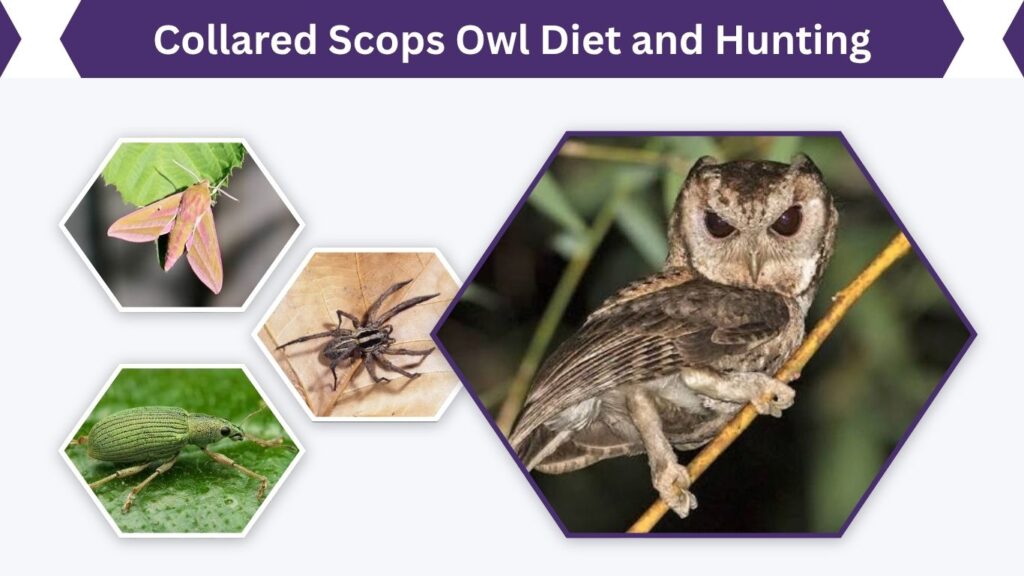
The collared scops owl diet consists primarily of insects, although this adaptable predator also takes small vertebrates. It typically hunts after dusk from a perch, watching and listening before dropping or flying toward prey. Insects provide an abundant food source, particularly in warm wooded habitats, while larger prey can provide substantial energy during breeding.
What Does a Collared Scops Owl Eat?
Its recorded prey includes:
- Beetles
- Grasshoppers
- Other large insects
- Geckos and other lizards
- Mice
- Small rodents
- Small birds
- Other small vertebrates
In Singapore, geckos are noted as favored prey, alongside insects and small vertebrates.
How Does It Hunt?
Collared scops owls often use a sit-and-wait strategy. An owl remains quietly perched until prey is detected, then swoops down and captures it using its talons.
This hunting style conserves energy and works particularly well along forest edges, gardens, woodland openings, and other areas where insects and small vertebrates are accessible.
Breeding, Juveniles, and Life Cycle
Breeding biology of the collared scops owl is less thoroughly documented than that of some larger owls. Available accounts indicate that it is a cavity-nesting species, usually choosing natural tree hollows or abandoned woodpecker holes. In much of its range, breeding takes place during the warmer part of the year when insects and other prey become more abundant.
Nesting and Young Owls
Typical breeding characteristics include:
- Breeding season commonly around February to May
- Nesting in natural tree cavities
- Use of abandoned woodpecker holes
- Nest cavities often around 2–5 meters or higher
- Usually 3–4 eggs
- Occasionally as many as five eggs
- Juveniles noticeably paler than adults
- Young birds show fine barring across the plumage
The species does not construct an elaborate stick nest. Eggs are laid directly inside the protected cavity.
Collared Scops Owl Lifespan
A well-established average lifespan specifically for wild Otus lettia is difficult to give because long-term survival data are limited. Exact figures sometimes circulated online may combine data from other scops, owl species or captive birds.
Like many owls, survival is generally most challenging during the juvenile period, when inexperienced young birds must learn to hunt independently and avoid predators.
Collared Scops Owl vs. Indian Scops Owl
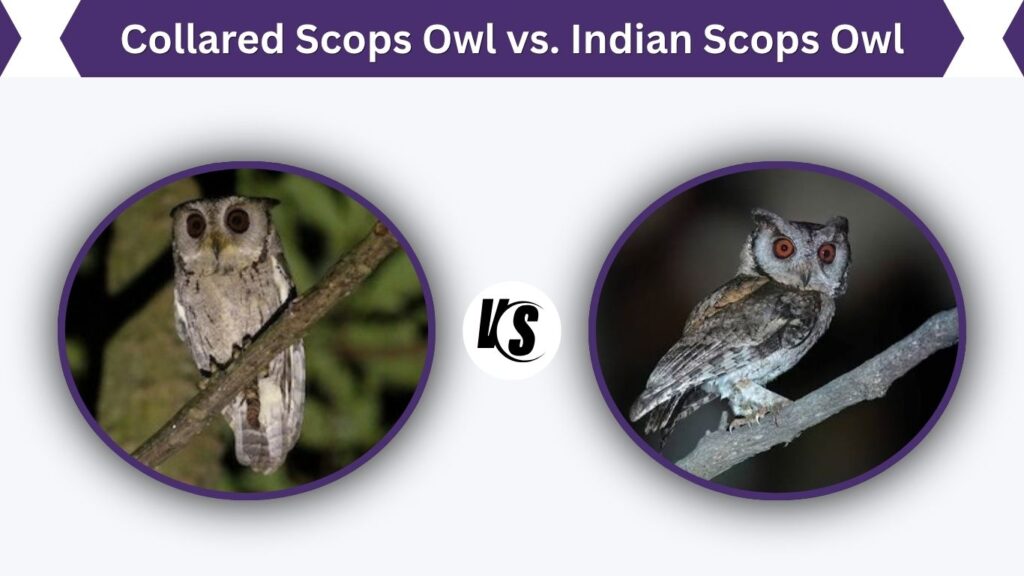
These two species are easily confused because they were historically treated within a broader species complex and remain similar in size and appearance. Modern taxonomies commonly recognize the collared scops owl as Otus lettia and the Indian scops owl as Otus bakkamoena. Their distributions are among the most useful clues for separating them.
Main Differences
The principal distinctions include:
- Collared scops owl: Otus lettia
- Indian scops owl: Otus bakkamoena
- O. lettia extends through parts of northeastern South Asia into Southeast Asia and southern China.
- O. bakkamoena occurs mainly from Pakistan through much of India and south to Sri Lanka.
- Plumage can overlap considerably.
- Vocalizations and geographic location are often more useful than color alone.
- Both are nocturnal cavity-nesting insect predators.
Taxonomy has changed over time, so older books and websites may use different species boundaries.
Conservation Status
The collared scops owl remains widespread and locally common in suitable Asian habitats. However, its exact conservation labeling can look confusing because major taxonomic authorities do not all draw the species boundaries in precisely the same way. Current IOC and eBird/Clements references recognize Otus lettia separately, while BirdLife’s published owl list uses a broader Collared Scops-owl treatment under O. bakkamoena.
Is the Collared Scops Owl Endangered?
BirdLife’s broader Collared Scops-owl treatment is categorized as Least Concern. Under modern split treatments, Otus lettia is also generally regarded as widespread rather than globally threatened. Habitat loss and removal of mature cavity-bearing trees can nevertheless affect local populations.
FAQs
Collared scops owls are frequently heard but overlooked because their plumage allows them to disappear against trunks and foliage. Taxonomic changes have also created confusion about their range, particularly when comparing the species with Indian and Japanese scops owls. These answers address the most common questions about identification, calls, size, diet, and distribution.
1. What is the scientific name of the collared scops owl?
Under current IOC and eBird/Clements taxonomy, the scientific name is Otus lettia.
2. How big is a collared scops owl?
Adults are approximately 23–25 cm long and generally weigh around 100–170 grams. Females are usually larger and heavier than males.
3. What does a collared scops owl call sound like?
Its characteristic call is a mellow single “buuo” note, typically repeated at intervals of roughly 12–20 seconds.
4. What do the collared scops owl eat?
It primarily eats beetles, grasshoppers, and other insects, but it can also capture geckos, mice, small birds, and other small vertebrates.
5. Is the collared scops owl found in Singapore?
Yes. The Bird Society of Singapore describes the collared scops owl as a common resident found in forests, mangroves, parks, and gardens.