
The Oriental scops owl is a small nocturnal owl known for its bright yellow eyes, short ear tufts, cryptic plumage, and distinctive repeated calls. Scientifically named Otus sunia, it occurs across a broad part of Asia, from the Indian subcontinent to East and Southeast Asia. Both gray and striking rufous color morphs occur. Despite its small size, this owl is an efficient nighttime hunter, feeding mainly on insects and spiders while occasionally capturing small vertebrates in forests, parks, gardens, and wooded countryside.
What Is an Oriental Scopus Owl?
The Oriental scops owl (Otus sunia) belongs to the typical owl family Strigidae. It is one of the smaller Otus species and spends most daylight hours concealed among dense foliage, against tree trunks, or inside sheltered cavities. Its camouflage can make it extremely difficult to detect until it begins calling after dusk.
Oriental Scops Owl Identification
Important identification characteristics include:
- Scientific name: Otus sunia
- Body length of approximately 17–21 cm
- Weight of around 75–95 g
- Bright yellow eyes
- Short, erectile ear tufts
- Dark grayish or blackish bill
- Feathered legs
- Gray-brown, reddish-gray, and rufous color forms
- Pale scapular patches on the wings
- Fine dark streaking and barring across the plumage
Females are generally somewhat heavier than males. When alarmed or trying to remain concealed, the owl can narrow its body profile and blend remarkably well with surrounding branches.
Oriental Scops Owl Rufous Morph
The rufous morph Oriental scops owl is especially eye-catching. Instead of predominantly gray-brown plumage, these individuals have warm reddish-orange upperparts and head feathers.
Their yellow eyes remain conspicuous, while dark streaks and pale markings break up the body outline. Both gray and rufous morphs have been documented in Singapore, demonstrating that color alone should not be used to separate them as different species.
Oriental Scops Owl Habitat and Range
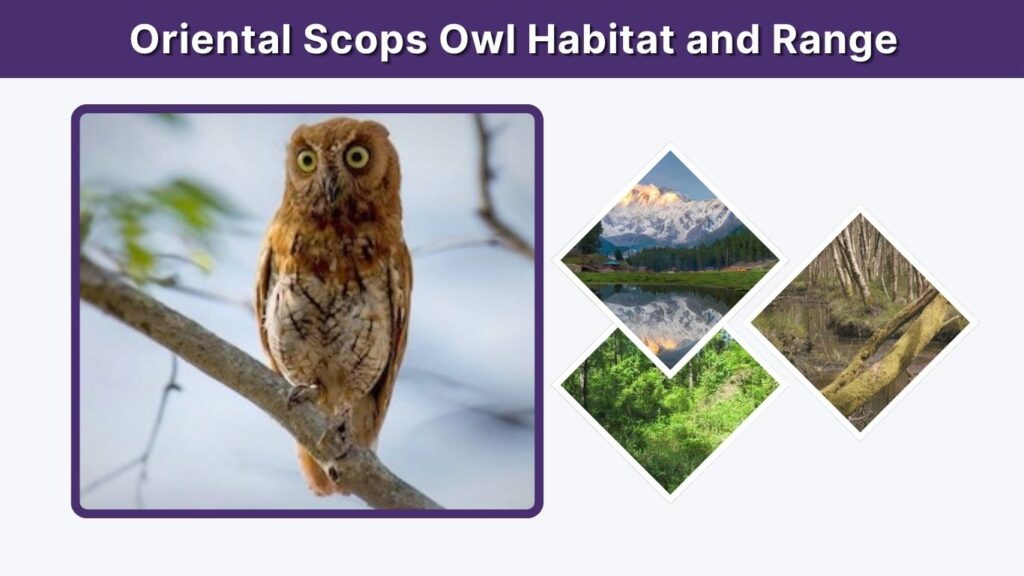
Oriental scops owls occupy a broad variety of wooded environments. They occur in both relatively natural forest and human-modified landscapes, provided suitable trees, daytime cover, prey, and nesting cavities are available. Some populations remain in the same general region year-round, whereas northern populations undertake substantial seasonal migrations to warmer parts of Asia.
Where Do Oriental Scops Owls Live?
Their overall distribution includes parts of:
- Pakistan
- India
- Nepal
- Bangladesh
- Sri Lanka
- Myanmar and Indochina
- China
- Korea
- Japan
- Southeastern Siberia
- Andaman and Nicobar Islands
- Malay Peninsula and nearby wintering areas
Northern populations are migratory, while southern populations appear largely resident. eBird’s current treatment separates northern, southern, and Walden’s population groups within the species.
Preferred Habitat
The Oriental scops owl can inhabit open and semi-open woodland, forest edges, wooded river corridors, parks, gardens, and savanna-like habitats with scattered trees.
It commonly hunts around edges and openings rather than remaining exclusively deep inside dense forest. During the daytime, however, dense foliage provides important camouflage and protection while the owl rests.
Oriental Scops Owl Call and Behavior
The Oriental scops owl is primarily nocturnal, beginning its activity around dusk. During daylight it usually remains motionless in vegetation or against a tree trunk. Its vocalizations are often a better clue to its presence than sight because its mottled plumage can closely resemble bark and dried leaves.
What Does an Oriental Scops Owl Call Sound Like?
Its typical vocalization consists of repeated throaty notes arranged in short phrases. The exact rhythm and quality vary geographically, which is scientifically interesting because different population groups also show differences in migration and vocal behavior.
Males become particularly vocal around breeding sites. Pairs can also duet during courtship, allowing individuals to communicate while remaining concealed in darkness.
Daily Behavior
Oriental scops owls generally:
- Become active around dusk
- Spend daytime hours roosting quietly
- Rest against trunks or inside dense foliage
- Occasionally roost in small groups
- Hunt from exposed perches
- Capture some insects while flying
- Use vocalizations during courtship and territorial activity
Their small body size and cryptic feathers make remaining hidden during daylight an effective defense.
Diet and Hunting
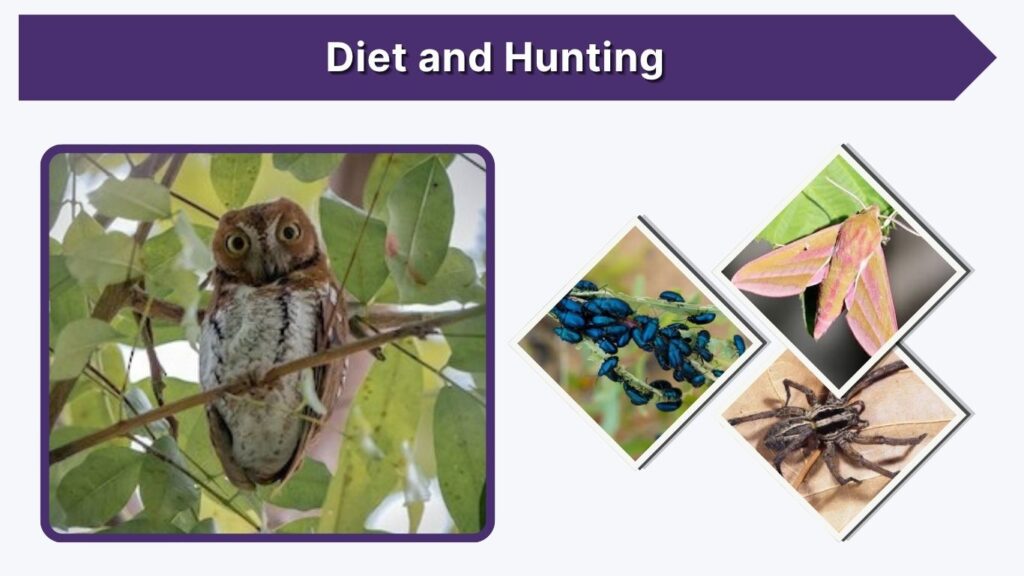
The Oriental scops owl diet consists mainly of invertebrates. Rather than depending heavily on rodents like many larger owls, it specializes in relatively small prey that is abundant around forest edges and vegetation. Hunting can occur from a perch or directly in flight, allowing the owl to exploit both ground-dwelling and flying insects.
What Does the Oriental Scopus Owl Eat?
Its diet commonly includes:
- Beetles and other insects
- Moths and other flying insects
- Grasshoppers
- Spiders
- Other small arthropods
- Small reptiles
- Tiny mammals
- Other small vertebrates when available
In Singapore, the species is also described as feeding mainly on insects and spiders, often watching from a perch before dropping onto prey or pursuing it in flight.
How Does It Hunt?
An Oriental scops owl may remain quietly perched while watching and listening for movement. Once prey is detected, it can swoop downward or pursue an insect through the air.
Large eyes improve low-light vision, while sensitive hearing assists with locating prey that may not be immediately visible. Its small size also allows it to maneuver effectively among branches and forest edges.
Oriental Scops Owl Breeding and Life Cycle
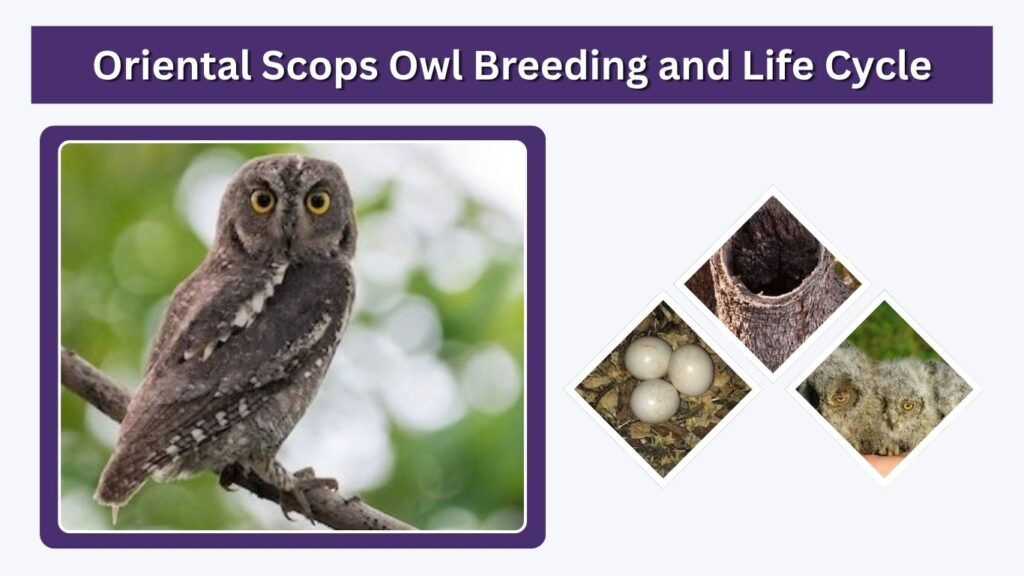
Oriental scops owls rely largely on existing cavities rather than constructing elaborate nests. Tree holes are particularly important, although suitable cavities in walls and artificial nest boxes may also be used. In the Indian subcontinent, breeding activity generally occurs from February through May.
Nest, Eggs, and Young Owls
Typical breeding characteristics include:
- Nests in tree cavities or wall holes
- Will sometimes accept nest boxes
- Male calls near potential nest locations
- Courtship may include male-female duets
- Typical clutch of 3–4 white eggs
- Female performs incubation
- Male supplies food during incubation
Young owls depend on their parents until they develop sufficiently to leave the nesting area and begin hunting independently.
Camouflage and Other Adaptations
The owl’s strongest adaptation is its cryptic plumage. Its gray or reddish coloration, streaks, and patches mimic tree bark so effectively that a motionless bird can almost disappear against a trunk.
Short ear tufts further alter the outline of its head, while nocturnal activity reduces competition with many daytime insect-eating birds. Strong feet, hooked claws, excellent low-light vision, and quiet flight support efficient nighttime hunting.
Oriental Scops Owl in Andaman, Sri Lanka and Singapore
The species has a complex geographic pattern across southern Asia. Recent eBird taxonomy recognizes different population groups that vary in distribution, migration, and vocalizations. This regional variation helps explain why searches for Oriental scops owls in the Andamans, Sri Lanka, and Singapore can produce somewhat different descriptions.
Regional Differences
In the Andaman Islands, the population known as Walden’s Oriental Scops-Owl is currently treated within Otus sunia as the modestus group. The southern group extends from northern Pakistan through India and Bangladesh to Sri Lanka, the Nicobar Islands, Myanmar, and Indochina.
In Singapore, the Oriental scops owl is considered an uncommon migrant. Both gray and rufous birds have been recorded, with accepted records including rufous individuals found during migration periods.
Conservation Status
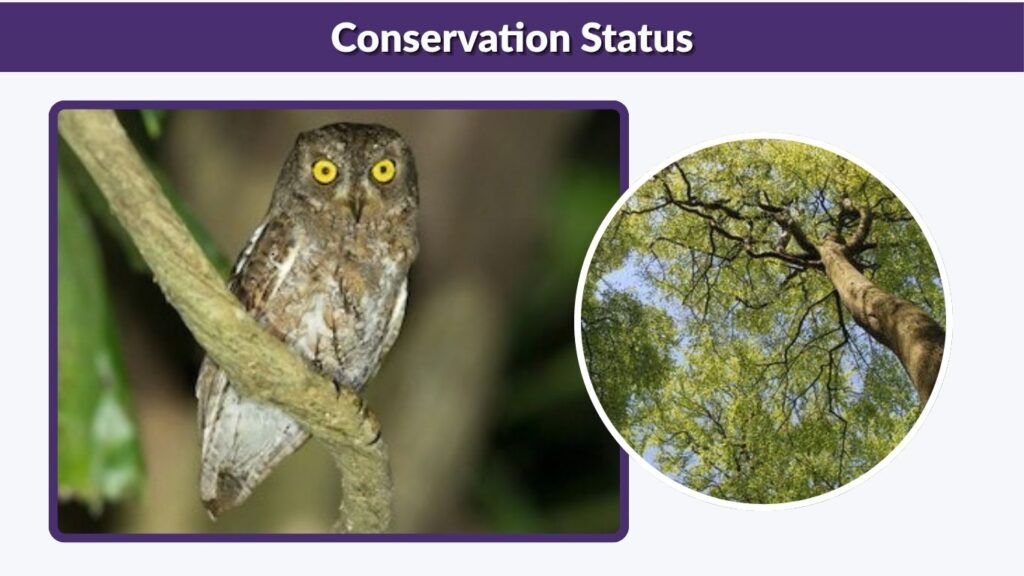
The Oriental scops owl remains widespread across much of Asia. Although local populations can be affected by forest loss and other habitat changes, its broad range currently keeps the species outside the globally threatened categories. Maintaining mature trees and natural woodland remains especially useful because these provide roost sites, hunting areas, and cavities suitable for nesting.
Is the Oriental Scops Owl Endangered?
The Oriental scops owl is currently listed as Least Concern by BirdLife International.
That classification means the species is not presently considered at high global risk of extinction. However, it does not mean populations in every part of its extensive range are equally secure.
FAQs
Oriental scops owls can be difficult to identify because of their variable plumage and secretive nighttime behavior. Their seasonal movements add another challenge, especially in Southeast Asia, where some birds occur mainly as migrants. These answers cover the most frequently searched questions about their scientific name, size, call, coloration, and distribution.
1. What is the scientific name of the Oriental scops owl?
The scientific name is Otus sunia. It belongs to the owl family Strigidae and the genus Otus.
2. How big is an Oriental scops owl?
Adults are approximately 17–21 cm long and weigh around 75–95 grams. Females are generally heavier than males.
3. What does an Oriental scops owl call sound like?
Its typical call is a repeated series of resonant, throaty notes. The rhythm varies geographically, and vocal differences have helped ornithologists distinguish regional population groups.
4. Are rufous Oriental scops owls a different species?
No. Rufous is a color morph of the Oriental scops owl. Gray-brown and reddish forms also occur, and both gray and rufous birds have been documented in Singapore.
5. Is the Oriental scops owl found in Sri Lanka?
Yes. Sri Lanka lies within the range of the southern Oriental scops owl group, which extends across parts of South and Southeast Asia.