
The tawny fish owl (Ketupa flavipes) is a large, powerful Asian owl strongly associated with forested rivers and mountain streams. Its warm orange-brown plumage, bright yellow eyes, prominent ear tufts, and heavy build make it distinctive. Unlike many owls that mainly hunt terrestrial animals, this species is adapted to catching aquatic prey. Tawny fish owls occur from the Himalayan region into parts of China and Southeast Asia, where healthy streams, mature trees, and relatively undisturbed forests provide important feeding and nesting habitat.
Tawny Fish Owl Facts and Identification
The tawny fish owl belongs to the typical owl family Strigidae and the fish-owl genus Ketupa. It is a substantial bird with a broad body, relatively large wings, long legs, and rough-textured feet suited to gripping slippery prey. Its plumage combines tawny, orange-rufous, black, and buff markings, helping the owl blend into wooded river valleys while resting during daylight.
Quick Tawny Fish Owl Facts
- Scientific name: Ketupa flavipes
- Family: Strigidae
- Body length: approximately 48–58 cm, with some references extending the range to about 61 cm
- Typical weight: roughly 2–2.5 kg, although measurements vary among studies and locations
- Diet: fish, frogs, crabs, other aquatic animals, rodents, reptiles, and occasionally birds
- Activity: mainly nocturnal and crepuscular
- Habitat: forested rivers, streams, wooded ravines, and nearby mature forest
- Conservation status: Least Concern globally
- Geographic region: South, East, and Southeast Asia
What Does a Tawny Fish Owl Look Like?
The bird has a strongly streaked orange-rufous appearance rather than uniform brown plumage. Its large yellow eyes stand out against a somewhat indistinct facial disc, while long, untidy ear tufts project from either side of the head.
Other useful identification features include:
- Heavy blackish streaking across the body
- Pale or whitish markings around the forehead and eyebrows
- A noticeable whitish throat area
- Strongly barred flight and tail feathers
- Partly feathered lower legs
- Greenish-yellow exposed portions of the legs
- Large, curved talons
- Broad, robust overall build
These characteristics can help separate it from the brown fish owl and buffy fish owl, although field identification may require careful observation.
Tawny Fish Owl Size, Weight and Wings
A tawny fish owl is commonly around 48–58 cm long, making it one of the larger Asian owls. One published summary gives a body mass of about 2,250 g, while other reported measurements show considerable individual variation.
Measurements of approximately 41–47.7 cm sometimes appear online as the bird’s “wingspan.” More accurately, these figures generally refer to wing length or wing chord, not the complete tip-to-tip wingspan. Reliable species accounts do not consistently publish a full wingspan measurement, so the two figures should not be confused.
Tawny Fish Owl Habitat and Distribution

Water is one of the defining features of tawny fish owl habitat. The species is particularly associated with mature forests containing permanent streams, rivers, pools, and wooded ravines. Trees provide daytime roosts and nesting opportunities, while freshwater habitats support fish, amphibians, crabs, and other prey. Studies also indicate that these owls can avoid heavily disturbed areas around agriculture and settlements.
Where Do Tawny Fish Owls Live?
Their geographic range includes parts of:
- India
- Nepal
- Bhutan
- Bangladesh
- Myanmar
- China
- Taiwan
- Laos
- Vietnam
The species occurs across sections of the Himalayan foothills and farther east into China and mainland Southeast Asia. Elevation varies considerably across the range. In some Himalayan localities it has been reported around 1,500–2,450 meters, whereas populations elsewhere can occur at substantially lower elevations.
Tawny Fish Owl in India
India forms an important part of the tawny fish owl’s western range. Records are particularly associated with northern and northeastern forest regions containing rivers and mountain streams. Photographs and observations from Uttarakhand, including areas around the Himalayan foothills, demonstrate the close relationship between these owls and wooded waterways.
Rather than living around any available body of water, the species benefits from a combination of freshwater prey, large trees, suitable roosts, and relatively intact forest. This dependence makes riverine forest quality important even where the owl itself is not globally threatened.
What Do Tawny Fish Owls Eat?

As its name suggests, the tawny fish owl is strongly adapted to aquatic feeding. However, describing it as exclusively fish-eating would be inaccurate. Research from different locations shows considerable dietary flexibility, with prey availability influencing what adults bring to their young and what they capture while foraging. Fish and amphibians can be especially important around productive forest streams.
Tawny Fish Owl Diet
Recorded or reported prey includes:
- Fish
- Frogs and other amphibians
- Freshwater crabs
- Shrimp and similar aquatic prey
- Snakes
- Lizards
- Rats and other rodents
- Moles and other small mammals
- Large insects
- Occasionally birds
Research on nestlings in Taiwan found fish and amphibians forming a major part of food delivered to young birds, illustrating how strongly the species can depend on stream ecosystems.
How Does a Tawny Fish Owl Catch Fish?
The owl commonly hunts from a perch overlooking water. After detecting prey near the surface, it can swoop downward and seize it with its feet. Rough surfaces underneath the toes help provide additional grip on slippery prey, while powerful curved talons help secure the catch.
Fish owls are unusual compared with many familiar woodland owls. Their hunting is heavily linked to sight and waterways, and they do not depend entirely on the extremely quiet flight used by many owl species to approach small terrestrial mammals.
Tawny Fish Owl Call, Sound and Behavior
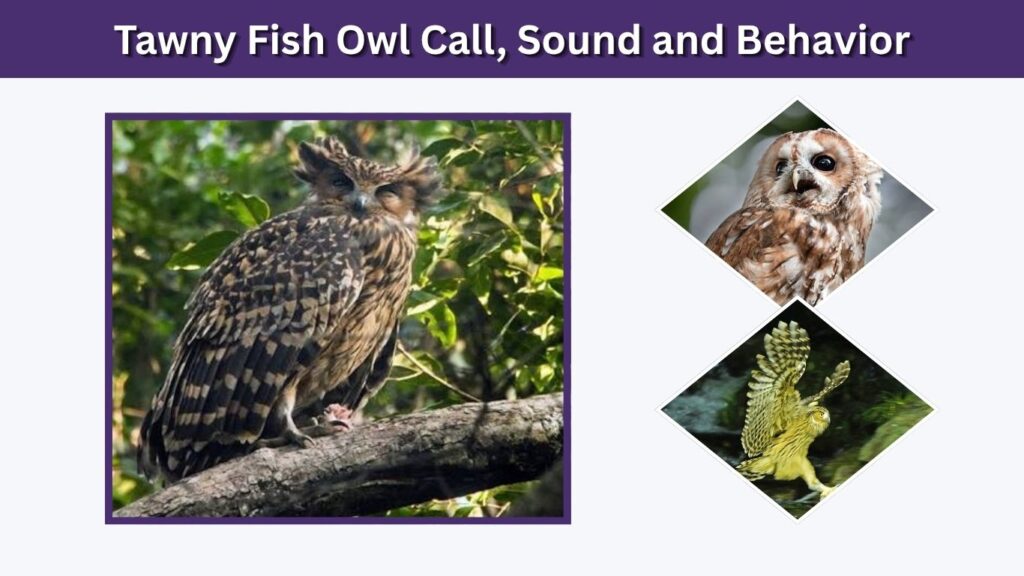
Seeing a tawny fish owl can be difficult because much of its activity occurs from evening through the night. Listening can therefore be useful when locating the species. Research on radio-tracked birds in Taiwan found that they usually left daytime roosts around sunset, returned before sunrise, and showed particularly strong movement and feeding activity around twilight.
What Does a Tawny Fish Owl Call Sound Like?
The territorial tawny fish owl call is generally described as a deep, two-part “whoo-hoo.” A second vocalization resembling a cat-like meow has also been reported.
Pairs may communicate vocally around breeding areas. Observations from a Tawny Fish Owl nest in Taiwan recorded adults duetting before their main foraging activity, showing that calls can play an important role in communication between paired birds.
Daily and Territorial Behavior
Tawny fish owls are generally solitary outside the pair bond and defend territories associated with productive waterways. During daylight they usually roost in mature forest, sometimes hundreds of meters from the stream itself.
Radio-tracking research showed that individual owls used multiple roost sites rather than relying on only one tree. Seasonal changes also influenced where birds rested and how actively they moved, demonstrating that their habitat requirements extend beyond a narrow strip immediately beside the water.
Breeding, Lifespan and Conservation
Information about tawny fish owl reproduction is less complete than information available for many widespread owl species. Known nesting sites nevertheless reveal considerable flexibility. Breeding pairs depend on secure locations near productive feeding areas, and mature riverine forests can provide several types of suitable sites. Protecting both nesting trees and the surrounding freshwater environment is therefore important.
Nesting and Reproduction
Known nesting locations include tree forks, natural cavities or sheltered sites, cliff areas, and occasionally abandoned nests made by other large birds. Tawny fish owls do not construct elaborate nests of their own.
Important breeding characteristics include:
- Clutches are usually small, commonly one or two eggs
- Breeding timing varies geographically
- Adults may use existing structures or natural nest sites
- Both aquatic prey and nearby forest are important during chick rearing
- Males may provide much of the prey during early nestling development
A Taiwan study documented substantial parental feeding activity and found amphibians and fish to be major foods delivered to the young.
Tawny Fish Owl Lifespan and Conservation Status
A dependable, species-specific average tawny fish owl lifespan in the wild has not been firmly established in the major references available, so precise figures sometimes given online should be treated cautiously.
Globally, BirdLife lists the tawny fish owl as Least Concern. BirdLife International Even so, individual populations can depend heavily on intact river forests. Loss of mature trees, disturbance around streams, declining water quality, and changes to freshwater ecosystems may reduce suitable habitat locally.
FAQs
The tawny fish owl is sometimes confused with other fish owls and with the Eurasian tawny owl because of their similar common names. These quick answers clarify some of the most frequently searched questions about its diet, size, habitat, fishing behavior, and identification.
1. Do tawny fish owls eat fish?
Yes. Fish are an important part of their diet, but they also eat frogs, crabs, reptiles, rodents, insects, and occasionally birds. Their diet varies according to local prey availability.
2. What do tawny owls eat?
The tawny owl (Strix aluco) and tawny fish owl (Ketupa flavipes) are different species. Tawny owls mainly hunt small mammals, birds, amphibians, and invertebrates. Tawny fish owls are much more closely associated with aquatic prey and forest streams.
3. How big is a tawny fish owl?
Adults are generally around 48–58 cm long, although some references report individuals approaching 61 cm. They are heavily built and can weigh more than 2 kg.
4. What does a tawny fish owl sound like?
Its territorial call is a deep “whoo-hoo.” The species can also produce a vocalization described as resembling a cat-like meow.
5. Where can tawny fish owls be found?
They occur across parts of the Himalayan region, northern India, Nepal, Bhutan, Bangladesh, Myanmar, China, Taiwan, Laos, and Vietnam. They are most strongly associated with wooded streams, rivers, and mature forest.