
The Jungle Owlet (Glaucidium radiatum) is a small, heavily barred owl found across much of the Indian subcontinent. Also called the Barred Jungle Owlet, it is recognized by its rounded head, bright yellow eyes, compact body, and fine horizontal barring. Unlike strictly nocturnal owls, it can sometimes be active during daylight, although dawn and dusk are usually best for observing it. This guide covers Jungle Owlet identification, size, habitat, food, call, breeding, juveniles, distribution, conservation status, and comparison with the Forest Owlet.
What Does a Jungle Owlet Look Like?
The Jungle Owlet is a stocky little owl whose dense barring provides excellent camouflage against bark and shaded woodland. It lacks the prominent false eye-spots seen on the back of the head in some other Glaucidium owlets. Its bright eyes and alert posture are particularly noticeable when it sits exposed on a branch at dawn or dusk.
Jungle Owlet Identification
Important identification features include:
- Scientific name: Glaucidium radiatum
- Compact, rounded body
- Rounded head without obvious ear tufts
- Bright yellow eyes
- Yellowish to greenish-yellow bill
- Dark brown upperparts with fine pale barring
- Whitish underparts crossed by dark horizontal bars
- Narrowly barred tail
- Relatively indistinct facial disc
- Short, powerful feet and claws
“Barred Jungle Owlet” is an alternative older/common name for the species rather than necessarily referring to a separate owl.
Jungle Owlet Size
The Jungle Owlet is a small owl, substantially smaller than many familiar large woodland owls. Its compact proportions help it maneuver among branches when chasing insects, lizards, and other small prey.
Despite its modest size, it often appears surprisingly bold. A perched bird may stare directly at an observer and bob or move its head while assessing its surroundings.
What Does a Juvenile Jungle Owlet Look Like?
Young Jungle Owlets have the same compact general build as adults but can appear softer and fluffier, especially soon after leaving the nest. Their plumage gradually develops the dense barring characteristic of mature birds.
Juveniles may remain close to their nesting area while being cared for by adults and learning to capture prey independently.
Jungle Owlet Habitat and Distribution
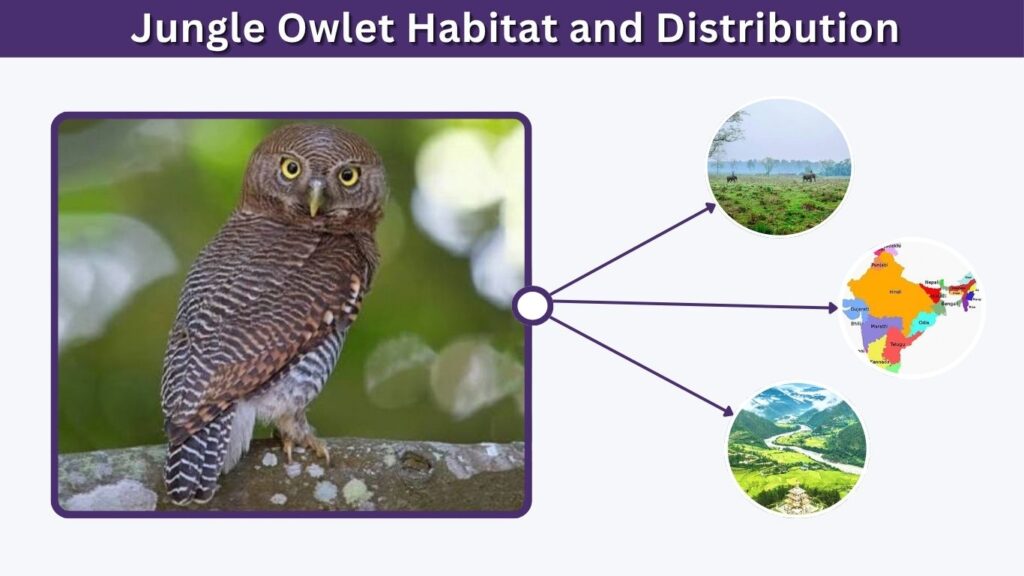
Jungle Owlets are primarily woodland birds associated with forest and plantation habitats. They occur from lowlands into foothills and can use dry as well as moist deciduous forest. Their distribution is centered on the Indian subcontinent, where they are resident rather than long-distance migrants. The species is currently assessed as having a large Indian range.
Where Are Jungle Owlets Found?
Their range includes:
- Much of India
- Southern Nepal
- Bhutan
- Bangladesh
- Sri Lanka
- Himalayan foothills
- Peninsular Indian forests
- Dry and moist deciduous woodland
- Secondary forest and bamboo areas
Published species accounts place the owl from northern India eastward through Nepal, Bhutan, and Bangladesh and south through peninsular India to Sri Lanka.
Jungle Owlet in India
India contains a large portion of the species’ distribution. State of India’s Birds classifies it as a resident species associated especially with forests and plantations and reports a large national distribution range. It is recorded in numerous states, including Kerala, Karnataka, Madhya Pradesh, Maharashtra, Gujarat, Rajasthan, Uttarakhand, Tamil Nadu, Odisha, and West Bengal.
Jungle Owlet in Sri Lanka
Jungle Owlets also occur in Sri Lanka, particularly in drier regions and adjacent eastern areas. Older ornithological accounts specifically describe the species as occurring in the island’s dry zone.
Jungle Owlet Food and Hunting Behavior
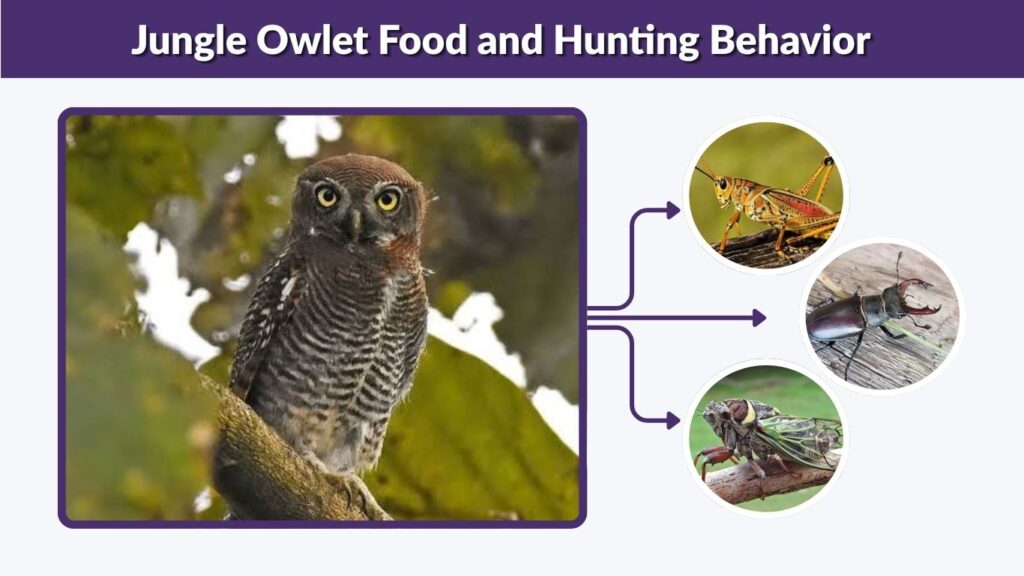
Although small, the Jungle Owlet is an effective predator. It usually watches its surroundings from a perch before dropping or flying toward prey. Insects form an important part of the diet, but the owl is capable of taking small vertebrates as well. It may hunt around dusk, at night, or occasionally during daylight.
What Do Jungle Owlets Eat?
Recorded foods include:
- Grasshoppers
- Locusts
- Cicadas
- Beetles
- Other large insects
- Lizards
- Small rodents
- Small birds
- Molluscs
Older Indian bird accounts also describe Jungle Owlets catching winged termites and taking mice, lizards, and small birds.
How Does a Jungle Owlet Hunt?
A Jungle Owlet commonly hunts from a perch. It scans the ground and surrounding branches before making a short, direct flight toward prey.
Its activity is strongest around dawn and dusk, but the species is not completely restricted to darkness. Individuals can sometimes be observed perched, calling, or hunting during daylight.
Jungle Owlet Call and Sound
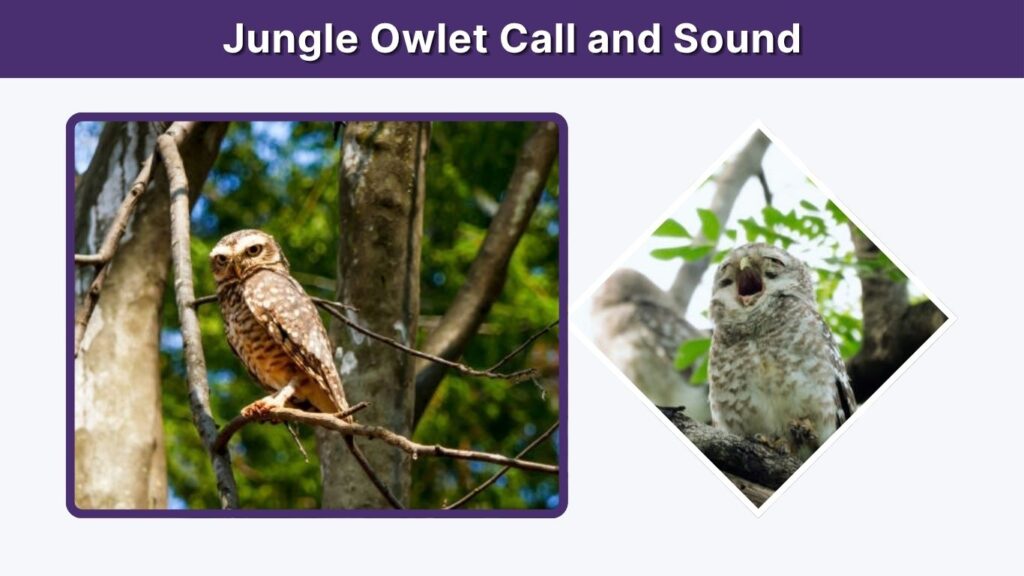
For many birdwatchers, the Jungle Owlet call is easier to detect than the bird itself. Dense woodland can conceal a motionless owl surprisingly well, while its vocalizations travel through the trees. Jungle Owlets produce several different calls, ranging from hollow trills to more mellow phrases, and vocal activity can be especially noticeable around dawn and dusk.
What Does a Jungle Owlet Sound Like?
Common vocal characteristics include:
- Loud hollow trilling
- Repeated rhythmic notes
- Mellow descending or changing phrases
- Calls given around dawn and dusk
- Occasional calling during the night
- Duetting or overlapping calls between individuals
eBird describes both loud, barbet-like hollow trills and a mellow multi-note call.
When Is the Best Time to Hear One?
Early morning and late afternoon are usually productive periods. Quiet forest tracks, woodland edges, and areas with mature trees provide good listening locations.
Because Jungle Owlets may remain still while calling, following the direction of the sound carefully is often more effective than searching for movement.
Jungle Owlet Nest, Breeding and Life Cycle
Jungle Owlets depend heavily on tree cavities for breeding. Rather than constructing a large exposed nest, they use natural hollows or abandoned cavities made by other birds. Mature trees therefore provide both daytime roosting sites and potential nesting places. Breeding timing varies geographically, but March through May is commonly cited for the species.
Jungle Owlet Nest
Typical nest characteristics include:
- Natural tree cavities
- Old woodpecker or barbet holes
- Cavities in trunks or large branches
- Nest height often several metres above ground
- Usually three or four white eggs
One detailed species account reports nests around 3–8 metres above ground and clutches of three or four white eggs.
Jungle Owlet IUCN Status
The Jungle Owlet is currently listed globally as Least Concern. The 2025 State of India’s Birds update also categorizes it as a low conservation-priority species in India, with a large distribution range and a stable long-term national trend in its assessment.
That status does not make woodland protection unimportant. Because the species relies heavily on wooded habitats and nesting cavities, maintaining mature trees and suitable forest structure remains valuable.
Jungle Owlet vs Forest Owlet
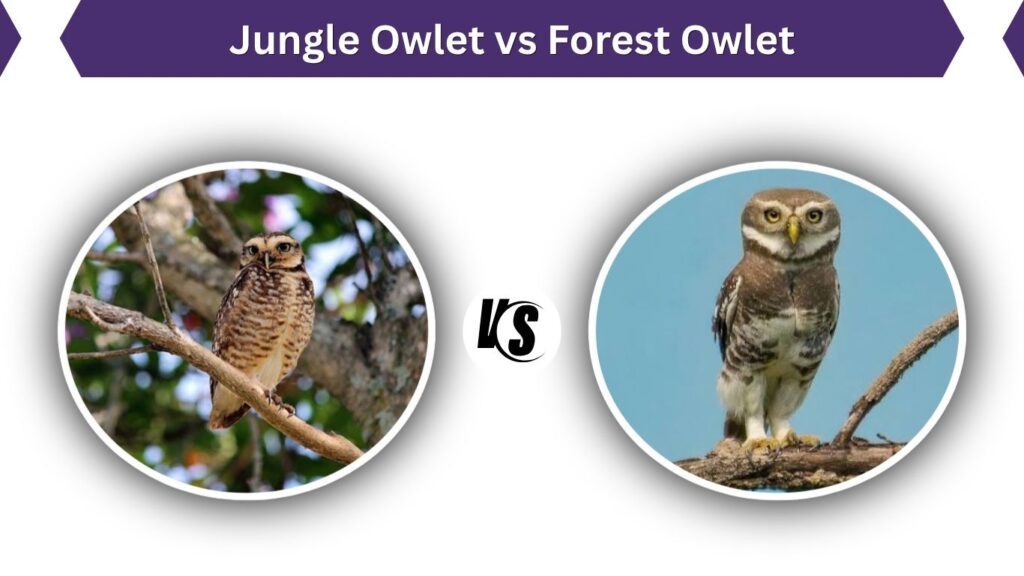
The Jungle Owlet and Forest Owlet are both small Indian owls, which can make their names confusing. They are nevertheless distinct species with different plumage patterns, ranges, and conservation situations. The Jungle Owlet is Glaucidium radiatum, while the Forest Owlet is currently recognized as Athene blewitti in BirdLife’s listing. Their conservation status is especially different.
Key Differences
Jungle Owlet: It has strong fine barring across much of its body, bright yellow eyes, and a broad distribution across the Indian subcontinent. It is currently categorized as Least Concern.
Forest Owlet: It has a different plumage pattern and a much more restricted distribution in central India. BirdLife currently lists the Forest Owlet as Critically Endangered.
Therefore, photographs should be identified using body pattern, geographic location, head markings, and other field characteristics rather than relying on size alone.
FAQs
Jungle Owlets are often noticed because of their distinctive calls and heavily barred appearance. Questions frequently arise about their alternative names, activity patterns, distribution, diet, and whether they occur outside India. The answers below summarize the most useful identification and natural-history information for birdwatchers and anyone learning about this small South Asian owl.
1. Is the Barred Jungle Owlet the Same as the Jungle Owlet?
Yes. Barred Jungle Owlet is used as an alternative or older common name for Glaucidium radiatum.
2. Is the Jungle Owlet Nocturnal?
It is mainly active around dusk, dawn, and nighttime, but it can also be seen active during daylight. eBird describes it as most active at dawn and dusk.
3. What Does a Jungle Owlet Eat?
Its diet consists mainly of insects such as grasshoppers, cicadas, locusts, and beetles, but it can also catch lizards, mice, molluscs, and small birds.
4. Is the Jungle Owlet Found in Sri Lanka?
Yes. The species occurs in Sri Lanka as well as India and other parts of the Indian subcontinent. In Sri Lanka it is particularly associated with drier regions.
5. Is the Jungle Owlet Endangered?
No. The Jungle Owlet is currently categorized globally as Least Concern. India’s 2025 assessment also places it in the low-priority conservation category.